Construction management vs project management: Which is which?

By
Marketing Team
@Onetrace
Construction management and project management are disciplines that help plan, coordinate, and control construction projects, with the shared goal of delivering work safely, on time, within budget, and to the required standard.
This level of control is essential in a high-risk, deeply fragmented industry, where around 75% of projects exceed their budgets and more than 85% experience delays.
But while construction management and project management work towards the same outcome, each plays a distinct role in guiding a project from planning to completion.
To help you understand where the two disciplines diverge, this construction management vs project management guide breaks down their eight key differences.
Key takeaways
Construction management and project management aren’t the same
Construction management focuses on site delivery, while project management oversees the project as a whole.
Both disciplines play a critical role
Successful projects rely on both disciplines working together to keep work safe, compliant, on time, and within budget.
Their responsibilities operate at different levels
Construction management focuses on day-to-day site activities, while project management focuses on budgets, stakeholders, contracts, and project performance.
Accurate information is essential
Both disciplines depend on reliable project data to make informed decisions and maintain visibility over progress.
A unified platform improves collaboration
Onetrace brings site and project teams together in one system, creating a single source of truth for delivery, compliance, reporting, and project oversight.
What is construction management?
Construction management is the practice of organising and overseeing the construction phase of a project to ensure work on site is carried out safely, efficiently, and in line with the agreed plans.
Its primary goal is to turn project plans and designs into completed, functional assets.
To do so, construction managers track key areas like:
Site progress
Resource allocation
Programme performance
Much of this work is guided by the Construction Management Plan, which outlines procedures, controls, and responsibilities for coordinating construction activities and mitigating associated risks.
What is project management in construction?
In construction, project management is the practice of overseeing a construction project throughout its lifecycle, from initial planning and design to completion and handover.
The aim of this discipline is to help projects achieve their commercial, operational, and functional objectives.
To deliver this outcome, project managers monitor areas like:
Project scope
Budget performance
Programme milestones
Contract and procurement activities
Risk and issue management
Stakeholder requirements
The construction project management plan provides the framework for this process, setting out how the project will be planned, delivered, monitored, and controlled across its every stage.
Construction management vs project management: 8 key differences
The following eight differences will help contractors understand how construction management and project management support successful project delivery, and where each discipline adds value.
1. Management scope
Construction management and project management share several areas of responsibility. Both disciplines contribute to project planning, budget oversight, risk management, communication, and coordination between multiple stakeholders.
However, each discipline also has a distinct area of focus within the wider project delivery process.
Construction management chiefly focuses on:
Site operations and day-to-day construction activities
Trade and subcontractor coordination
Resource allocation, including labour, materials, and equipment
Health, safety, and regulatory compliance
Quality assurance and inspections
Construction scheduling and progress monitoring
Site logistics and procurement coordination
As for project management, it typically takes responsibility for:
Project planning and overall delivery strategy
Stakeholder and client requirements
Budget planning and financial performance
Contract administration and procurement oversight
Project-wide risk and change management
Programme governance and reporting
Design, procurement, construction, and handover coordination
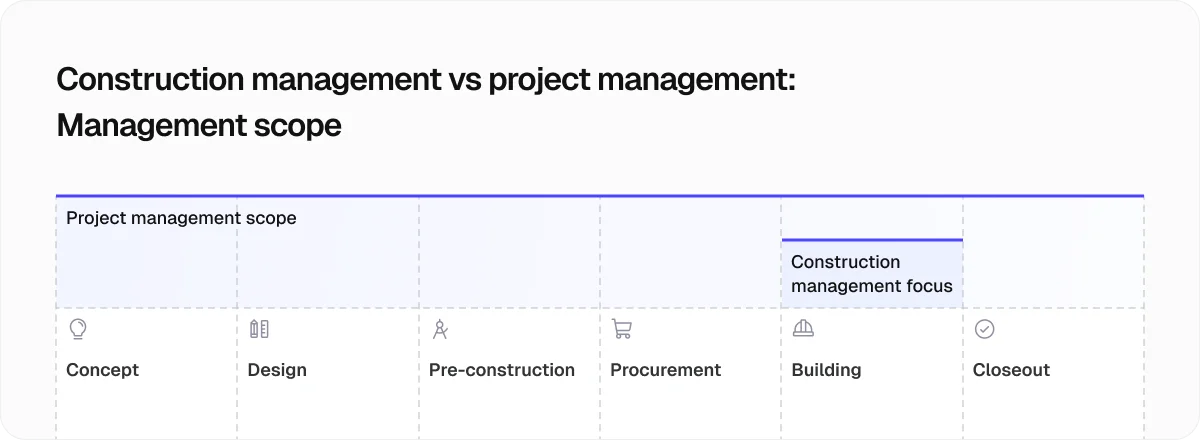
While there is some overlap between the two disciplines, construction management is primarily concerned with directing the delivery of the work itself, whereas project management focuses on coordinating the project as a whole.
2. Project lifecycle coverage
Although construction management is mainly associated with the construction phase, it can also add value at other stages. Depending on the project and procurement approach, construction management may contribute during pre-construction planning and project closeout as well.
The table below shows the construction management vs project management contributions at different stages of the project lifecycle:
Construction phase | Project management | Construction management |
Pre-construction | • Project planning and budgeting • Stakeholder coordination • Procurement strategy • Programme development | • Constructability reviews • Buildability advice • Sequencing input • Early procurement support |
Construction | • Budget and programme oversight • Stakeholder communication • Risk and change management • Performance reporting | • Site operations • Trade coordination • Resource management • Quality control • Safety compliance |
Closeout and handover | • Contract closeout • Financial reconciliation • Stakeholder handover • Final approvals | • Punch list completion • Final inspections • As-built documentation • Site demobilisation |
3. The people behind each discipline
Both construction managers (CMs) and project managers (PMs) are highly sought after across the UK construction industry, with the latter added to the UK’s critical occupations list in 2024.
But strong demand isn’t the only similarity these professions share.
Professionals in both disciplines are expected to demonstrate a combination of leadership, communication, organisational, and problem-solving skills.
The main difference lies in the specialist knowledge that sits alongside those skills.
CMs typically rely more heavily on technical construction knowledge, site operations expertise, health and safety management, and trade coordination. PMs, on the other hand, place greater emphasis on client relationships, commercial performance, strategic planning, contract management, and project governance.
As for the route into each profession, there’s no single path. The table below outlines some of the most common entry routes and what they typically involve:
Entry route | Construction management | Project management |
University degree | Construction management, construction engineering, civil engineering, surveying, or related construction disciplines | Degree in construction, engineering, architecture, business, or another subject followed by project management training |
Apprenticeship | Construction Site Management or Design and Construction Management degree apprenticeships | Associate Project Manager or Project Manager apprenticeships |
Industry experience | Progression from site-based roles such as supervisor, estimator, technician, or surveyor | Progression from project support, coordination, engineering, or management roles |
Professional qualifications | CIOB membership, CSCS certification, specialist construction training | APM qualifications, PRINCE2, Agile, and other project management certifications |
Earning potential is strong in both careers.
According to the National Careers Service, experienced construction managers can earn up to around £65,000 per year, while experienced project managers can earn up to £75,000. Salaries can rise significantly with experience, location, project complexity, and professional accreditation, particularly in sectors delivering large-scale infrastructure and commercial projects.
For contractors, understanding the backgrounds and skill sets behind each discipline can lead to more effective collaboration. Knowing where each professional’s expertise lies makes it easier to communicate clearly, build stronger working relationships, and get the right people involved at the right time.
4. Centre of activity
For the most part, construction management is carried out on the job site, where construction activities take place in real time. The discipline remains closely tied to the project's physical environment, with decisions often informed by changing site conditions, workforce activity, and construction progress.
Project management is typically carried out off site, whether in an office, at a client location, or across multiple project environments.
That said, project management isn’t entirely removed from the field, as many project managers regularly visit sites to review progress, attend meetings, and maintain visibility over project delivery.
5. Reporting lines and collaboration
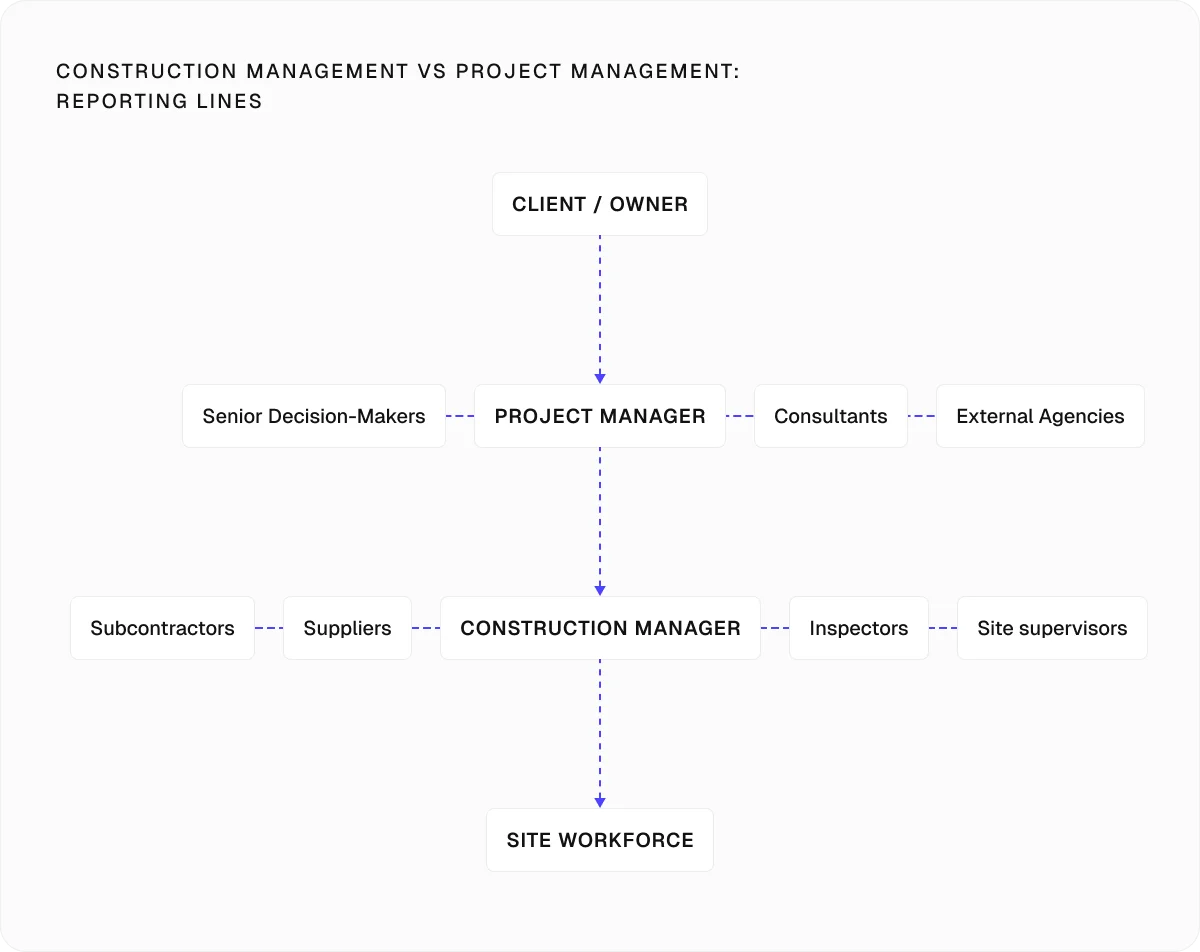
Construction management and project management sit at different points within the project’s communication structure.
Construction management is largely connected to site teams and delivery partners. Information typically flows between subcontractors, suppliers, inspectors, supervisors, and other personnel carrying out the work. Daily reports on progress, safety, quality, and site issues are then passed up through the project team.
Project management sits closer to the client and the wider stakeholder group. Communication often involves project owners, senior decision-makers, consultants, external agencies, and other parties with an interest in the project’s overall performance and outcomes.
6. Budget oversight
Construction management is predominantly focused on site-level costs. This includes labour productivity, material usage, equipment allocation, and other day-to-day factors that can affect on-site spending. Because construction management operates closest to the work itself, it’s often the first to identify issues that could lead to cost overruns.
Project management takes ownership of the project’s overall financial performance, with the PM being in charge of:
Managing the master budget
Forecasting future expenditure
Administering contracts
Approving financial changes
7. Risk management
In 2024/25 alone, the UK construction sector recorded 35 fatal injuries and around 50,000 non-fatal injuries, demonstrating how quickly unmanaged risks can affect both people and project outcomes.
Construction management is primarily concerned with operational risks that emerge on site.
This includes safety hazards, quality issues, supply shortages, productivity challenges, and other factors that can disrupt construction activities. The focus is on identifying problems early and responding quickly to minimise their impact.
Project management takes a broader view of risk.
Alongside safety and quality concerns, it addresses risks related to budgets, schedules, contracts, compliance, stakeholder expectations, and project objectives. This allows potential threats to be assessed and managed before they affect overall project performance.
8. Information management
Information is one of the most valuable resources on any construction project. Both disciplines rely on accurate, up-to-date information to make decisions, coordinate activities, and maintain visibility over project performance.
Construction management is typically supported by information generated on site.
This may include:
Daily logs
Safety records
Inspection reports
Progress updates
Labour reports
Quality documentation
Together, these records provide a detailed picture of how construction activities are progressing.
Project management relies more heavily on information that supports planning, coordination, and oversight. Common examples include:
Project schedules
Financial reports
Procurement records
Risk registers
Contract documentation
The systems used by each discipline reflect these different needs.
Construction management often relies on software that supports site documentation, field coordination, and progress tracking, while project management tends to use platforms designed for planning, forecasting, financial oversight, and project control.
Bring construction management and project management together with Onetrace
While construction management and project management serve different purposes, neither discipline works in isolation. Successful projects depend on information flowing freely between the field and the wider project team, with everyone working from the same set of accurate, up-to-date records.
That’s why using separate tools for each discipline can only create more problems than it solves. Information becomes fragmented, duplicate data entry increases, and important details get lost between teams.
Onetrace helps prevent this scenario by combining construction management software with robust project management features.
From a construction management perspective, the focus is often on capturing precise information in the field, maintaining quality standards, managing compliance requirements, and keeping site activities running smoothly. Features that support these goals include:
Custom forms: Standardise site inspections, surveys, and installation records to improve consistency and reduce missing information.
Mobile app: Capture site data, progress updates, and evidence directly from the field, even when working offline.
Photographic evidence: Create a clear visual record of completed work to support quality assurance and compliance.
Digital site management: Organise drawings, locations, and project data to improve site coordination and visibility.
Approvals: Resolve quality issues earlier through structured review and feedback workflows.
Timesheets: Monitor workforce attendance and project activity in real time.
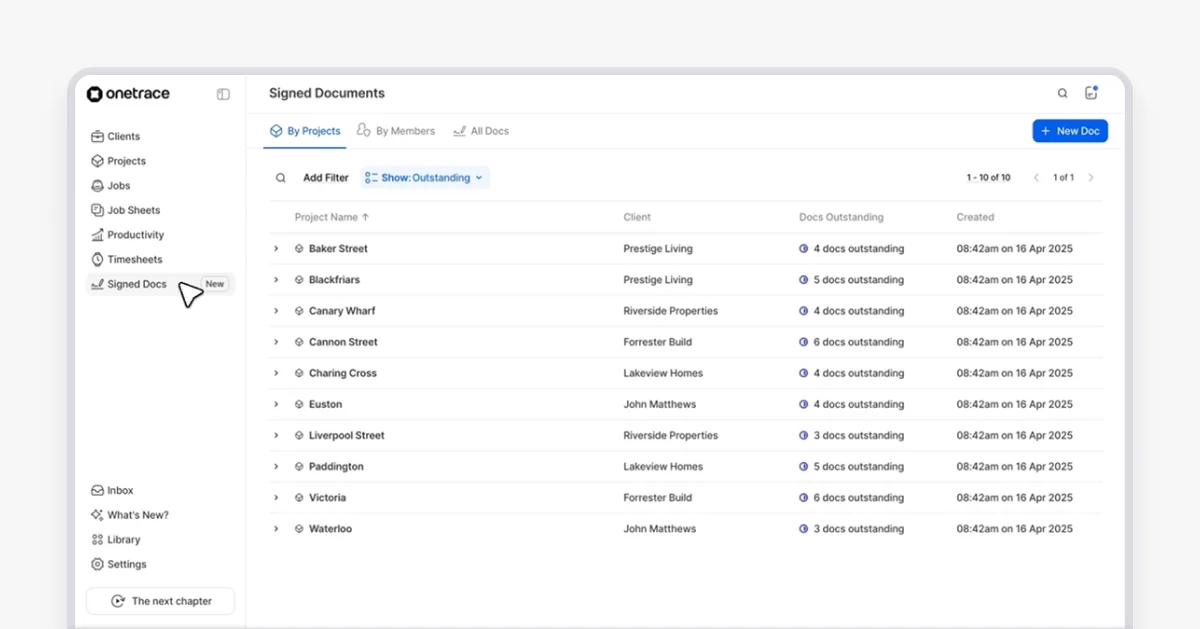
Signed documents: Maintain compliance by tracking sign-offs for RAMS, Toolbox Talks, and other critical documentation.
Project management depends on reliable information to maintain visibility across budgets, stakeholders, documentation, risks, and project performance. Onetrace supports these priorities through features like:
Project templates: Standardise project setup to improve governance and consistency across multiple projects.
Material tracking: Monitor material usage and expenditure to support budget control and financial oversight.
Variation tracking: Track scope changes in real time to improve commercial control and client transparency.
Progress reports: Present project data in a clear, professional format for stakeholders, auditors, and clients.
Productivity dashboards: Measure team and project performance to support planning and resource allocation.
Client and contact management: Centralise stakeholder information to simplify communication and coordination.
Documentation management: Control access to contracts, specifications, drawings, and project records from a single location.
By connecting site teams, project teams, and other stakeholders in one platform, Onetrace ensures that decisions are always based on the same information, whether they are being made on site, in the office, or in the boardroom.
If you’d like to see how this works in practice, book a personalised demo with the Onetrace team. We’ll walk you through the features most relevant to your business, show how they can help solve your day-to-day construction and project management challenges, and get you up and running quickly if you’re ready to move forward.
FAQ
What is better, construction management or project management?
Neither construction management nor project management is inherently better. They serve different purposes and work together to help deliver construction projects safely, on time, and within budget.
What is the difference between a CM and a PM?
The main difference between a CM and a PM is that a construction manager focuses on delivering work on-site, while a project manager oversees the project as a whole.
Can a construction manager be a project manager?
Yes, a construction manager can be a project manager. Many professionals move between the two disciplines as they gain experience and develop additional commercial, management, and planning skills.
Is project management and construction management the same degree?
No, project management and construction management aren’t the same degree. While they share some common subjects, construction management focuses more on construction processes and site delivery, whereas project management focuses on planning, coordination, and project control.
Marketing Team
@Onetrace
The Onetrace marketing team is passionate about sharing insights, ideas, and innovations that help construction businesses stay connected, compliant, and efficient. Combining industry expertise with a love for clear communication, we aim to deliver content that empowers professionals to work smarter and safer.