Contractor vs subcontractor: 7 key differences explained

By
Marketing Team
@Onetrace
Contractors and subcontractors are construction professionals who work together to execute projects. In most construction projects, the contractor is responsible for hiring and managing subcontractors.
On larger projects, major construction firms may coordinate dozens of specialist subcontractors—from electricians and plumbers to roofing and groundworks teams—to keep work moving safely, on time, and within budget.
However, who hires whom isn’t the only difference between these roles.
With that in mind, this guide will explain seven key contractor vs subcontractor differences, including their responsibilities, skills, and earnings.
Key takeaways
Contractors manage projects, and subcontractors deliver specialist work
Contractors oversee project delivery and client relationships, while subcontractors complete specific tasks within their trade or area of expertise.
Contractors take on more risk and responsibility
From budgets and compliance to site safety and project outcomes, contractors carry broader responsibilities than subcontractors.
The right path depends on your goals
Contracting suits those who enjoy management and client-facing work. Subcontracting is often a better fit for professionals who want to focus on their trade.
Good records help avoid delays and disputes
Clear documentation, accurate reporting, and strong communication make it easier for contractors and subcontractors to work together effectively.
Technology strengthens contractor-subcontractor collaboration
Onetrace helps subcontractors capture evidence, manage documentation, and share accurate project information, all of which makes compliance, communication, and client sign-off much easier.
What are contractors in construction?
In construction, contractors are businesses or individuals responsible for delivering a project on behalf of a client, often by coordinating multiple trades and managing the work from start to finish.
In the UK, contractors are commonly known as main contractors because they hold the main contract with the client.
On larger projects, you may also hear the term Tier 1 contractor, which usually refers to large companies that sit at the top of the supply chain and lead project delivery.
Where more than one contractor is involved, the client may also appoint a principal contractor to oversee health and safety during the construction phase under the Construction (Design and Management) Regulations (CDM) 2015.

It’s also important to understand how His Majesty’s Revenue and Customs (HMRC) defines contractors under the Construction Industry Scheme (CIS).
For CIS purposes, a contractor is any business or organisation that pays subcontractors for construction work. This definition extends beyond traditional construction firms and can include:
Property developers and speculative builders
Local authorities
Housing associations and housing trusts
Government departments and public bodies
Non-construction businesses that spend more than £3 million on construction work over a 12-month period
This distinction matters because contractors operating under CIS have specific responsibilities around payments to HMRC.
What are subcontractors in construction?
In construction, subcontractors are businesses or individuals hired by a contractor to carry out a specific part of a project, usually within a particular trade or area of expertise.
This is also how CIS defines subcontractors—businesses or individuals that carry out construction work on behalf of a contractor.
In the UK, subcontractors can be categorised in different ways, including by their workforce model, method of appointment, and trade specialism. The first classification relates to how subcontractors are engaged and paid. It commonly includes:
Self-employed subcontractors (independent workers or businesses paid under CIS)
Limited company subcontractors (incorporated businesses paid under CIS)
Directly employed workers (engaged on a PAYE basis by the subcontracting firm)
Agency workers (supplied through a third party, paid via the agency or umbrella company)
Self-employment is particularly common in the UK construction industry, with around 39% of the workforce classed as self-employed in the first quarter of 2026.
Based on how they were selected and appointed, subcontractors can be:
Type | Selected by | Appointed by | Notes |
Domestic | Main contractor | Main contractor | Most common type; client has no involvement in selection |
Nominated | Client | Main contractor | Client negotiates terms; now rare in UK/JCT (Joint Contracts Tribunal) practice |
Named | Client (shortlist in tender docs) | Main contractor | Main contractor retains full performance responsibility; effectively becomes a domestic subcontractor once appointed |
Finally, subcontractors can be grouped by the trade they specialise in. These specialist trades allow contractors to bring in the expertise needed for different stages of a project without employing every skill in-house.
Common, in-demand trades include carpentry, bricklaying, plumbing, electrical work, roofing, plastering, and groundworks.

Contractor vs subcontractor: Breaking down the 7 main differences
Contractors and subcontractors play complementary but ultimately different roles on a construction project.
These seven key differences will help you understand how each fits into the wider project team.
1. Core responsibilities
The main contractor vs subcontractor difference is that the former oversees the delivery of the entire project, while the latter focuses on completing a specific part of it.
Contractors are responsible for planning, coordinating, and managing construction work throughout the project lifecycle. Their core duties typically include:
Securing work and agreeing contracts with clients
Planning project timelines and resources
Hiring and managing subcontractors
Sourcing materials and equipment
Overseeing progress and project delivery
Acting as the main point of contact for the client
Subcontractors, on the other hand, are brought in to carry out specialist work within their area of expertise.
Their responsibilities generally include completing agreed tasks, managing their own workforce and resources, coordinating with other trades, and delivering work to the required standard and deadline.
This doesn’t mean subcontractors have no role in shaping project delivery. It’s quite the opposite—their specialist knowledge and hands-on experience can be invaluable when it comes to planning work, solving technical challenges, and identifying practical ways to improve efficiency on site.
2. Chain of command
Clients may have a say in subcontractor selection, but their direct contractual relationship is usually with the contractor.
Contractors are responsible for delivering the agreed scope of work and typically serve as the main point of contact between the client and the wider project team.
Subcontractors sit one level further down the project hierarchy. Although they may communicate with clients on certain projects, their instructions, payments, and day-to-day coordination generally come through the contractor.
3. Financial risk and payment responsibilities
Payment delays are widespread in the UK construction industry, with as many as 95% of firms affected. Subcontractors share a disproportionate share of this burden, with 82% of all overdue construction invoices being owed to them by Tier 1 contractors.
With money being one of the biggest pressure points in construction, clearly defined financial responsibilities are essential for maintaining healthy cash flow across the supply chain.
From a financial perspective, contractors carry overall responsibility for project budgets, material costs, and payments throughout the project. Under CIS, they must also:
Verify subcontractors
Make deductions where required
Submit returns and pay any deducted amounts to HMRC
Subcontractors have a narrower financial role but still face significant risk. They often invest in labour, equipment, and materials before receiving payment, while also managing their own tax obligations, CIS records, and cash flow.
4. Health and safety responsibilities
When it comes to health and safety, contractors and subcontractors share responsibility, but not in equal measure.
Contractors are responsible for managing safety across the site as a whole. This includes:
Identifying hazards
Implementing safety procedures
Ensuring workers have access to appropriate training and personal protective equipment (PPE)
Subcontractors, in contrast, are expected to maintain safe practices within their area of work. These refer to using the equipment correctly, securing tools and materials, reporting hazards promptly, and making sure their teams follow site rules and procedures.
It’s worth noting that labour-only subcontractors may be treated similarly to employees for health and safety purposes, which can increase the contractor’s responsibilities and potential liability.
5. Skills and qualifications
Both roles require strong communication, problem-solving, and project coordination skills, but the expertise they rely on tends to differ.
Contractors need a broad understanding of construction processes alongside business and management skills. Depending on the size of the project, this can include budgeting, planning, subcontractor management, and client communication.
Subcontractors typically develop deeper expertise within a specific trade. Their value comes from specialist knowledge and practical experience rather than oversight of the wider project.
As for formal qualifications, they vary by trade and role.
Contractors commonly hold supervisory or management qualifications, such as NVQ Level 3–7 in construction, site supervision, or site management. Depending on their responsibilities, many also hold relevant certifications, including:
Construction Skills Certification Scheme (CSCS) cards (often Gold, Black, or White)
Subcontractors are more likely to hold trade-specific qualifications, such as NVQ Level 2 or 3 in plumbing, electrical installation, carpentry, roofing or other specialist trades.
Depending on their area of work, they may also hold industry-recognised accreditations and memberships, such as FIRAS, BM TRADA, or ASFP certification for passive fire protection professionals.

6. Liability and insurance
Contractors can be held accountable for issues affecting the wider project, including subcontractor performance, site incidents, and defects. As a result, they typically require broader insurance cover, such as public liability, employers’ liability, and contract works insurance.
Subcontractors remain liable for their own workmanship, compliance, and trade-specific risks. They usually carry their own insurance cover, with public liability insurance being one of the most commonly requested documents during subcontractor onboarding.
7. Earnings
In general, contractors often have higher earning potential because they take on greater financial risk, while subcontractors typically earn based on their specialist skills and the amount of work they complete.
The table below shows indicative UK earnings for common contractor roles:
Role | Average annual earnings |
Building Surveyor | £45,000–£60,000 |
Project Manager | £50,000–£60,000 |
Site Manager | £57,000–£62,000 |
Quantity Surveyor | £50,000–£75,000+ |
Subcontractor earnings tend to vary more widely because they’re closely tied to trade, location, experience, and payment structure.
According to National Careers Service data, annual earnings for common construction trades range from around £17,000–£32,000 for painters and decorators to £24,000–£46,000 for plumbers.

Many subcontractors work on a self-employed basis and charge day rates or project rates rather than earning a fixed salary. As a result, experienced specialists can often earn more than these figures suggest.
Contractor vs subcontractor: Which path is right for you?
The right choice depends on your skills, career goals, and the level of responsibility you’re willing to take on. Neither path is inherently better; they simply suit different types of construction professionals.
The contractor route may be a good fit if you want greater control over projects, enjoy managing people and budgets, and are comfortable building client relationships. Contractors also have more influence over pricing, subcontractor selection, and the overall direction of a project.
That said, the role comes with significant administrative, financial, and compliance responsibilities.
In fact, the number of construction contractor businesses in the UK fell from 99,088 in 2024 to 97,115 in 2025, reflecting some of the pressures facing the sector.
By contrast, subcontracting offers a way to build a successful construction career without taking on full responsibility for project delivery.
While subcontractors still run their own businesses and manage their own workload, they are generally free from many of the commercial and managerial pressures that come with being a contractor. This allows them to focus on building a strong reputation within their trade, which can secure a steady stream of work while maintaining a high degree of independence.
Bringing contractors and subcontractors together with the right technology
Contractors and subcontractors may have different responsibilities, but successful projects depend on both sides working from the same information and maintaining clear records throughout the job.
For subcontractors, this means being able to prove work was completed correctly, provide documentation when it’s needed, and keep contractors updated without excessive phone calls, emails, or paperwork.
That’s where Onetrace can help.
Specifically designed for subcontractors, this construction software makes it easier to capture site data, share updates, and maintain a traceable audit trail that contractors can trust.
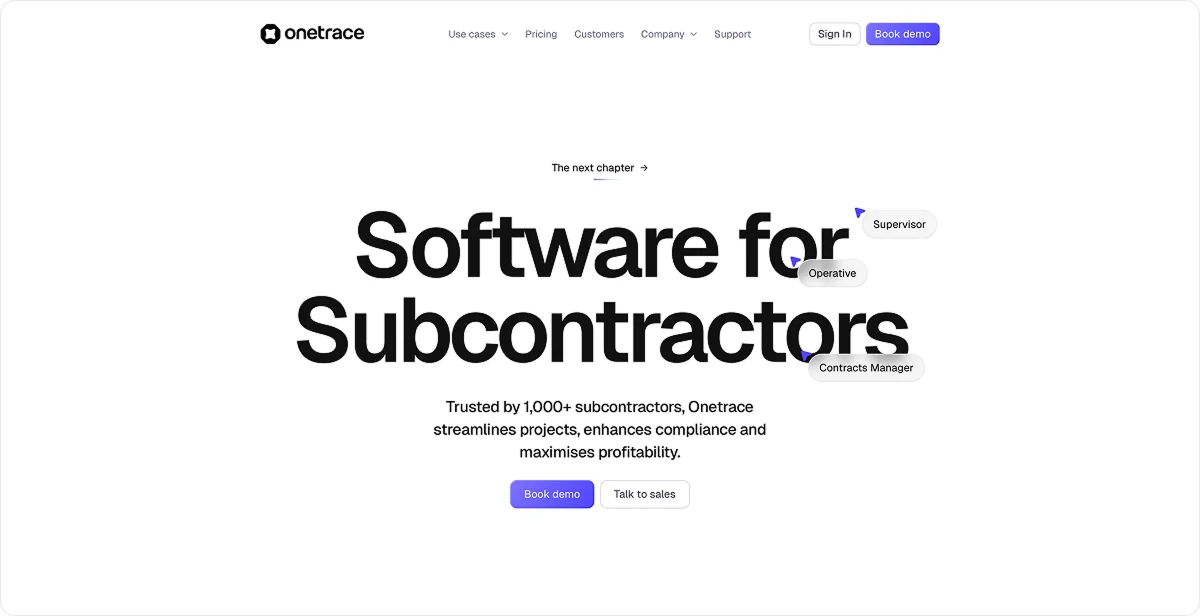
With Onetrace, subcontractors can:
Capture photographic evidence before, during, and after work to demonstrate quality and support client sign-off
Complete standardised digital forms with mandatory fields, ensuring important information is never missed
Track materials, installations, and variations in real time, creating an accurate record of what was completed and why
Store drawings, certificates, and other project documents in one place, making information easy to access when contractors request it
Generate professional reports instantly, helping reduce disputes, support compliance requirements, and speed up approvals
Provide a complete audit trail through digital records, operative declarations, and QR-linked project histories
By giving contractors greater visibility and subcontractors better control over their activities, Onetrace helps both parties work more efficiently together, reducing administrative burden, improving accountability, and making project delivery smoother from start to finish.
To see how Onetrace can support contractor and subcontractor workflows, book a tailored walkthrough with the team.
FAQ
What’s the difference between a subcontractor and a contractor?
A contractor is responsible for managing and delivering a construction project, while a subcontractor is hired to complete a specific part of that project, usually within a particular trade or specialism.
Is a contractor a subcontractor?
A contractor can be a subcontractor. Under CIS, many businesses act as contractors on some projects and subcontractors on others, depending on who hired them.
What defines you as a subcontractor?
You’re a subcontractor if you carry out construction work for a contractor under a subcontract agreement rather than working directly for the client.
Marketing Team
@Onetrace
The Onetrace marketing team is passionate about sharing insights, ideas, and innovations that help construction businesses stay connected, compliant, and efficient. Combining industry expertise with a love for clear communication, we aim to deliver content that empowers professionals to work smarter and safer.