Construction risk management explained [A complete guide]

By
Marketing Team
@Onetrace
Construction risk management is the process of identifying, assessing, and dealing with the risks that can affect a construction project.
While risk management matters across all industries, construction brings a higher level of uncertainty than most other sectors.
In terms of safety alone, the sector consistently ranks among the most dangerous ones, with around 2.5% of UK construction workers reporting a non-fatal workplace injury in 2024/25, compared to 1.8% across all industries.
But while safety risks tend to get the most attention, they’re only part of the picture. The US-based Construction Industry Institute has identified over 100 different risks that can affect the execution of a project.
With these numbers in mind, having a structured approach to construction risk management is an absolute must, and this guide is an excellent starting point.
Key takeaways
Construction risk management is about staying in control, not removing risk
You can’t eliminate risk in construction, but you can manage it by understanding what might happen, how likely it is, and how to respond before it impacts the project.Risks come from multiple areas, not just safety
Health and safety, financial, legal, operational, labour, and environmental risks often happen at the same time, so you need a full view of the project rather than focusing on one area.A defined process makes risk manageable
Following a simple approach helps you stay on top of risk: identify what could go wrong, assess the impact, focus on what matters, take action, and keep everything under review.Most project issues come from poor coordination and visibility
Delays, rework, and cost overruns are often caused by miscommunication, outdated information, or a lack of oversight, not just external factors.Using the right tools makes risk easier to manage day to day
Tools like Onetrace give you real-time visibility, structured reporting, and a clear record of work, helping you reduce errors, stay compliant, and keep projects on track.
What is construction risk management?
Construction risk management is the structured process of managing the risks that could affect a project’s budget, timeline, quality, or safety.
At a basic level, it’s about understanding what might go wrong, how likely it is, and what you’re going to do about it before it becomes a problem.
Construction risk management usually starts at the planning stage and continues throughout the entire project. The goal isn’t to remove risk entirely, as that’s not realistic in construction, but to stay in control of it.
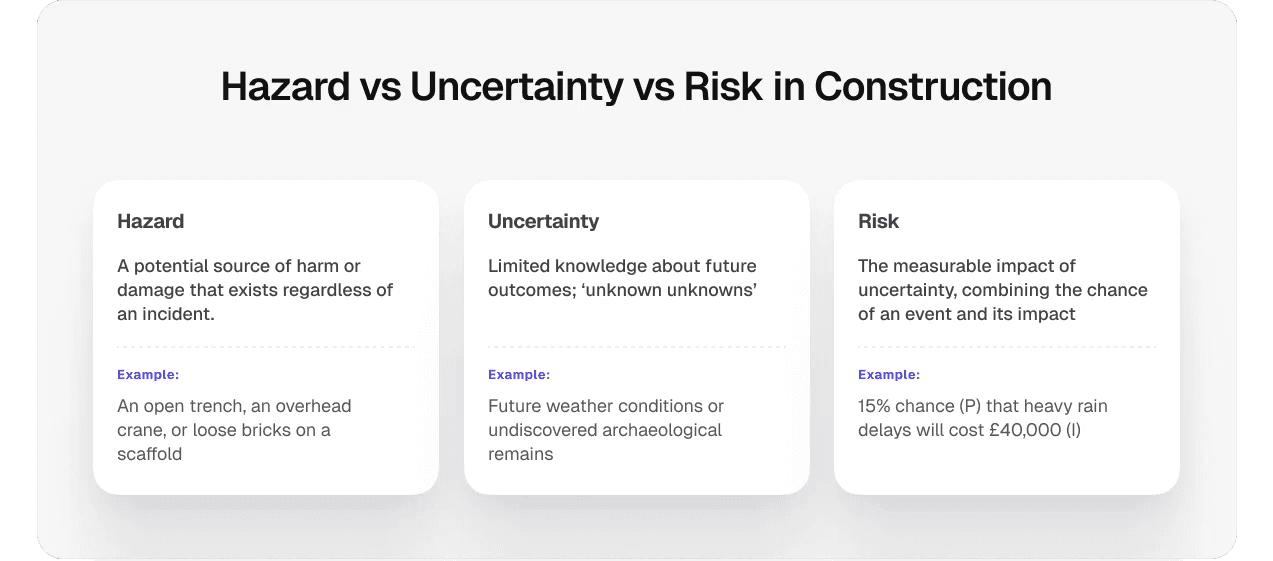
How is risk defined in construction?
In construction, a risk is an uncertain event or set of circumstances that, if it happens, will have an impact on a project’s objectives, such as cost or schedule.
It’s typically understood as a combination of two factors: the likelihood of something happening and the consequences if it does.
Why is construction risk management important?
Construction risk management is important because it helps keep projects under control when things start to change—which they often do.
In practice, a structured approach to risk management helps you:
Keep costs under control
Stay on programme
Improve safety on site
Avoid rework and wasted effort
Make better decisions
Use resources more effectively
Keep everyone aligned
Who is responsible for construction risk management?
Multiple stakeholders are responsible for construction risk management.
The project team manages most of the risks on site, while the client and senior stakeholders focus on bigger-picture risks that affect the project’s overall success.
In some cases, a dedicated risk manager helps coordinate the process and keep everything aligned.
The table below shows how key roles typically contribute to managing risk on a construction project:
Role | Contribution to risk management |
Client / Project owner | Sets project objectives and risk appetite, manages high-level business risks, and ensures contingency plans are in place |
Project manager | Oversees the overall risk management process and ensures risks are identified, tracked, and addressed across the project |
Principal designer | Identifies and reduces design-related risks, particularly around health and safety |
Principal contractor | Manages construction phase risks, including site safety, coordination, and delivery risks |
Site manager | Handles day-to-day risks on site, ensures safe working practices, and responds to issues as they arise |
Project team (Engineers, QS, etc.) | Identifies and manages operational risks related to cost, time, and quality |
Risk manager (if appointed) | Coordinates the risk process, maintains the risk register, and supports risk reviews and reporting |
Contractors and subcontractors | Manage risks within their scope of work, including labour, materials, and execution |
External consultants | Provide specialist input on technical, legal, or environmental risks |
6 common types of risks you need to manage in construction projects
Construction projects are exposed to a wide range of risks, often at the same time. To manage them properly, you need to take a broader view across the whole project.
Here are six common types of risk to keep in mind:
1. Health and safety risks
Health and safety risks relate to the hazards people face on site and the potential for injury, illness, or worse.
These come from the nature of the work: working at height, using heavy machinery, handling hazardous materials, and operating in changing site conditions.
Managing these risks matters because their impact is significant across the industry, as shown by the alarming numbers in the Health and Safety Executive’s 2025 Construction statistics in Great Britain report:
35 fatal injuries to workers in 2024/25
Around 50,000 non-fatal injuries reported each year
An estimated 79,000 cases of work-related ill health
2. Financial risks
Financial risks refer to anything that affects a project’s budget, cash flow, or overall financial performance.
They often build up over time with small overruns, delays, or changes, gradually pushing costs beyond what was planned. That’s part of the reason why around 70% of UK construction projects end up exceeding their budgets, with an average overrun of 18%.
Common contributing factors include:
Cost overruns from inaccurate estimates or unexpected site conditions
Cash flow issues caused by delayed client payments or rising material costs
Delays that increase labour, equipment, and overhead costs
Scope creep, where changes add unplanned work and expense
Rework, which adds cost without adding value (11% of the total project cost)
3. Legal and contractual risks
Legal and contractual risks arise from how a project is set up and regulated.
They’re common across UK construction, with only around 20% of major planning decisions being made within the 13-week statutory timeframe, and 61% of industry professionals citing planning and regulatory delays as a key issue.
These risks can affect timelines, costs, and working relationships across the project.
They usually show up as:
Contract disputes over scope, responsibilities, or payment terms
Regulatory non-compliance, leading to delays or penalties
Approval and permitting delays, slowing down progress
Poor contract administration, causing misunderstandings or claims
Design errors or omissions, leading to rework and liability issues
4. Operational and technical risks
Operational and technical risks come from the way a project is planned, coordinated, and delivered on a day-to-day basis.
They sit in the systems, processes, and communication needed to keep work moving on site.
The table below outlines some of the most common operational and technical risks and explains why they need to be managed:
Risk | Why it needs to be addressed |
Poor communication | Leads to mistakes, rework, and delays |
Inaccurate or outdated information | Causes incorrect work, delays in decision-making, and costly corrections |
Poor scheduling and planning | Disrupts workflow, creates bottlenecks, and increases the risk of delays |
Unclear scope of work | Makes it difficult to plan properly, often leading to disputes, changes, and extra costs |
Document management issues | Slows down access to critical information and increases the risk of errors |
Manual reporting processes | Delays issue tracking and increases the risk of missed or inaccurate information |
Poor coordination between trades | Leads to clashes, rework, and inefficiencies on site |
Luckily, most of these risks are manageable with the right systems in place.
Well-rounded construction site management software like Onetrace centralises documentation, communication, and progress tracking. It allows you to keep teams aligned, access the latest information on site, and record issues as they happen.
5. Supply chain and labour risks
Supply chain and labour risks centre on the availability, cost, and reliability of the people and materials needed to deliver a project. When either is disrupted, it can affect progress, quality, and overall costs.
Labour, in particular, is a growing concern across the UK construction industry.
As of 2025, over 140,000 vacancies remain unfilled, and this gap is only widening. According to some estimates, the UK construction industry will need as many as one million additional workers by 2032.
But it’s not just about shortages. Labour risks also come from:
Skills gaps, where workers lack the experience needed for specific tasks
Incorrect hiring, leading to delays, rework, or disputes
Loss of knowledge, as experienced workers retire (around 750,000 professionals are expected to retire by 2036)
Poor workforce planning, affecting productivity and quality
These factors make labour risk harder to manage, as it’s not only about having enough people but having the right people, with the right skills, at the right time.
6. Environmental and sustainability risks
Environmental and sustainability risks stem from external conditions such as weather, site constraints, environmental regulations, and infrastructure limitations.
These factors are often outside your control but can still have a direct impact on progress and costs.
While you usually can’t prevent these risks, you can manage how they affect the project by:
Planning for delays
Building contingencies into the programme
Keeping clear records to deal with compliance and reporting requirements
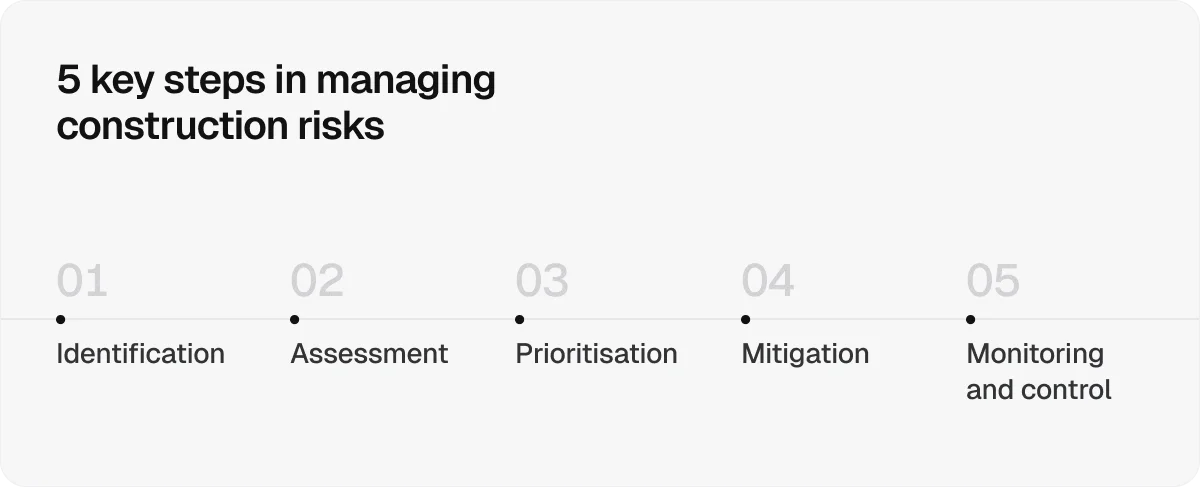
How to manage risk in construction projects: 5 key steps
Managing risk in construction projects involves a well-defined approach that helps you stay on top of issues as they arise.
These five steps set out how to do that in practice.
1. Understand what could impact the project
To manage risk effectively, you must first identify those that could affect the project.
The aim is to build a clear picture of what could go wrong—or change—based on the scope, location, and type of work.
You can do this by:
Carrying out risk assessments to identify hazards and potential issues
Reviewing project documents, including drawings and specifications
Assessing site conditions, such as access, ground conditions, and surrounding constraints
Speaking with the project team and stakeholders to gather practical insights
Looking at similar past projects to spot recurring issues and patterns
This process should continue throughout the project, not just at the start, since new risks can emerge as work progresses. A practical way to go about it is to record risks in a register and hold regular workshops or reviews aimed at capturing new risks.
2. Evaluate how risks could affect the project
Once risks are identified, you need to assess how serious they are.
This means looking at how likely each risk is to happen and what impact it would have on cost, programme, quality, or safety.
You can do this by:
Using a risk matrix to map risks based on severity
Applying qualitative analysis to describe potential effects
Using quantitative methods for high-value or complex risks
3. Focus on the risks that matter most
Not every risk will affect the project in the same way, so the focus should be on those that are most likely to cause real disruption.
Identify these liabilities by:
Comparing risks based on their potential impact on cost, programme, and safety
Highlighting risks that could stop or significantly delay work
Grouping related risks to see where issues could build up
Focusing on risks within your control, where action can make a difference
Reviewing priorities regularly as the project changes
This step helps you direct time and resources where they’ll have the most effect, rather than spreading effort across every possible issue.
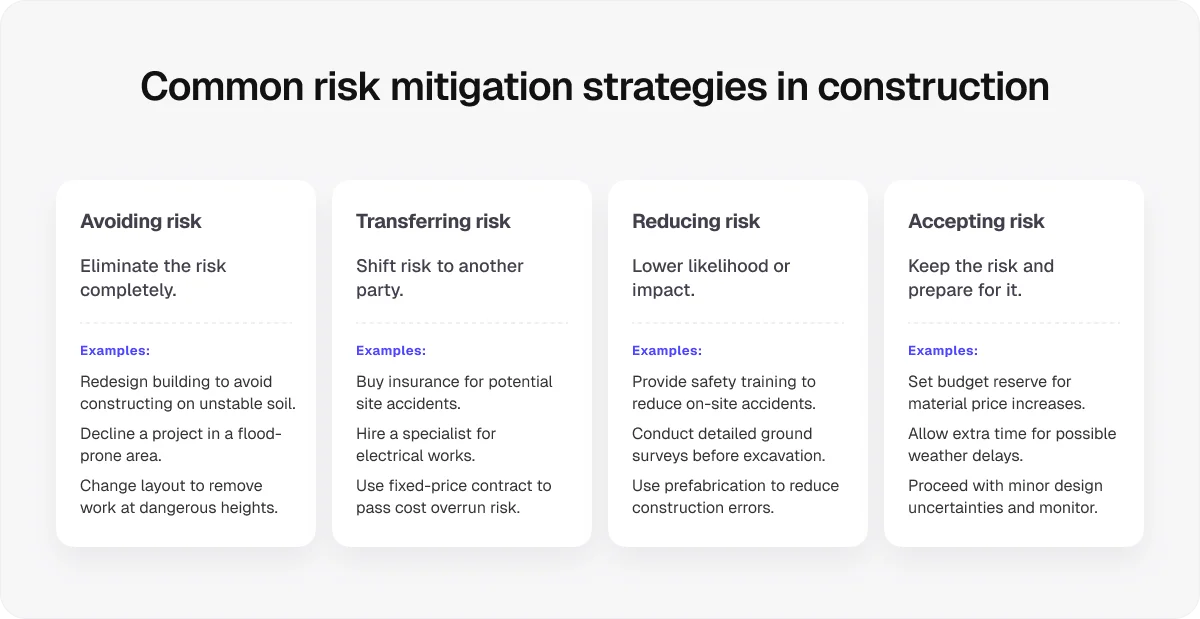
4. Decide how to deal with each risk
This step is about choosing the most practical way to handle risks based on their potential impact and the degree of control you have over them.
You can respond by:
Avoiding the risk by changing the scope, design, or approach
Reducing the risk by putting controls in place (e.g. training, better planning, or safer methods)
Transferring the risk to another party, such as through contracts or insurance
Accepting the risk where the impact is low or unavoidable, often with contingency in place
5. Monitor risks and update your approach
Risk management doesn’t stop once actions are in place.
You need to keep risks under review as the project progresses and update your approach when conditions change.
This process includes:
Reviewing risks regularly as part of project meetings
Tracking whether mitigation actions are working
Updating the risk register as new risks emerge
Capturing lessons learned to improve future projects
This helps ensure risks stay under control throughout the project, not just at the start.
8 best practices for construction risk management
Here are the eight best practices to keep risks under control throughout the entire project:
Keep documentation accurate and accessible: Clear records reduce disputes and make it easier to track decisions and compliance.
Maintain clear communication across teams: Consistent communication keeps everyone aligned and reduces errors and rework.
Work with qualified and reliable teams: The right people reduce delays and are better equipped to handle issues as they arise.
Follow regulations and compliance requirements: Staying aligned with legal standards avoids delays, penalties, and rework.
Verify materials, suppliers, and operatives: Certifications and checks reduce the risk of defects, delays, and liability issues.
Test new methods or technologies early: Early testing helps avoid costly problems during delivery.
Carry out regular site checks and reviews: Ongoing monitoring helps catch issues early before they escalate.
Use digital tools to improve visibility: Centralised systems reduce miscommunication and give teams access to up-to-date information.
How Onetrace helps with construction risk management
Managing risk in construction comes down to visibility, control, and consistency.
The challenge is keeping track of everything—people, progress, documentation, and compliance—while the job is moving.
This is where Onetrace can help.
With this valuable construction management software, you can:
Get real-time visibility of what’s happening on site: Live updates help you spot issues early, keep teams aligned, and avoid delays.
Capture daily reporting without delays or gaps: Record activity as it happens, reducing missed information and late updates.
Track time and attendance with timesheets: See who’s on site and when, improving planning and reducing labour-related issues.
Use safety and quality checklists with approvals: Ensure work is done correctly the first time, reducing rework and compliance risks.
Record Toolbox Talks and compliance documents with signatures: Keep clear proof that teams have received and signed key information.
Capture photo evidence on site: Create a traceable record of work completed, helping resolve issues and avoid disputes.
Keep all documentation in one place: Maintain a central record of decisions, changes, and project activity.
Thanks to these features, you’ll deal with fewer information gaps and have better control over the risks that affect your projects every day.
To see what this looks like in practice, schedule a personalised walkthrough with the Onetrace team and go one step closer to effective construction risk management.
FAQ
What are the 5 steps of RM?
The five steps of risk management (RM) are identifying risks, assessing their likelihood and impact, focusing on the most important ones, deciding how to deal with them, and monitoring them throughout the project.
What are the four types of construction risk?
The four most common types of construction risks are health and safety, financial, legal and contractual, and operational risks.
How to reduce risk in construction?
To reduce risk in construction, you must plan early, keep communication clear, document everything, and use systems that give you visibility and control over what’s happening on site.
Marketing Team
@Onetrace
The Onetrace marketing team is passionate about sharing insights, ideas, and innovations that help construction businesses stay connected, compliant, and efficient. Combining industry expertise with a love for clear communication, we aim to deliver content that empowers professionals to work smarter and safer.