Planning and scheduling in construction: Definitive guide

By
Marketing Team
@Onetrace
A lack of proper planning and scheduling is felt quickly on any construction project.
Recent industry research shows that more than a third of construction professionals (38%) see the planning process itself as the main cause of delays. The next two most common causes—changing project parameters (36%) and delays in materials or equipment (35%)—can also be linked to plans that didn’t leave enough room for change, unrealistic lead times, and ineffective coordination between teams.
The same is true for scheduling.
While it runs throughout the project lifecycle, it includes the most important aspects early on: testing assumptions, setting realistic sequences, and exposing risks before work starts. When planning is rushed or incomplete, the schedule ends up carrying the strain.
With that in mind, let’s take a look at planning and scheduling in construction, including how they’re used, where problems arise, and what helps projects stay on track from day one.
Key takeaways
Planning and scheduling are different, but they only work when used together
Planning defines what needs to be delivered and how, while scheduling applies those decisions to time and sequence. Treating them as separate or one-off tasks is a common reason projects drift once work starts.Good planning and scheduling reduce risk long before work reaches the site
Clear scope, realistic sequencing, and grounded resource estimates help teams spot issues early, avoid clashes, and prevent optimistic assumptions from being locked into the programme.Most planning and scheduling problems come from coordination, not effort
Incomplete information, misaligned stakeholders, resource conflicts, and late changes are what undermine plans. Involving site teams, keeping plans live, and tracking progress against a baseline make a real difference.The process matters as much as the output
Breaking work down, sequencing it logically, estimating honestly, and updating the schedule as conditions change turns planning and scheduling into active control tools, not static documents.Technology is now essential to keep plans connected to the site’s reality
Modern projects move too fast for spreadsheets and disconnected tools. Platforms like Onetrace give teams a single source of truth, live site visibility, and clear accountability, helping plans stay accurate, schedules stay relevant, and decisions stay grounded in what’s actually happening on site.
What is construction planning?
Construction planning is the structured process of organising construction work, with the aim of creating a workable route from requirements to delivery.
To achieve this goal, planners must:
Define the scope of work
Break work into manageable tasks
Sequence activities
Allocate labour, materials, and plant
Allow for risk and change
The planners in question can include project owners, project managers, engineers, estimators, and delivery teams, each contributing their expertise to shape a plan that reflects both commercial goals and on-site reality.
But this level of detail can’t be achieved with a single, high-level plan.
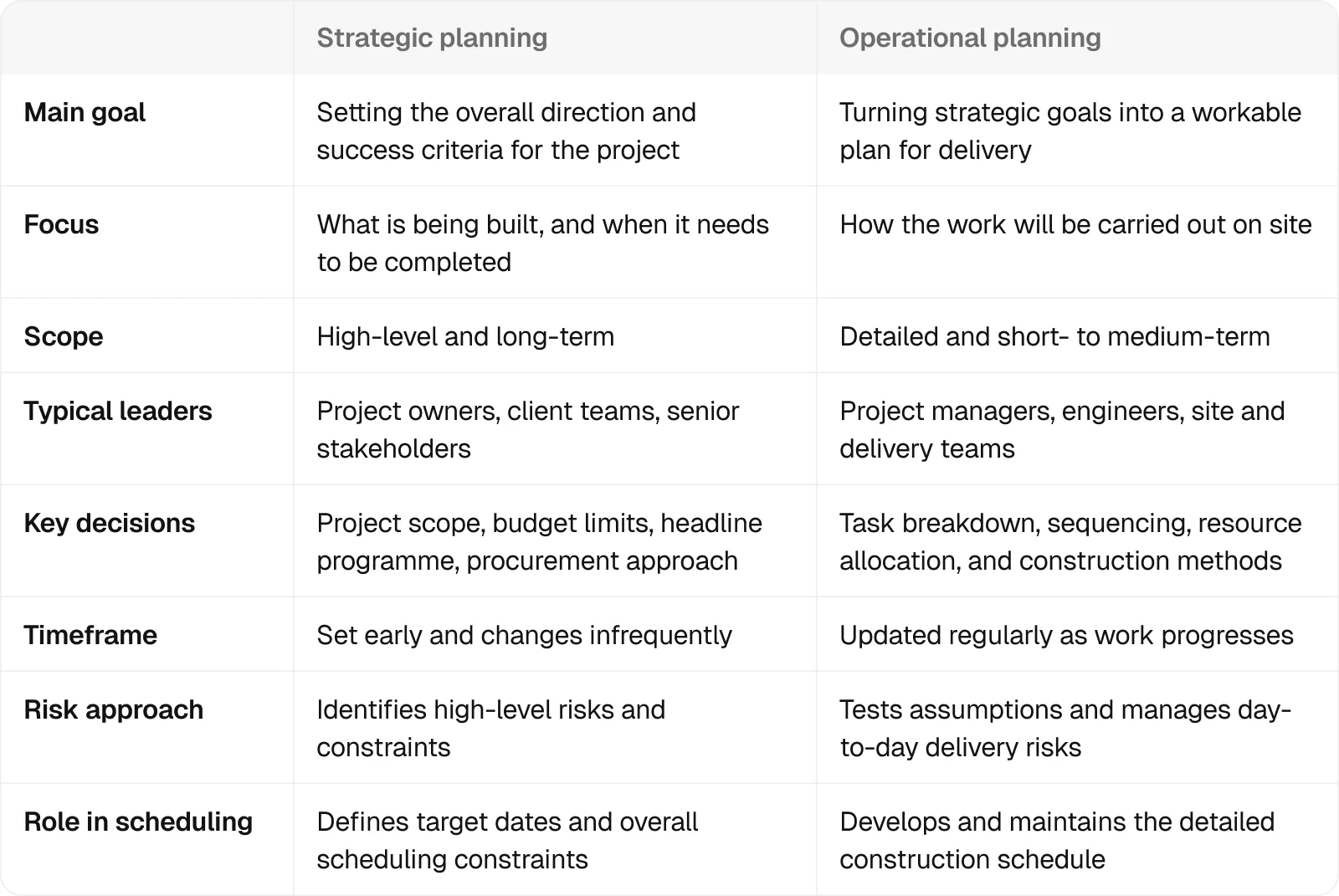
It requires planning at two levels: setting the overall direction early on and working through the practical details that enable progress on site. These two levels are also known as strategic planning and operational planning, and the table below shows how they differ:
What is construction scheduling?
Construction scheduling is the process of organising construction work over time. It takes the decisions made during planning and places them on a timeline that teams can work on, emphasising:
When activities start and finish
How different activities depend on one another
Where time is most critical to overall delivery
The aim here is to keep work moving in the right order and to give everyone a shared view of what needs to happen next. This helps teams understand priorities, coordinate trades, and see where time is tight.
While the overall goal remains the same, you can use different scheduling methods to draw attention to different parts of the schedule.
For example, the Critical Path Method (CPM) highlights which activities control the overall finish date, while the Program Evaluation and Review Technique (PERT) focuses on uncertainty in activity durations and completion time.
Regardless of your choice of method, scheduling remains an ongoing task.
Once construction starts, progress needs to be tracked and schedules adjusted to reflect what is actually happening on site.
Short-term schedules support day-to-day coordination, while longer-term schedules help teams measure progress against key dates and commitments.
The challenges that undermine planning and scheduling in construction
Given the sheer number of moving parts involved in a construction project, it’s no surprise that planning and scheduling often come under pressure.
The most common challenges you’ll encounter when planning and scheduling construction work include:
Incomplete or inaccurate information: Early plans are often based on partial designs, early cost assumptions, or unconfirmed site conditions, which can lead to unrealistic schedules and rework later.
Poor coordination between stakeholders: When designers, contractors, subcontractors, and suppliers aren’t aligned, schedules can quickly fall apart due to missed handovers, late information, or conflicting priorities.
Resource shortages and over-allocation: Limited availability of skilled labour, plant, or materials, especially across overlapping projects, can leave schedules overcommitted and difficult to deliver.
Design changes and scope creep: Late design decisions, evolving client requirements, or unclear scope can force frequent schedule revisions and disrupt work already underway.
Weather and external disruptions: Adverse weather, permitting delays, inspections, and regulatory approvals can all impact progress and are often outside the project team’s direct control.
Reliance on static or disconnected tools: Schedules managed in spreadsheets or standalone tools can be slow to update, hard to share, and prone to version control issues, making it harder to respond to change.
Pro tip:
While you can’t control the weather or prevent every late design change, many planning and scheduling issues are avoidable.
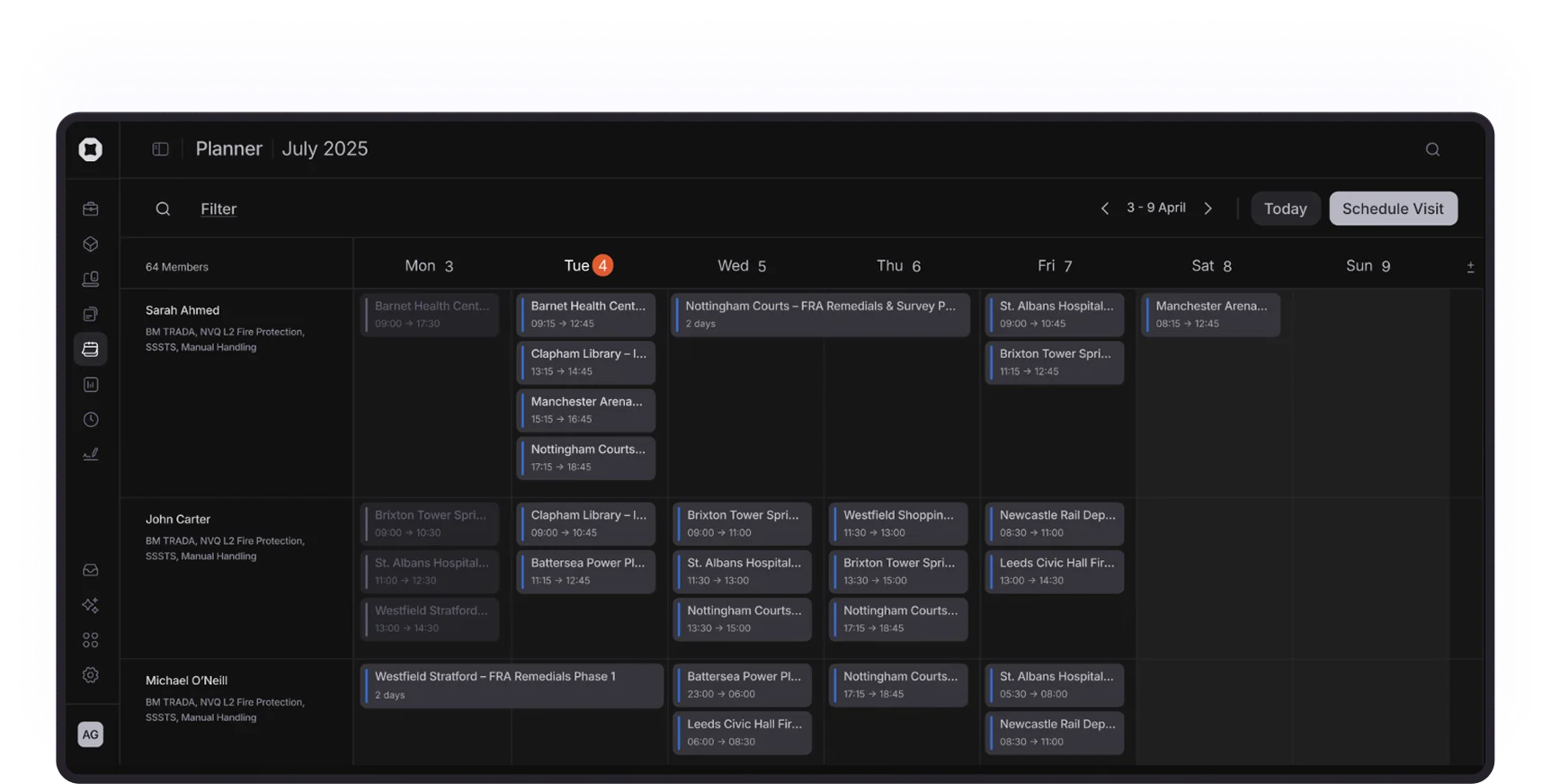
Working with comprehensive scheduling software like Onetrace helps teams operate from a single, reliable source of information.
With real-time access to schedules, work statuses, and variations, everyone stays aligned, changes are easier to manage, and problems are surfaced earlier, before they turn into delays on site.
The value of good planning and scheduling in construction
Overcoming planning and scheduling challenges is rarely easy, but the payoff is clear. One look at the outcomes shows why so many teams continue to invest time and effort in getting this right:
Fewer delays and cost overruns: Clear plans and realistic schedules reduce clashes, late decisions, and rework that push projects off programme and over budget.
Better use of labour, plant, and materials: When work is properly sequenced, resources arrive when needed, idle time is reduced, and over-allocation across projects is easier to avoid.
Improved productivity on site: Teams spend less time waiting for access, information, or materials and more time completing planned work.
Stronger coordination between teams: A shared plan and schedule improve communication across trades, suppliers, and site teams, reducing misunderstandings and handover issues.
Fewer disputes and claims: Clear records of scope, sequence, and change make it easier to manage expectations and resolve issues before they escalate.
Safer working conditions: Better sequencing and visibility reduce overcrowding, conflicting activities, and unmanaged risk on site.
Higher client confidence: Consistent progress and reliable updates build trust and make delivery easier to manage and explain.
Healthier margins: Fewer surprises, better control, and reduced waste support stronger financial outcomes over the life of the project.
How to create a construction plan and schedule: 7 key steps
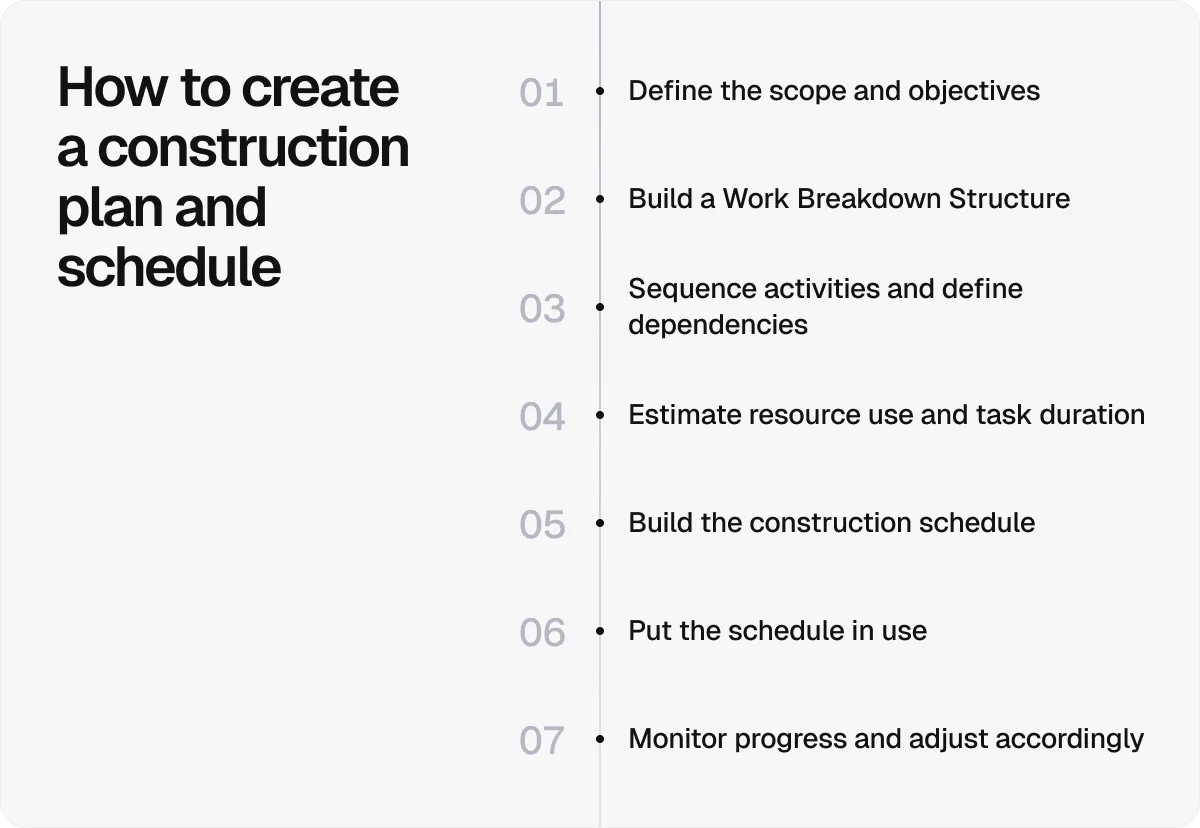
Planning sets the approach and structure, while scheduling applies that structure to time and sequence. Used together, they give teams clarity early on and control once work begins.
Here’s how the process typically unfolds on a construction project, step by step.
Step 1: Define the scope and objectives
Before anything else, everyone needs to be clear on what the project is meant to deliver.
Laying the groundwork here means setting out the following:
Client requirements
Key outcomes
Budget and time limits
Major milestones
A clear scope reduces ambiguity and provides a stable reference point for all planning and scheduling decisions that follow.
Step 2: Break the work down
You can’t tackle an entire construction project all at once.
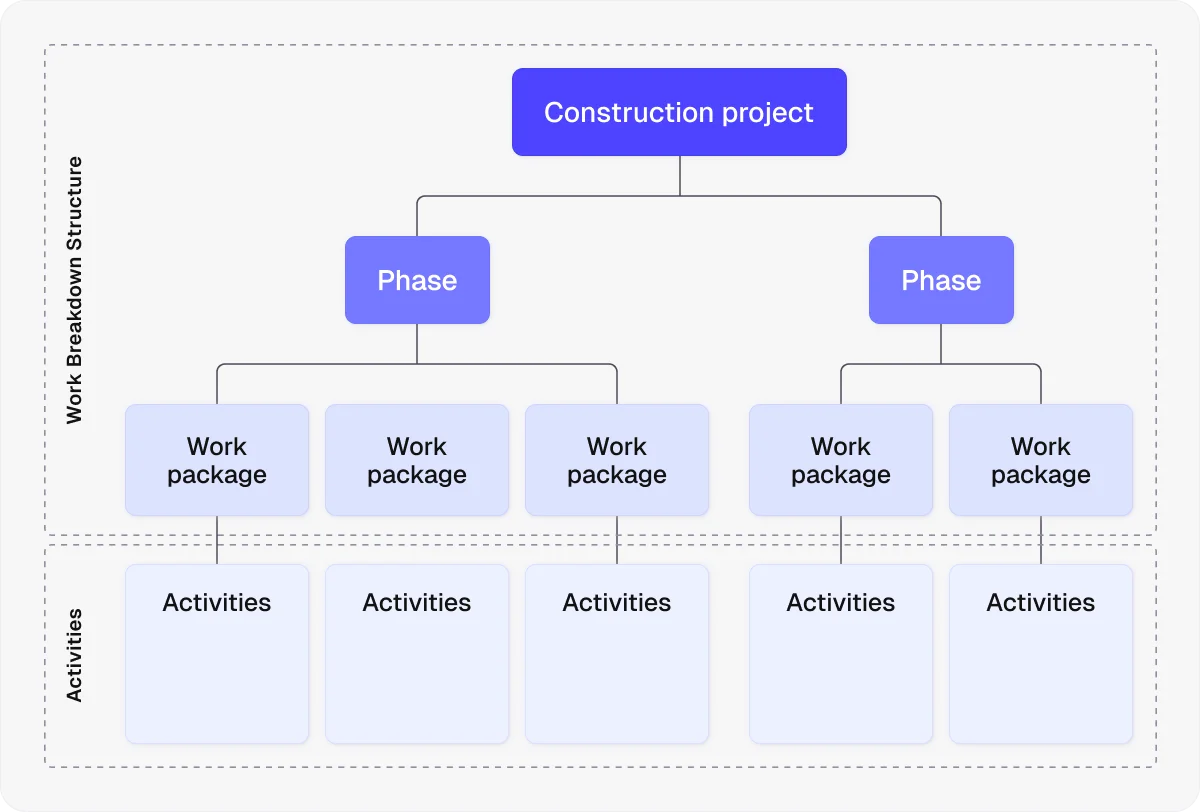
Instead, translate the scope into a work breakdown structure (WBS) that splits the project into manageable tasks and work packages.
Each task should be clearly defined, measurable, and assigned to a responsible team. This step connects high-level planning to practical delivery and sets the foundation for sequencing and scheduling.
Step 3: Sequence activities and define dependencies
Very few construction activities happen in isolation.
That’s why you should identify the logical order of work by mapping what must happen first, what can run in parallel, and where approvals or inspections sit.
This step tests whether the plan is buildable in practice and prevents clashes and unrealistic assumptions before they reach the site.
Step 4: Estimate resources and durations
Planning only works when it reflects real site conditions.
At this point, you should assign realistic labour, plant, and material requirements to each task and estimate their durations. The estimate should be based on:
Historical data: Use actual productivity rates and outcomes from similar past projects, not best-case assumptions.
Site experience: Take input from people who understand on-site conditions, access constraints, and trade sequencing.
Supplier input: Consider confirmed lead times, availability, and delivery constraints for materials and equipment.
This step exposes whether the plan can actually be delivered with the people, plant, and materials available.
Step 5: Build the construction schedule
The focus now shifts to turning planning into a usable timeline.
You can do so by:
Setting start and finish dates
Linking activities
Identifying milestones
Allowing for float
The schedule becomes the working output of the planning process and the main tool for coordinating teams and tracking progress.
Step 6: Share, align, and assign
The people delivering the work must understand what’s expected of them.
That’s why you should confirm responsibilities, handovers, and expectations with each relevant party by walking them through the plan and schedule in a kickoff or coordination meeting.
Details should be confirmed trade by trade, checking whether the key dates and sequences are realistic from a site perspective. If not, the agreed changes should be recorded, updating the schedule right away.
The up-to-date plan should then be shared in a format everyone can access.
Step 7: Monitor progress and adjust plans
The changes don’t stop once the plan and schedule go live. You just move from the planning stage to the active control stage.
In this stage, you need to track progress against the schedule and make updates to reflect site reality, allowing you to address any issues early.
For example, if prolonged bad weather prevents external works from going ahead, the schedule should be updated to delay affected activities, resequence internal tasks where possible, and revise upcoming milestones to reflect the lost time.
Best practices for planning and scheduling in construction
With planning and scheduling in construction, your number one goal should be to create outputs that reflect how work actually gets done and keep them useful as conditions change.
The following best practices focus on practical habits that can help you stay in control throughout a project:
Start planning early and keep it live: Early planning gives teams more options and fewer surprises, but it only works if plans are reviewed and updated as the job evolves. Treat planning and scheduling as an ongoing process, not a one-off task.
Involve site and field teams: Schedules are more reliable when the people delivering the work help shape them. Site teams bring practical insight into access, sequencing, and productivity that desk-based plans often miss.
Build contingency and float deliberately: Allow time where risk is highest, rather than spreading float thinly or removing it altogether. This makes schedules more resilient when change occurs.
Track progress against a clear baseline: A baseline schedule gives teams a reference point for understanding whether the project is drifting and why. Without it, delays are harder to identify and explain.
Align planning with procurement and cash flow: Programmes should reflect lead times, delivery constraints, and payment cycles. When planning and procurement drift apart, schedules quickly become unworkable.
Together, these practices help turn planning and scheduling into tools teams rely on, rather than documents they work around.
Why planning and scheduling in construction need technology
Modern construction projects move too fast and involve too many people to rely on static spreadsheets or disconnected scheduling tools. When planning and scheduling are managed in isolation, teams lose visibility, updates lag behind reality, and decisions are made on outdated information.
This is what construction management software helps avoid.
These modern platforms provide a single place to manage programmes, capture what’s happening on site, and adjust plans based on real conditions.
Rather than replacing good planning, Onetrace strengthens it by offering:
A single source of truth: All site data, schedules, drawings, and records live in one place, reducing version confusion and duplicated effort.
Live visibility from site: Operatives capture progress, photos, timesheets, and status updates through a simple mobile app, giving managers an up-to-date view of how work is tracking.
Clear structure across complex sites: Drawings can be organised by blocks, levels, zones, and cores, making it easier to link planned work to exact locations on site.
Real-world resource insight: Time and attendance tracking shows who is on site and when, helping teams sense-check schedules against actual labour availability.
Built-in accountability and approvals: Work is submitted, reviewed, and approved through clear workflows, reducing late-stage issues and supporting smoother handovers.
Faster, clearer reporting: Structured data and photographic evidence make it easier to report progress, manage variations, and resolve issues before they affect the schedule.
Sign up for a tailored Onetrace demo to see how the platform can help your teams stay aligned, respond faster to change, and keep control of time and delivery as work moves forward.
Marketing Team
@Onetrace
The Onetrace marketing team is passionate about sharing insights, ideas, and innovations that help construction businesses stay connected, compliant, and efficient. Combining industry expertise with a love for clear communication, we aim to deliver content that empowers professionals to work smarter and safer.