What is construction photo documentation? [+Best practices]

By
Marketing Team
@Onetrace
In construction, the work you do is only as strong as the records that support it.
From first plans to handover, project documentation is what ties every stage of the job together, helping prove progress, justify decisions, and resolve disputes.
Photo documentation, in particular, provides a level of clarity that written records often can’t. They show site conditions and completed work without interpretation, which makes them easier to understand, harder to argue against, and far more useful when questions come up later.
But for photo documentation to work, it has to be done properly and with a purpose.
This article breaks down what construction photo documentation entails, why it’s crucial on site, and how to do it well in practice.
Key takeaways
Construction photo documentation is about proof, not just pictures
Photos taken before, during, and after work create a continuous visual record of what happened on site. When questions come up about conditions, progress, or responsibility, this record is far more reliable than memory or written notes.Photos play a practical role across the entire project lifecycle
From recording existing site conditions and hidden works to tracking progress, quality checks, and completed tasks, photo documentation supports real site decisions day to day, not just final reporting.Good photo documentation reduces disputes and uncertainty
Construction is a dispute-heavy industry, and many disagreements come down to what can be proven. Dated, well-organised photos help clarify the sequence of events, align stakeholders, and support fair outcomes regarding claims, payments, and variations.Photos support safety, quality, and learning when used properly
Regular photos help spot hazards and quality issues early. Over time, these records also become a valuable reference for training teams and improving how future work is delivered.Software turns photos into a usable system, not a storage problem
Taking photos alone isn’t enough. Tools like Onetrace connect photos to jobs, tasks, forms, and reports, keep them organised, and add approvals where needed. That’s what turns site photos into reliable evidence you can actually use when it matters.
What is construction photo documentation?
Construction photo documentation is the process of taking and keeping dated photos of a construction site at key stages of work: before work starts, while it’s in progress, and after it’s finished.
Photos taken at different stages of the work process serve different purposes:
The before photos record existing site conditions and any issues outside your control.
Photos taken during the work show how the job was carried out and what was visible at the time.
The after photos confirm what was completed and the state it was left in.
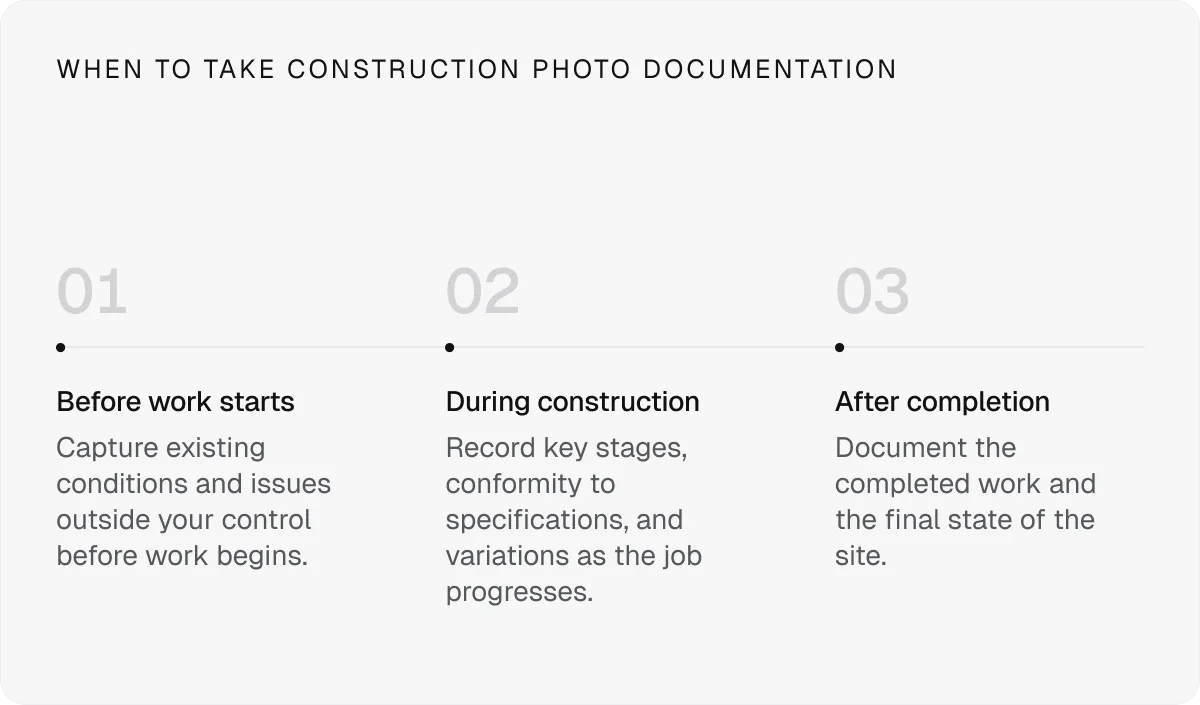
Together, these photos create a clear, continuous visual record of the operations, showing how the job progressed from start to finish.
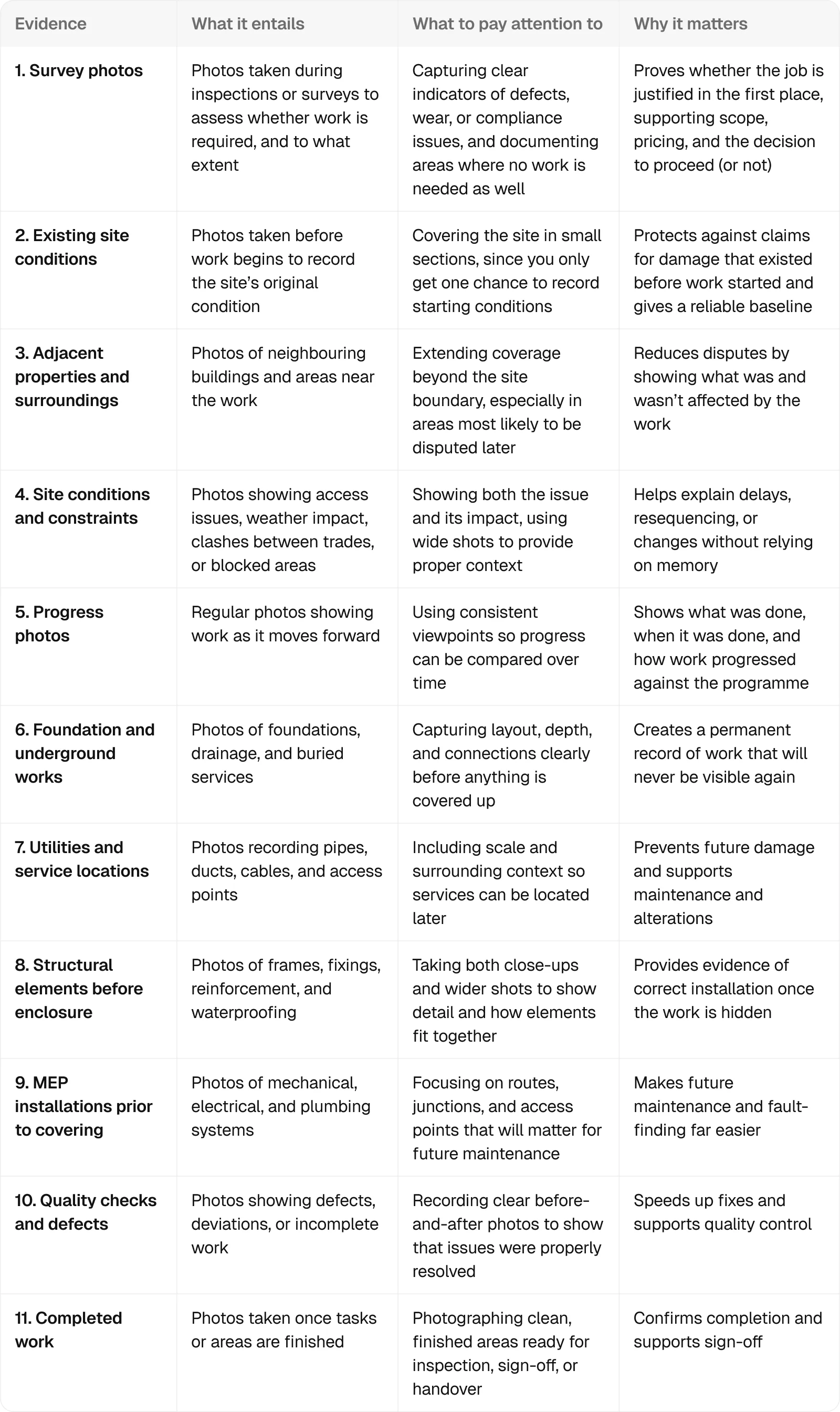
How is construction photo documentation used: 10 real site examples
Construction sites change constantly, with multiple trades, tasks, and conditions in play simultaneously.
That’s why there are many different ways construction photo documentation is used, depending on what needs to be recorded and when.
The table below outlines the most common real-world examples:
Why construction photo documentation matters: 8 key reasons
Photos are taken constantly on construction projects, but they’re not just a by-product of the job.
Below are eight key reasons photo documentation matters on site.
1. It protects against claims
Construction is a dispute-heavy industry. So much so that the UK has a specialist court dedicated to these cases: the Technology and Construction Court.
Many claims come down to what can be proven rather than what’s remembered.
When issues surface later, photos help show what was done, what was visible, and where responsibility sits, limiting liability to what you’re actually responsible for and reducing the risk of drawn-out disputes.
2. It creates a reliable record of events in the correct order
With multiple trades, tasks, and changes happening at the same time, it’s easy for the sequence of events on a construction site to become unclear.
Construction photo documentation helps prevent this by anchoring tasks to specific moments in time.
This visual timeline makes it far easier to explain progress, track changes, and refer back to past decisions without relying on memory or incomplete notes.
3. It aligns stakeholders
Many communication problems on construction projects come down to people working from different information.
What’s clear on site isn’t always clear to clients, managers, or other trades who aren’t there every day.
Photo documentation helps close that gap by showing site conditions and decisions visually, without long explanations.
Shared photos make progress, issues, and changes easier to understand, reducing back-and-forth, cutting down misunderstandings, and keeping everyone aligned around the same facts.
4. It helps spot issues early
On-site issues usually start small and grow as work moves on. Regular photo documentation makes it easier to spot them early, while they’re still visible and easier to fix.
Reviewing photos as work progresses helps teams catch defects, clashes, or missed steps before they’re covered up, reworked, or passed on to the next trade.
5. It improves safety and quality
Safety is a non-negotiable part of construction work.
Photo documentation supports on-site safety by showing:
How work is carried out on site
Whether safety measures are in place
How risks are managed
By taking regular photos, you can help identify hazards while the work is being carried out or prove safety compliance when it’s reviewed.
The same applies to quality, which is one of the biggest challenges in construction project management.
Photos make it easier to check workmanship, spot defects, and confirm that work meets the required standard.
Pro tip:
Photos alone don’t guarantee good workmanship. They need to be paired with checks that confirm the work meets the required standard.
That’s where structured approvals come in.
In Onetrace, approvals act as digital checkpoints in the workflow.
When a job is completed, photos and supporting details are submitted for review. If the execution meets requirements, it’s approved. If not, it’s rejected with clear feedback, so issues can be corrected before work moves on.
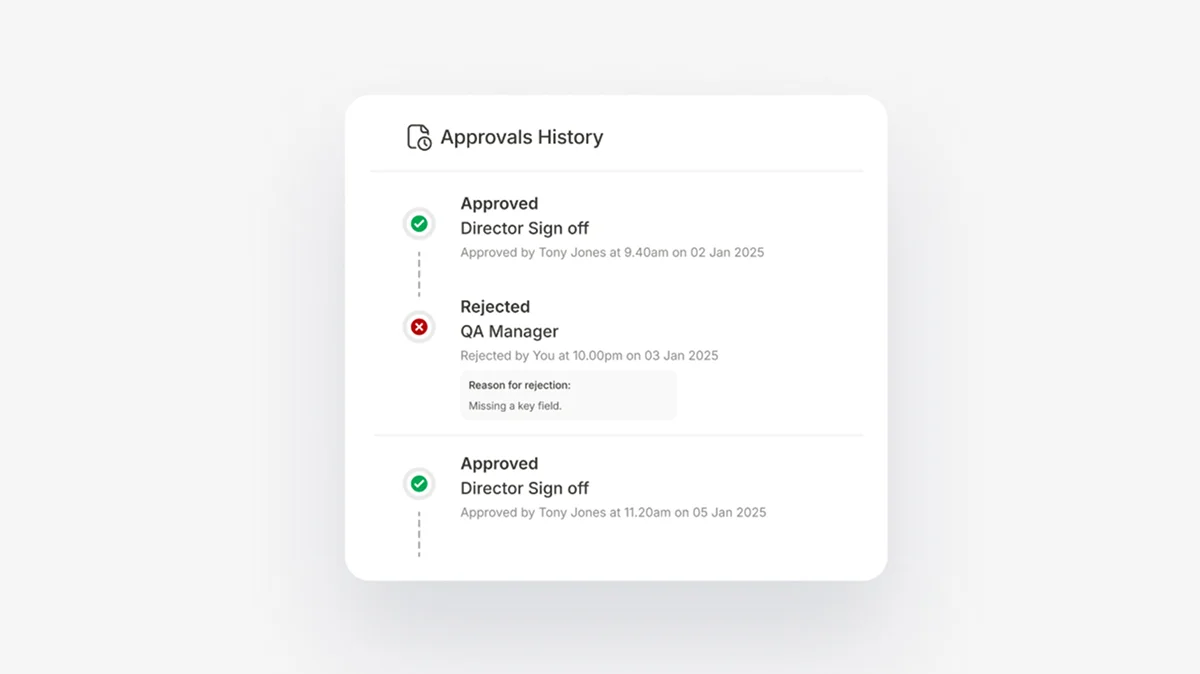
This helps avoid common quality problems such as missing information, unclear photos, or work being signed off too early, and makes it easier to maintain consistent standards across multiple sites and teams.
6. It supports fair payments and accurate valuations
Valuations are often disputed because different parties have different views of how much work was actually completed at a given point.
Construction photo documentation helps remove that uncertainty by showing what was installed, what stage work had reached, and whether areas were truly ready to be signed off.
This is especially useful for staged payments, variations, and interim valuations.
When photos are tied to specific tasks or milestones, they give both sides a shared reference, making payment discussions quicker, fairer, and less open to disagreement.
7. It creates a record that can be used for training, learning, and future work
Photo documentation doesn’t stop being useful once a job is finished.
Over time, it builds a visual record of how work was carried out, what worked well, and where issues arose.
These records can be used to:
Train new team members
Brief crews on similar jobs
Avoid repeating the same mistakes on future projects
8. It supports marketing and tendering
Before-and-after photos and well-documented projects make it easier to show the type and quality of work you deliver.
These records support tenders, prequalification questionnaires, and client discussions by providing real examples rather than descriptions.
With every new project, you’ll build a useful library you can draw on when bidding for new work or presenting your track record.
How to get construction photo documentation right: 8 best practices
Construction photo documentation can only deliver real value when it’s done properly.
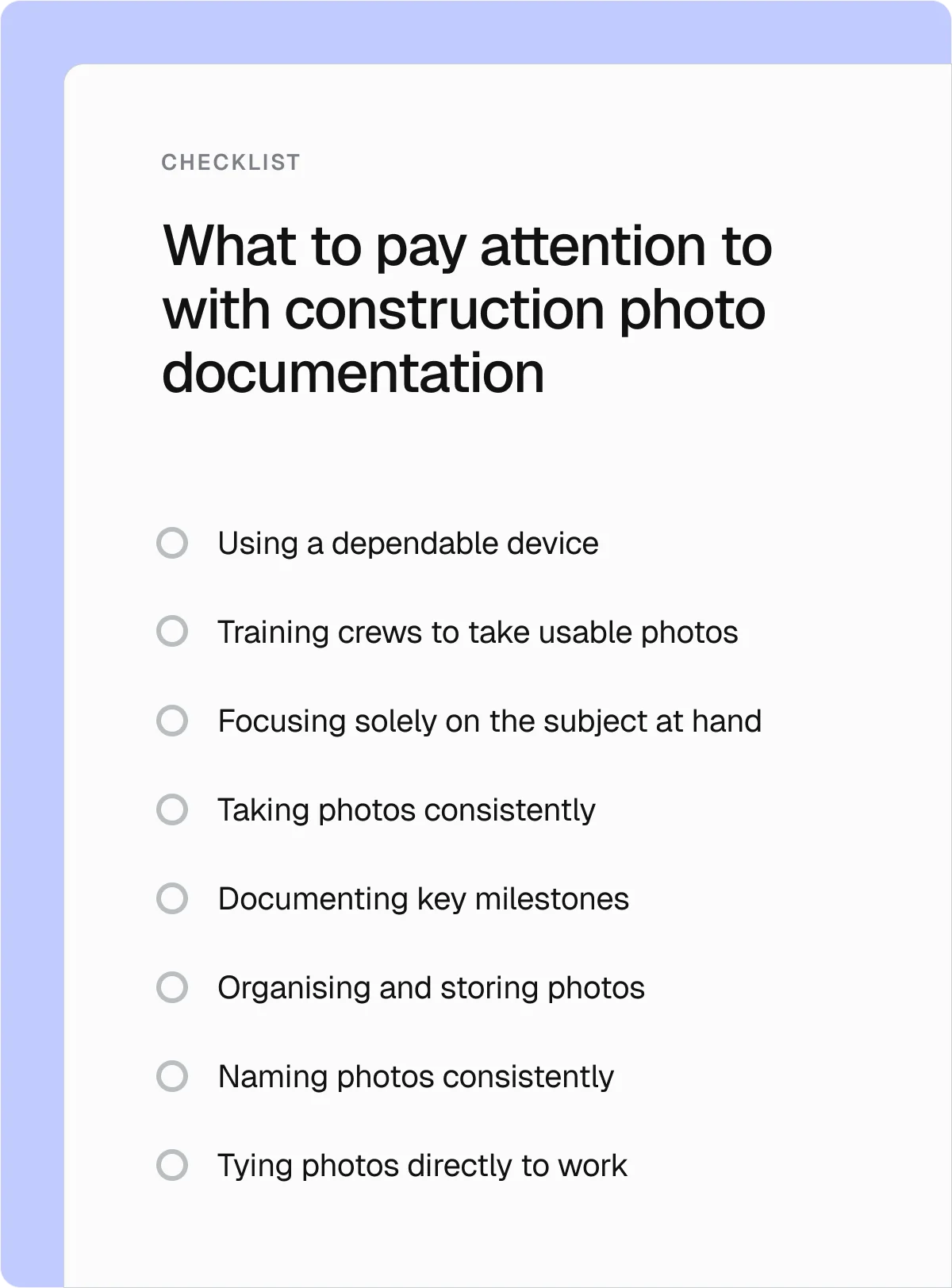
Here are some best practices that help make sure photos are useful, reliable, and easy to work with:
Use the right equipment: Site records and inspections rely on clear, high-resolution images, which is why dependable devices matter.
Train crews to take clear, usable photos: Proper photo documentation depends on crews knowing how to focus on the subject, frame shots properly, and capture enough context with multiple angles.
Check the area before taking photos: Photos work best when they show exactly what they’re meant to show, without avoidable distractions or issues in the background.
Take photos regularly and consistently: Consistent photo capture reduces gaps in records and avoids relying on memory.
Document key milestones: Milestones are often the points that get inspected, questioned, or paid for, which makes them especially important to record.
Keep photos organised and easy to find: Photo documentation quickly loses value if images are scattered across devices or folders and can’t be retrieved easily.
Use consistent naming and structure: Clear naming and structure make it obvious what each photo shows, even before it’s opened.
Link photos to tasks and reports: Photos are most useful when they’re tied directly to the work they relate to, showing what was done and when.
Why use software for construction photo documentation
Most of the benefits of construction photo documentation come from how photos are captured, stored, and connected to the rest of the job.
While you might be able to take quality photos in isolation, they will quickly lose value if they aren’t organised, easy to retrieve, or clearly linked to specific work, dates, and decisions.
This is where dedicated software like Onetrace makes a real difference.
By using this construction site management software, you turn individual site photos into a reliable, usable record rather than a scattered photo library.
Onetrace allows you to:
Capture before, during, and after photos directly from the site, even in high-pressure, unpredictable environments
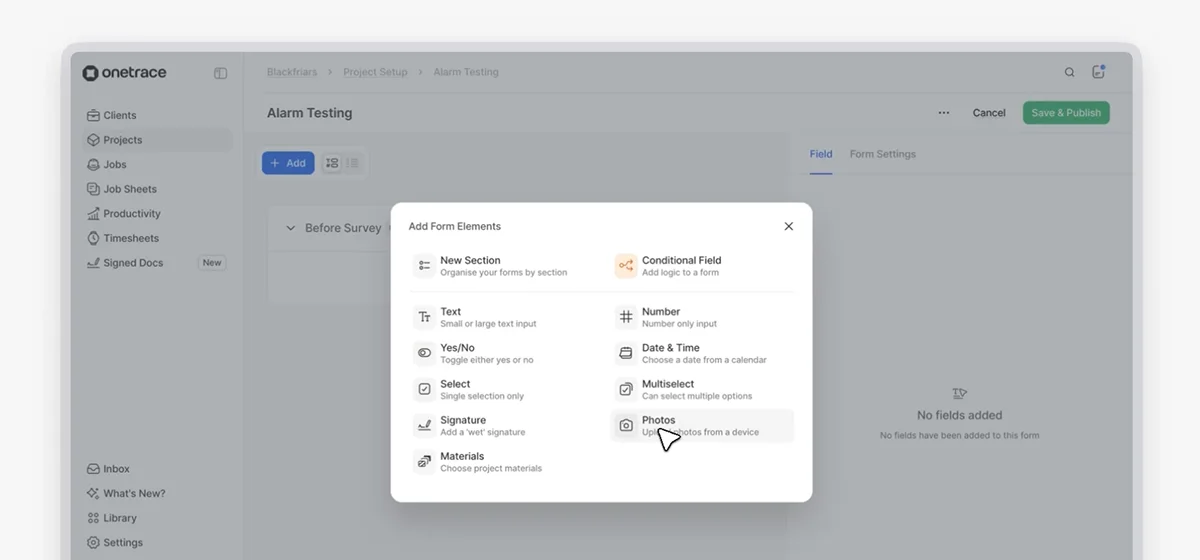
Use job-specific forms to guide what photos are needed
Make photos mandatory where evidence is required
Add conditional steps (for example, requiring photos only when work is carried out)
Attach photos to specific jobs, tasks, surveys, or inspections
Include photos directly in reports
Onetrace also takes care of the organisation, so every photo is easy to retrieve later, even months or years on. This includes:
Storing all photos in one place
Detecting duplicate photos to keep records clean
Linking photos to specific jobs
Request a personalised Onetrace demo to learn how the software can help your business organise and simplify construction photo documentation.
Marketing Team
@Onetrace
The Onetrace marketing team is passionate about sharing insights, ideas, and innovations that help construction businesses stay connected, compliant, and efficient. Combining industry expertise with a love for clear communication, we aim to deliver content that empowers professionals to work smarter and safer.