How to solve communication problems in construction projects?

By
Marketing Team
@Onetrace
Communication shapes how work actually happens on construction projects.
When information is unclear, late, or incomplete, the effects show up quickly: in rework, delays, disputes, and safety incidents.
That’s why around 52% of global rework is linked to poor data and miscommunication, and 16% of construction professionals identify a lack or delay of information as the number one cause of programme slippage.
Proper communication can also help solve common construction issues. After all, up to 95% of construction disputes are resolved directly between the parties involved, emphasising the importance of clear, consistent safety communication.
While communication issues are often treated as personal failings, they are systemic problems built into how projects are set up and run.
With that in mind, this article explores practical ways to solve communication problems in construction projects at a project-wide level.
Key takeaways
Set clear communication rules from day one
Don’t assume people have the same expectations. Define who shares what, with whom, and when. Clear decision paths and escalation routes reduce delays and prevent minor issues from turning into disputes.Standardise and centralise information
Communication breaks down when documents live in too many places. Use one system as a single source of truth, standard formats for key records, and clear ownership so everyone works from the same, up-to-date information.Use the right communication method for the job
Not every message belongs in an email or a meeting. Match the method to the message so urgent issues move fast, complex topics get proper discussion, and formal changes are tracked correctly.Support communication with training, structure, and openness
Tools and processes only work if people know how to use them and feel safe speaking up. Regular training, well-run meetings, visual communication, and open feedback loops help issues surface early.Use construction-specific digital tools to tie it all together
Platforms like Onetrace bring communication, documents, schedules and site updates into one place, with real-time visibility for site and office teams.
1. Establish a clear communication framework from day one
People arrive on site with different habits and expectations about how information flows. That’s why there should be no assumptions about communication on your site.
Instead, projects need a clear framework that should define:
Communication responsibilities and timing: Everyone should know what information they’re responsible for sharing, who needs to receive it, and when it needs to be passed on to keep work moving.
Decision-making hierarchy: The project team should have a shared understanding of how decisions are made and where issues should be escalated if they can’t be resolved at the site level.
Decision authority: Clear limits should be set on who can approve scope, cost, and programme changes, so decisions aren’t delayed or made without the right authority.
Escalation routes: When issues stall or risk affecting the programme, there should be a defined escalation route to ensure they’re addressed quickly and at the right level.
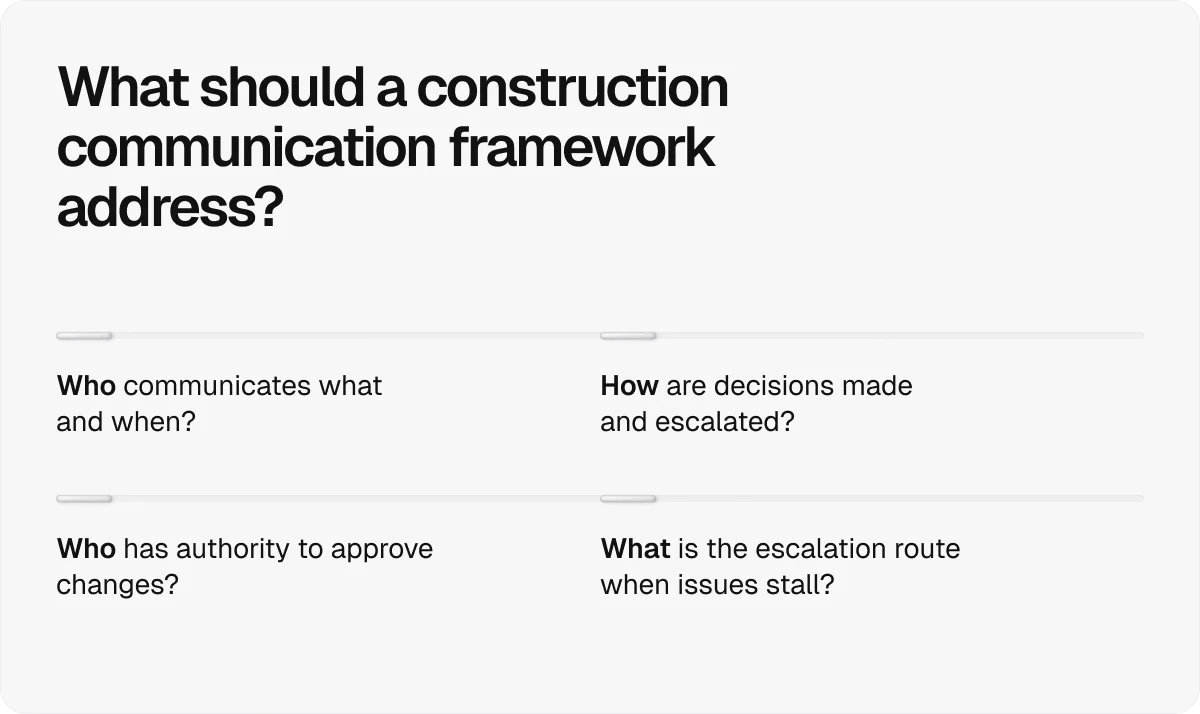
A well-designed communication framework reduces assumptions, speeds up decisions, and limits conflict before it has a chance to grow.
2. Standardise and centralise documentation
For communication to work at scale, it’s not enough to agree on how people talk. The information itself needs to be consistent, current, and easy to find.
Standardising documentation is a great way to solve communication problems in construction projects before they even appear. By removing guesswork and giving everyone the same point of reference, standardisation reduces the risk of miscommunication that occurs when documents are scattered across emails, folders, and personal devices.
To standardise your construction project, you should:
Keep all documents in one central system as a single source of truth
Use standard formats for RFIs, site instructions, and meeting minutes
Enforce version control for drawings and programmes
Require written confirmation for any scope or schedule change
Assign clear ownership for updates and responses
3. Match the communication method to the message
To avoid confusion and unnecessary delays, each communication method should have a clear purpose.
The table below breaks down common communication methods used in construction and where each one works best.
Communication method | Best for | Example |
Face-to-face conversations | Complex or sensitive issues that need quick alignment | Resolving a clash between trades on site |
Phone calls | Urgent matters that can’t wait for a written follow-up | Confirming a delayed delivery that affects the day’s work |
Emails | Non-urgent updates or written confirmation | Sharing a meeting summary or confirming agreed actions |
Formal meetings | Issues affecting multiple parties or the wider programme | Weekly coordination or progress meetings |
RFIs | Design questions that affect scope or quality | Clarifying a missing dimension on a drawing |
Change orders | Formal approval of scope, cost, or programme changes | Recording an agreed variation before work starts |
Safety briefings and signage | Communicating hazards and safe working methods | Toolbox Talks or temporary warning signs |
Project management software | Centralised, traceable project communication | Issuing updated drawings to all trades |
These communication methods should be defined early and introduced clearly to everyone involved in the project, both on and off site. This can happen when:
Setting expectations during kick-off meetings
Onboarding new trades
Confirming how information will be shared day to day
Pro tip:
Choose your construction management software well, and you can remove much of the day-to-day communication burden.
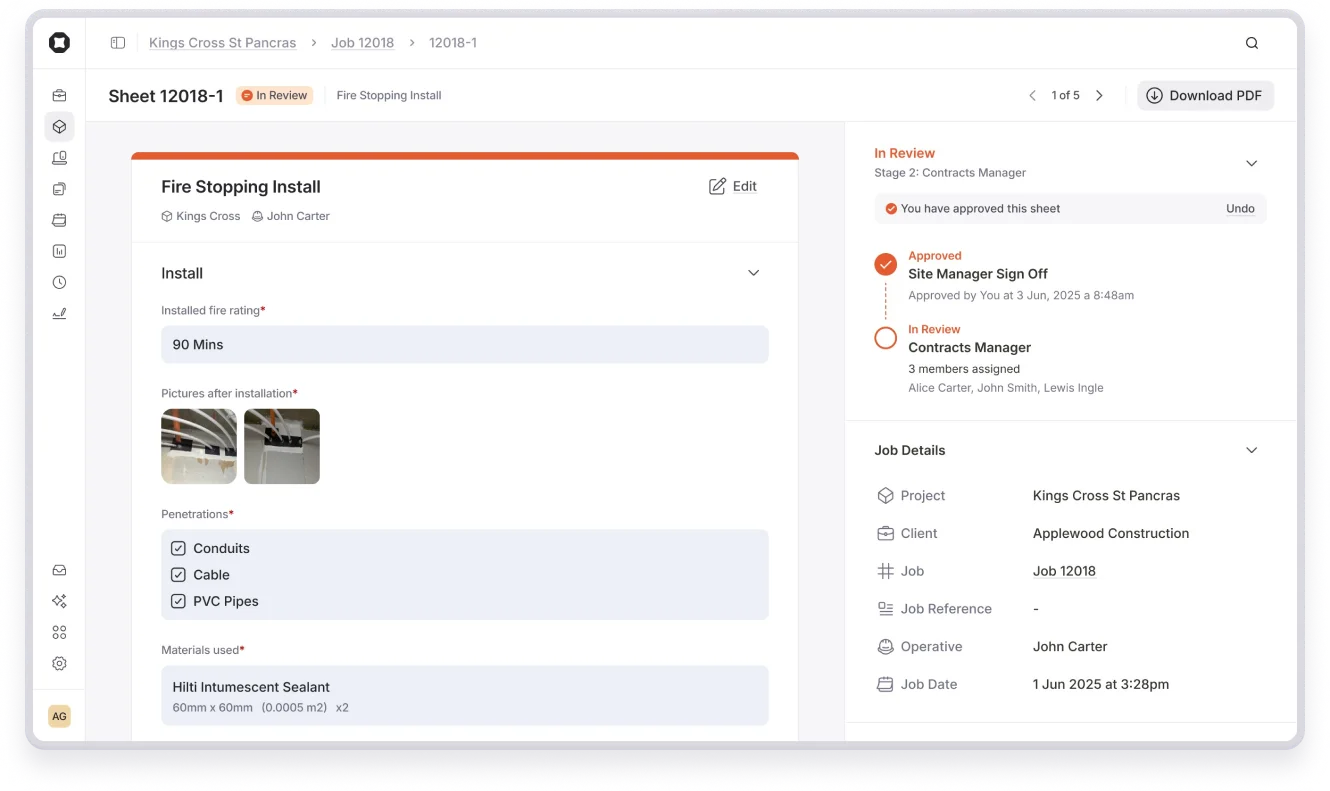
Tools like Onetrace build communication directly into how work is recorded, checked, and approved, with features like:
Operative declarations: Operatives confirm work directly in the app, creating clear accountability without follow-up calls or emails.
Drawings, pins, blocks, and zones: Drawings are uploaded, marked up, and organised by blocks, levels, zones and cores, so issues are tied to exact locations rather than vague descriptions.
Custom statuses: Statuses can mirror real-site workflows, making it clear what’s complete, what’s pending, and what needs attention.
Variation tracking: Variations are visible in real time, reducing disputes caused by unclear or undocumented changes.
Signed documents and compliance: RAMS, Toolbox Talks, and other documents are issued, signed, and tracked digitally, with instant notifications and full audit trails.
Approvals and quality assurance: Job sheets move through defined approval chains with feedback at each stage, speeding up remediation and reducing late-stage snagging.
4. Train people to communicate well and use the tools
You can put in a lot of effort to set up clear processes and choose the right software, but they will only work if people know how to use them properly. Without training, tools meant to improve communication end up underused, and gaps in information appear quickly.
Training should cover the following:
Refreshing people on agreed processes
Showing them how information should be logged
Building basic skills like clear writing, listening, and issue reporting
Also, training should happen at every level. For example, if operatives use push-to-talk solutions like walkie-talkies, they should know exactly which channel to use for safety alerts, deliveries, or coordination between trades.
Clear communication helps operatives report issues early, supervisors coordinate work more smoothly, and managers make decisions with confidence.
5. Run regular, well-structured meetings
Construction projects rely on ongoing updates to stay on track. Construction schedules are reviewed, costs are checked, and health and safety risks are reassessed regularly. On-site communication is no different—it needs the same rhythm and discipline.
Regular meetings help teams surface issues early, align on priorities, and coordinate work across trades.
But gathering people together isn’t enough; meetings without structure waste time and leave decisions unclear.
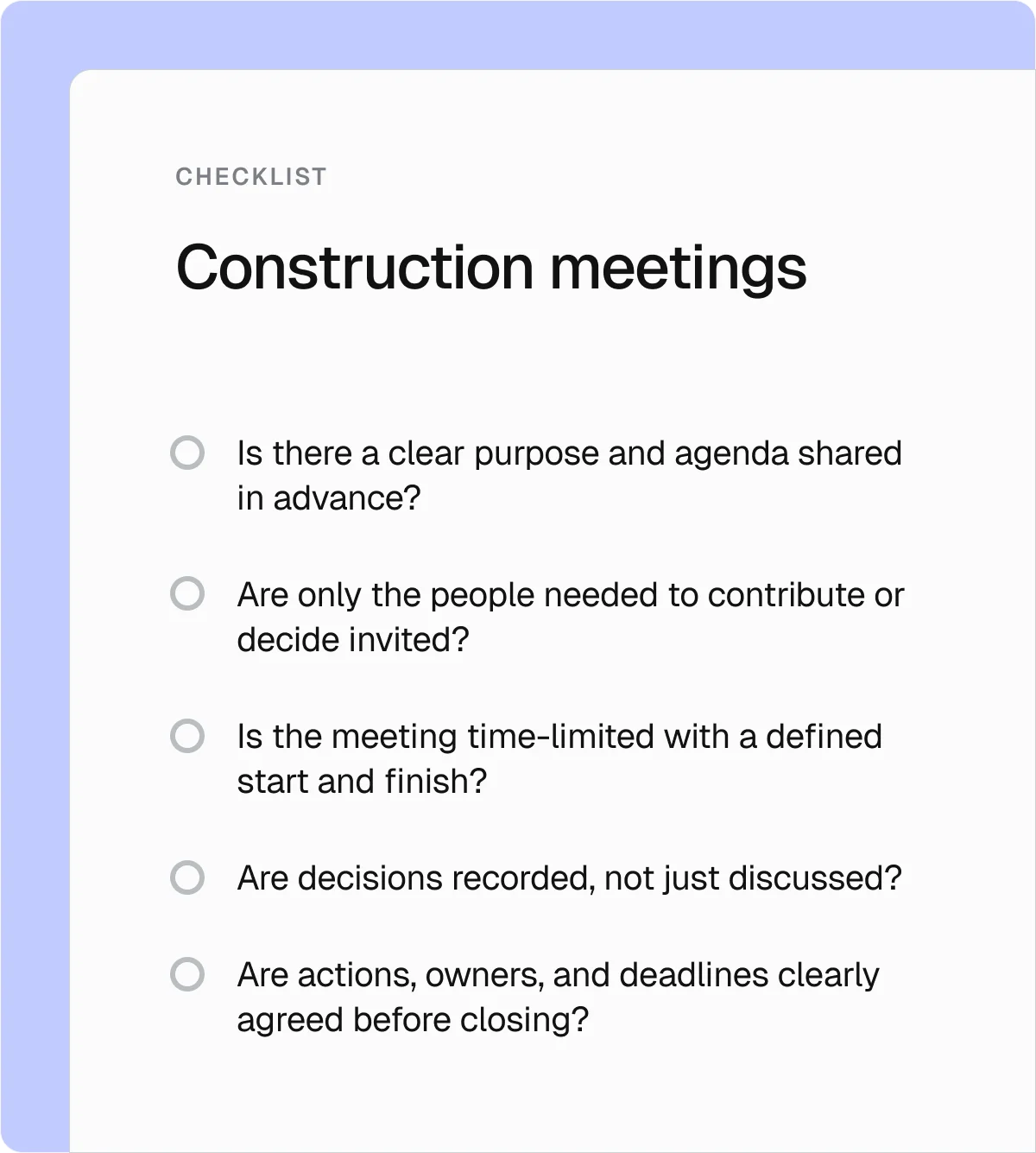
Effective site meetings should be:
Purpose-led, with a clear agenda and objective
Limited to the right people, not everyone by default
Time-boxed, to keep discussions focused
Action-oriented, with clear next steps
Daily or weekly huddles should be supported by visual communication.
Using visual boards for programme, safety, and constraints helps teams understand tasks and progress more quickly than words alone. For remote or hybrid meetings, sharing a PPTX viewer link let's all parties view presentation slides instantly in a browser without needing software installed.
Visual communication is crucial for safety, too. Research shows that visual aids in Toolbox Talks improve hazard recognition, allowing workers to spot risks from over 1.5 metres away.
6. Keep communication open beyond the meeting room
Open communication shouldn’t stop when the meeting ends. Teams can only solve communication problems in construction projects if they feel safe to raise concerns as work is happening, not just when they’re asked.
Here are a few requirements you need for creating such an environment:
Leaders model openness by listening rather than dominating.
Clear routes exist for raising issues outside formal meetings.
Regular check-ins happen beyond progress updates.
Feedback is actively requested and acted on.
7. Keep messages clear, simple, and consistent
Construction projects bring together a wide mix of people—operatives, supervisors, managers, designers, suppliers, and subcontractors—often working across different locations and levels of experience.
That’s why it’s crucial to keep communication clear for everyone involved, not just technically correct for a few.
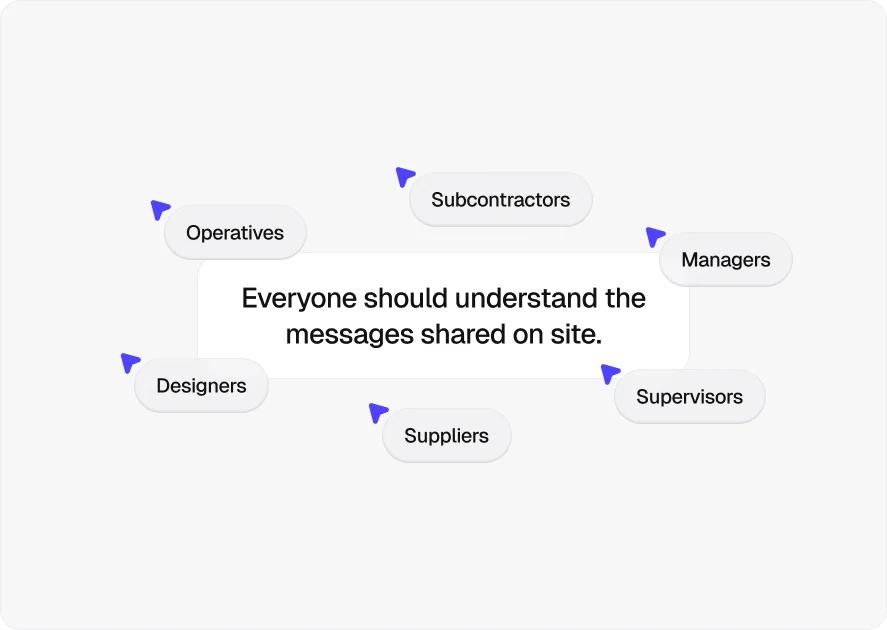
Messages that are unclear, overly detailed, or full of jargon slow things down and increase the risk of mistakes.
Clear communication on site should only involve:
Plain language, with minimal jargon and acronyms
Focused messages, covering one issue at a time
Brief but complete information, without unnecessary detail
Of course, some messages will still have to be technical. In this case, they should be targeted only at the people who need that level of detail.
For example, a detailed structural fix or design tolerance should be shared between engineers and the relevant trade, while the wider team only needs to know what’s changing, where, and when.
Remember to proofread messages, especially those shared across teams, to ensure they are easy to understand.
8. Address language barriers on site
On many construction sites, not everyone speaks the same first language, which can affect how messages are understood.
In the UK, for example, around 19.6% of the construction workforce was non-UK born in 2023, with common languages on site including Romanian, Polish, and Punjabi.
When instructions, safety information, or changes aren’t fully understood, it can lead to rework, frustration, and increased safety risk.
Besides using plain, simple language wherever possible, you should also do the following to reduce language-related issues:
Support verbal instructions with visual aids such as drawings or photos, or create explainer videos to demonstrate tasks clearly and consistently.
Provide translated materials for inductions and safety briefings.
Identify bilingual team members and support them properly.
Check understanding, rather than assuming messages have landed.
Using digital tools to solve communication problems in construction projects
Digital tools have changed how construction teams share information. Updates can move faster, records are easier to track, and fewer things fall through the cracks.
But not all tools have the same impact.
When it comes to day-to-day communication, construction-specific project management platforms make the biggest difference.
Tools like Onetrace are built around how work actually happens on site. They bring communication into one place, so teams don’t have to chase emails, messages, or paperwork.
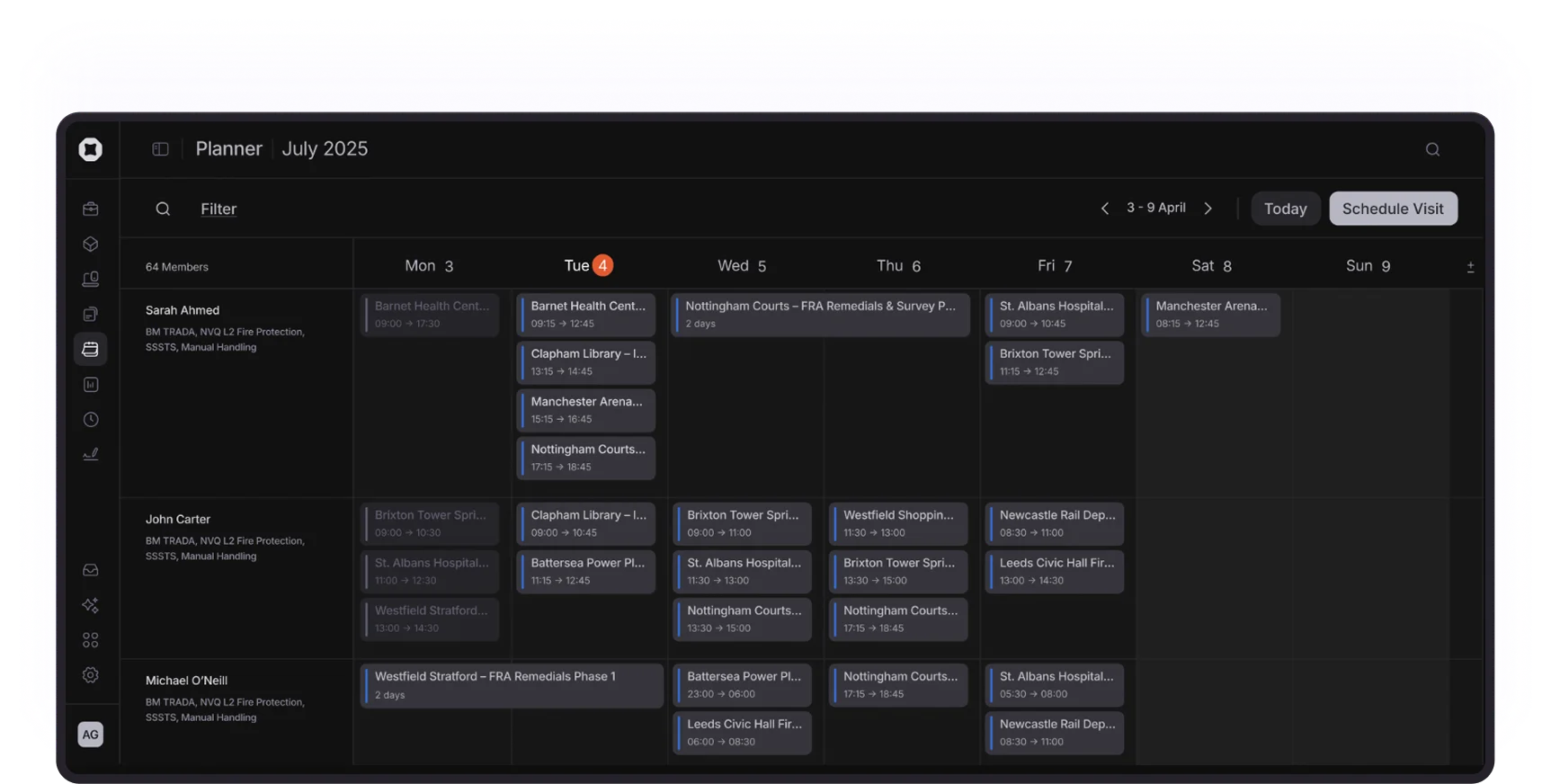
Onetrace helps you solve communication problems in construction projects by:
Keeping a central repository for drawings, schedules, documents, and site records
Providing real-time updates from site to office, and back again
Using visual planners and schedules so everyone knows what’s happening and when
Offering mobile access that works on site, even offline
The result is shared visibility, clearer responsibility, and fewer assumptions.
Book a tailored walkthrough today to see how Onetrace can improve day-to-day communication on your projects.
Marketing Team
@Onetrace
The Onetrace marketing team is passionate about sharing insights, ideas, and innovations that help construction businesses stay connected, compliant, and efficient. Combining industry expertise with a love for clear communication, we aim to deliver content that empowers professionals to work smarter and safer.