AI in construction planning: 10 benefits for contractors

By
Marketing Team
@Onetrace
Construction planning is the process of organising the people, resources, and tasks needed to deliver a project safely, on time, and within budget.
It’s one of the most important stages of any build because setbacks during the planning process can have knock-on effects across the entire project. In the 2025 SME State of Trade Survey, 36% of respondents reported delays linked to the planning stage, making it the second most common cause after extreme weather and climate events.
However, as projects become larger and more complex, traditional planning methods often struggle to keep up with the volume of information, dependencies, and changes involved, making these setbacks harder to avoid.
Artificial intelligence, on the other hand, isn’t limited by the same capacity constraints, which is one of the reasons roughly 80% of construction professionals are either already using AI tools or planning to adopt them within the next five years.
If you’re weighing up the potential value of this technology for your business, this guide explores 10 benefits of AI in construction planning.
Key takeaways
AI helps contractors plan faster and more accurately
By analysing project data and comparing different scenarios, AI enables teams to create more precise plans in less time.
Automation frees up time for higher-value work
AI can handle tasks like information searches, data analysis, and document reviews, allowing planners to focus on decision-making and coordination.
Better planning reduces delays, costs, and risks
AI can identify bottlenecks, improve resource allocation, and flag potential issues before they affect project delivery.
Data-driven insights support better decisions
AI lets teams turn project data into useful insights, improving visibility into schedules, resources, costs, and project performance.
Precise data is essential for getting value from AI
Most contractors use tools like ChatGPT to support planning tasks. Onetrace provides the accurate, organised project data these tools need to deliver useful results.
10 practical benefits of AI in construction planning
When used well, AI can help contractors manage growing project complexity more effectively while creating the conditions for better project outcomes.
Here are 10 practical benefits of using AI in construction planning.
1. Getting plans in place faster
Traditional planning often involves manually reviewing large amounts of project data, comparing options, and updating plans as project requirements change. AI can speed up this process by analysing data in real time and quickly assessing different scenarios and schedules.
Instead of spending days testing alternatives, planning teams can evaluate multiple options in a fraction of the time.
AI can also generate and compare design iterations based on factors like cost, buildability, and structural requirements, enabling teams to develop more precise plans faster.
2. Taking the heavy lifting out of planning
A planner spends much of their time on work that supports planning rather than on planning itself.
Searching through technical documents, reviewing specifications, analysing data, preparing reports, and keeping project records up to date can quickly eat into the time available for higher-value tasks.
AI automates many of these routine activities.
The most common uses of AI in construction include:
Searching for technical information
Drafting and reviewing text
Analysing data
Summarising documents
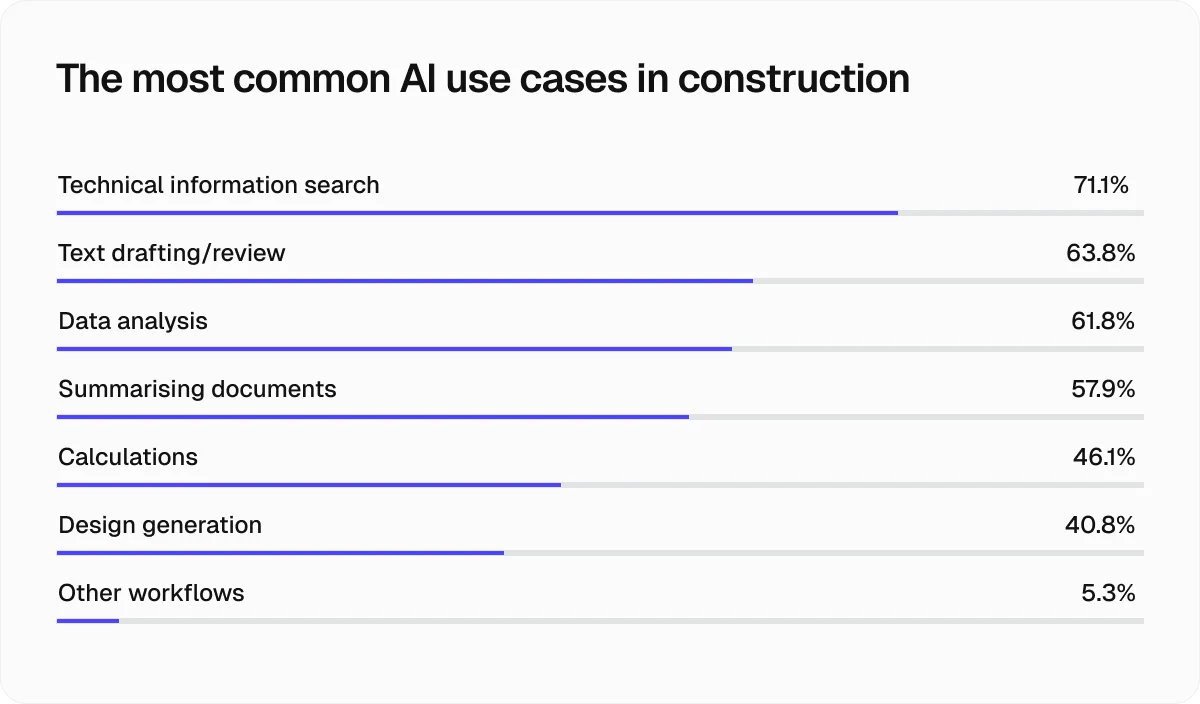
By spending less time gathering and processing information, planners can devote more effort to coordinating work, making decisions, and solving project challenges. The result is a more productive planning process without the need to increase headcount.
3. Building more reliable project schedules
Construction schedules rarely unfold exactly as planned. Changing site conditions, resource constraints, design alterations, and coordination issues can all disrupt progress and put deadlines at risk.
AI can make schedules more reliable by analysing historical and real-time project data to identify potential bottlenecks before they affect delivery. It can also:
Evaluate different sequencing options
Support more realistic timeline planning
Continuously adjust forecasts as project conditions change
Thanks to these capabilities, contractors can build schedules that better reflect the realities of project delivery and respond more quickly to disruptions.
4. Reducing project costs
Cost overruns often start long before work begins on site. Inaccurate estimates, inefficient resource allocation, overlooked risks, and planning errors can all add unnecessary costs to a project.
The table below highlights some of the main ways AI supports contractors in keeping project costs under control:
Cost-saving area | How AI helps during planning |
More accurate estimates | Analyses historical and current project data to produce more reliable cost forecasts and reduce reliance on assumptions |
Better resource allocation | Matches labour, equipment, and materials to planned work more effectively, reducing idle time, over-allocation, and waste |
Improved procurement planning | Identifies design conflicts, missing information, and coordination issues before they become expensive site problems |
Fewer planning errors | Flags potential issues earlier, when changes are easier and less costly to make |
Reduced rework | Supports material planning and supplier decisions to help avoid shortages, delays, and unnecessary inventory costs |
Earlier risk detection | Highlights potential cost pressures, bottlenecks, and delivery risks before they escalate and affect project budgets |
Rather than relying on contingency to absorb uncertainty, contractors can use AI to build more accurate plans, make better use of resources, and maintain greater control over project costs from the outset.
5. Spotting risks earlier
Project risks usually don’t appear overnight. Labour shortages, supply chain issues, coordination gaps, and productivity problems often develop gradually before affecting delivery.
AI can surface these issues early by monitoring project data for patterns and warning signs that are easy to miss during manual reviews. For example, it can:
Flag activities at risk of delay
Identify upcoming resource shortages
Highlight recurring performance issues
Reveal gaps in project information before they affect planned work
This gives contractors more time to assess their options and adjust plans while there is still flexibility to do so. Instead of reacting once problems have already emerged, they can now take a more proactive approach to risk management during the planning process.
6. Improving safety planning
A key part of the planning process is identifying potential hazards before they become real-world risks. To do so, construction teams must assess planned activities, work sequences, site layouts, and other project conditions, and put appropriate controls in place.
AI can support this process by:
Analysing historical incident and near-miss data
Identifying activities with higher risk exposure
Highlighting recurring hazards that could indicate increased safety risks
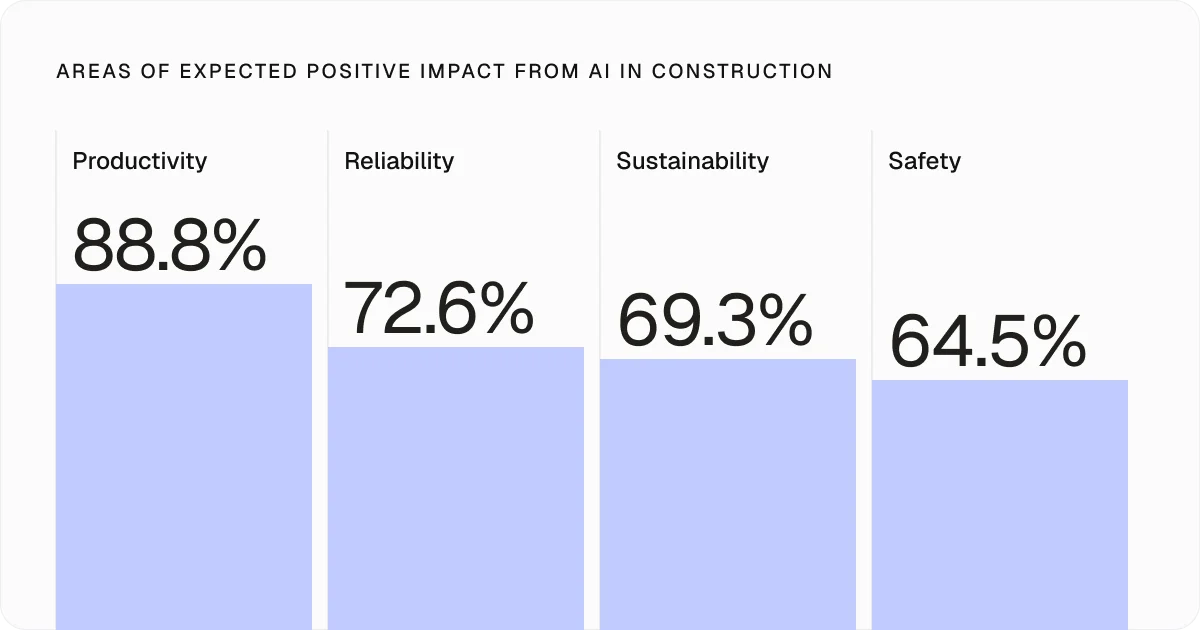
This potential is reflected in industry sentiment. In a 2025 report surveying UK and international construction professionals, 64.5% of respondents said they believe AI will improve safety.
7. Connecting project information more effectively
Construction planning depends on information from many different sources, including drawings, BIM models, specifications, schedules, and procurement data. When that information sits in separate systems or formats, it can be difficult to maintain a complete and accurate view of the project.
AI tackles this fragmentation by automatically interpreting, organising, and connecting information across different software platforms and data sources. Common use cases include:
Identifying inconsistencies between documents
Supporting the reconciliation of 2D drawings and 3D models
Making large volumes of project information easier to search and analyse
By improving the flow of information between teams and systems, AI contributes to a more connected planning process.
8. Making more informed decisions
Construction projects generate vast amounts of information, and the challenge is turning it into something useful.
AI helps by bringing together data from multiple sources, analysing it at scale, and presenting insights that support planning decisions. Instead of relying solely on experience or manual reviews, teams can make decisions based on a clearer picture of project performance and potential risks.
The table below highlights some of the information AI can provide during the planning process:
AI insight | How it supports planning |
Schedule performance trends | Identifies activities that are falling behind plan and may require intervention |
Potential project delays | Highlights areas where timelines may be at risk based on current project conditions |
Resource availability and utilisation | Supports labour, equipment, and material planning across project phases |
Procurement risks | Flags potential material shortages, delivery issues, or supplier-related concerns |
Cost forecasts | Provides greater visibility into expected project costs and budget performance |
Productivity trends | Helps teams understand whether planned production rates are realistic |
Emerging project risks | Identifies patterns and warning signs that may affect delivery if left unresolved |
Progress against milestones | Gives stakeholders a clearer view of project status and upcoming priorities |
9. Keeping teams aligned
Construction planning involves input from multiple stakeholders, including project managers, designers, subcontractors, procurement teams, and site personnel. When different teams work from conflicting information, misunderstandings and coordination issues can quickly emerge.
AI strengthens alignment by turning large volumes of project information into easier-to-understand, actionable insights. It can:
Extract key details from drawings, specifications, RFIs, reports, and meeting notes
Highlight coordination issues
Answer routine questions that would otherwise require multiple emails or calls to resolve
With better visibility and a shared understanding of project priorities, teams can spend less time chasing information and resolving miscommunication, and more time on the work that moves projects forward.
10. Lowering barriers to digital adoption
Construction has historically lagged behind many other industries when it comes to digitalisation. As a result, some planning teams may hesitate to adopt new technologies or struggle to get the full value from digital tools.
AI closes this gap by making technology more accessible.
Instead of relying on specialised knowledge or complex workflows, users can search project information, access guidance, and complete tasks using simple text or voice prompts. AI can also provide contextual support and surface relevant information when it’s needed.
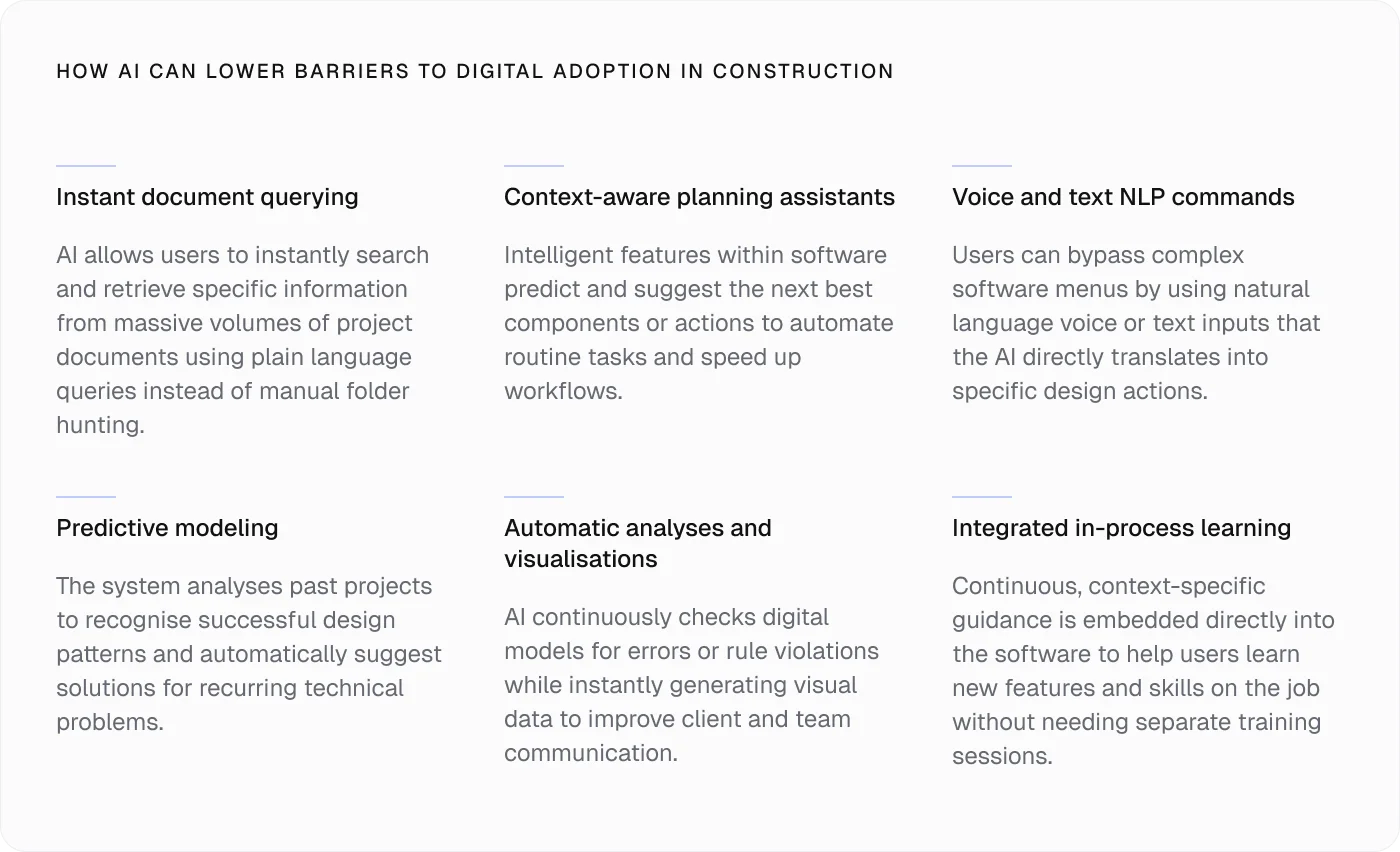
By making digital tools easier to engage with, AI allows more people to benefit from technology-driven planning without requiring extensive training or technical expertise.
How to reap the benefits of AI in construction planning
When discussing AI in construction planning, it’s important to separate reality from hype. Contractors aren’t using AI systems that can automatically plan entire projects without human input.
Instead, most construction professionals rely on general-purpose AI tools to support day-to-day planning tasks. According to the 2025 Digital Construction Report, ChatGPT is the most widely used tool among current AI users (86.8%).
These professionals still need a reliable way to collect, organise, and access project information. After all, AI is only as useful as the data it’s given. If information is incomplete, inconsistent, or difficult to find, the quality of the output will suffer, too.
This is where construction management software like Onetrace comes in.
By creating a single source of truth for project data, this platform provides the foundation that AI tools need to deliver useful planning insights.
Onetrace can support AI-assisted planning by capturing the following types of project data:
Custom forms: AI can analyse structured survey, inspection, and installation data to identify trends, recurring issues, resource requirements, and planning risks across projects.
Photographic evidence: Site photos can provide valuable context for AI-assisted reviews, letting teams assess progress, spot issues, and compare conditions across locations.
Material tracking: Records of material types, quantities, costs, and usage can support procurement planning, cost forecasting, and resource allocation decisions.
Project drawings and location details: Structured information linked to blocks, levels, zones, and specific locations helps AI understand where work is taking place and identify patterns across a project.
Timesheets and workforce data: Labour data can support resource planning, productivity analysis, workload forecasting, and schedule optimisation.
Productivity data: Information on project performance, team output, completed work, and costs allows AI to uncover trends and highlight opportunities for improvement.
Variation tracking: Records of scope changes can be analysed to flag common causes of variations, forecast their impact, and improve future planning accuracy.
Project documentation: Drawings, specifications, RAMS, contracts, certificates, and other project records can be searched, summarised, and analysed using AI tools, making information easier to access and use.
The better your project data, the more value you’ll get from AI in construction planning and beyond.
If you’d like to see how Onetrace can help you capture, organise, and manage the information needed for AI-assisted planning, book a personalised demo. We’ll show you the features most relevant to your business and how they can help you build a stronger foundation for smarter planning decisions.
FAQ
What is AI in construction planning?
AI in construction planning refers to the use of artificial intelligence to support planning activities like scheduling, resource allocation, risk management, forecasting, and data analysis. Rather than replacing planners, AI helps them process information more efficiently and make more informed decisions.
Can AI create construction plans automatically?
No. While AI can analyse data, identify risks, improve schedules, and support decision-making, it can’t independently plan and manage a construction project from start to finish. Effective construction planning still relies on human expertise, accurate project information, and professional judgement.
Marketing Team
@Onetrace
The Onetrace marketing team is passionate about sharing insights, ideas, and innovations that help construction businesses stay connected, compliant, and efficient. Combining industry expertise with a love for clear communication, we aim to deliver content that empowers professionals to work smarter and safer.