Construction workforce intelligence: A complete guide

By
Marketing Team
@Onetrace
Construction workforce intelligence is the use of real-time workforce data to understand what’s happening on site and make better decisions about productivity, safety, and planning.
It sits within the wider shift toward digital, data-driven construction, as the industry looks for more effective ways to tackle persistent challenges like labour shortages, rising costs, and low productivity.
With over 140,000 vacancies slowing down housing and infrastructure projects, essential materials rising by more than 60% in some cases, and productivity growing by just 0.4% annually between 2000 and 2022, construction professionals have little room for inefficiency.
To help you be as efficient as possible, this guide breaks down the core principles of construction workforce intelligence and explains how to use it to improve performance on site.
Key takeaways
Workforce intelligence turns unused data into real decisions
Most construction data has traditionally gone unused, but workforce intelligence connects and analyses it in real time so teams can act while work is still ongoing.Real-time visibility is what sets it apart from traditional methods
Instead of relying on delayed reports and manual processes, teams get a live view of site activity, allowing them to spot issues early and adjust before those problems impact the project.It covers every part of workforce performance, from site activity to long-term planning
From tracking daily attendance and productivity to forecasting future labour needs and costs, workforce intelligence gives a complete picture of how labour is used across projects.The biggest value comes from practical outcomes on site
Better decision-making, fewer delays, improved safety, stronger accountability, and more reliable cash flow all come from having accurate, connected workforce data.The right platform makes workforce intelligence possible in practice
Tools like Onetrace bring workforce data, site activity, and project records into one system, making it easier to capture accurate data, improve visibility, and run more controlled, efficient projects.
What is construction workforce intelligence?
Construction workforce intelligence is a structured approach to collecting, analysing, and using workforce data to gain a reliable view of how labour is performing across projects.
It brings together information on elements like workforce performance, availability, and experience to support better planning, safer operations, and more consistent project execution now and in the future.
Construction workforce intelligence vs traditional workforce management
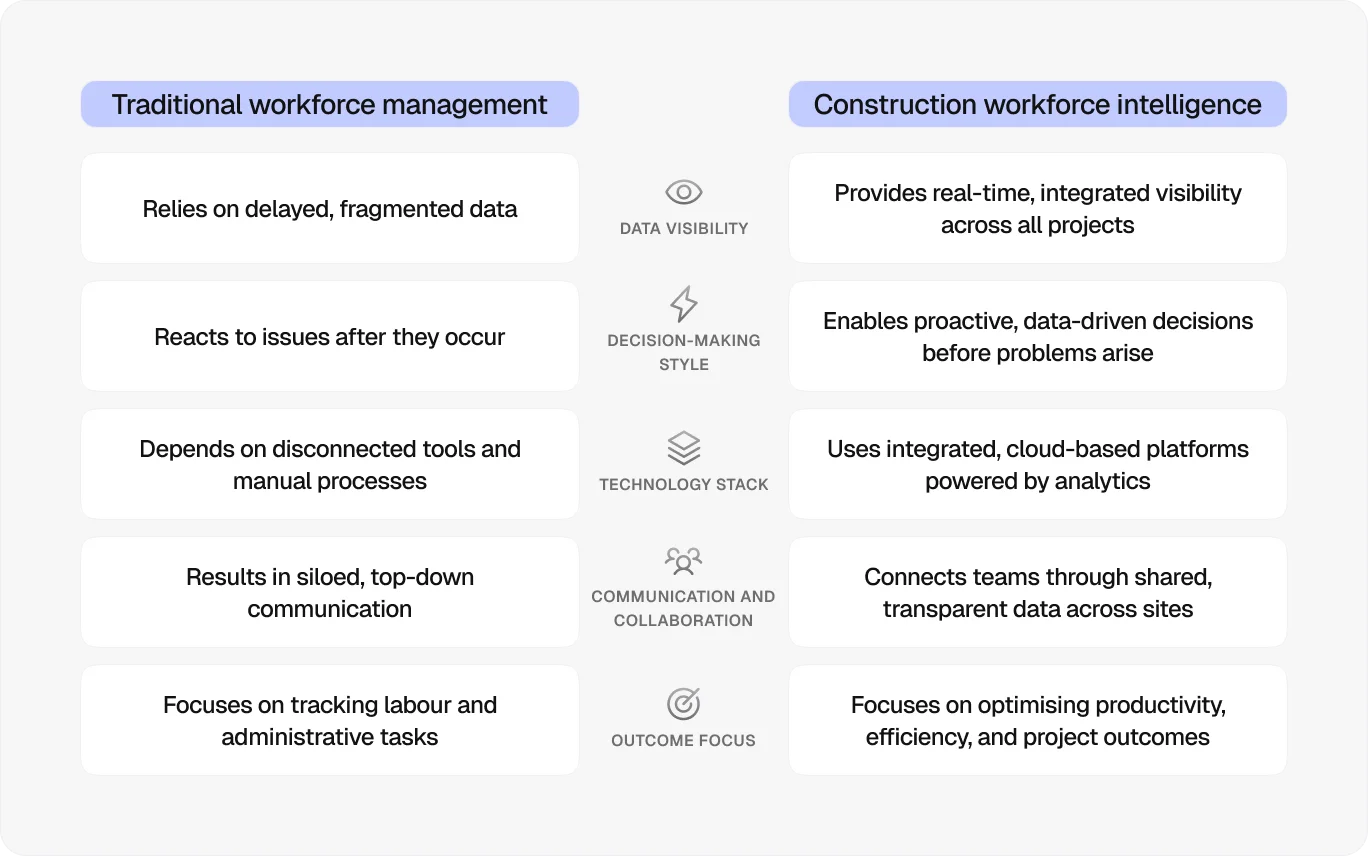
The core component that separates construction workforce intelligence from traditional workforce management is real-time visibility.
Construction teams have always collected data, with timesheets, site reports, and labour logs having been part of the job for decades. So, the issue has never been a lack of construction data, but what happens to it afterwards.
Older research suggests that as much as 96% of construction data goes unused, revealing a major gap between data collection and meaningful use. This gap can be largely attributed to traditional ways of working.
Manual processes, delayed reporting, and disconnected systems mean data is often incomplete, hard to access, or outdated.
By the time insights are available, the work has already moved on.
Construction workforce intelligence closes this gap by capturing and connecting data in real time.
This gives teams a current view of workforce performance and helps them spot issues early, allocate labour more effectively, and make decisions while work is still in progress.
6 key areas of construction workforce intelligence
Construction workforce intelligence covers a wide range of activities, from day-to-day site tracking to long-term workforce planning.
To make them easier to understand and use, these activities can be grouped into six key areas.
1. Operational workforce intelligence
Operational workforce intelligence focuses on giving teams a live view of what’s happening on site.
It brings together real-time data on workforce activity, including:
Task progress
Crew activity
Coordination between labour and equipment
Tools like GPS tracking and digital check-ins add another layer of visibility, helping teams understand exactly who is on site and when.
This level of visibility helps teams answer questions such as:
Are crews working efficiently right now?
Which tasks or areas are falling behind schedule?
Where is time being lost during the day?
2. Productivity intelligence
Productivity intelligence looks at how effectively labour is being used across projects.
It connects workforce activity to output, making it easier to see whether time on site is translating into real progress. It does so by tracking:
Output per worker or crew
Task completion rates
Workforce utilisation
Productivity intelligence also involves comparing labour input against project milestones to identify gaps in performance or areas where resources are under- or overused.
Combine all the data, and you get insight into:
Which crews or roles are delivering the best results
Where bottlenecks or slowdowns are happening
How labour performance can be improved over time
Despite its importance, this area of construction workforce intelligence is still overlooked.
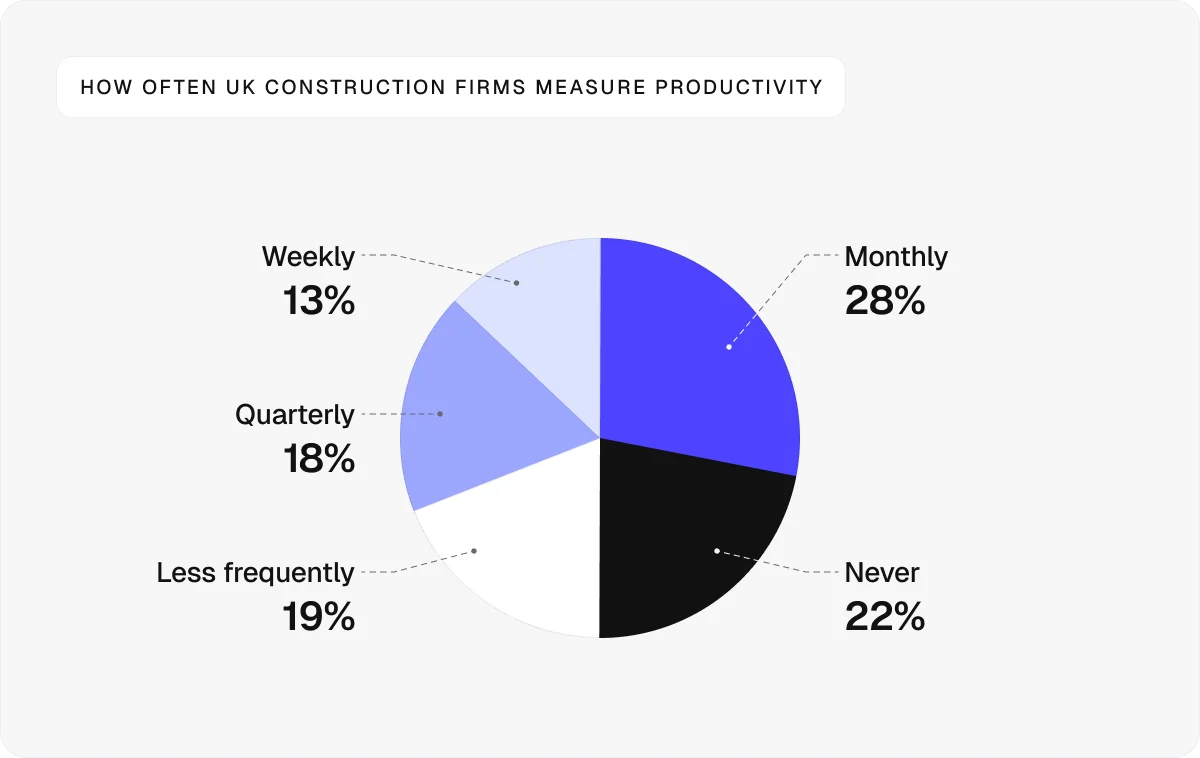
In the UK, 22% of construction firms never measure productivity, and only 13% track it weekly, meaning many teams lack the timely insight needed to make improvements while work is still ongoing.
3. Safety and compliance intelligence
Safety and compliance intelligence focuses on managing risk and making sure all site activity meets required regulatory standards.
To achieve this, it covers elements like:
Safety observations
Incident tracking
Compliance records
Training data
Safety and compliance intelligence primarily relies on digital tools for site briefings, RAMS sign-offs, and pre-registration checks, which help ensure operatives are fully prepared before starting work.
Ultimately, this area of construction workforce intelligence helps address the following concerns:
Where safety risks are increasing
Whether workers are following the required procedures
How to reduce incidents and improve site safety
4. Workforce planning and allocation intelligence
Workforce planning and allocation intelligence is about making sure the right people are in the right place at the right time.
It supports both short-term scheduling and longer-term resource planning through:
Tracking workforce availability
Matching skills to tasks
Managing labour demand across projects
This area of intelligence also draws on skills and experience data to build stronger teams and avoid misallocation.
Thanks to all this data, organisations can determine:
Whether there are enough workers for the upcoming work
Whether the right skills are assigned to the right tasks
How to avoid overstaffing or gaps in labour
5. Financial workforce intelligence
Financial workforce intelligence links workforce activity directly to cost and budget performance, helping teams understand how labour decisions affect project margins.
This is made possible by tracking labour costs, analysing overtime, measuring cost per task or project phase, and connecting hours worked to project rates.
As a result, financial workforce intelligence provides clarity on:
Whether labour costs are staying within budget
Where overspending is happening
How workforce decisions impact overall profitability
6. Predictive and strategic intelligence
Predictive and strategic intelligence builds on historical and real-time data to support longer-term decisions, allowing firms to plan ahead rather than react to issues as they arise.
Specifically, it helps teams see how current decisions will affect future workload, staffing, and project delivery, answering forward-looking questions like:
How will workforce needs change over time?
What actions should be taken now to avoid future issues?
8 key benefits of construction workforce intelligence
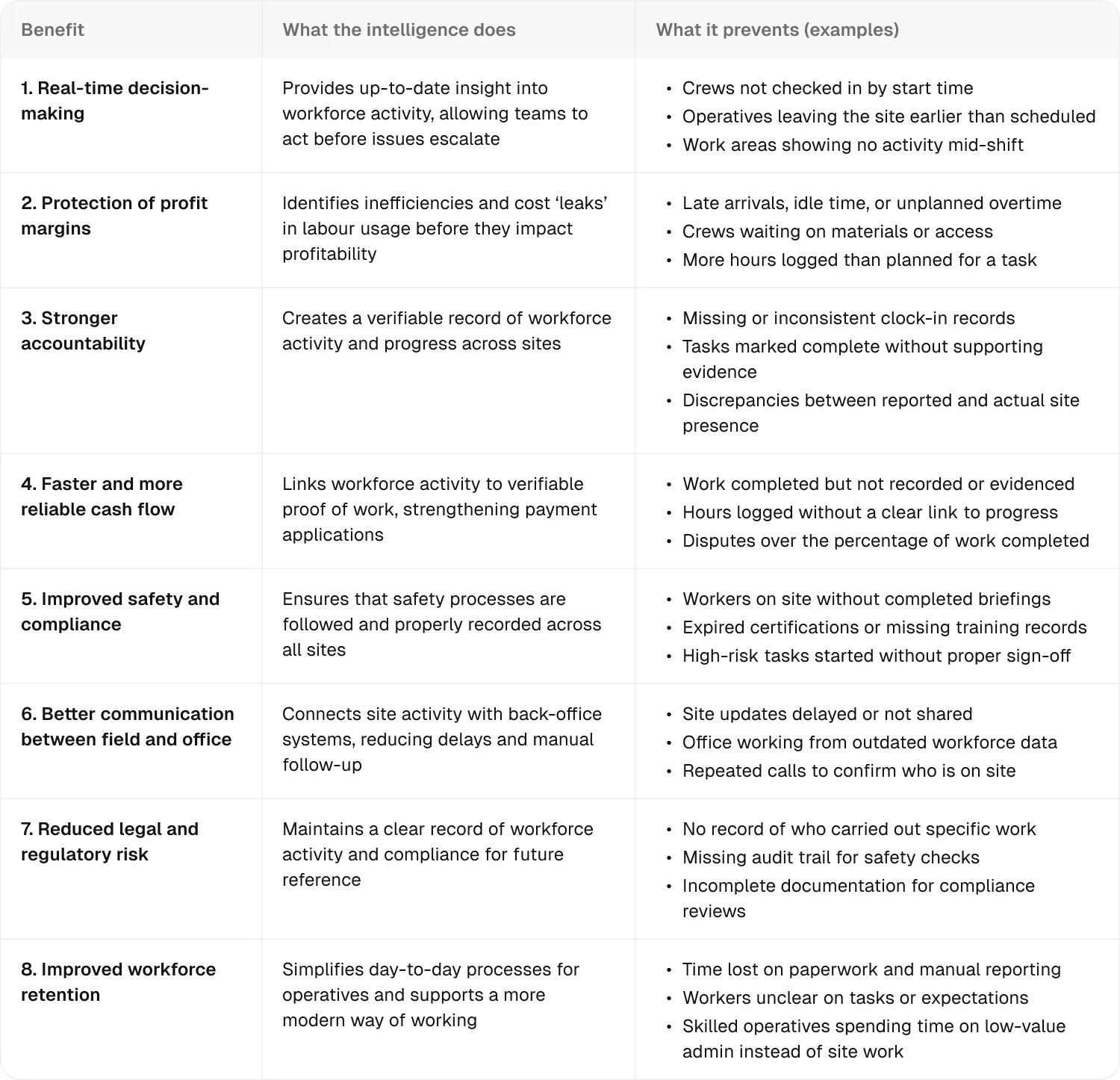
The different areas of construction workforce intelligence come together to deliver practical, measurable benefits across projects.
The table below outlines what the eight most important ones are and how they show up in practice.
How to implement construction workforce intelligence
Implementing construction workforce intelligence means putting the right systems in place to capture, connect, and use workforce data in a consistent way.
In practice, that comes down to adopting digital tools, training teams to use them properly, and making sure the data these systems generate is actually used to inform decisions.
The systems in question include:
IoT and connected devices to track location, movement, and site conditions
Mobile apps and field data capture tools to record attendance, activity, and site updates in real time
Cloud-based platforms to centralise data and keep it accessible across projects
Integrations with project management systems to connect workforce data with schedules, costs, and progress
AI and analytics tools to identify patterns and support forecasting
Platforms like Onetrace simplify construction workforce intelligence by combining several of these capabilities in one place.
Instead of relying on three separate tools, teams can use a single system that covers mobile data capture, workforce management, and project management.
Onetrace: Your command centre for construction workforce intelligence
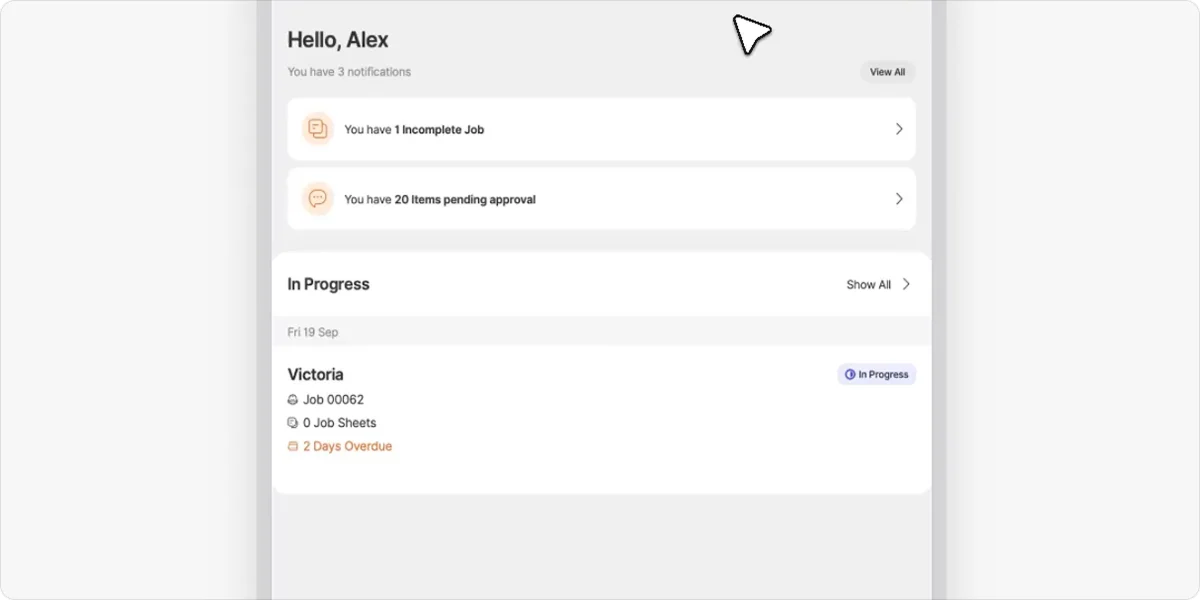
Onetrace is a construction site management platform that allows construction professionals to capture, manage, and use workforce and project data in real time.
It supports construction workforce intelligence through these key capabilities:
Mobile app for real-time site data capture: Operatives log time, capture photos, and complete compliance tasks as work happens, ensuring data is recorded accurately and without delay.
Timesheets with GPS tracking: These provide a reliable record of who is on site, when they arrived, and how long they worked, improving both visibility and payroll accuracy.
Custom forms and structured data capture: A form-builder feature standardises data recording across projects, reducing errors and making it easier to analyse performance and compliance.
Photographic evidence and audit trails: They create a traceable record of work completed, supporting quality checks, client reporting, and dispute resolution.
Signed documents and compliance tracking: Digital sign-offs for RAMS, Toolbox Talks, and other documents ensure compliance is recorded in real time, with clear visibility of who has reviewed and approved what.
Multi-stage approvals and QA workflows: Supervisors build accountability into the process by tracking work through review and sign-off stages, helping prevent issues before handover.
Planning and scheduling tools: Teams can assign and reallocate labour quickly, keeping projects aligned as conditions change.
Rates and cost tracking: Labour rates and cost categories can be linked to work carried out, helping teams understand how workforce activity impacts project costs and margins.
Reporting and documentation: Structured reports that link workforce activity to progress, supporting better decision-making and faster payments.
Onetrace also addresses the common challenges of implementing construction workforce intelligence by being easy to adopt, practical to use on sites, and built around real site workflows, not idealised processes.
If you want to see what this looks like in practice, the best way is to try it.
Book a personalised demo with the Onetrace team to see how the software can help you capture better data, improve visibility, and run more controlled, efficient projects.
FAQ
Why is workforce intelligence important in construction?
Workforce intelligence is important in construction because it helps address common industry challenges, such as labour shortages, rising costs, and low productivity.
What data is used in construction workforce intelligence?
Typical data used in construction workforce intelligence includes timesheets, attendance records, task progress, safety reports, training records, and workforce skills. When combined, this data provides a more complete view of workforce performance.
Marketing Team
@Onetrace
The Onetrace marketing team is passionate about sharing insights, ideas, and innovations that help construction businesses stay connected, compliant, and efficient. Combining industry expertise with a love for clear communication, we aim to deliver content that empowers professionals to work smarter and safer.