Construction management guide: Everything you need to know

By
Marketing Team
@Onetrace
Construction management is the process of planning, coordinating, and overseeing construction projects so work stays on schedule, within budget, and to the required standard.
It plays a vital role in an industry where new work alone was worth a record £140.68 billion in 2024, spread across more than 370,000 registered firms and 1.4 million workers.
The bigger the market, the more people, activities, and decisions there are to coordinate—and that’s the challenge construction management exists to tackle.
But what does construction management actually involve day to day, and what does it take to do it well?
This guide explains the core principles, responsibilities, and best practices to help you understand the role and run construction projects more effectively.
Key takeaways
Construction management keeps projects under control
It brings together planning, coordination, budgeting, quality, safety, and risk management to deliver projects successfully.Success depends on more than one person
While the construction manager leads the project, successful delivery relies on close collaboration between clients, designers, contractors, subcontractors, and other specialists.Strong processes reduce delays, costs, and risks
Clear planning, accurate reporting, proactive communication, and continuous monitoring prevent problems before they escalate.Digital tools make construction management more effective
Connected software improves visibility, simplifies documentation, strengthens compliance, and allows teams to make faster, better-informed decisions.Onetrace simplifies day-to-day construction management
Onetrace gives contractors, subcontractors, and construction managers one place to manage documentation, track progress, record proof of work, and stay compliant, helping teams deliver projects more efficiently and with greater confidence.
What is construction management?
Construction management is the professional discipline of delivering construction projects by balancing technical, commercial, and operational requirements throughout the project lifecycle.
It brings together people, processes, and resources needed to turn designs and plans into completed assets while managing competing priorities like cost, quality, safety, time, and risk.
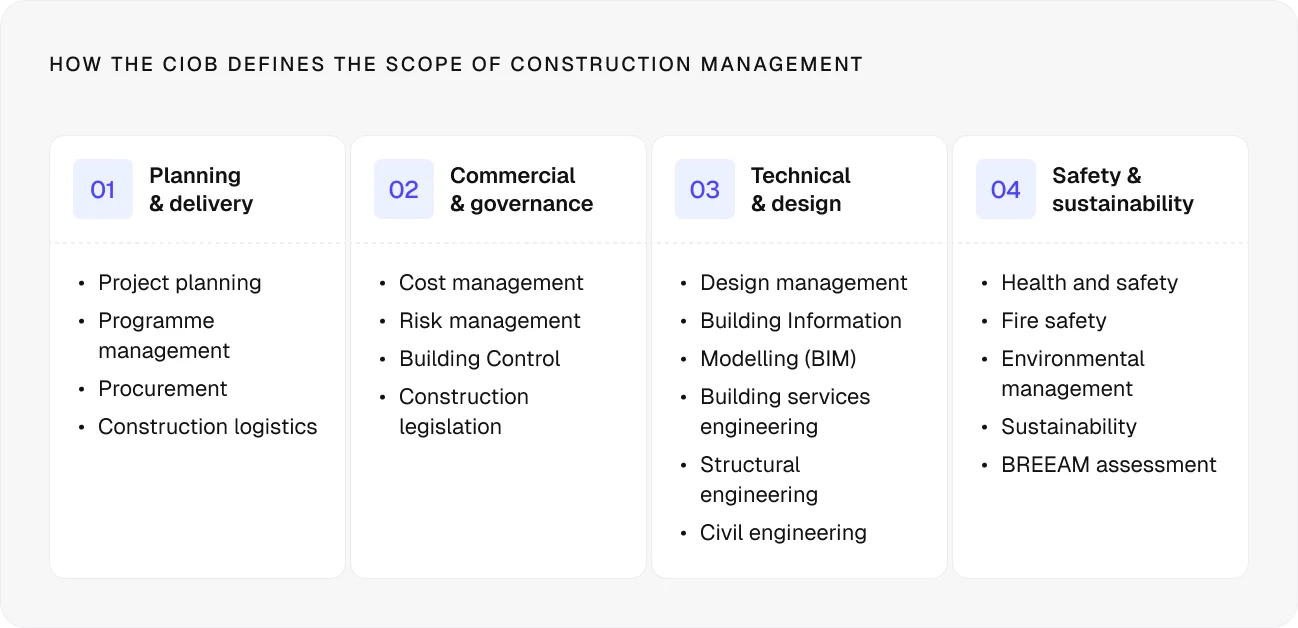
In the UK, the Chartered Institute of Building (CIOB) takes an even broader view of construction management.
Rather than limiting it to the delivery of individual projects, the CIOB defines it as the management of the development, conservation, and improvement of the built environment as a whole.
Its definition recognises that construction management extends beyond the construction phase to encompass the entire lifecycle of built assets, from initial concept to completion, operation, reuse, and sustainable development.
What is the purpose of construction management?
The purpose of construction management is to help projects achieve their objectives in a controlled and predictable way.
It establishes the systems, processes, and leadership needed to coordinate everyone involved in a project, from clients and designers to contractors and subcontractors, suppliers, and regulators.
Whether managing a residential development, a commercial office, or a major infrastructure project, the goal remains the same: to deliver a successful outcome while reducing delays, controlling costs, managing risks, and meeting the client’s expectations.
Who is responsible for construction management?
The construction manager (CM), who is typically appointed by the client or project owner, is primarily responsible for construction management.
The role attracts professionals from a wide range of construction backgrounds, including:
Site management
Civil engineering
Surveying
Estimating
Many CMs also gain professional accreditation through organisations like the CIOB, reflecting the broad technical, commercial, and leadership skills the role demands.
However, despite leading the project, a CM doesn’t work in isolation.
Successful project delivery depends on close collaboration between multiple specialists, each with their own responsibilities and expertise:
Role | How they contribute to construction management |
Project owner | Sets the project objectives, approves major decisions, and provides strategic direction |
Architect | Provides the design information needed to plan, coordinate, and deliver the works |
Engineers | Resolve technical challenges and ensure engineering requirements are met throughout the project |
General contractor | Organises construction activities and manages subcontractors on site |
Deliver specialist trade work and coordinate with the wider project team to keep work progressing | |
Site manager or foreman | Supervises daily site operations and keeps work aligned with the construction programme |
Quantity surveyor | Manages project costs and provides the commercial oversight needed to control the budget |
Procurement manager | Secures the materials, equipment, and services needed to keep work on schedule |
Health and safety manager | Maintains safe working practices and helps ensure compliance with legal requirements |
Contract manager | Oversees contractual obligations and helps manage commercial risks and change |
Keep in mind that smaller projects often have leaner teams, in which case, the CM may also fulfil responsibilities typically handled by dedicated specialists.
What does construction management involve? 8 key activities
Construction management brings together a wide range of responsibilities, from planning work before the first shovel hits the ground to handing over a completed project.
While the exact scope depends on the project’s size and complexity, these are the eight core activities that underpin successful project delivery.
1. Planning and programming the project
Every well-executed project starts with a well-defined plan.
Before construction begins, the construction manager works with relevant stakeholders to:
Define the project scope
Establish priorities
Identify potential risks
Create a realistic programme of works
This stage also involves deciding how resources, equipment, and site logistics will be organised so work can progress efficiently once construction begins.
2. Managing project costs
Keeping a project within budget requires constant oversight.
As part of construction management, costs are consistently tracked throughout the project. This allows CMs to compare actual spending against forecasts and respond quickly when prices, scope, or market conditions change.
CMs also continuously look for opportunities to maximise project value, whether through better planning, more efficient construction methods (e.g., off-site prefabrication), or smarter use of resources.
3. Procuring contractors, labour, and materials
Construction management ensures the right people, materials, and equipment are available when they’re needed. To achieve this outcome, CMs usually:
Plan procurement
Evaluate tenders
Select contractors
Coordinate deliveries to avoid unnecessary delays
These activities have become increasingly important as the construction sector faces growing commercial pressures.
According to the EY-Parthenon quarterly analysis of UK profit warnings, UK-listed housebuilders issued eight profit warnings in the first half of 2026—the highest level since the 2008 financial crisis. The figure reflects the combined impact of rising input costs, planning delays, labour shortages, and ongoing market uncertainty.
While strong construction management can’t control these external factors, effective procurement helps reduce their impact by securing reliable (sub)contractors, managing supplier relationships, and planning for potential disruptions.
4. Coordinating project teams
Construction projects rely on dozens of people, teams, and businesses working towards the same objective.
The construction manager acts as the central point of coordination, keeping all stakeholders aligned throughout the project. This alignment rests on:
Maintaining clear communication between team members
Sharing accurate project information and updates
Coordinating design changes and resolving clashes
Responding promptly to requests for information (RFIs)
5. Managing quality and compliance
Delivering work on time means little if the outcome fails to meet the required standards.
Construction managers establish quality assurance processes, monitor workmanship through regular inspections, and ensure completed work complies with contract requirements and relevant regulations.
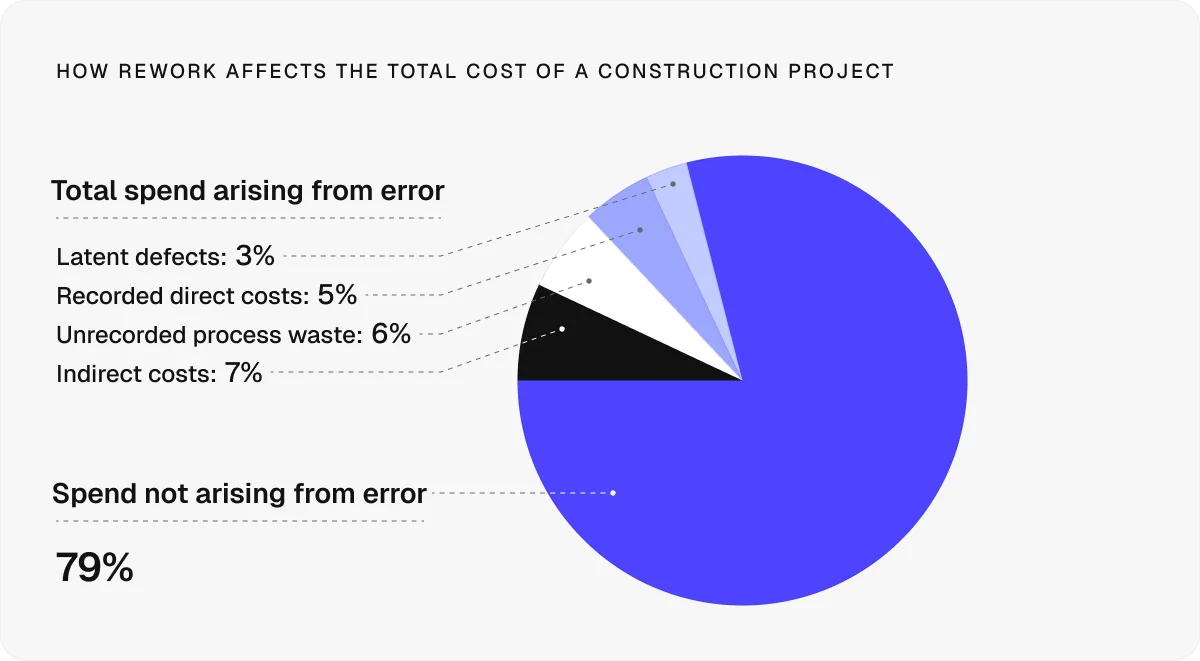
Quality management detects and resolves issues as work progresses, rather than at the end of a project, reducing costly rework later.
6. Managing health, safety, and risk
While health and safety is a shared responsibility across the project team, construction managers play a central role in planning, coordinating, and monitoring safety throughout the project. They typically:
Develop project-wide health and safety plans alongside site and safety specialists
Coordinate risk assessments and ensure safe systems of work are in place
Monitor compliance with legal requirements through inspections, audits, and regular site reviews
Respond to incidents, emerging risks, and changing site conditions by coordinating corrective actions
While fatal injuries in the construction sector fell to 25 in 2025/26 from a five-year average of 37, construction still accounted for more worker fatalities than any other major industry sector. These figures highlight why proactive health and safety management remains one of construction managers’ most important responsibilities.
7. Monitoring progress and managing change
Design revisions, weather, supply chain issues, and unexpected site conditions can all affect construction progress.
That’s why construction managers continuously:
Monitor performance against the programme
Report progress to stakeholders
Manage changes in a controlled way to minimise disruption
By tracking progress throughout the project, they can identify problems early and take corrective action before delays or cost overruns escalate.
8. Closing out the project
Construction management continues beyond the completion of the physical works.
The closeout stage ensures the finished asset is ready for handover by:
Completing inspections
Resolving outstanding defects
Compiling as-built records
Preparing operation and maintenance documentation
A well-managed handover provides the client with everything needed to operate and maintain the asset while creating a traceable record of how the project was delivered.
The impact of effective construction management: 8 essential benefits
When done well, construction management creates value at every stage of a project. Some of its most important benefits include:
Better cost control: Continuous budget monitoring and forecasting help keep spending under control, reduce waste, and minimise the risk of costly overruns.
Stronger programme performance: Careful planning, realistic scheduling, and proactive coordination keep work progressing and reduce the impact of delays and disruptions.
Higher-quality outcomes: Consistent quality management, inspections, and early issue resolution reduce defects, minimise rework, and improve the finished asset.
Improved risk management: Identifying and addressing commercial, technical, safety, and programme risks early prevents small issues from becoming major project problems.
Safer construction sites: Effective health and safety management promotes safer working practices, strengthens compliance, and helps reduce the likelihood of accidents and incidents.
More efficient resource use: Better coordination of labour, materials, equipment, and subcontractors improves productivity and helps avoid unnecessary downtime.
Clearer communication and collaboration: Keeping clients, designers, contractors, subcontractors, and suppliers aligned improves decision-making, speeds up issue resolution, and reduces misunderstandings.
Greater flexibility throughout delivery: A structured management approach makes it easier to respond to design changes, supply chain disruption, and evolving client requirements without losing control of the project.
How to improve construction management: 7 best practices
These seven best practices can help construction managers deliver more predictable, efficient, and successful outcomes:
Best practice | What it entails | Why do it |
1. Define responsibilities from day one | Making sure every stakeholder understands their role, decision-making authority, and reporting lines before work begins | Reduces confusion and prevents tasks from falling through the cracks |
2. Standardise project documentation | Using consistent templates and processes for RFIs, site reports, inspections, meeting minutes, and delivery records | Improves traceability and reduces the risk of miscommunication |
3. Make decisions using real-time data | Basing decisions on current site information rather than outdated reports | Allows you to respond to delays, budget changes, and emerging risks faster |
4. Create a strong reporting culture | Encouraging regular progress updates, early escalation of issues, and accurate site reporting | Makes problems easier and less expensive to resolve |
5. Stay ahead of regulatory change | Reviewing changes to legislation, building regulations, and safety requirements throughout the project | Reduces the risk of rework or enforcement action |
Replacing manual spreadsheets and paper records with connected digital systems that centralise schedules, documents, site records, and communication | Makes collaboration easier and reduces administrative work | |
7. Review completed projects and apply lessons learned | Holding structured project reviews after handover | Identifies successful approaches, recurring issues, and opportunities to improve future delivery |
How Onetrace supports effective construction management
Construction management depends on accurate information, consistent processes, and full visibility across every stage of a project, which is best achieved with construction management software like Onetrace.
Onetrace allows teams to:
Keep all project information in one place: Store drawings, forms, certificates, site records, and supporting documents in a central location that’s easy to access on site or in the office.
Capture accurate site records as work happens: Record inspections, surveys, installations, and photographic evidence directly from site, creating a complete digital record of completed work.
Strengthen quality assurance: Use structured approval workflows to identify issues earlier, standardise inspections, and make sure work is checked before moving to the next stage.
Improve project coordination: Assign work, manage schedules, track workforce activity, and give everyone access to the latest project information.
Stay on top of compliance: Manage RAMS, certifications, signatures, and other compliance records with clear audit trails, making it easier to prepare for client reviews and regulatory inspections.
Track progress with confidence: Monitor completed work through live updates, marked-up drawings, and detailed reporting, giving project teams better visibility throughout delivery.
Create reliable proof of work: Generate professional reports that combine site records, approvals, photographs, and supporting documentation, reducing disputes and simplifying project handovers.
Whether you’re coordinating multiple teams, managing compliance-heavy projects, or replacing paper-based processes with a connected digital workflow, Onetrace gives you the visibility, control, and traceability needed to deliver projects more efficiently.
To see what this looks like in practice, arrange a tailored walkthrough of Onetrace and discover how it can support your day-to-day construction management.
FAQ
What does construction management do?
Construction management plans, coordinates, and oversees construction projects to keep work on schedule, within budget, compliant with regulations, and to the required quality and safety standards.
What is the highest-paying job in construction management?
The highest-paying jobs in construction management are typically senior leadership positions, such as Construction Director, Project Director, and Programme Director. Experienced UK construction managers can usually earn up to £65,000 a year, according to the National Careers Service.
Is construction project management a stressful job?
Yes, construction project management can be stressful because it involves balancing budgets, schedules, safety, quality, and multiple stakeholders. However, strong planning, communication, and digital tools can make the role far more manageable.
Will construction management be replaced by AI?
No, construction management is unlikely to be replaced by AI. While AI can automate tasks such as scheduling, reporting, and data analysis, construction managers are still needed to lead teams, make complex decisions, manage risks, and solve problems that require human judgement.
Marketing Team
@Onetrace
The Onetrace marketing team is passionate about sharing insights, ideas, and innovations that help construction businesses stay connected, compliant, and efficient. Combining industry expertise with a love for clear communication, we aim to deliver content that empowers professionals to work smarter and safer.