Digitalisation in construction: Where to begin and why?

By
Marketing Team
@Onetrace
Digitalisation in construction is the adoption of digital technologies to streamline construction planning, project management, and operational execution.
This industry shift hasn’t been widely embraced in the construction sector. After all, construction was ranked as the least digitised sector in Europe by the McKinsey Global Institute roughly a decade ago.
While the 2020 pandemic pushed many construction firms to adopt digital tools faster, progress across the industry has remained uneven.
With this in mind, let’s look at the current state of digitalisation in the construction industry, including the technologies driving it, the benefits and challenges involved, and the strategies supporting successful implementation.
Key takeaways
Digitalisation in construction is about improving how projects run
Construction digitalisation uses connected tools, real-time data, and automated workflows to improve planning, coordination, reporting, and project delivery across the full project lifecycle.The biggest value comes from better visibility and faster decisions
Technologies like IoT, BIM, AI, drones, and construction management software help teams track progress, reduce delays, improve safety, control costs, and spot issues earlier.Adoption is still slower than many expect
Despite the many benefits, many construction professionals still report not using digital technologies on projects. High costs, skills gaps, disconnected systems, and resistance to change remain major barriers.Successful digitalisation starts small and stays practical
The most effective approach is usually gradual adoption. Firms should focus on solving the most obvious operational problems first, choose tools that fit existing workflows, and involve site teams early in the rollout process.Construction management platforms can simplify digital adoption
Tools like Onetrace help firms centralise project data, automate admin, improve site visibility, and standardise workflows without disrupting how teams already work.
What is digitalisation in the construction industry?
Digitalisation in the construction industry is the integration of digital technologies, connected systems, and real-time data into construction workflows to improve planning, coordination, decision-making, and delivery across the full project lifecycle.
It covers a wide range of tools and processes, but most digital construction technologies fall into these three broad categories:
Category | Explanation | Examples |
Digital data capture | Tools that collect and record information from sites, teams, equipment, and projects in real time | Sensors, Internet of Things (IoT) devices, 3D scanning, drones |
Process automation | Technologies that reduce manual tasks, standardise processes, and improve day-to-day efficiency | Robotics, 3D printing |
Digital modelling and insight | Systems that turn project data into useful insights for forecasting, reporting, risk management, and decision-making | Building information modelling (BIM), virtual reality, artificial intelligence (AI), digital twins |
It’s worth noting that some technologies, such as AI, can operate across multiple categories.
The same applies to construction management software, which rarely fits into just one category.
That’s because these tools are often used to collect project data, automate workflows, and generate real-time insights at the same time, making them one of the most versatile digital solutions in construction today.
7 core technologies driving digitalisation in construction
While each digital technology plays an important role in construction, these seven stand out for their impact, adoption, and long-term potential.
1. IoT
The Internet of Things (IoT) refers to connected devices and sensors that collect and share real-time data over the internet.
In construction, IoT is used to:
Observe site conditions in real time
Monitor worker movements and high-risk areas
Oversee equipment performance and usage
Track tools, materials, and assets across sites
These capabilities give contractors better visibility across projects, helping reduce downtime, improve safety, prevent losses, and support faster decision-making on the site.
2. Robotics
In construction, robotics refers to the use of automated or semi-automated machines to carry out on-site tasks with limited human input.
These tasks include:
Repetitive construction work (e.g., bricklaying and concrete pouring)
Autonomous or semi-autonomous vehicle operation (e.g., dump trucks and excavators)
Material handling and transport (e.g., lifting systems and material carriers)
High-risk inspection and site work (e.g., demolition robots and remote-controlled machinery in hazardous areas)
As a result, robotics can help improve productivity, reduce manual labour demands, increase consistency, and support safer working conditions.
3. Drones
Drones are unmanned aerial vehicles (UAVs) used to capture aerial imagery, survey data, and real-time site information.
Some of their most common tasks in construction include:
Tracking project progress through high-resolution imaging
Inspecting hard-to-reach or high-risk areas
Supporting topographic measurements and reality capture
Drones are used for these tasks because they enable faster, safer, and more comprehensive data capture and better documentation throughout delivery.
4. AI
Artificial intelligence (AI) refers to digital systems that can analyse data, recognise patterns, and carry out tasks that normally require human decision-making.
In construction, AI is used to:
Predict safety risks and project delays
Optimise scheduling and resource planning
Review project documents and contracts
Support progress tracking and reporting
Automate parts of the design and planning process
These use cases help construction teams make faster decisions, reduce manual work, improve forecasting, and manage project risks more effectively.
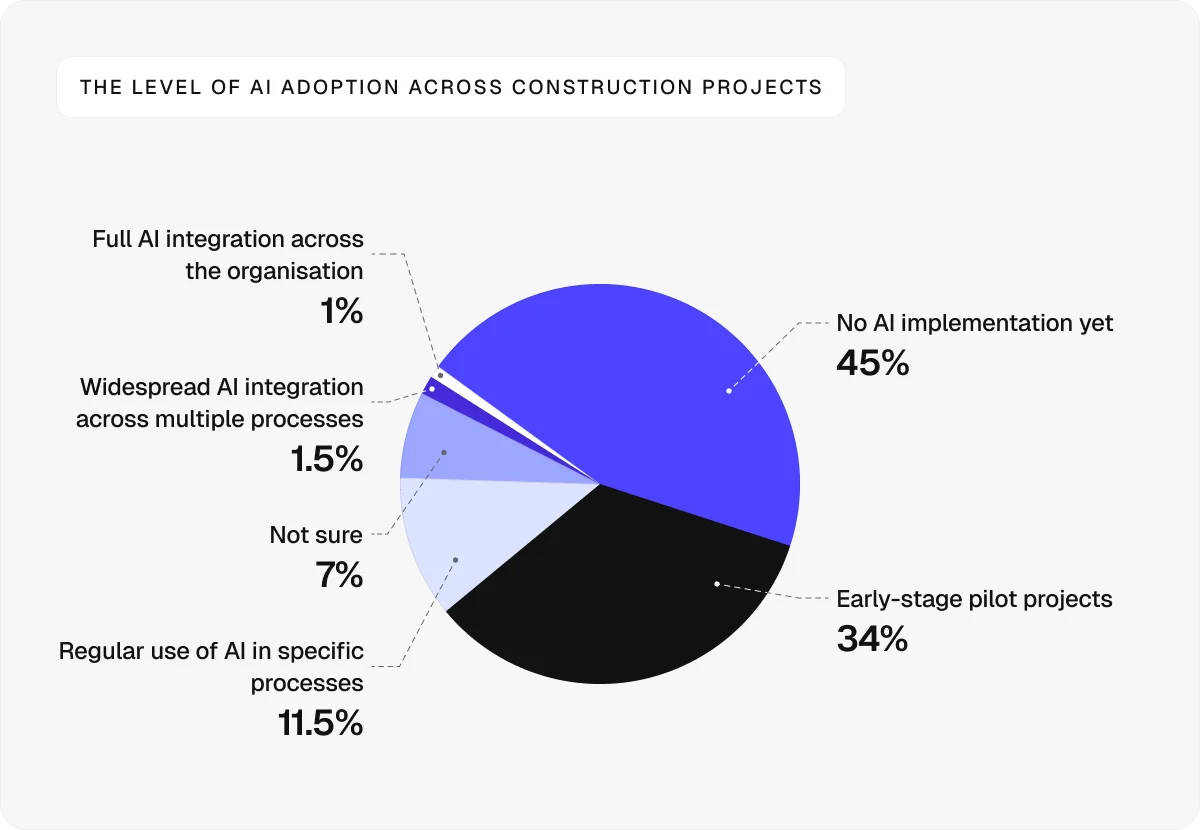
Despite these benefits and growing interest, AI adoption in construction remains relatively limited. Recent industry research found that 45% of construction organisations haven’t yet implemented AI, while 34% are still in early pilot stages.
5. BIM
Building Information Modelling (BIM) is a collaborative digital process that uses intelligent 3D models and shared project data to support planning, design, execution, and long-term asset management.
Unlike traditional workflows, where teams often work separately, BIM gives architects, engineers, contractors, and subcontractors access to a shared digital model that updates in real time.
This approach helps:
Improve coordination between project teams
Detect design and system clashes before work starts
Give teams better visibility across the project lifecycle
For now, architects remain the biggest BIM adopters.
However, adoption across the wider construction sector is expected to continue growing, with overall usage projected to reach around 60% by 2027.
6. Digital twins
A digital twin is a real-time virtual model of a building, asset, or construction project that mirrors real-world conditions and performance.
The use of digital twins allows construction teams to:
Test and optimise project designs before work begins
Monitor operational performance throughout the build
Support predictive maintenance and lifecycle management
As a result, firms can make better decisions, reduce inefficiencies, improve energy performance, and spot potential issues earlier.
7. Construction management software
Construction management software refers to digital platforms used to manage, track, and coordinate construction projects from a central system.
When the choice matches the workflow needs, these platforms help construction firms:
Monitor day-to-day site activity and overall project progress
Manage health and safety compliance
Track project costs, budgets, and financial performance
Coordinate project documentation, communication, and workflows
These features allow construction teams to stay organised, efficient, and compliant while maintaining better control over project delivery.
The reality of digitalisation in construction: 6 biggest challenges
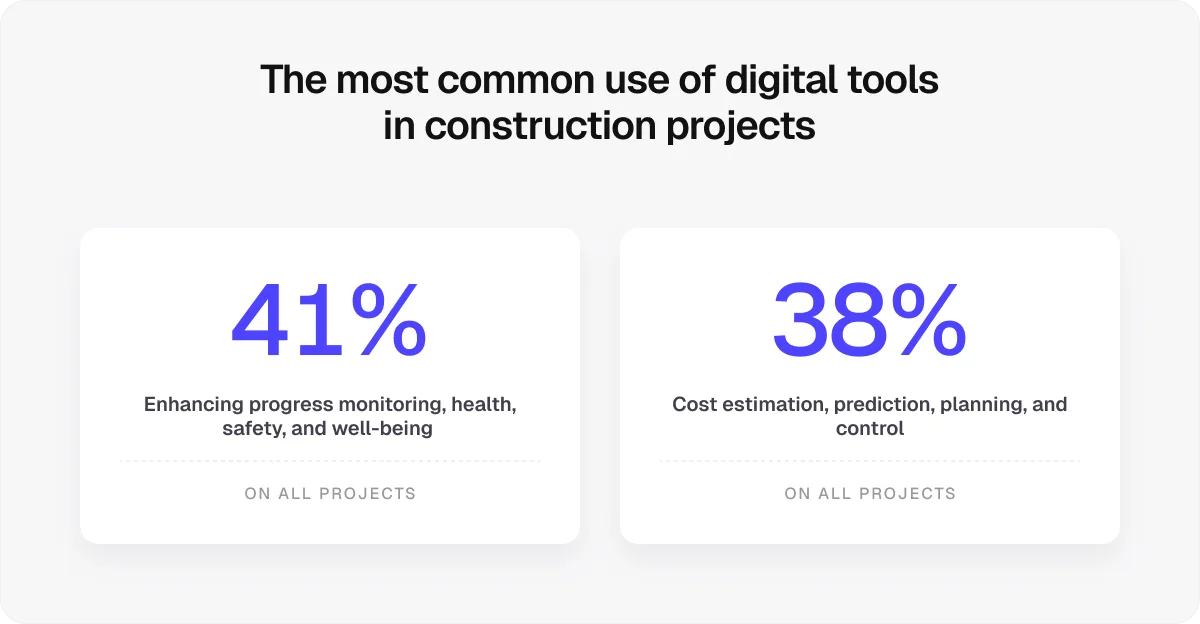
According to the Royal Institution of Chartered Surveyors 2024 report on digitalisation in construction, around 43% of construction professionals reported not using digital technologies on any of their projects.
More concerningly, that figure seems to be on the rise, increasing from 40% in 2021 and 42% in 2022.
This raises an important question: Why is adoption moving so slowly?
These six challenges help explain why many construction firms still struggle to digitalise:
Challenge | Why it’s so prominent | How to overcome it |
High implementation costs | Many firms struggle to justify upfront spending on software, equipment, and digital infrastructure without concrete short-term returns. | Start with smaller digital rollouts, focus on quick wins, and use scalable SaaS solutions to reduce upfront costs. |
Lack of digital skills | Many construction teams still lack the training and confidence needed to use digital tools effectively. | Provide practical training, involve site teams early, and give extensive support during rollout. |
Resistance to change | Long-established workflows and reliance on traditional processes can slow digital adoption across teams. | Demonstrate clear day-to-day benefits and introduce new tools gradually through practical use cases. |
Integration and compatibility issues | Construction projects often involve disconnected systems, platforms, and stakeholders that don’t work well together. | Choose interoperable tools, standardise data-sharing practices, and work with vendors that offer integration support. |
Fragmented and inconsistent data | Poor-quality or siloed project data limits reporting accuracy, collaboration and decision-making. | Centralise project information and establish consistent data management processes across teams and projects. |
Lack of standards and guidance | Rapid technological change has left many firms unsure about best practices, compliance, and implementation strategies. | Follow recognised industry standards and work with experienced technology partners where needed. |
The value of digitalisation in construction: 10 key benefits
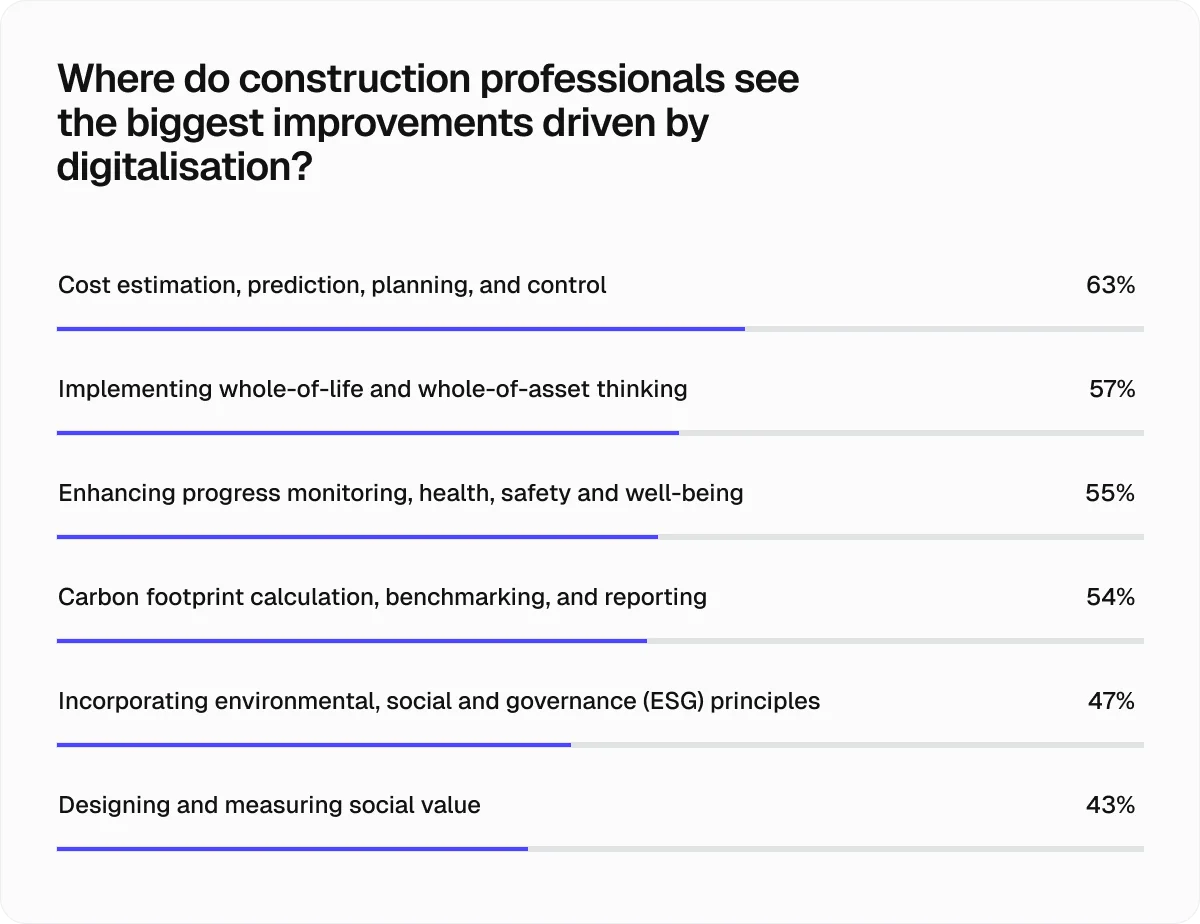
Despite the persistent challenges surrounding digitalisation in construction, firms still have strong reasons to invest in it. These include:
Better project visibility: Real-time data and connected systems give teams a more complete view of project progress, costs, risks, and site activity.
Faster project delivery: Digital workflows, automated scheduling, and improved coordination help reduce delays and keep projects moving.
Improved communication and collaboration: Shared platforms and live project updates reduce misunderstandings between contractors, subcontractors, and other stakeholders.
Lower costs and less waste: Better forecasting, live tracking, and more accurate planning help reduce rework, material waste, and budget overruns.
Improved productivity: Automation and digital tools reduce manual admin, streamline repetitive tasks, and help teams work more efficiently.
Better decision-making: Real-time reporting and data analytics help teams identify problems earlier and make more informed decisions.
Enhanced safety management: Digital technologies help teams identify hazards, monitor site conditions, and improve compliance.
Stronger quality control: Digital documentation, automated inspections, and live reporting improve consistency and reduce errors across projects.
Improved sustainability: Digital tools support carbon tracking, energy analysis, and more efficient resource use throughout the project lifecycle.
Greater competitiveness: Firms adopting digital construction technologies are often better positioned to meet client expectations, improve service delivery, and win future work.
How to start digitalising your construction business: A step-by-step guide
If you’re willing to push past the challenges to reap the benefits of digitalisation in construction, these practical steps are a good place to start:
Assess your current workflows: Identify where delays, manual admin, duplicated work, or communication gaps are slowing your projects down.
Start with high-impact use cases: Prioritise technologies that deliver practical value quickly, such as digital site reporting, document management, or progress tracking software.
Choose tools that fit your existing workflows: Select technologies that align with how your teams already work. For example, cloud-based project management platforms usually integrate more easily into existing operations than highly customised systems that require teams to completely change established workflows.
Invest in workforce training early: Digital adoption is far more effective when teams understand how such tools can help them. Hands-on training and site-level involvement are often more effective than top-down rollout.
Integrate systems wherever possible: Avoid disconnected platforms that create new data silos. Connecting project management, reporting, safety, and financial systems helps improve visibility and reduce duplicated work.
Standardise information management: Consistent data capture, reporting structures, and document processes make digital systems easier to manage across projects and teams.
Take a long-term approach: Digitalisation works best as an ongoing operational strategy. Focus on gradual improvement instead of trying to transform everything at once.
How Onetrace supports digitalisation in construction
Rather than focusing on a single part of digital construction, Onetrace, a leading, cloud-based construction site management platform, supports all three core areas of digitalisation.
Digital data capture
Onetrace helps teams capture accurate site information in real time through a mobile-first workflow designed for operatives on the ground.
Key features include:
Photographic evidence capture before, during, and after work
Mobile forms for surveys, installations, inspections, and compliance workflows
Offline working capabilities for complex sites with a poor signal
Drawing markups and pinpoint project tracking across blocks, levels, and zones
Digital timesheets with GPS tracking and live attendance visibility
These features create a stronger audit trail, improve accountability, and ensure project information is captured consistently across every site.
Process automation
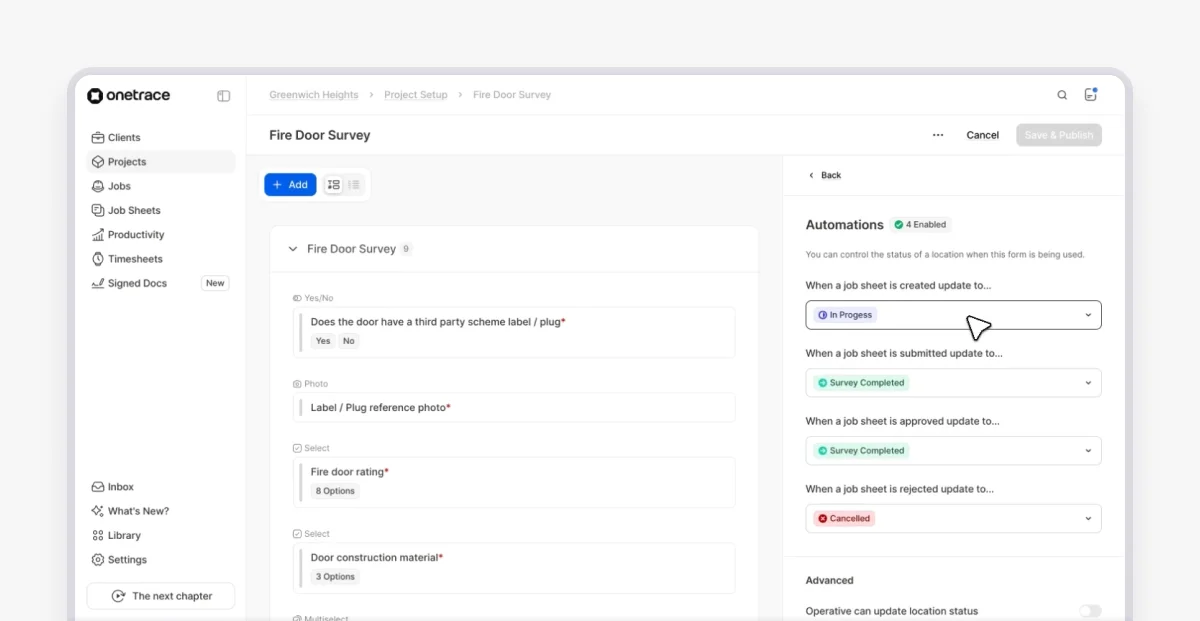
Onetrace helps reduce manual admin and standardise workflows across projects, thanks to features like:
Custom statuses with automated workflow triggers
Conditional form fields that adapt based on previous answers
Project templates that pre-populate forms, approvals, materials, and workflows
Digital insight and project visibility
Onetrace gives contractors and subcontractors clearer operational visibility across projects through:
Live project tracking across teams and sites
Real-time dashboards and day views for attendance and job progress
Instant PDF and Excel report generation
Shared real-time project data between site teams and management
API and webhook access for connecting project data across operational systems
The result is a more connected flow of project information between site teams and management systems, improving operational decision-making.
How Onetrace addresses common digitalisation challenges
Many construction firms struggle with digital adoption because tools are often too complex, too rigid, or too expensive to scale properly.
Onetrace is designed to avoid those problems. It offers:
Ease of use: Onetrace is built for non-technical users, with simple workflows, clear language, and low training requirements.
Flexible pricing: Onetrace uses a per-user monthly subscription model, allowing firms to scale usage up or down depending on project workloads.
Centralised project data: Site records, forms, drawings, reports, and timesheets are managed in one connected system instead of across disconnected tools and spreadsheets.
Integration support: API and webhook integrations help connect Onetrace with existing business systems, reducing disconnected workflows and duplicate data entry.
Customisable workflows: Forms, statuses, approvals, and templates can all be tailored to different trades, projects, and operational processes.
Strong support and onboarding: Teams receive practical implementation support designed around real construction workflows rather than generic software training.
For construction firms looking to digitalise without disrupting how their teams already work, Onetrace offers a more practical and operationally focused approach to digital transformation.
Book a personalised demo with the Onetrace team to see what this approach looks like in practice.
FAQ
What are the 4 pillars of digital transformation?
The four main pillars of digital transformation are technology, data, processes, and people.
What are the 4 types of digitalisation?
The four common types of digitalisation are process digitalisation, business model digitalisation, operational digitalisation, and customer experience digitalisation.
Marketing Team
@Onetrace
The Onetrace marketing team is passionate about sharing insights, ideas, and innovations that help construction businesses stay connected, compliant, and efficient. Combining industry expertise with a love for clear communication, we aim to deliver content that empowers professionals to work smarter and safer.