Quality management in construction: 12 processes to succeed

By
Marketing Team
@Onetrace
Quality has always been the mark of good construction. From master builders inspecting stone by hand to today’s digital site teams, the goal has stayed the same: deliver work that meets the required standard the first time.
According to the 2026 Construction Management and Chartered Institute of Building (CIOB) client survey, 76% of clients rank quality of work as their top priority when choosing a contractor, even ahead of cost certainty.
But delivering quality is more challenging than it used to be.
Projects are bigger, teams are more fragmented, and compliance requirements are more demanding than ever. That’s why getting quality management right takes structured planning, inspection, and oversight at every level of a project.
If you’re looking to improve quality management in construction, start with the 12 essential processes outlined below.
Key takeaways
Quality management combines QA and QC
QA prevents defects through the right processes, while QC verifies that completed work meets the required standards.Quality starts before construction begins
Strong planning, design reviews, workforce training, and supplier approval reduce defects before work starts on site.Continuous improvement reduces repeat issues
Tracking non-conformances and lessons learned helps strengthen your quality management system over time.Digital quality management simplifies compliance
Onetrace centralises inspections, approvals, documentation, and reporting, making it easier to deliver compliant, high-quality projects.
What is quality management in construction?
Quality management in construction is the system of processes used to plan, monitor, deliver, and improve quality throughout a project.
It combines quality assurance (QA), which focuses on preventing defects through the right processes, and quality control (QC), which checks completed work against the required standards.
Together, QA and QC cover every part of project delivery, from people and processes to materials, workmanship, and finished work.
The ultimate goal of QA and QC processes is to stop failures reaching the finished work. When successful, these processes help:
Reduce costly rework
Support compliance
Protect tight profit margins
Effective quality management also creates a consistent standard of delivery across multiple field teams and subcontractors.
Who is responsible for quality management in construction?
In construction, quality management is a shared responsibility.
While a dedicated quality manager or QA/QC team often coordinates the process, delivering quality depends on everyone involved in planning, supervising, executing, and inspecting the work.
Role | How they contribute to quality management |
Client / Owner | Defines quality expectations, project requirements, and acceptance criteria |
Design team | Produces clear, buildable designs and specifications that minimise errors and ambiguity |
Plans quality activities, allocates resources, and ensures quality requirements are met throughout the project | |
Site manager / Site supervisor | Oversees day-to-day work, ensures teams follow quality procedures, and addresses issues as they arise |
Subcontractors and operatives | Carry out work to the required standards and report defects or non-conformities |
Building Control and third-party inspectors | Verify compliance with the Building Regulations, contract requirements, and other applicable standards through independent building inspections |
Quality management in construction: 6 essential QA processes
Here are the six QA building blocks of effective quality management in construction.
1. Quality Management System (QMS) and quality planning
A Quality Management System (QMS) is the framework that defines how quality is managed across a construction business. It sets the policies, procedures, responsibilities, and standards that help teams deliver consistent results, meet regulatory requirements, and continuously improve.
Many contractors base their QMS on ISO 9001, the world’s most widely used quality management standard.
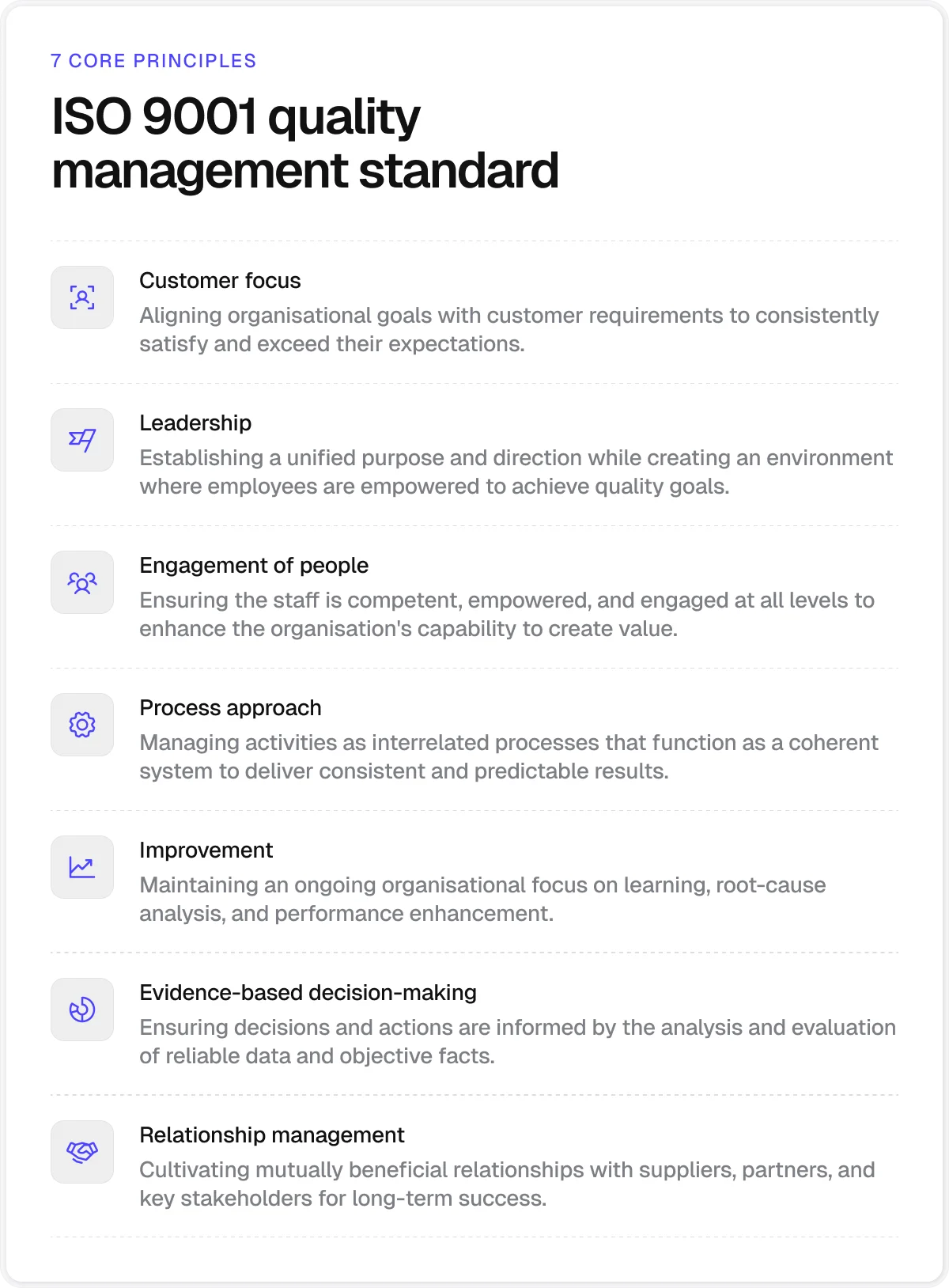
A company-wide QMS should then be translated into a project-specific Quality Management Plan (QMP) before work begins.
The plan defines the project’s quality objectives, roles and responsibilities, inspection requirements, documentation, and acceptance criteria, giving everyone a clear understanding of how quality will be managed on site.
A well-built quality plan should be practical rather than performative. This means it should:
Reflect how work will actually be delivered on site
Be accessible to everyone who needs it
Stay up to date throughout the project
Pro tip:
Build your quality plan around the client’s priorities, not just your internal processes.
Understanding whether quality, programme, cost, sustainability, or long-term performance matters most to your client helps set realistic objectives and focus quality efforts where they’ll have the greatest impact.
2. Building Safety Act and the golden thread setup
A single construction project can generate thousands of documents, including drawings, specifications, RFIs, material declarations, inspection records, test results, and design changes.
Managing these records properly isn’t just about staying organised.
It’s what allows every contractor, subcontractor, and inspector to:
Work from the same approved information
Maintain a complete record of key decisions
Prove that work was carried out in accordance with project requirements
For higher-risk buildings, effective document management is also a legal requirement.
Under the Building Safety Act 2022, dutyholders must maintain a golden thread of information—a secure, accurate, and up-to-date digital record of safety-critical information that follows the building from design through construction and into occupation.
Even where the Building Safety Act doesn’t apply, the same principles represent good practice.
Maintaining accurate, accessible, and version-controlled project information offers numerous benefits, including reducing quality risks, simplifying handover, and providing a reliable audit trail throughout the project lifecycle.
Pro tip:
Start building handover documentation and O&M manuals from day one.
Keeping records up to date throughout the project makes handover much smoother and ensures the golden thread continues into the building’s operational life.
3. Design risk management and constructability reviews
Many construction quality problems originate long before work starts on site.
Design reviews and constructability assessments help identify these issues early, when they’re far easier and less expensive to resolve. A typical review should cover:
Compliance with the Building Regulations 2010 and other project requirements
Coordination between structural, architectural, and MEP designs
Buildability and sequencing before work begins
Design clashes using BIM and other coordination tools
Safety risks and designer duties under the Construction (Design and Management) Regulations 2015
Resolving design issues before construction begins reduces uncertainty on site, minimises changes during delivery, and gives every contractor and subcontractor a clearer standard to build against.
Pro tip:
Involve site teams and specialist subcontractors in design reviews wherever possible. They often identify practical construction issues that aren’t obvious from drawings alone.
4. Workforce competency and quality training
An older exploratory study published in the International Journal of Quality & Reliability Management ranked human resource management as the single biggest driver of quality in construction, ahead of customer satisfaction and construction-specific factors like code compliance, technical specification adherence, and design constructability.
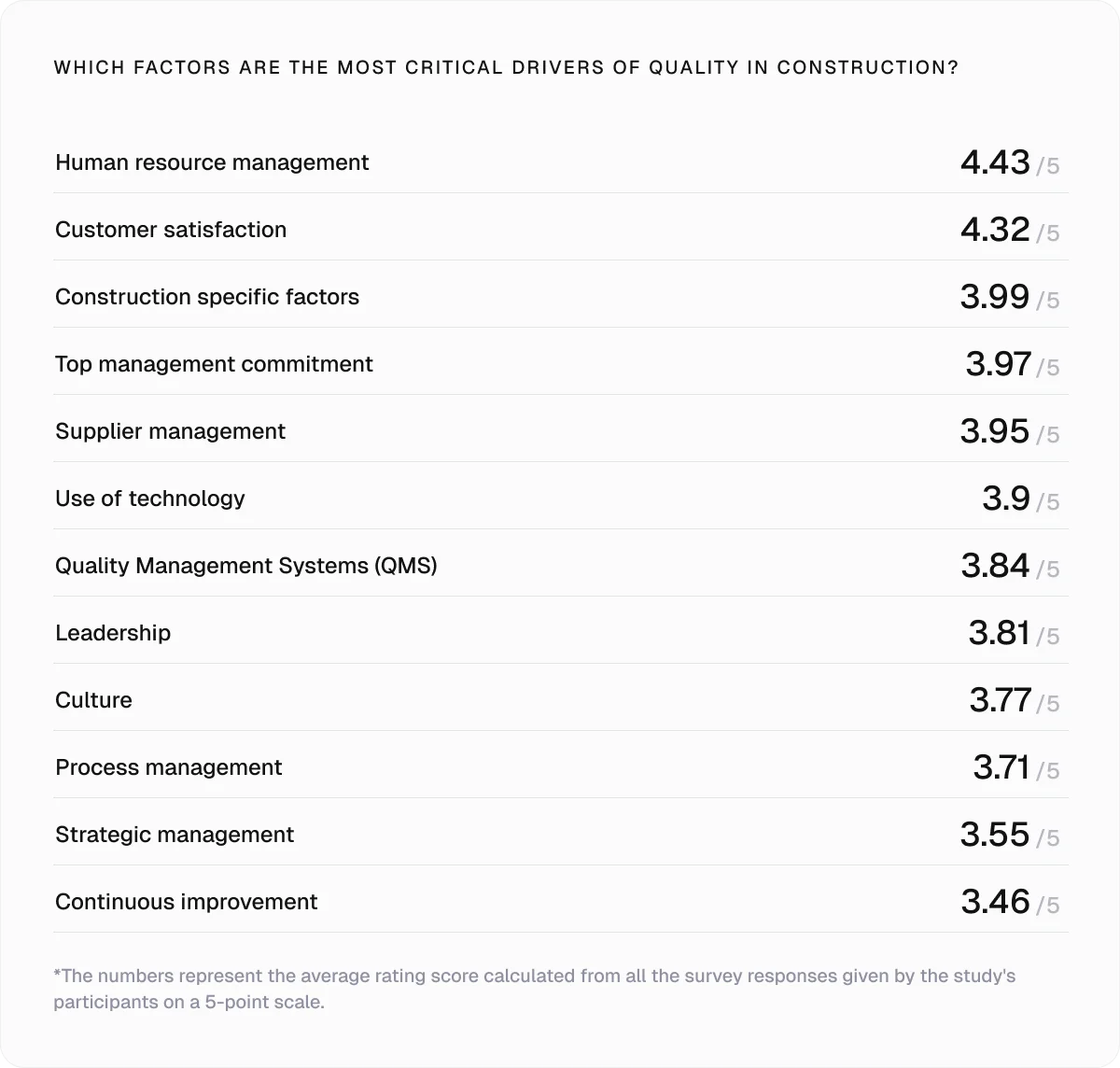
In practice, this means that construction quality is largely determined by how well people are prepared to do the job.
That’s why quality management should include:
Structured inductions
Toolbox Talks
Trade-specific training
Competency assessments
In addition, everyone carrying out specialist work should have the appropriate qualifications and certifications, such as relevant CSCS cards.
Investing in workforce competency reduces errors, improves workmanship, and helps close the gap between how a building is designed to perform and how it performs in practice.
Pro tip:
Use a construction site management platform like Onetrace to manage workforce competency in one place.
With the platform’s Signed Docs feature, you can:
Store certificates, job instructions, and other competency records in a central location
Distribute Toolbox Talks and other mandatory documents directly to operatives while tracking acknowledgements and signatures in real time
Maintain a complete audit trail demonstrating that operatives were trained, informed, and authorised to carry out the work
5. Supply chain pre-qualification and material compliance
Even highly competent site teams can’t deliver quality if they’re working with the wrong suppliers or non-compliant materials. That’s why every organisation involved in the project should have a structured and standardised process for approving specialist subcontractors, suppliers, and products before work begins.
For subcontractors and suppliers, the verification process may include recognised pre-qualification schemes such as the Common Assessment Standard (CAS).
As for materials, businesses should ensure compliance with:
The contract specification
Relevant British Standards (BS/BS EN)
Applicable product certifications, such as UKCA marking
Technical submittals, manufacturer documentation, and third-party certifications provide evidence that products are suitable before they reach the site.
6. Continuous improvement and corrective actions
Quality management doesn’t end when a project is complete.
Every audit, non-conformance, recurring defect, and lesson learned should be used to strengthen the processes behind future projects.
The ultimate goal is to improve the QMS so the same problems are less likely to happen again.
Pro tip:
Maintain a non-conformance (NC) register and analyse recurring issues over time.
Identifying patterns across multiple projects and targeting the root causes of quality failures costs less over time than repeatedly fixing the same defects.
Quality management in construction: 6 essential QC processes
Once construction begins, the focus shifts from preventing defects to verifying quality. These six QC processes ensure work complies with project requirements before it progresses.
1. Incoming material inspection
Before materials are incorporated into the works, they should be inspected to confirm they match what was specified and approved. This inspection typically includes verifying:
The correct product, quantity, and dimensions
Product condition and any signs of damage
Compliance with the approved specification
Required certifications and accompanying documentation
Materials that don’t meet the project requirements should be identified, segregated, and rejected before installation.
2. Inspection and Test Plan (ITP) execution
Inspection and Test Plans (ITPs) are developed during the quality planning stage. Once construction begins, they become a vital QC tool, ensuring inspections and testing take place at the right stages before work progresses.
An ITP typically defines:
What needs to be inspected or tested
When inspections or hold points occur
Who is responsible for carrying them out
Which acceptance criteria must be met before work can proceed
Executing the ITP involves carrying out and digitally recording all required quality verification activities throughout construction.
Depending on the scope, these might include:
Concrete cube compressive testing
Airtightness testing
Acoustic performance testing
Passive fire stopping inspections
MEP commissioning
Third-party accredited testing
Inspection records, test results, commissioning certificates, and sign-offs form part of the project’s golden thread of information.
3. Benchmarking, mock-ups and sample approvals
Before large-scale construction begins, benchmark installations, mock-ups, and material samples establish the expected standard of workmanship, appearance, and performance.
Once approved, they become the reference point against which the remaining work is inspected.
This process is particularly valuable for complex details, high-value finishes, or repetitive work, where identifying issues early prevents defects from being repeated across the project.
4. Site inspections and workmanship verification
Regular site inspections validate that work is being carried out in accordance with the approved drawings, specifications, and quality standards. Unlike benchmark inspections, they assess the quality of ongoing work throughout the project.
These inspections should verify:
Workmanship and installation quality
Compliance with approved drawings and specifications
Dimensional tolerances and alignment
The quality of finishes and completed work
Any non-conformities should be recorded and corrected before subsequent activities begin.
Pro tip:
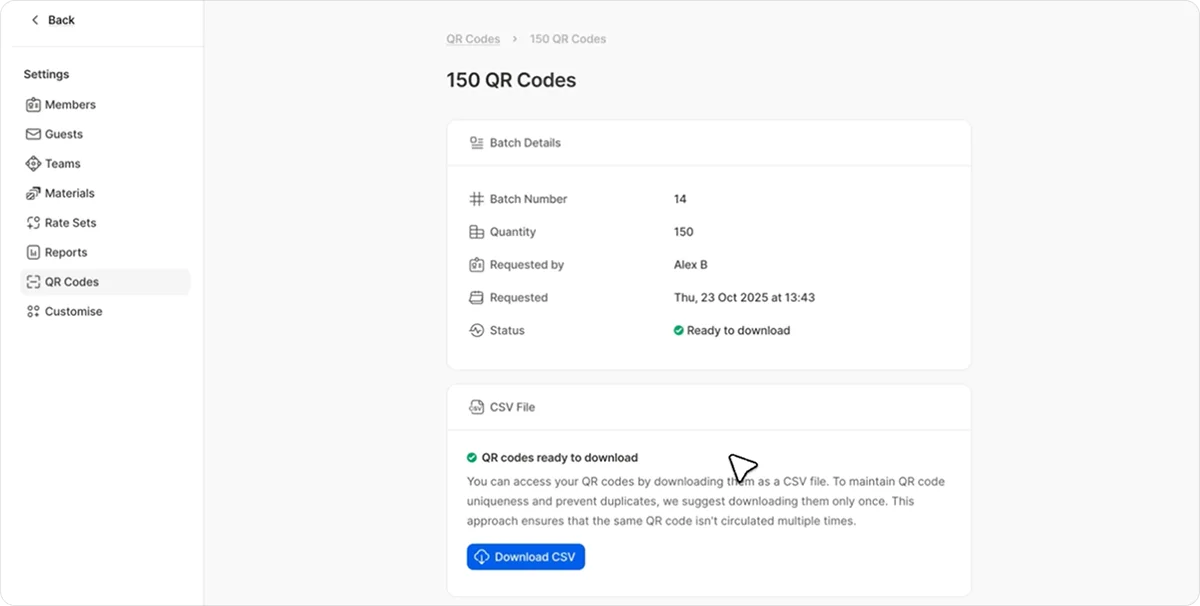
Use QR codes to link completed work to its inspection records.
With Onetrace, operatives can tag installations with a QR code that provides instant access to the full history of inspections, job sheets, and maintenance activities, making workmanship easier to assess.
5. Non-conformance and defect management
When work fails to meet the required specification, the issue must be formally recorded, investigated, and corrected before construction can continue.
A structured non-conformance process prevents defective work from being concealed by subsequent trades and ensures all quality issues are resolved before handover.
As part of this process, you should create a Non-Conformance Report (NCR) to:
Document work that fails inspection
Identify the immediate cause
Assign corrective actions
Verify remedial work
Formally close out the issue
6. Practical completion, snagging and final verification
Before a project can be handed over, the completed works must be inspected, tested, and verified to confirm they meet the contract requirements, design intent, and applicable statutory standards.
This final stage ensures all outstanding issues have been resolved, required documentation has been completed, and the building is ready for occupation or client acceptance.
Key parts of this QC process include:
Snagging and final defect verification: Conduct pre-handover inspections, produce snag lists, track outstanding items, examine remedial works, and confirm all defects have been closed out before practical completion.
Final inspection, testing, and commissioning: Complete final inspections, statutory testing, and systems commissioning, including Building Control approval and, where applicable, compliance with the Building Safety Act requirements for higher-risk buildings.
As-built documentation and handover: Verify as-built drawings, O&M manuals, warranties, test certificates, and other handover documentation to demonstrate compliance with contractual and regulatory requirements.
Build a stronger quality management process with Onetrace
Modern construction management software is essential for maintaining compliance, improving visibility, and reducing the administrative burden of inspections, testing, and documentation.
It allows construction teams to resolve issues faster, improve communication and collaboration, and make better-informed decisions based on real-time project data.
With Onetrace, the entire quality management process can be digitised through features like:
Custom inspection forms: Capture consistent quality data using standardised forms, mandatory fields, and project templates to reduce human error.
Approval workflows: Digitise multi-stage QA sign-offs to improve accountability, speed up feedback, and prevent defects from progressing.
Photographic evidence: Record inspections with before, during, and after photos to create a complete audit trail for compliance and client sign-off.
Digital reporting: Generate professional PDF and Excel inspection and handover reports in just a few clicks to streamline client handovers and audit preparation.
Document management: Store drawings, certificates, RAMS, and other project records in one central location for easy access and traceability.
Want to see these features in action?
Book a personalised demo and discover how Onetrace can help you deliver higher-quality projects with less administration.
FAQ
What is ISO 9001 in construction?
ISO 9001 is the international standard for QMS. In construction, it provides a framework for consistently delivering projects that meet customer, regulatory, and quality requirements.
What are the 7 principles of ISO 9001?
The seven ISO 9001 quality management principles are customer focus, leadership, engagement of people, process approach, improvement, evidence-based decision making, and relationship management.
What are the 7 basic tools used in total quality management?
The seven basic quality tools are the cause-and-effect diagram, check sheet, control chart, histogram, Pareto chart, scatter diagram, and stratification (or flowchart, depending on the methodology).
What is the best tool for quality control?
The best quality control tool depends on the task. In construction, digital inspection and quality management software like Onetrace is often the most effective solution because it centralises inspections, approvals, reporting, and compliance records.
Marketing Team
@Onetrace
The Onetrace marketing team is passionate about sharing insights, ideas, and innovations that help construction businesses stay connected, compliant, and efficient. Combining industry expertise with a love for clear communication, we aim to deliver content that empowers professionals to work smarter and safer.