What is a construction site risk assessment? [Full guide]

By
Marketing Team
@Onetrace
Construction is an inherently dangerous industry to work in, and that reality is reflected in the numbers.
The fatal injury rate in UK construction is 1.92 per 100,000 workers—around 4.8 times higher than the all-industry rate. At the same time, 2.5% of construction workers sustain a non-fatal injury each year, compared with 1.8% across all industries.
While danger can’t be completely eliminated, it can be managed, and a risk assessment plays a central role in that control.
With this in mind, let’s look at what a construction site risk assessment is, how to carry it out step by step, and why it matters on every project.
Key takeaways
A construction site risk assessment is about reducing risk, not removing it completely
Construction will always involve some level of danger. The goal is to identify hazards, assess their severity, and put practical controls in place so that risk is sensible, controlled, and legally compliant.Risk assessments must match the work being done
You may need a general site assessment, task-specific assessments, or specialist ones, such as for work at height. The type and depth of assessment should reflect the actual activities, site conditions, and stage of the project.The responsibility sits with the employer, but it must be done by a competent professional
Whether you are an employer or self-employed, you are legally required to assess and manage risk. The assessment must be carried out by someone with the right knowledge and experience, and the significant findings must be recorded if five or more people are employed.Strong risk management needs strong site visibility
Transparent documentation, signed RAMS, live updates, and proper audit trails make risk management easier to enforce in practice. Tools like Onetrace support this by centralising compliance documents and giving you better visibility across your site.
What is a construction site risk assessment? The basics
A construction site risk assessment is a structured process used to identify hazards on site, assess the level of risk they pose, and implement practical control measures that reduce risk to a level that is sensible, controlled, and legally compliant.
What are the types of construction site risk assessments?
In construction, there is usually a general site risk assessment that covers the overall risks present on most projects. Alongside this, there are project-specific or task-specific risk assessments that focus on particular activities, trades, or hazards.
Common examples of specialised risk assessments include:
Work at height assessment: It focuses on fall risks and the controls needed for scaffolds, ladders, roofs, and other elevated work areas.
Fire risk assessment: It identifies fire hazards, ignition sources, and escape routes, setting out how fire risk will be managed on site.
Manual handling risk assessment: It assesses how loads are lifted, carried, or moved on site. It looks at factors such as load weight, lifting technique, handling frequency, and the need for mechanical aids to reduce the risk of strains and musculoskeletal injuries.
Control of Substances Hazardous to Health (COSHH) assessment: This assessment is required when work involves hazardous substances, such as dust, chemicals, or fuel, and it sets out how exposure will be controlled.
The type of assessment you need should match the work being done on the construction site.
Who is responsible for the construction site risk assessment?
The employer is responsible for the construction site risk assessment. If you’re a self-employed contractor, that responsibility sits with you. Employers must conduct a suitable and sufficient risk assessment, or appoint someone competent to do it.
However, even if this task is delegated, accountability can’t be passed on. Management remains responsible for making sure risks are properly assessed and controlled.
If a business employs five or more people, the significant findings of the risk assessment must be recorded.
Who can conduct a construction site risk assessment?
A construction site risk assessment must be conducted by a competent person. ‘Competent’ means someone with the right knowledge, experience, and understanding of the work involved.
The person conducting the construction site risk assessment doesn’t have to be a health and safety expert, but they must be capable of identifying hazards, judging the level of risk, and deciding on suitable controls.
In many cases, this could be a site manager, supervisor, or business owner with hands-on experience of the tasks being assessed.
Where the work is complex or high-risk, additional training with recognised providers such as the British Safety Council can help ensure the assessment is thorough and reliable.
Is a construction site risk assessment required by law?
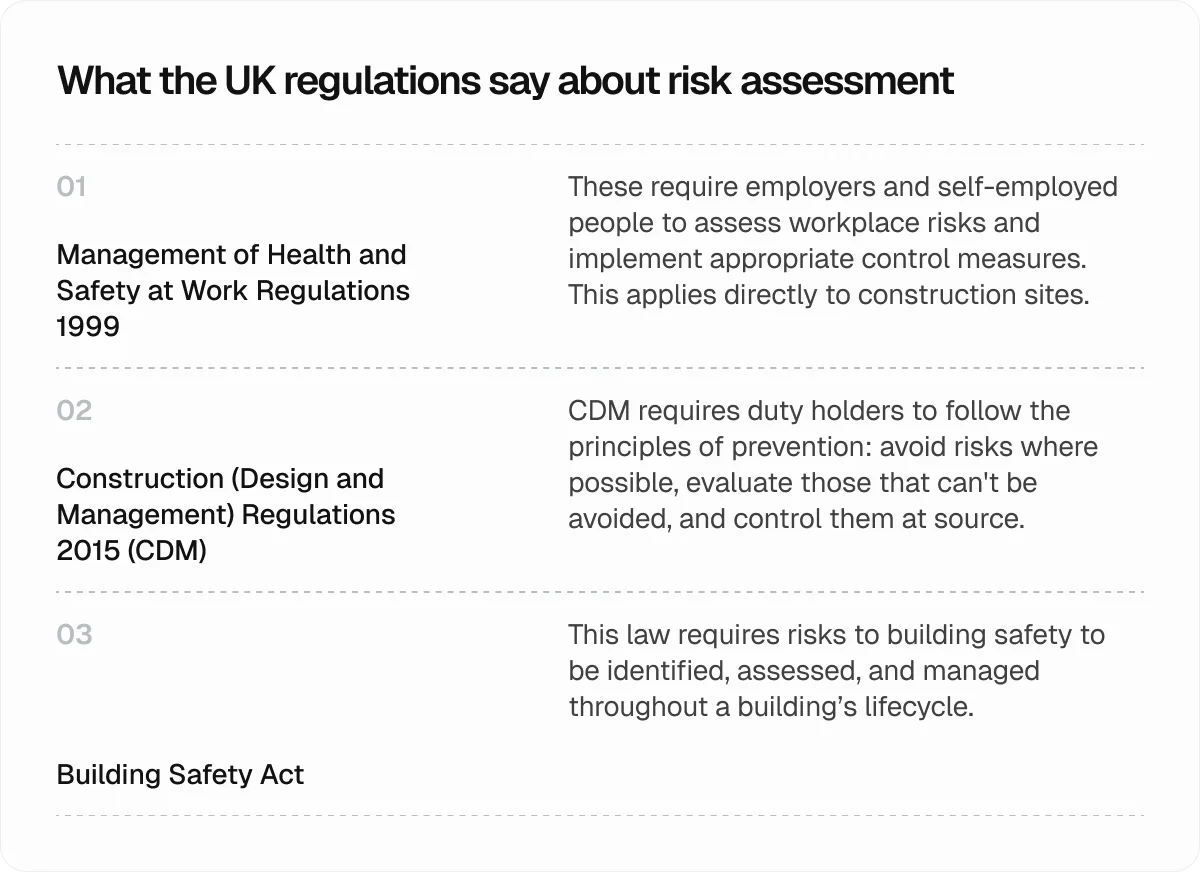
In the UK, employers and self-employed contractors are legally required to assess and control risks on construction sites.
However, the law doesn’t prescribe a specific format or document titled ‘construction site risk assessment’.
It only requires risks to be assessed and the findings to be recorded as evidence that hazards have been properly evaluated and managed.
Who requires a construction site risk assessment in practice?
Beyond meeting your legal duties and proving that risks are properly controlled, you may need to provide a construction site risk assessment to:
A principal contractor: Principal contractors often require subcontractors to submit Risk Assessment Method Statements (RAMS) before allowing work to start.
A client: Clients may request risk assessments from contractors working on their premises to confirm that suitable controls are in place.
A landlord or building owner: Landlords commonly require RAMS before approving alteration, fit-out, or maintenance works.
Designers or project teams during the tender stage: Risk information may be shared as part of tender documents so contractors and suppliers can price and plan the work accurately.
How often should a construction site risk assessment be completed?
The frequency of construction site risk assessments depends on whether they’re formal or dynamic.
A dynamic risk assessment is part of day-to-day site management.
Supervisors and workers assess changing conditions as work progresses, including weather shifts, access route changes, and the arrivals of new trades.
These assessments aren’t always formally documented, but their outcomes are often reflected in daily logs, briefings, and inspection reports.
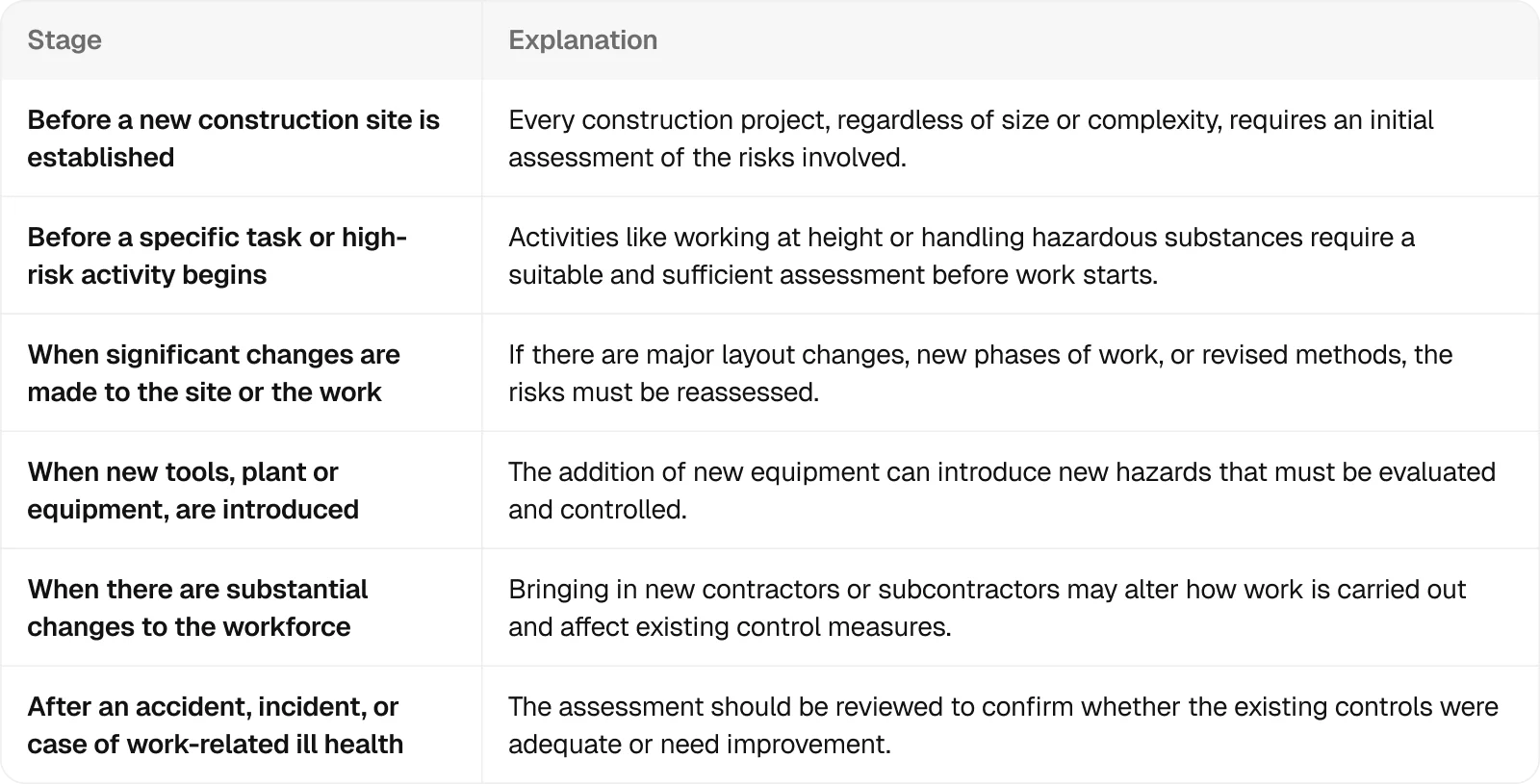
A formal risk assessment must be completed at key stages of the construction project:
How to conduct a construction site risk assessment step by step
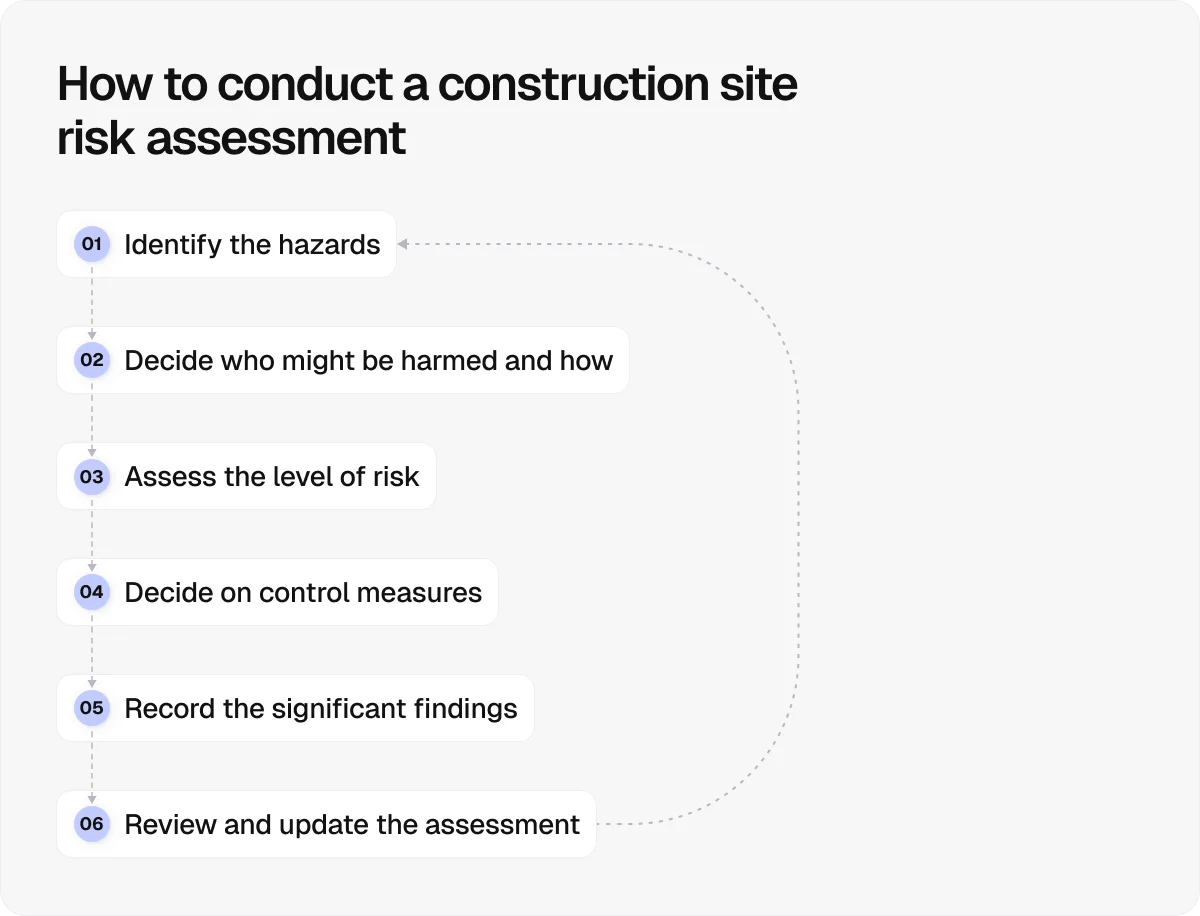
No matter what type of construction site risk assessment you are conducting, the process follows a similar structure.
Step 1: Inspect the site and identify hazards
To protect your workers and others from harm, you must first understand what could injure them. That is why the first step in a construction site risk assessment is to work through the site methodically and pinpoint anything with the potential to cause harm.
You can do this by:
Walking the site and observing the work as it’s actually being done
Reviewing past accident, incident, and ill-health records to uncover less obvious risks
Checking manufacturer instructions and safety data sheets for tools, plant, and substances in use
Speaking with workers and supervisors who perform the tasks daily and understand the real pressures and shortcuts
Considering how risk might enter the site, such as through deliveries, visitors, or neighbouring activities
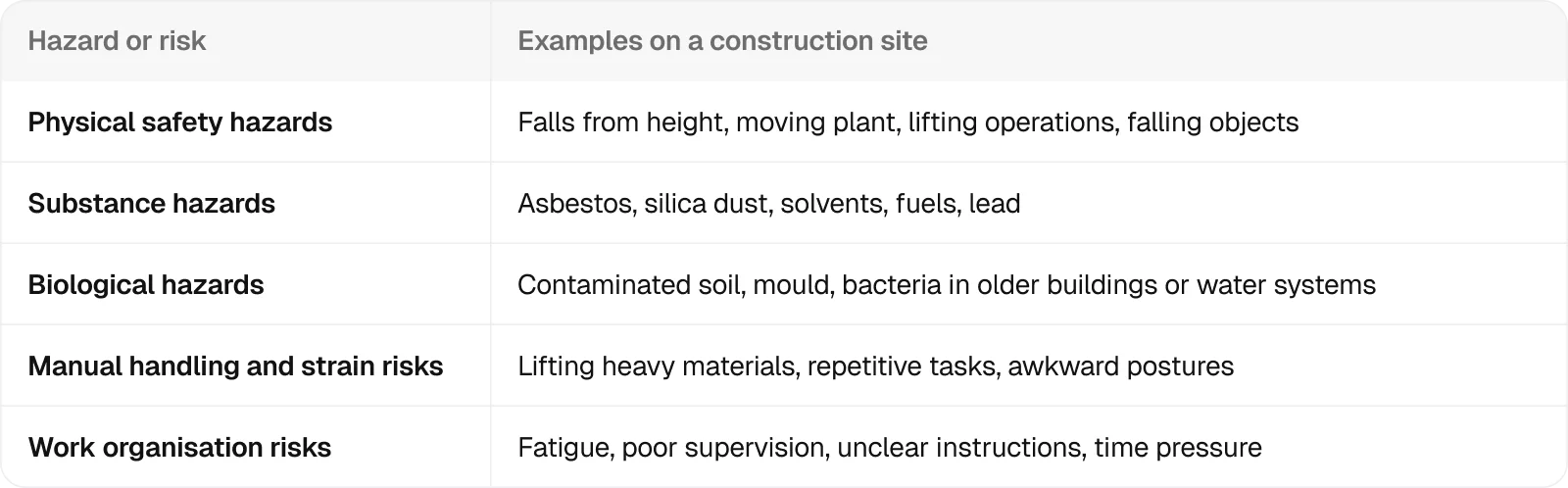
The table below outlines common hazards and risks that you might identify at this point:
Pro tip:
Another effective way to identify risk early is by using construction site management software like Onetrace.
Digital tools give you live visibility of what is happening on site, making it easier to spot patterns and issues before they become incidents.
Here are a few examples of how Onetrace’s features help you do just that:
Photographic evidence: Capture and store images of hazards, such as unsafe access, poor housekeeping, or damaged equipment, creating a clear audit trail.
Drawing mark-ups with pins: Flag specific risk areas on site plans, such as high-risk zones, service routes, or restricted access points, so everyone can see exactly where controls are needed.
Operative declarations: Require operatives to confirm completed work in the app, building accountability and making it easier to identify gaps in safety compliance.
Real-time approvals: Review and approve work from a central hub, helping supervisors spot issues early and prevent late-stage snagging.
Material tracking: Keep a clear record of materials on site, supporting better control of hazardous substances and high-risk components.
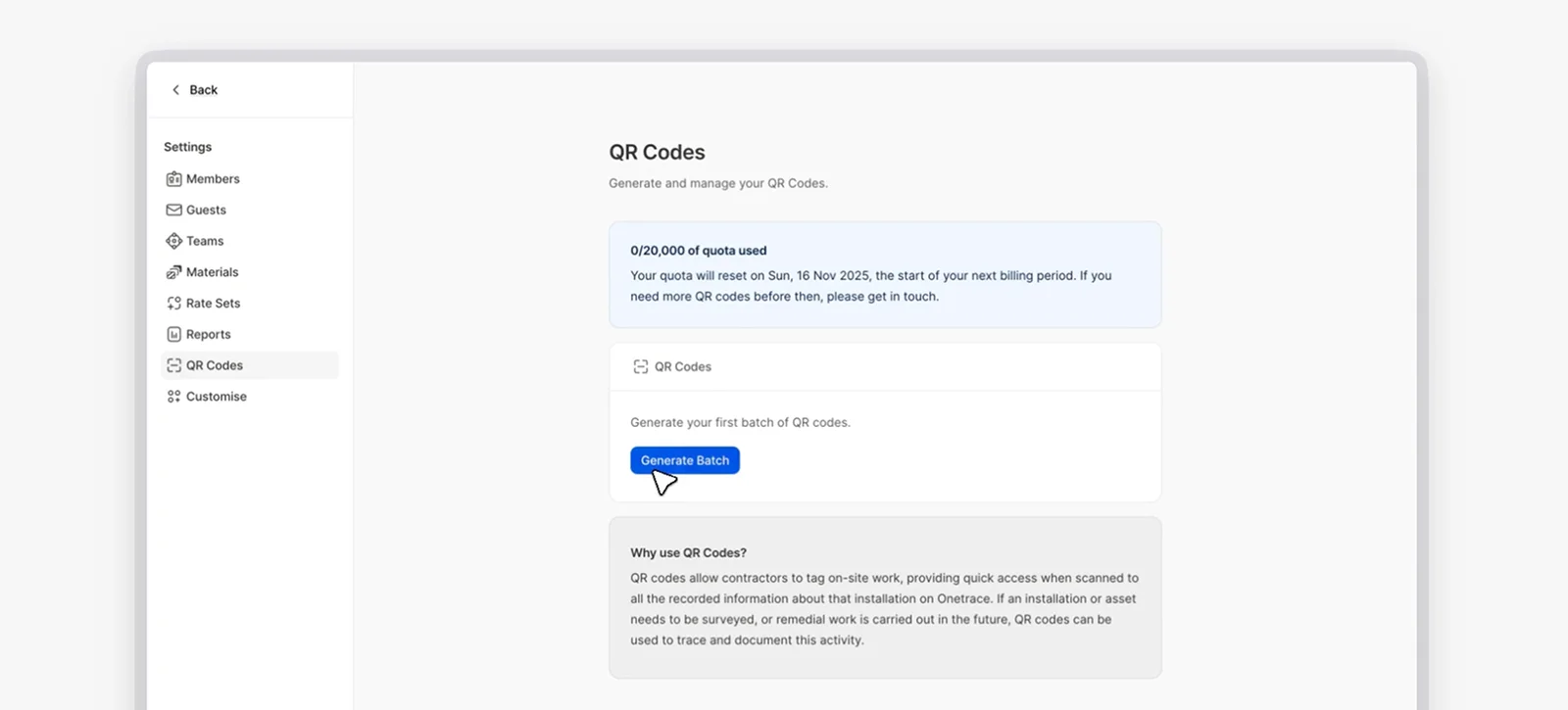
QR codes: Tag completed work or installed assets with QR codes, giving future operatives instant access to installation details, inspection history, and maintenance records.
Step 2: Define who is at risk and how they could be harmed
When determining who could be affected by on-site hazards, you must look beyond the immediate task and consider everyone who may be present on or near the site, whether they are directly involved in the work or not.
For this step, you don’t need to list individuals by name. Instead, identify groups that may be exposed to the hazard, such as:
Employees
Subcontractors and contractors
Site visitors
Delivery drivers
Members of the public near the site
Young or inexperienced workers
Lone workers
Defining how these groups could be harmed means describing the type of injury or ill health that could occur. This can include a fall leading to fractures, exposure to dust causing respiratory issues, or contact with live electricity resulting in burns or fatal injury.
Step 3: Evaluate the level of risk
Not every risk carries the same weight, which is why you must judge how serious each risk you’ve spotted so far really is.
This means considering two key factors:
Likelihood: How likely is it that harm will occur?
Severity: If it does, how serious could the outcome be?
Likelihood depends on factors such as the frequency of exposure, the environment, and the competence of those involved.
Severity looks at the potential impact: from minor injury to life-changing harm or worse.
Most businesses use a simple risk matrix to assign a rating:
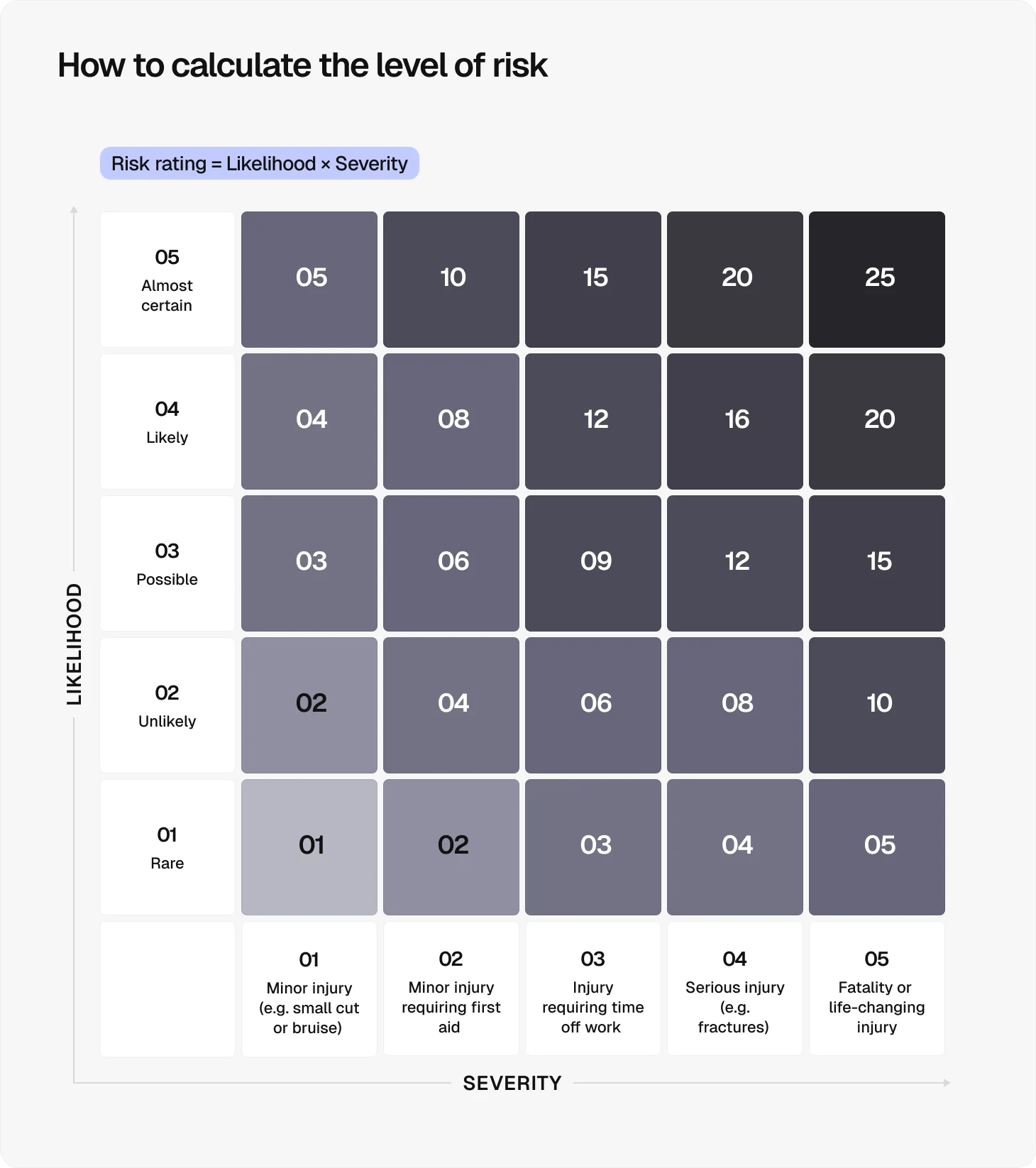
The goal is to prioritise action and ensure controls are proportionate to the level of risk.
Step 4: Select appropriate control measures
According to the Construction (Design and Management) Regulations (CDM), you should avoid risks entirely where possible, and where they can’t be avoided, control them at source.
Controls must be proportionate, practical, and suited to the real conditions on site.
Common control measures on construction sites include:
Installing edge protection, barriers, or netting to prevent falls and falling objects
Segregating pedestrians and vehicles with clear walkways and zoning
Improving housekeeping and regular waste removal
Providing safe, well-maintained tools and equipment
Delivering task-specific training and clear site briefings
Using appropriate personal protective equipment (PPE)
Securing the site to prevent unauthorised access
Setting up clear signage and emergency procedures
Step 5: Document the significant findings
Putting your findings in writing will help you stay organised, show that risks have been properly considered, and demonstrate compliance if you’re ever asked to provide evidence.
A standard risk assessment form makes this straightforward.
Reputable industry bodies provide templates along with guidance on how to complete them. A typical form records:
What hazards have been identified
Who may be harmed
What control measures have been put in place
Whether any further action is required
Who completed the assessment and when
For higher-risk activities, you can pair your risk assessment with a method statement. Together, these form a Risk Assessment Method Statement (RAMS).
The risk assessment identifies the hazards and level of risk, while the method statement explains step by step how the work will be performed safely.
Pro tip:
Having a well-written RAMS is only part of the job. You also need clear proof that it has been read, understood, and accepted by the people doing the work.
With Onetrace’s digital document signing, you can request and collect signatures for RAMS or Toolbox Talks directly through the app.
Operatives receive instant notifications, can read and sign documents on their phone, and you can track who has signed and who is still pending in real time.
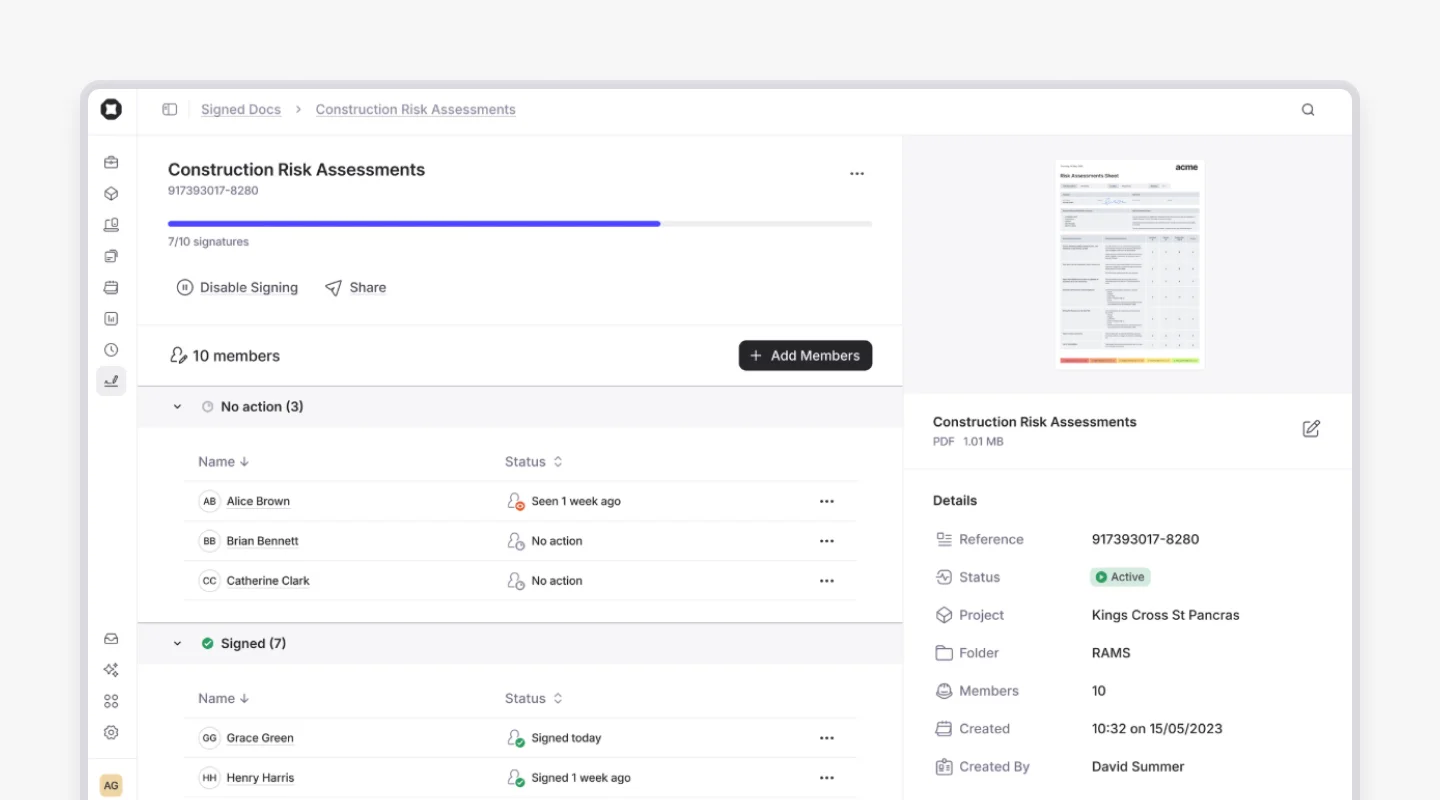
This creates a clear audit trail, reduces missed signatures, and keeps compliance documents organised in one central place.
Step 6: Review and update the risk assessment
Conditions on construction sites change quickly, and controls that worked at one stage may not be suitable later on.
Regular review ensures risks remain properly managed and that new hazards aren’t overlooked.
That’s why you should review the risk assessment:
After any significant change to the site, work methods, or schedule
After introducing new plant, equipment, or materials
After an accident, incident, or near miss
When there are major changes to the workforce
At planned intervals, proportionate to the level of risk
If controls aren’t working as intended, further action must be taken before work continues.
Why carry out a construction site risk assessment
One of the primary purposes of a construction site risk assessment is to ensure the health, safety, and well-being of everyone affected by the work.
However, conducting a construction site risk assessment can also help you:
Maintain quality: By identifying technical and process risks early, you reduce the chance of defects, rework, and missed standards.
Protect productivity: Fewer incidents mean fewer delays, fewer lost working days, and less disruption to the programme.
Control costs: Preventing accidents helps avoid fines, claims, equipment damage, and the hidden costs of downtime and retraining.
Strengthen planning and decision-making: Assessing risks forces you to think through methods, resources, and sequencing before problems arise.
Build client confidence: A transparent risk assessment shows that health and safety have been properly considered and managed.
Strengthen your risk management with Onetrace
Taking construction site risk assessments seriously is essential for safeguarding people, protecting your business, and keeping projects on track.
To do that well, you should use every tool at your disposal.
While Onetrace can’t carry out a risk assessment for you, it can give you the visibility, structure, and accountability needed to manage risk properly.
Book a personalised demo with the Onetrace team to see how better site control supports stronger risk management in practice.
Marketing Team
@Onetrace
The Onetrace marketing team is passionate about sharing insights, ideas, and innovations that help construction businesses stay connected, compliant, and efficient. Combining industry expertise with a love for clear communication, we aim to deliver content that empowers professionals to work smarter and safer.