Construction safety management process [A complete guide]

By
Markrting Team
@Onetrace
Construction safety management is the practice of identifying, controlling, and monitoring workplace risks to keep people safe during all stages of a construction project.
This level of oversight is crucial in an industry where the fatal injury rate is 1.92 per 100,000 workers and around 2.5% of workers sustain a non-fatal injury each year—both figures significantly higher than the average across all industries in Great Britain.
To help you build safer sites and manage risks more effectively, this guide covers the key principles of construction safety management and its main stages.
Key takeaways
Construction safety management is about preventing problems
A structured safety management process helps identify hazards early, control risks, and protect workers, the public, and the project itself.Safety is everyone’s responsibility
While principal contractors often lead safety efforts, clients, designers, contractors, subcontractors, and workers all have important duties under UK law.Strong safety management goes far beyond risk assessments
Effective safety management includes planning, training, setting up the site, monitoring, incident reporting, and maintaining a health and safety file for future work.Good safety performance supports business performance
Managing safety well can reduce incidents, minimise costly delays, improve compliance, strengthen client relationships, and create a better working environment for employees.The right tools make safety management easier to control
As projects become more complex, managing inspections, documentation, sign-offs, and compliance manually becomes increasingly difficult. Digital construction management software like Onetrace helps centralise safety processes, reduce admin, and maintain visibility across every project.
What is construction safety management?
Construction safety management is the systematic planning, coordination, and control of health and safety activities throughout a construction project.
Its primary purpose is to keep workers and everybody affected by construction activities safe.
Construction sites are constantly changing environments, with workers exposed to risks like falls from height, moving vehicles, hazardous substances, and heavy machinery. A structured approach to safety helps identify these risks early and put controls in place before incidents occur.
Construction safety management is also essential for meeting legal duties.
UK regulations require employers and duty holders to assess risks, provide safe systems of work, and take reasonable steps to protect workers and anyone else affected by construction activities.
Strong safety management helps demonstrate compliance and reduces the likelihood of enforcement action, fines, and project delays.
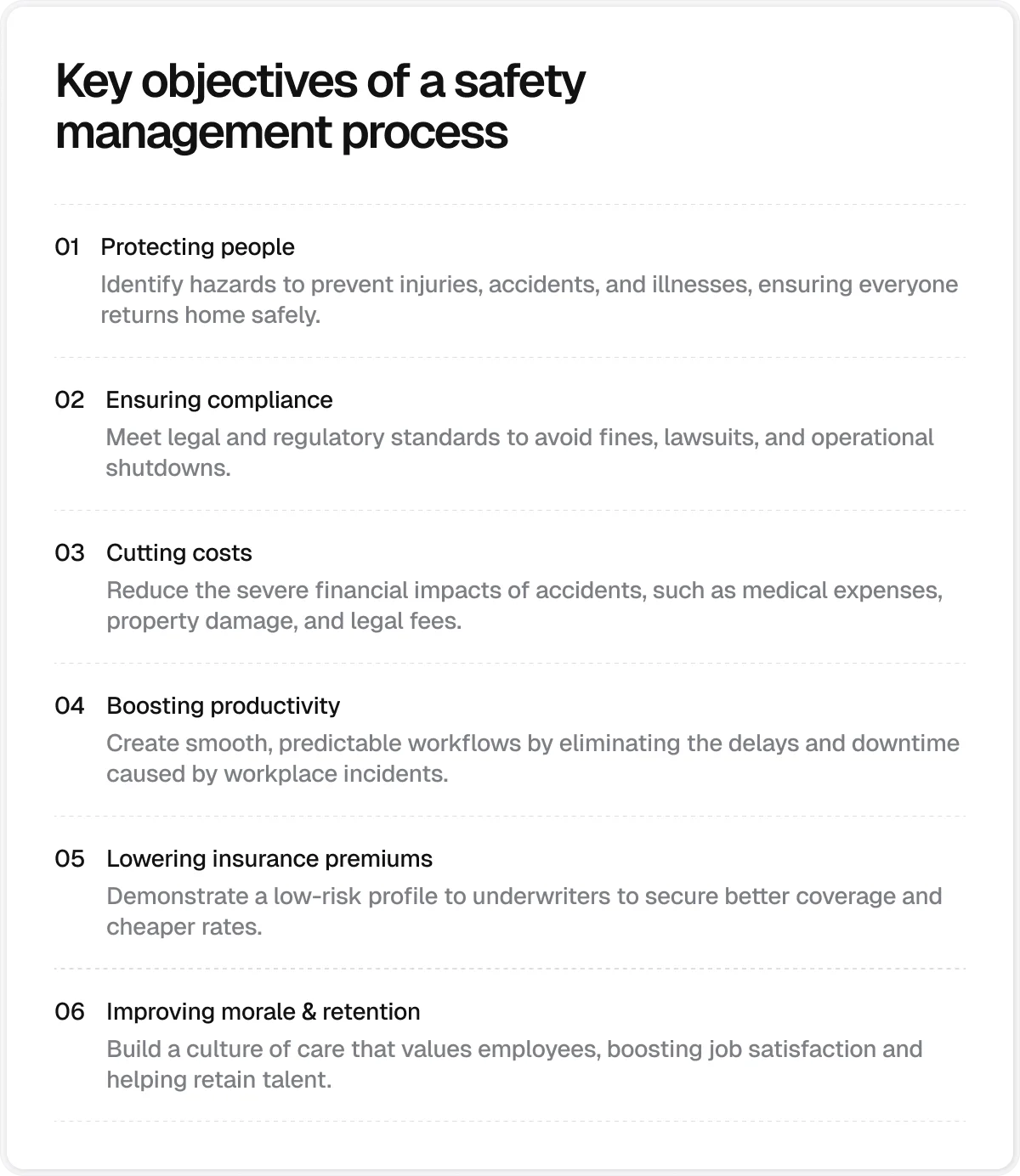
Beyond safety and compliance, successful safety management supports better business performance.
According to HSE data, the construction sector loses around 2.2 million working days each year due to work-related injuries and ill health. The annual cost of these incidents is estimated at £1.4 billion.
A well-managed safety programme helps reduce these losses while creating a safer and more reliable working environment. It can also improve worker confidence, support staff retention, and strengthen relationships with clients, contractors, and insurers.
Which safety regulations should contractors comply with?
In the UK, contractors must comply with a range of health and safety laws designed to protect workers, site visitors, and members of the public.
The most important regulations include:
Health and Safety at Work etc. Act 1974 (HSWA): This foundational law places a legal duty on employers and the self-employed to protect the health, safety, and welfare of workers and anyone else who may be affected by their activities.
Management of Health and Safety at Work Regulations 1999 (MHSWR): These regulations require employers to assess workplace risks, implement suitable control measures, provide health and safety training, and regularly review their safety arrangements.
Construction (Design and Management) Regulations 2015 (CDM): CDM 2015 sets out the responsibilities of clients, designers, contractors, and principal contractors, ensuring that health and safety is planned, managed, and monitored throughout the lifecycle of a construction project.
There are also several regulations that apply to specific construction activities and hazards, including:
Control of Substances Hazardous to Health Regulations 2002 (COSHH)
Lifting Operations and Lifting Equipment Regulations 1998 (LOLER)
Provision and Use of Work Equipment Regulations 1998 (PUWER)
Together, these regulations form the legal framework that underpins construction safety management in the UK.
Who is responsible for managing safety on a construction project?
No single person is responsible for managing safety on a construction project.
While the principal contractor typically takes the lead in managing health and safety during the construction phase, everyone involved in a project has a role to play.
The table below outlines the main duty holders and their key safety management responsibilities:
Role | Safety management duties |
Client | • Appointing competent duty holders • Providing relevant project information • Ensuring adequate resources for health and safety • Supporting effective pre-construction planning • Confirming suitable safety arrangements are in place before work begins |
Designer / Principal designer | • Identifying foreseeable risks during design • Eliminating hazards where possible • Reducing risks that can’t be designed out • Providing information about residual risks • Coordinating with other duty holders on safety matters |
Principal contractor | • Planning construction-phase health and safety activities • Coordinating contractors and subcontractors • Developing and maintaining the construction phase plan • Monitoring site risks and control measures • Managing interactions between different trades and work activities |
Contractors and subcontractors | • Following site rules and safety procedures • Carrying out risk assessments for their work • Providing safe systems of work • Cooperating with other duty holders • Reporting hazards, incidents, and safety concerns |
Workers | • Following site safety procedures • Using equipment and PPE correctly • Taking reasonable care of themselves and others • Reporting defects, hazards, and unsafe conditions • Cooperating with employers and supervisors on safety matters |
8 key stages of the construction safety management process
While each of these areas could be explored in much more detail, understanding the eight core stages of the construction safety management process will give you a solid foundation for managing safety effectively.
1. Site risk assessment and hazard identification
You can’t keep people safe if you don’t fully understand what could harm them. That’s why the first stage of the construction safety management process is identifying site hazards and assessing the risks they create.
This usually includes the following activities:
Hazard identification: Review planned activities, equipment, materials, and site conditions to pinpoint anything that could cause injury or ill health.
Risk assessment: Evaluate the likelihood and potential impact of each hazard to determine where controls are needed most.
Control measure selection: Eliminate hazards where possible and reduce remaining risks through safer working methods, equipment, or site arrangements.
RAMS development: Document risks and safe systems of work in risk assessments and method statements.
2. Construction safety planning and documentation
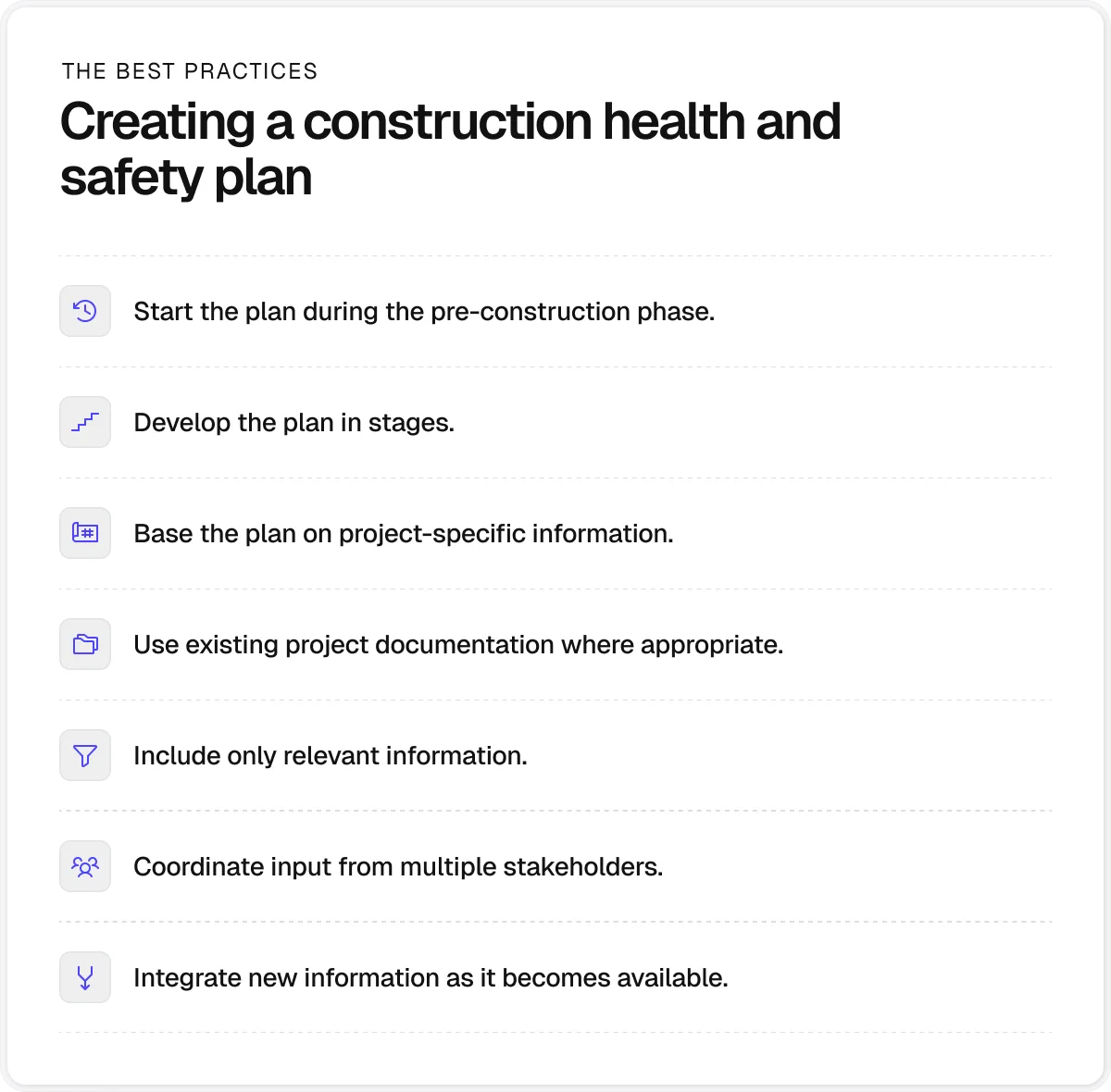
Safety management requires a written construction health and safety plan that can be shared with everyone who needs it, from contractors and subcontractors to supervisors and site managers.
This plan provides a consistent framework for coordinating work, controlling risks, and demonstrating compliance.
As such, it should cover:
Project risks and constraints
Roles and responsibilities
Risk assessments and method statements
Site rules and control measures
Welfare and emergency arrangements
Training and communication
Monitoring and review procedures
3. Worker training and safety communication
A safety plan only works when it reaches the people doing the work. That’s why training and communication are a critical stage of the construction safety management process.
Before work begins, employers should verify that workers have the knowledge, skills, and certifications needed for their role. The initial competency check should be supported with site inductions, task-specific training, and appropriate supervision to help workers understand site-specific safety requirements, which also include information about:
Site hazards
Control measures
Emergency procedures
Safe systems of work
These topics should be reinforced through regular Toolbox Talks, briefings, and day-to-day supervision to ensure safety expectations remain clear as the project evolves.
4. Site setup and safety arrangements
Safe work depends on the environment in which the construction project takes place.
The table below breaks down the main elements of a safe and well-organised construction site:
Site setup element | Key activities | Why it matters for safety management |
Site access and traffic management | Segregating vehicles and pedestrians, controlling entry points, and managing loading and unloading areas | Reduces the risk of collisions, struck-by incidents, and unauthorised access |
Site boundaries and security | Installing fencing, barriers, signage, and access controls | Protects workers, the public, and the site itself from preventable risks |
Welfare facilities | Providing toilets, washing facilities, rest areas, drinking water, and changing facilities | Supports worker wellbeing, hygiene, and compliance with legal requirements |
Housekeeping and storage | Managing waste, maintaining clear walkways, and designating storage areas for materials and equipment | Reduces fire risks, trip hazards, and site congestion |
Lighting | Providing adequate task lighting, route lighting, and emergency lighting where required | Helps workers move and work safely, particularly in low-light conditions |
Emergency preparedness | Establishing emergency procedures, escape routes, fire precautions, and first aid arrangements | Ensures workers can respond quickly and effectively when incidents occur |
5. HSE notification and regulatory reporting
In some cases, construction work can’t begin until the Health and Safety Executive (HSE) has been notified of the project.
Under CDM 2015, this applies if the project is expected to last longer than 30 working days with more than 20 workers on site at the same time, or exceed 500 person-days of construction work.
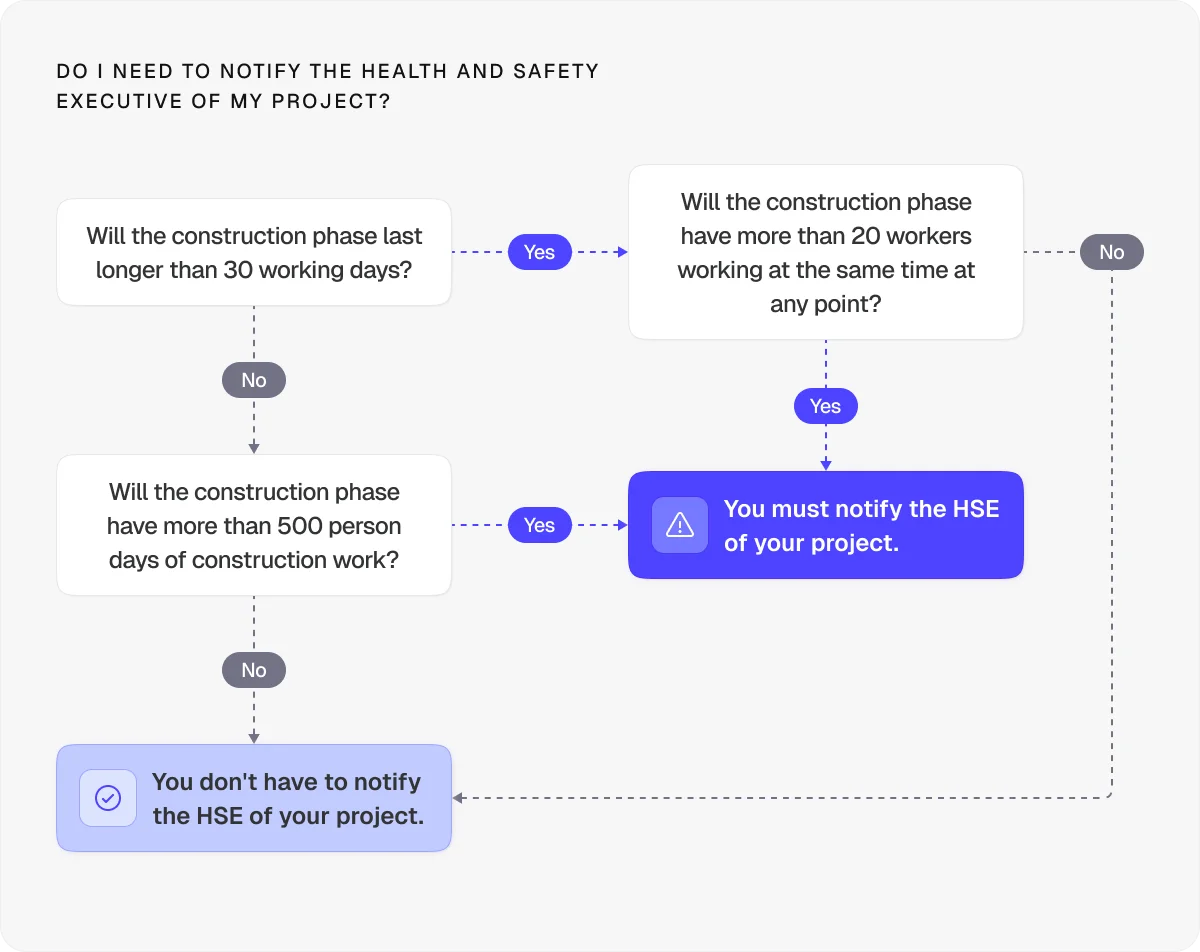
Where notification is required, an F10 notice must be submitted before work starts and kept up to date if project details change.
6. Monitoring, reporting, and incident management
Once work is underway, safety management becomes an ongoing process of ensuring that controls remain effective and are being followed in practice.
This typically involves overseeing day-to-day operations, conducting site inspections, and monitoring near misses or minor incidents that could signal larger risks.
When incidents do occur, a structured response is essential.
Key steps include:
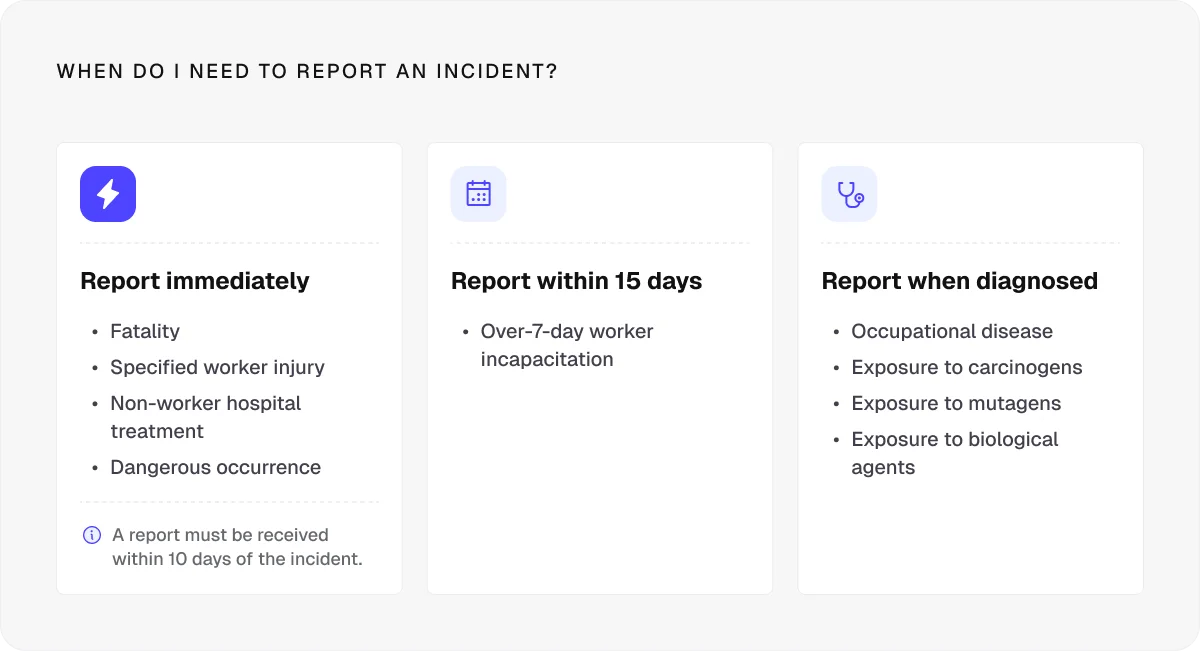
Record accidents, injuries, work-related illnesses, and dangerous occurrences in line with RIDDOR requirements.
Report serious injuries, fatalities, and specified dangerous occurrences to HSE without delay.
Determine what happened, identify root causes, and establish corrective actions.
Maintain accurate records of reportable incidents, including dates, locations, people involved, and actions taken.
Address identified issues and update procedures, risk assessments, or training where needed to prevent recurrence.
7. Safety performance review and continuous improvement
Robust safety management doesn’t end with monitoring performance.
The insights gathered throughout the project should be used to strengthen safety processes and reduce future risks.
This typically involves:
Reviewing risk assessments and method statements when site conditions, project scope, or working methods change
Analysing accidents, illnesses, and near misses to identify underlying causes and opportunities for improvement
Identifying recurring safety issues and trends that may point to weaknesses in existing controls
Evaluating whether safety procedures, site rules, and training arrangements are working as intended
Updating safety processes and control measures based on lessons learned throughout the project
8. Health and safety file preparation
The final stage of the construction safety management process focuses on creating a health and safety file for the completed asset (e.g., a building, bridge, road, or other structure).
This file provides information that future designers, contractors, maintenance teams, and building owners may need to carry out work safely.
A health and safety file should cover:
Residual risks that remain after construction has been completed
Information needed to safely maintain, repair, renovate, or demolish the asset
Significant health and safety information generated during the design and construction phases
To ensure the file remains useful throughout the asset’s lifecycle, it should be organised in an accessible format that makes key information easy to find.
Pro tip:
Although the file is provided to the client at project completion, it should be compiled gradually and consistently throughout the project to avoid a last-minute scramble for information.
Take control of construction safety management with Onetrace
Construction safety management is ultimately a people-driven process.
People assess risks, communicate safe systems of work, monitor compliance, and act when problems arise.
But as projects increase in size and complexity, people alone can’t carry the entire process. Managing inspections, sign-offs, records, evidence, and compliance across multiple projects requires tools designed for the job.
That’s why contractors are turning to digital construction management software like Onetrace to stay in control of safety compliance and gain the full benefits of effective safety management.
Onetrace makes this possible through tools like:
Centralised document management: Store risk assessments, certificates, product data sheets, safety records, and project documentation in one place for easy access and audit readiness.
Standardised forms and project templates: Ensure safety information is collected consistently throughout every project, helping teams follow the same processes and compliance requirements.
Signed Docs: Distribute RAMS, Toolbox Talks, and other safety documents digitally, track acknowledgements in real time, and ensure required sign-offs are completed before work begins.
Photographic evidence: Capture site conditions, hazards, inspections, and completed work to create a traceable visual record of safety activities and compliance.
QR code tracking: Link completed work to a digital record that can be accessed during future inspections, maintenance, or compliance checks.
Reporting and audit trails: Generate detailed reports containing forms, photos, signatures, and project data to support audits, investigations, client sign-offs, and regulatory compliance.
Planner and workforce visibility: Coordinate teams more effectively, improve communication, and ensure workers have access to the latest project information and safety requirements.
To learn more about these features and see how Onetrace can help you improve safety compliance, reduce admin, and maintain greater control over your projects, book a personalised platform walkthrough.
FAQ
What is safety in construction management?
Safety in construction management refers to the processes, procedures, and controls used to prevent accidents, injuries, and work-related illness on construction projects.
What are the top 10 safety risks in construction?
While risks vary between projects, the top 10 safety risks in construction usually include:
Falls from height
Moving vehicles and mobile plant
Falling objects
Excavation and trench collapses
Electrical hazards
Manual handling injuries
Exposure to hazardous substances
Machinery and equipment accidents
Excessive noise exposure
Hand-arm vibration exposure
What is the 20/20 rule in construction?
The 20/20 rule is a hazard awareness technique that encourages workers to stop every 20 minutes and spend 20 seconds scanning a 20-foot radius (approximately 6 metres) around their work area for new hazards, changing conditions, or potential safety risks.
Markrting Team
@Onetrace
The Onetrace marketing team is passionate about sharing insights, ideas, and innovations that help construction businesses stay connected, compliant, and efficient. Combining industry expertise with a love for clear communication, we aim to deliver content that empowers professionals to work smarter and safer.