What is a construction site report? A complete guide

By
Marketing Team
@Onetrace
A construction site report is a written record of what’s happening on the site at a given moment, providing a clear snapshot of site conditions, activities, and any issues that need attention.
This report plays a key role in keeping a site under control, which is why it’s worrying that so few construction professionals feel fully on top of their reporting practices. Only 16% say they’re completely confident that their work-in-progress reports reflect the true state of a project without late adjustments—and work in progress is one of the essential areas a well-structured site report should capture.
To help build that confidence from the start, this article breaks down what a construction site report is, what it must include, and how to write one that gives all stakeholders a reliable view of site performance and project status.
Key takeaways
Construction site reports keep projects under control
They provide a reliable record of site activities, progress, issues, and conditions, allowing teams to make informed decisions.Reliable reports focus on facts and measurable progress
Record specific outputs, quantities, and observations rather than vague updates to improve accuracy and accountability.The best reports cover more than just progress
Include weather, resources, safety observations, quality issues, delays, photos, and outstanding actions to create a complete site record.Reporting works best when information is captured in real time
Updating reports as work happens reduces errors, improves evidence quality, and makes reports more useful for managing the project.Construction management software makes reporting easier
Onetrace helps teams capture site data, photos, inspections, and project records in one place, reducing admin time and creating a single source of truth across the project.
What is a construction site report?
A construction site report is a structured document used to record and monitor work carried out on a site over a specific period, creating an accurate record of day-to-day operations.
This is one of the many different types of reports used in construction, alongside progress, financial, and handover reports. Which types of reports you’ll end up using depends on the size and complexity of your project, the stakeholders involved, and the information that needs to be tracked throughout the build.
A construction site report, in particular, focuses on activities taking place on site. As a result, it forms the basis of reporting on most construction projects, providing the core information that many other reports and project records rely on.
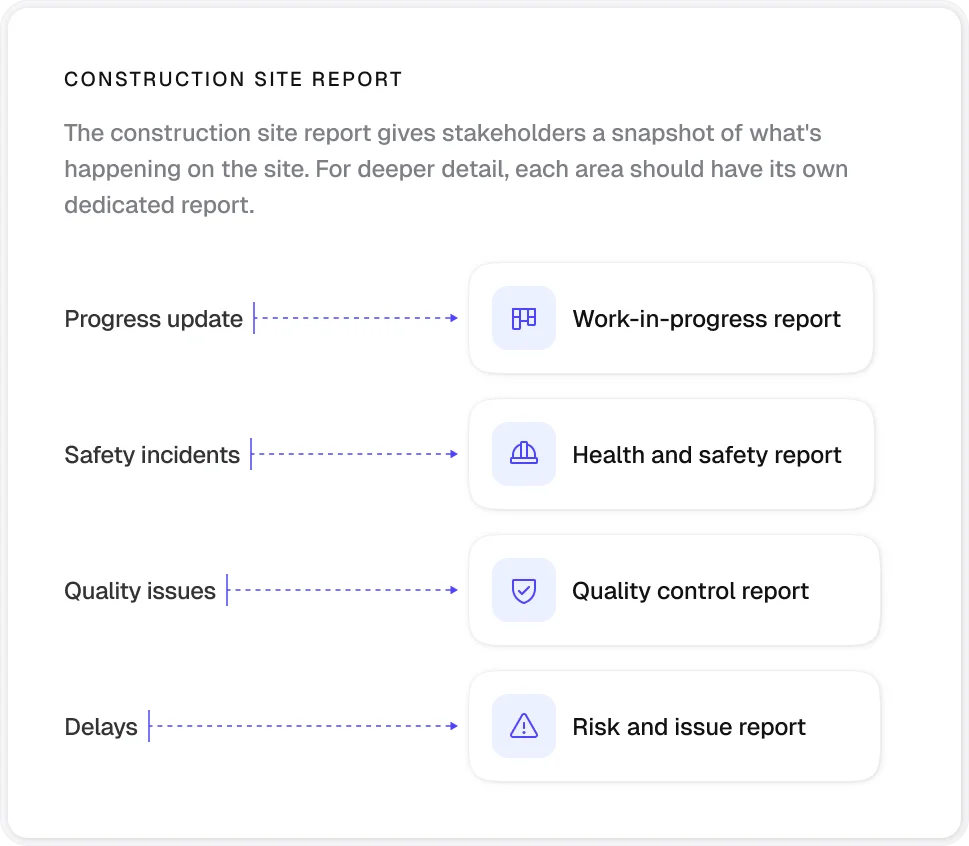
This focus makes it more limited in scope than a construction progress report, which typically looks at the wider status of a project, including programme performance and budget considerations.
However, a narrower scope doesn’t mean a construction site report is overly detailed. Unlike safety, quality control, or inspection reports, it’s designed to provide an overview rather than an in-depth analysis of a specific area.
This balance makes it valuable for stakeholders, who can get a clear picture of site activity without reviewing multiple specialist reports.
Who prepares a construction site report?
A construction site report is usually prepared by the site manager, foreman, or supervisor—someone with direct visibility of the work taking place on site.
While one person is typically responsible for compiling the report, the information it contains often comes from several sources, including:
Site staff
Health and safety personnel
Inspectors
Because the report is intended to reflect real on-site conditions, it’s usually based on site walks, inspections, discussions with project teams, meeting records, and observations gathered throughout the reporting period.
How often should a construction site report be completed?
Construction site reports can be completed daily, weekly, or monthly. The frequency depends on the level of risk, the stage of the project, and any contractual obligations around progress reporting, interim valuations, and payment schedules.
For instance, daily reporting is common on larger or more complex projects, where teams need close visibility of site activity and potential issues. Weekly reports are often used to provide a broader summary of work completed, while monthly reports are typically aligned with valuation and payment cycles.
Some projects may also require a temporary increase in reporting frequency. For example, additional reporting may be needed when:
Work is taking place on the critical path
Site conditions change unexpectedly
Progress begins to fall behind programme
Pro tip:
Whatever reporting schedule you follow, don’t wait until the deadline to gather information. Site reports are most valuable when they are updated as work takes place, while details are still fresh.
Why is a construction site report important?
A construction site report is important because it allows teams to:
Track progress against the programme and maintain visibility over completed and ongoing work
Identify delays, risks, and issues early, giving teams more time to take corrective action
Monitor health and safety performance and maintain a record of site conditions and incidents
Improve communication between site and office teams by ensuring everyone works from the same information
Gather evidence for clients, consultants, and other stakeholders when updates or decisions need to be supported
Create a reliable audit trail of site activity, reducing reliance on memory or informal updates
Support payment applications, extension of time claims, and dispute resolution with accurate contemporaneous records
Strengthen accountability across project teams by creating a shared record of what was completed, what issues arose, and what actions were taken
10 key elements of a construction site report
A construction site report doesn’t need to—and shouldn’t—be lengthy. What matters is that it captures the right information clearly, accurately, and consistently.
The following 10 elements form the foundation of a well-structured site report.
1. Site and project information
The opening section of a construction site report should establish the basic information needed to identify and reference the report. This typically includes:
Project name
Site location, area, phase, or zone covered by the report
Reporting period or report date
Name and role of the report author
2. Weather and site conditions
This section of a construction site report records the environmental conditions that may affect work, helping teams understand how external factors are influencing progress, productivity, and safety. These factors include:
Temperature
Rainfall or precipitation
Wind conditions
Ground conditions
Weather-related work stoppages or disruptions
Regular weather tracking is important because construction projects are highly exposed to changing conditions. According to the 2024 European Construction Weather Report by Aggreko, 92.6% of the 853 surveyed UK and European construction managers reported experiencing project difficulties due to weather. 75.2% of them said extreme weather caused major delays that led to missed deadlines or financial penalties.
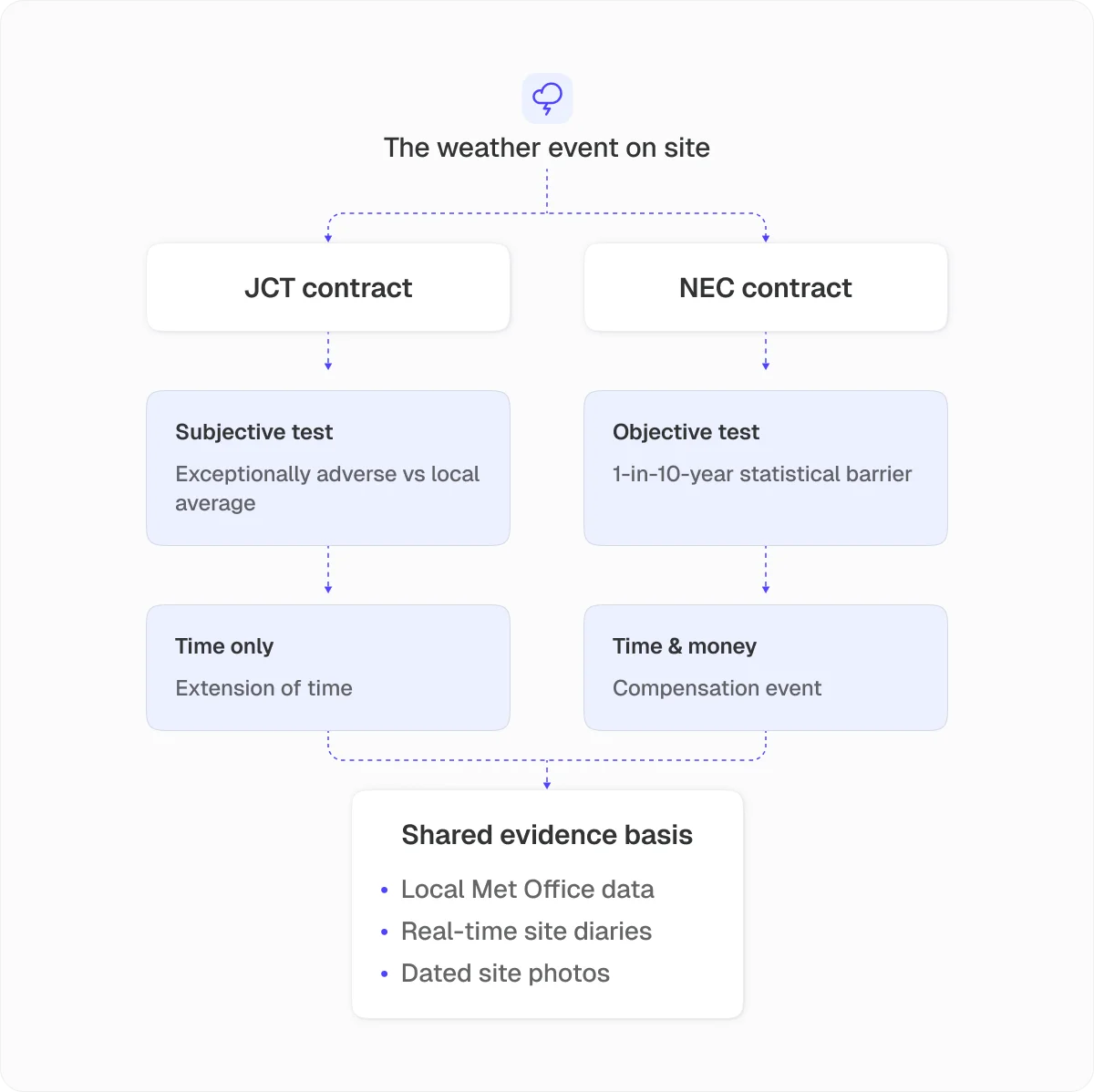
Accurate weather records can also support extension of time claims under the Joint Contracts Tribunal (JCT) and New Engineering Contract (NEC) contracts, where contractors may need to demonstrate exactly what conditions were experienced on site and how they affected the works.
3. Work completed and project progress
Tracking work as it moves through different stages of completion allows construction teams to measure progress, spot delays early, and keep projects on track. The information that makes these outcomes possible includes:
Completed tasks
Work in progress
Progress against milestones
Significant site events
Pro tip:
Be specific when reporting progress, and record measurable outputs wherever possible. For example, instead of relying on broad updates like ‘Work continuing as planned’, write ‘Installed 120 square metres of plasterboard on Level 2, bringing the area to 80% completion against programme’.
This approach creates a more accurate picture of project performance and makes the report far more useful for planning, cost management, and decision-making.
4. Labour, plant, and materials
Recording the resources used on site lets teams understand where labour, equipment, and materials are being deployed, making it easier to monitor productivity, control costs, and identify potential shortages before they affect delivery.
The information you should cover includes:
Number of workers on site
Trades and subcontractors involved
Labour hours worked
Plant and equipment used
Plant operating and idle time
Material deliveries
Materials consumed
Material shortages, waste, or rejected quantities
This information is particularly important at a time when labour and material pressures continue to affect the industry.
According to the 2025 (H2) State of Trade Survey, 72% of SME builders have been affected by a shortage of skilled tradespeople, while nearly half reported project delays as a result. Material costs remain a significant concern as well, with 47% of housebuilders reporting rising material prices as a key driver of construction cost increases.
Pro tip:
Resource data is most valuable when it’s linked to output. Recording that a team worked eight hours tells you the labour cost incurred; recording that the team worked eight hours to install 100 square metres of flooring tells you the output achieved and the productivity behind it.
5. Health and safety observations
Safety compliance is important and extensive enough to justify its own reporting processes, inspections, and compliance records. A construction site report should, therefore, only provide a summary of key health and safety information rather than attempt to replace dedicated safety reports.
This summary should cover items like:
Hazards identified on site
Safety inspections carried out
Safety incidents and near misses
Corrective actions taken
Personal protective equipment (PPE) compliance issues
6. Quality observations and defects
Maintaining quality on a construction project depends on identifying issues early and keeping accurate records of inspections and completed work. This is particularly important for work that will later be covered up, since it’s difficult to inspect or verify once construction progresses.
This section of the construction site report usually lists:
Quality inspections completed
Defects identified
Testing results
Non-conformances raised
Corrective actions taken
Outstanding quality issues
7. Issues, delays, and corrective actions
Bringing all observed issues together helps stakeholders understand how risks to the project are being managed and what actions are being taken to keep work progressing.
Typical issues recorded in this part of the report include:
Delays affecting planned work
Material or labour shortages impacting progress
Design, information, or coordination issues
Weather-related disruptions affecting delivery
Unplanned site disruptions
Risks requiring immediate attention
Pro tip:
Focus on the impact as well as the issue itself. Rather than simply noting a material shortage, add which activities are affected, what consequence it will have for the programme, and what steps are being taken to minimise disruption.
8. Visitors and site attendance
Construction sites often receive visits from clients, consultants, inspectors, suppliers, and other stakeholders. Keeping a record of these visits creates an audit trail of stakeholder involvement throughout the project and supports site security and accountability.
Your visitor log should cover the following information:
Visitor name
Company or organisation
Purpose of the visit
Areas of the site visited
Time of arrival and departure
9. Site photos and supporting evidence
Photographs provide visual evidence of written observations and create a documented record that can be referenced long after the work has taken place.
Your construction site report should be supplemented by the following photo documentation:
Progress photos
Photos of completed work
Photos of defects or quality issues
Photos of safety observations
Photos of site conditions
Pro tip:
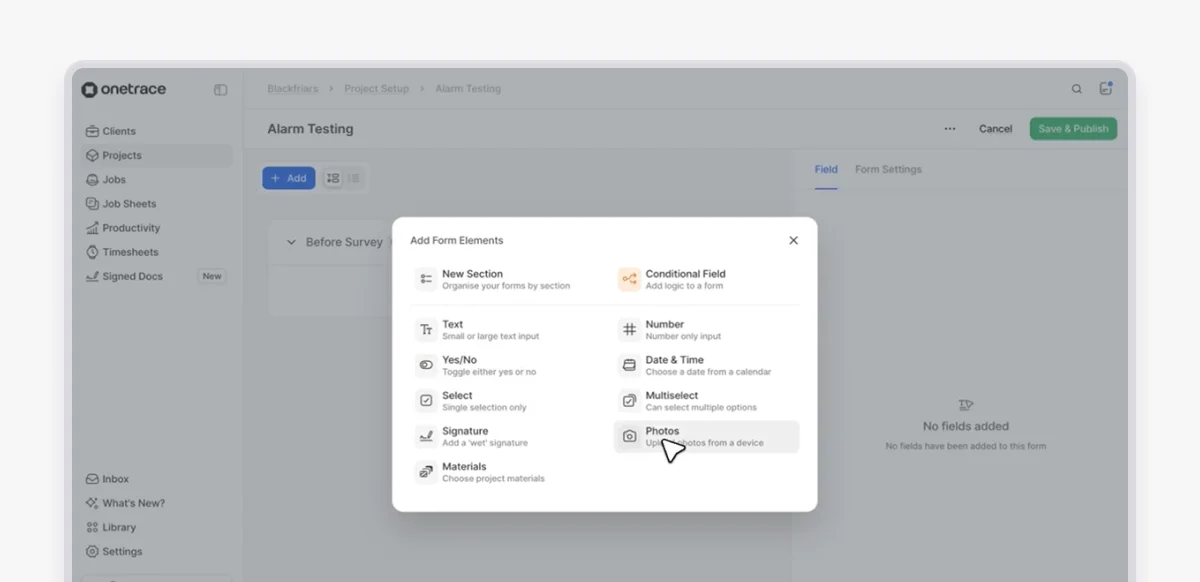
Always add context to site photos. A photograph is far more useful when it’s linked to a specific location, activity, trade, or issue. The most practical way to approach this is by using construction site management software with a dedicated app.
With Onetrace, for example, site teams can capture photos directly from the site and attach them to forms, inspections, observations, and completed work records. This creates a stronger audit trail and ensures photographic evidence remains connected to the activity it’s intended to support.
10. Open actions and next steps
While open actions may be recorded throughout the construction site report, it’s good practice to bring outstanding items together in one place at the end. This makes it easier to track what still needs to be done.
Every action should have a defined owner and deadline, as actions without accountability are more likely to be delayed or overlooked.
6 tips for writing construction site reports
Follow these six tips to make your construction site reports useful for everyone who relies on them to manage project delivery:
Use a consistent structure: Organise reports into standard sections so stakeholders can quickly find the information they need and compare reports over time.
Write clearly and objectively: Use factual, neutral language supported by locations, quantities, and observations rather than opinions or assumptions.
Focus on information that matters: Include details that help teams manage progress, identify risks, make decisions, or demonstrate compliance, while avoiding unnecessary duplication.
Support updates with evidence: Use photos, measurements, inspection records, and other supporting information to strengthen the accuracy and reliability of your reports.
Review reports before submission: Check that key information is complete, delays are explained, photos are labelled, and outstanding actions have been assigned to an owner.
Centralise project information: Store reports, photos, inspections, and related records in a single system to maintain an audit trail and avoid reporting silos that create conflicting versions of project information.
Why use Onetrace for construction site reports
While construction site reports can be completed using spreadsheets or paper forms, these approaches often create duplicate data, inconsistent records, and information silos. As a result, teams waste time chasing updates, re-entering information, and trying to piece together project records from multiple systems.
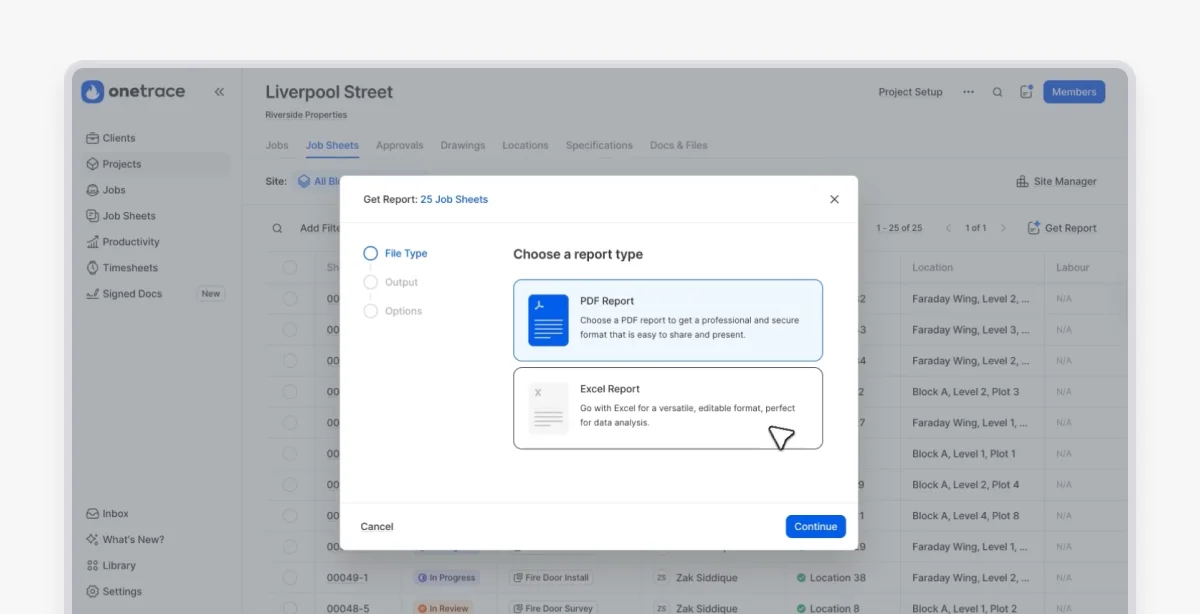
Construction management software like Onetrace prevents these scenarios by bringing all project records into one place. Site teams can capture information as work happens, managers gain real-time visibility into project performance, and reports can be generated from a single source of truth rather than manually assembled from different sources.
Some of the features that make Onetrace particularly useful for construction site reporting include:
Custom forms and templates: Create standardised templates with mandatory fields, checklists, photos, and conditional questions to ensure consistent data capture across projects.
Mobile reporting app: Capture site information, photos, timesheets, inspections, and observations directly from site using a mobile app that also works offline.
Digital site management: Organise projects by blocks, levels, zones, and locations so reporting data remains structured and easy to find.
Material and resource tracking: Record labour, materials, and project costs in one place to improve visibility and reporting accuracy.
Approvals and quality assurance workflows: Route completed work through approval stages, capture feedback, and maintain a documented record of quality checks and sign-offs.
Centralised document management: Store drawings, RAMS, certificates, contracts, and supporting project documents within the same system.
Automated report generation: Create professional PDF and Excel reports using information already captured on site, reducing administration time and manual data entry.
By centralising project information and capturing data at the point of work, Onetrace makes construction site reporting more consistent, reliable, and accessible for everyone involved in project delivery.
Want to see these benefits firsthand?
Book a personalised demo to explore the features most relevant to your business, see how Onetrace can help solve day-to-day reporting challenges, and get up and running quickly if it’s the right fit for your team.
FAQ
What is a construction report?
A construction report is a document used to record and communicate information about a construction project, such as site activities, progress, safety observations, resource usage, and project performance.
How to write a construction site report?
To write a construction site report, record key information about site activities, progress, resources, safety, issues, and completed work. The report should be factual, well-structured, and supported by evidence.
What do site reports usually contain?
Site reports usually contain project information, weather conditions, progress updates, labour and plant usage, material records, safety observations, recorded issues, visitor records, site photos, and outstanding actions.
Can ChatGPT create a report?
Yes, ChatGPT can help create construction site reports from information you provide, such as site notes, photos, inspection results, and progress updates. However, the report should always be reviewed by someone with direct knowledge of the project before it’s submitted.
Marketing Team
@Onetrace
The Onetrace marketing team is passionate about sharing insights, ideas, and innovations that help construction businesses stay connected, compliant, and efficient. Combining industry expertise with a love for clear communication, we aim to deliver content that empowers professionals to work smarter and safer.