Residential vs commercial construction management [Guide]

By
Marketing Team
@Onetrace
Residential and commercial construction are both major parts of the UK building industry.
Residential work covers homes, and it’s the biggest segment of the industry, with around 60,700 businesses and a market worth £98.7 billion in 2026. Commercial construction focuses on business premises, comprising roughly 17,600 businesses and generating £28 billion the same year.
But scale isn’t the only factor that sets residential and commercial work apart.
Project scope, regulations, stakeholders, budgets, and day-to-day priorities all vary between the two, which means that each type of construction requires a different approach to planning, coordination, and delivery.
This residential vs commercial construction management guide walks you through the 10 main differences and what they mean for managing projects successfully.
Key takeaways
Residential and commercial management share the same core responsibilities
Both involve managing budgets, programmes, quality, compliance, and project teams, but the scale and complexity differ.Commercial projects are typically more complex
Larger teams, stricter regulations, and more stakeholders mean commercial projects require greater coordination and documentation.The right sector depends on your career goals
Residential management suits those who enjoy smaller projects and close client relationships, while commercial offers experience on larger, more technical developments.Construction management software keeps projects under control
Onetrace centralises schedules, workforce management, and project records, making it easier to manage residential, commercial, or mixed portfolios.
What is residential construction management?
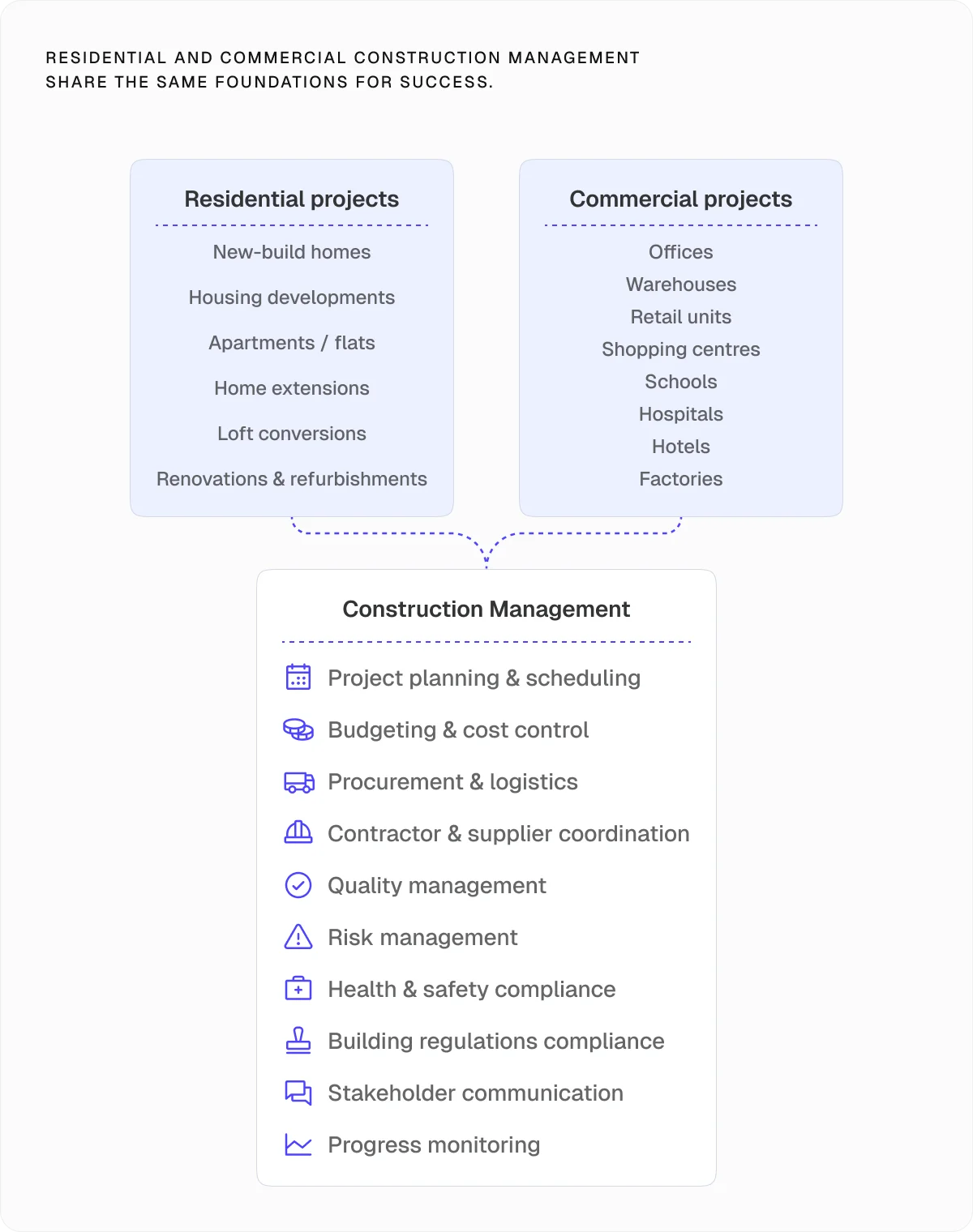
Residential construction management is the process of organising and overseeing projects that build, renovate, or repair homes. These projects include new-build houses, flats, housing developments, extensions, loft conversions, and major refurbishments.
While every project is different, the goal is usually the same: to deliver a safe, high-quality living space that meets regulatory requirements and the client’s expectations, stays within budget, and is completed on time.
To achieve these outcomes, a residential construction manager will:
Create and manage project schedules
Oversee budgets and control costs
Coordinate subcontractors and suppliers
Plan procurement and deliveries
Monitor quality and workmanship
Track progress against the programme
Identify and manage project risks
Ensure compliance with building regulations and health and safety requirements
Residential construction managers also act as the main point of contact between homeowners, developers, designers, and trades, helping keep everyone informed and resolve issues as they arise.
What is commercial construction management?
Commercial construction management is the discipline of delivering projects that build, refurbish, or maintain non-residential buildings used for business, industry, or public services. These buildings include:
Offices
Warehouses
Retail units
Shopping centres
Schools
Hospitals
Hotels
Factories
Like its residential counterpart, commercial construction management involves handling budgets, schedules, resources, quality, and compliance throughout the project.
By keeping every part of the project aligned, commercial construction management helps deliver buildings that are ready for day-to-day operations and long-term use.
Residential vs commercial construction management: 10 key differences
At their core, residential and commercial construction management involve many of the same responsibilities. However, the context in which those responsibilities are carried out varies considerably from one sector to the other.
Whether you’re starting a career in construction management or thinking about moving from residential to commercial projects (or the other way around), understanding these 10 differences between the two disciplines is essential.
1. Project scope and complexity
Residential projects typically involve fewer trades, simpler building systems, and smaller teams, so they’re more straightforward to deliver from a management perspective.
Commercial developments, by contrast, usually bring together many more contractors, consultants, suppliers, and specialist trades. They may also include complex systems like lifts, fire protection, advanced HVAC, and extensive electrical infrastructure, all of which require careful coordination throughout the project.
This increased complexity has a direct impact on project timelines.
While many residential projects can be delivered within three to 12 months, commercial developments typically take a year or more. Delays can also have greater financial and contractual consequences, making detailed planning, scheduling, and collaboration an even more important part of the construction manager’s role.
That said, the line isn’t always clear-cut.
A high-end custom home or large residential development may be more complex than a small office fit-out or retail refurbishment.
In practice, it’s the size, technical requirements, and number of moving parts—not just whether a project is residential or commercial—that determine how demanding it is to manage.
2. Project teams and decision-making
Residential construction projects are normally managed by a smaller team. In most cases, the construction manager coordinates specialist subcontractors like roofers, plumbers, and carpenters, alongside the client.
Commercial projects, on the other hand, require input from a larger multidisciplinary team.
In addition to subcontractors, construction managers often work closely with:
Architects
Structural and civil engineers
Specialist consultants
Quantity surveyors
Compliance professionals
Client representatives
3. Compliance and regulatory oversight
Regulatory compliance is a core part of both residential and commercial construction management.
In both sectors, managers are responsible for ensuring work complies with:
Planning conditions (where required)
They also coordinate Building Control inspections throughout the project to demonstrate compliance before work can be signed off.
Commercial projects, however, often face a higher level of regulatory oversight.
Many of them must meet additional requirements for fire safety, accessibility, energy performance, and specialist building services, while certain sectors, such as healthcare and laboratories, must comply with industry-specific standards as well.
The biggest distinction comes with higher-risk buildings under the Building Safety Act 2022.
This regime applies to residential buildings at least 18 metres or seven storeys high that contain two or more homes, as well as hospitals and care homes during design and construction.
These projects are regulated by the Building Safety Regulator and must maintain a continuous golden thread of safety information and pass statutory Gateway approval stages.
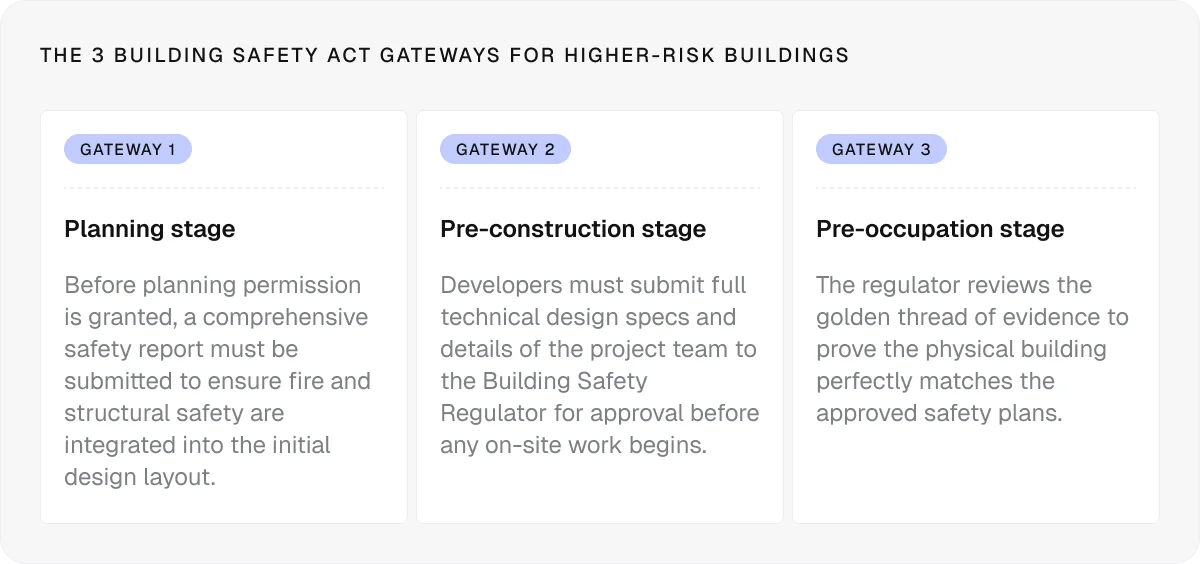
For construction managers, these additional requirements mean that compliance is normally a much larger part of day-to-day project management.
4. Site location and logistics
A project’s location has a direct impact on how it’s managed.
Residential sites are often planned around existing neighbourhoods, where managers need to minimise disruption to residents, coordinate deliveries on smaller roads, and work within tighter site boundaries.
As for commercial projects, they’re more likely to be located in business parks, industrial estates, or busy town centres. The construction manager’s role is to plan for larger deliveries, heavy plant, traffic management, designated loading areas, and continued access for neighbouring businesses or the public in these areas. As a result, logistics planning tends to play a much bigger role throughout the project.
5. Labour availability and workforce management
Labour availability has become one of the biggest challenges in construction project management across both residential and commercial projects.
According to the 2026 Sector Skills Needs Assessment by Skills England, the UK construction industry could face a shortfall of between 201,000 and 755,000 workers by 2030, depending on economic conditions.
A major driver of this demand is the government’s target of building 1.5 million homes in England, which is estimated to require a further 333,000 workers between 2024 and 2030.
However, increased demand for housebuilding isn’t the only workforce challenge facing residential construction managers.
Residential projects are often delivered by sole traders who may be balancing multiple jobs at once. As a result, managers may need to adapt schedules when availability changes or work overruns on another project.
Maintaining strong relationships with reliable subcontractors can also be more challenging, as smaller firms typically have limited capacity and may need to prioritise work based on existing commitments.
Commercial construction managers deal with different workforce management challenges.
Their projects usually involve larger specialist subcontractors with dedicated site teams, providing greater capacity but requiring much closer coordination between multiple trades working simultaneously.
Pro tip:
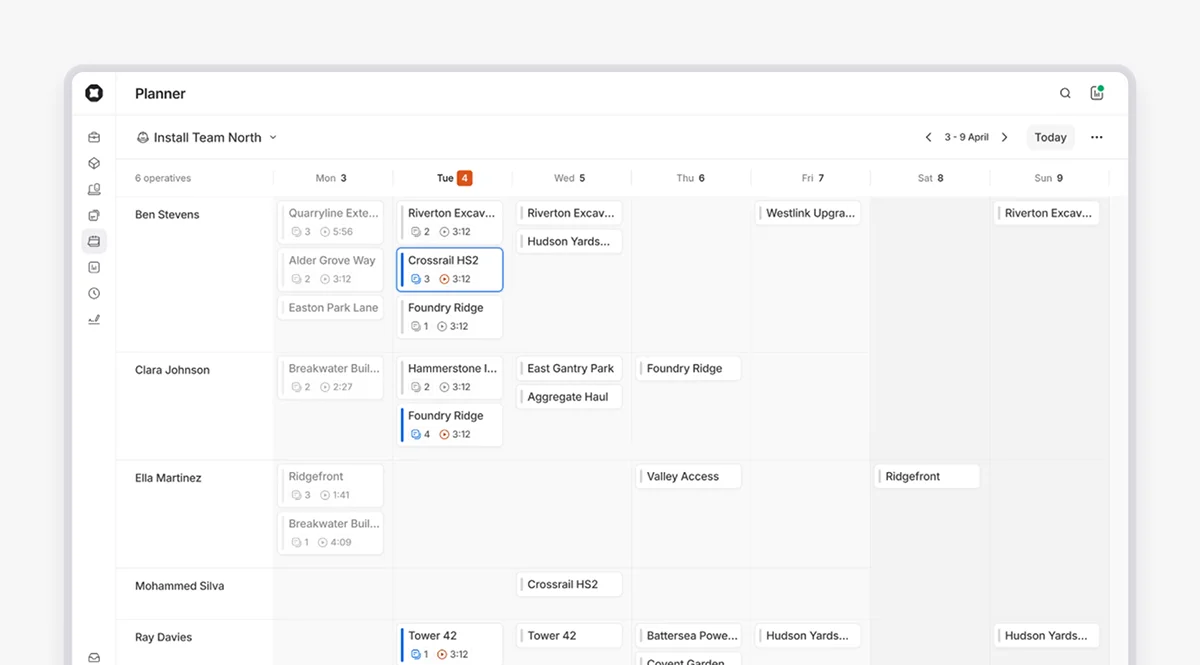
Managing labour across multiple sites is much easier when everyone is working from the same system.
Construction workforce management software like Onetrace helps contractors plan labour, track attendance, manage timesheets, and share real-time schedule updates, giving managers greater visibility while reducing manual administration.
6. Project administration and documentation
Commercial projects usually generate more paperwork due to their size, complexity, and the number of stakeholders involved. These records include:
Detailed contract documentation
Technical submittals
RFIs
Meeting minutes
Inspection documentation
Project closeout information
Residential projects still require careful record-keeping, but the administrative workload is generally lighter and involves fewer formal processes.
7. Material procurement and cost management
Material procurement is a critical part of construction management in both sectors, particularly as prices continue to fluctuate. According to the Department for Business and Trade, construction material prices increased by 5.4% in the year to May 2026, although some products experienced much sharper rises.
For residential construction managers, rising material costs can quickly squeeze margins, particularly on fixed-price projects where changes are difficult to pass on to clients. Procurement also tends to involve more customer-selected products and finishes, meaning late design changes or long lead times can affect both budgets and programmes.
Commercial construction managers face similar procurement risks, but on a different scale.
While buying in greater quantities can improve purchasing power, delays or price increases can have a much greater financial impact because of the size of procurement and the knock-on effect on multiple trades working to a tightly sequenced programme.
For example, the cost of fabricated structural steel alone increased by 13.1% in the year to May 2026, reinforcing the importance of accurate forecasting, early procurement, and effective supplier management.
8. Client relationships and communication
Residential construction managers usually work directly with homeowners, who often see the project as an extension of themselves rather than simply a building project. Their home is where they live, raise their family, and invest their savings, so decisions are naturally more personal.
As a result, conversations about layouts, finishes, colours, or small design details can become emotionally charged, and changes are more common as clients refine their vision throughout the project.
Commercial clients tend to view projects through a different lens.
Whether the client is a developer, business, property owner, or public sector organisation, decisions are generally driven by budgets, functionality, operational requirements, and return on investment. Individual preferences still exist, but they’re usually balanced against commercial objectives and agreed through formal approval processes.
These different priorities also influence communication.
Residential construction managers often spend more time answering questions, reassuring homeowners, and managing expectations around costs, disruption, and programme changes.
Because of this, success in residential construction management often depends on strong customer service and expectation management.
Commercial construction managers, on the other hand, communicate with project teams rather than individual homeowners. Progress is typically discussed through meetings, RFIs, technical submittals, and written approvals, with decisions shared across multiple stakeholders.
Pro tip:
Keeping clients informed doesn’t have to mean answering dozens of phone calls or email updates.
With Onetrace, construction managers can give clients visibility into project progress while managing all client and contact information in one place.
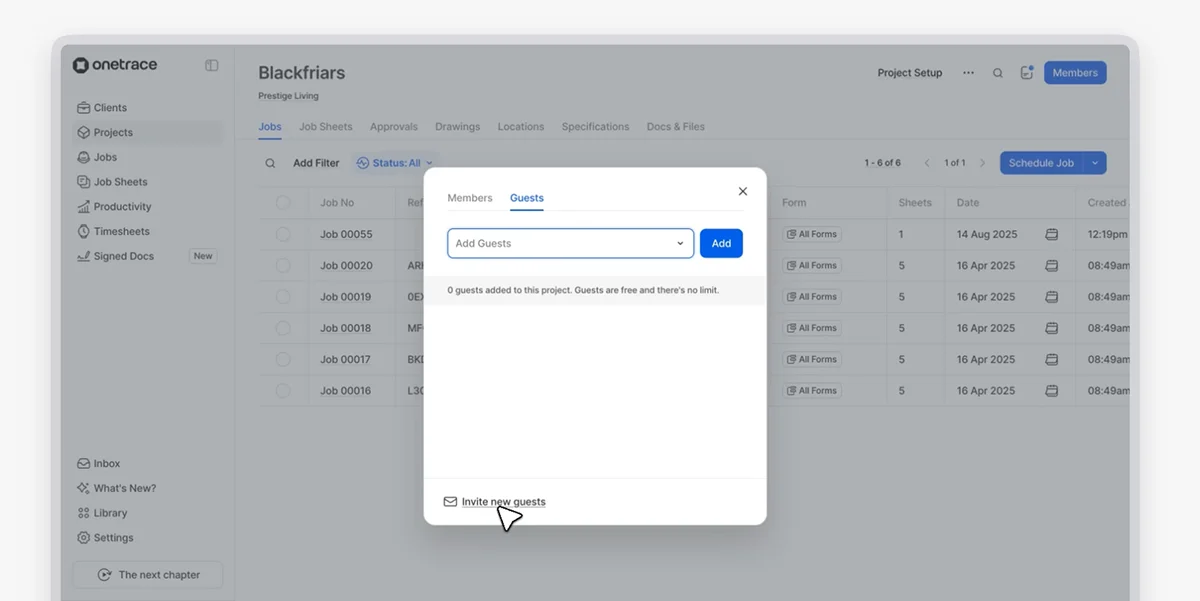
By giving all relevant stakeholders access to the same up-to-date project information, teams can reduce unnecessary communication, improve transparency, and build stronger client relationships.
9. Working hours and client availability
Residential construction managers are more likely to schedule phone calls, meetings, or site visits outside standard working hours, as homeowners are often unavailable during the day.
Commercial projects, in contrast, typically operate within normal business hours, with client meetings, site inspections, and progress reviews planned as part of the wider project schedule.
10. Budget management and financial control
On residential projects, clients usually spend their own savings or mortgage finance. This means that every variation, upgrade, or unexpected cost is closely scrutinised.
Residential construction managers, therefore, spend as much time managing client expectations and controlling change requests as they do tracking project costs.
However, this doesn’t mean commercial construction managers have greater freedom to spend.
Commercial projects are typically governed by strict budgets, formal procurement processes, and clearly defined approval procedures.
Any proposed changes are assessed against their impact on cost, programme, and commercial objectives before they are approved.
Residential vs commercial construction management: Which should you choose?
Neither residential nor commercial construction management is inherently better. The right choice depends on the type of work you enjoy and the environment in which you perform best.
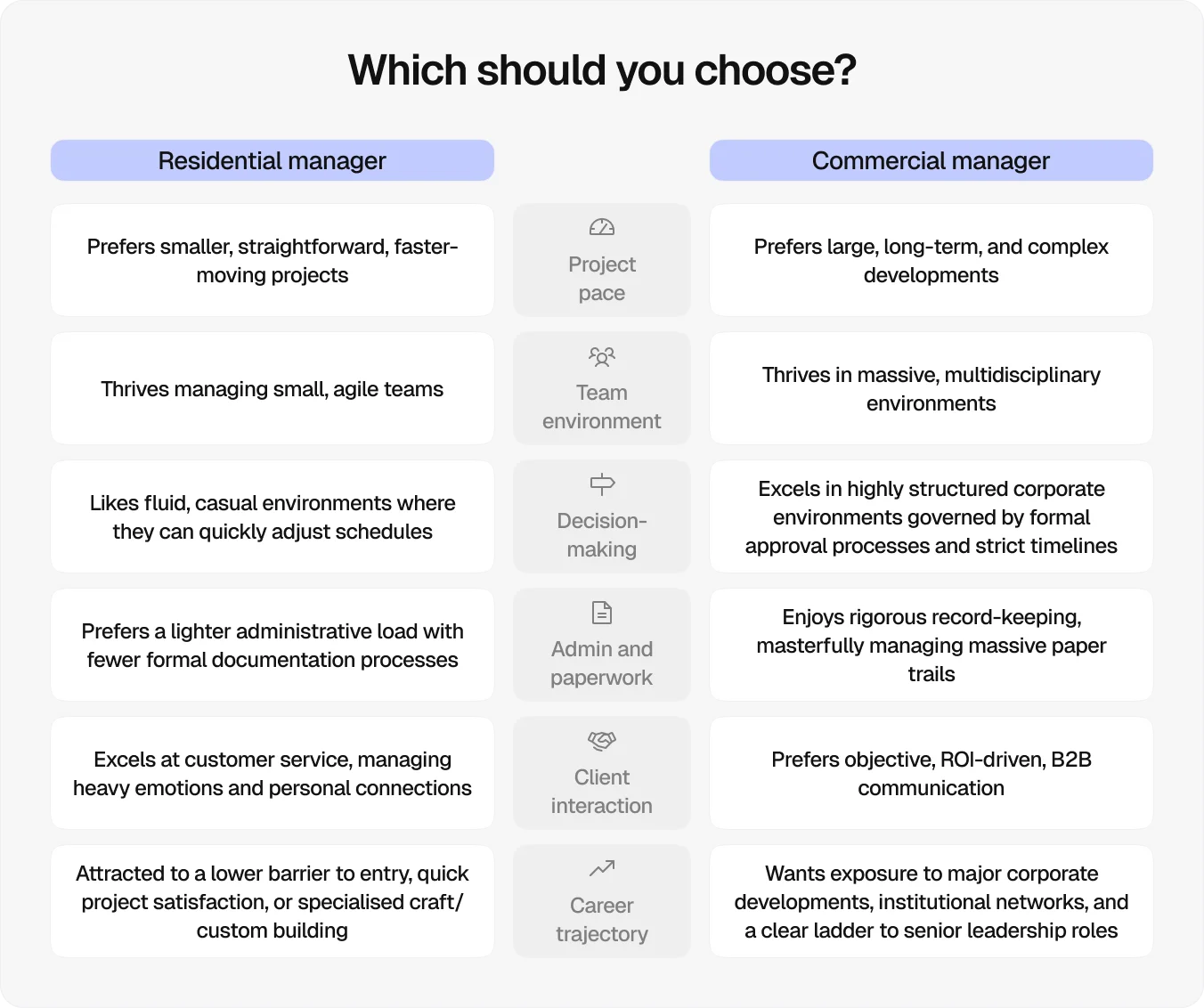
Residential construction management may suit you if you prefer smaller, faster-moving projects, enjoy working closely with homeowners, and take satisfaction in creating individual homes or restoring period properties. It can also offer a lower barrier to entry, which makes it an attractive starting point for construction managers earlier in their careers.
Commercial construction management is often a good fit for those who want to work on larger, more technically demanding projects. It can provide greater exposure to major developments, established contractors, and large organisations, so it appeals to construction managers looking to progress into senior leadership roles.
Manage residential and commercial projects with one platform
You may move between residential and commercial construction management as your career progresses, but the need for accurate information, clear communication, and effective project control remains the same.
Onetrace brings every aspect of project management together in a single platform. You can use it to:
Schedule operatives and manage workforce availability
Track attendance with GPS-enabled timesheets
Store all project documents in a central location
Monitor material usage, costs, and project variations
Capture photographic evidence and maintain a complete proof of work
Generate professional reports for clients, auditors, and other stakeholders
Keep project stakeholders informed with real-time project updates and shared visibility
As projects become more complex, consistency becomes just as important as visibility.
Onetrace standardises surveys, inspections, and installations using custom forms, project templates, approval workflows, and digital documentation, ensuring every project follows the same quality and compliance processes.
Whether your business specialises in residential construction, commercial construction, or both, Onetrace gives you the visibility and control to keep projects on schedule, manage costs, improve collaboration, and provide traceable proof of work from the first survey to final handover.
Book a personalised demo with the Onetrace team to see how the platform can solve your day-to-day project management challenges.
FAQ
What is commercial management in construction?
Commercial management in construction is the process of overseeing the financial and contractual aspects of a project, including procurement, cost control, contract administration, valuations, and risk management to ensure the project remains commercially viable.
What is the difference between commercial and residential construction?
The main difference between commercial and residential construction is that residential projects focus on homes for people to live in, while commercial projects involve buildings used for business, public services, or industrial purposes.
What is the difference between a residential project manager and a commercial project manager?
The difference between a residential project manager and a commercial project manager lies in the types of projects they manage. Residential project managers typically coordinate house builds, extensions, and renovations, while commercial project managers manage larger developments involving multiple stakeholders, stricter compliance requirements, and more complex logistics.
Which type of contractor makes the most money?
There isn’t a single type of contractor that always makes the most money. Earnings depend on factors like project size, specialism, location, reputation, and business model. Contractors working on large commercial or specialist projects often have the highest earning potential, but successful residential contractors can also generate significant profits.
Marketing Team
@Onetrace
The Onetrace marketing team is passionate about sharing insights, ideas, and innovations that help construction businesses stay connected, compliant, and efficient. Combining industry expertise with a love for clear communication, we aim to deliver content that empowers professionals to work smarter and safer.