How AI is transforming construction scheduling in 2026

By
Marketing Team
@Onetrace
For decades, construction scheduling has been both an art and a headache.
From pencil sketches to spreadsheets and now cloud-based construction scheduling software, the process has come a long way.
And yet, change is far from over.
Even as construction teams get comfortable with digital scheduling tools, artificial intelligence (AI) is already rewriting the rules, and businesses are taking notice.
In 2024, 37% of construction firms reported using AI or machine learning, up from 26% the previous year.
But where does construction scheduling fit into that shift?
Despite rapid progress, today’s AI tools still depend on clear, accurate, and well-organised project data. In other words, AI can enhance scheduling, but it can’t replace the need for strong scheduling practices.
With this in mind, let’s look at what AI construction scheduling can do today, the challenges it faces, and where it’s taking the industry next.
Key Takeaways
AI turns scheduling into a discovery process, not just documentation
Instead of manually building static timelines, AI explores thousands of possible project sequences to find the most efficient balance of time, cost, and resources. It doesn’t replace planners; it amplifies their decision-making power.Speed and accuracy are improving side by side
AI builds realistic schedules significantly faster by learning from historical project data. This leads to faster planning cycles and timelines that reflect real-world performance, reducing costly optimism and rework on site.Downtime and waste are shrinking thanks to data-driven coordination
AI can predict material delays, resource clashes, or crew idle time before they happen. This helps teams keep workers and equipment productive, cutting waste and avoiding bottlenecks that eat into profit.The biggest barriers aren’t technical; they’re cultural and structural
Resistance to change, poor data quality, a lack of digitisation across processes, and skill gaps still slow down AI adoption. Firms that invest early in data organisation and digital training will unlock the greatest productivity gains.Your data foundation determines your AI success
The more accurate and connected your project data is, the more powerful AI scheduling becomes. Platforms like Onetrace help teams centralise schedules, timesheets, and field reports, giving AI the structured data it needs to deliver faster, smarter, and more profitable projects.
What is AI construction scheduling, and how does it work?
AI construction scheduling or generative construction scheduling is the use of artificial intelligence to automatically create, test, and optimise construction plans.
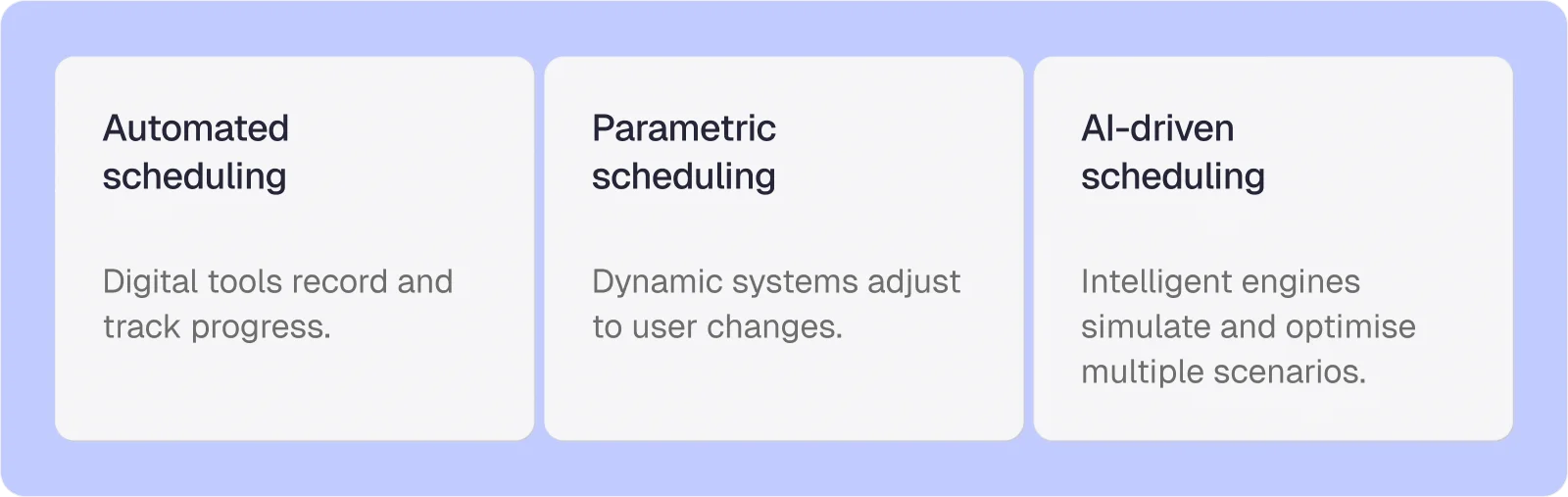
Most of today’s software falls into one of the two categories:
Automated scheduling: Programs like Onetrace digitise the planning process, making it easy to assign jobs, track progress, and share updates in real time.
Parametric scheduling: The user adjusts one variable, like a start date or crew size, and the system recalculates everything else.
Tools from both of these categories still depend on the user to decide what changes to make.
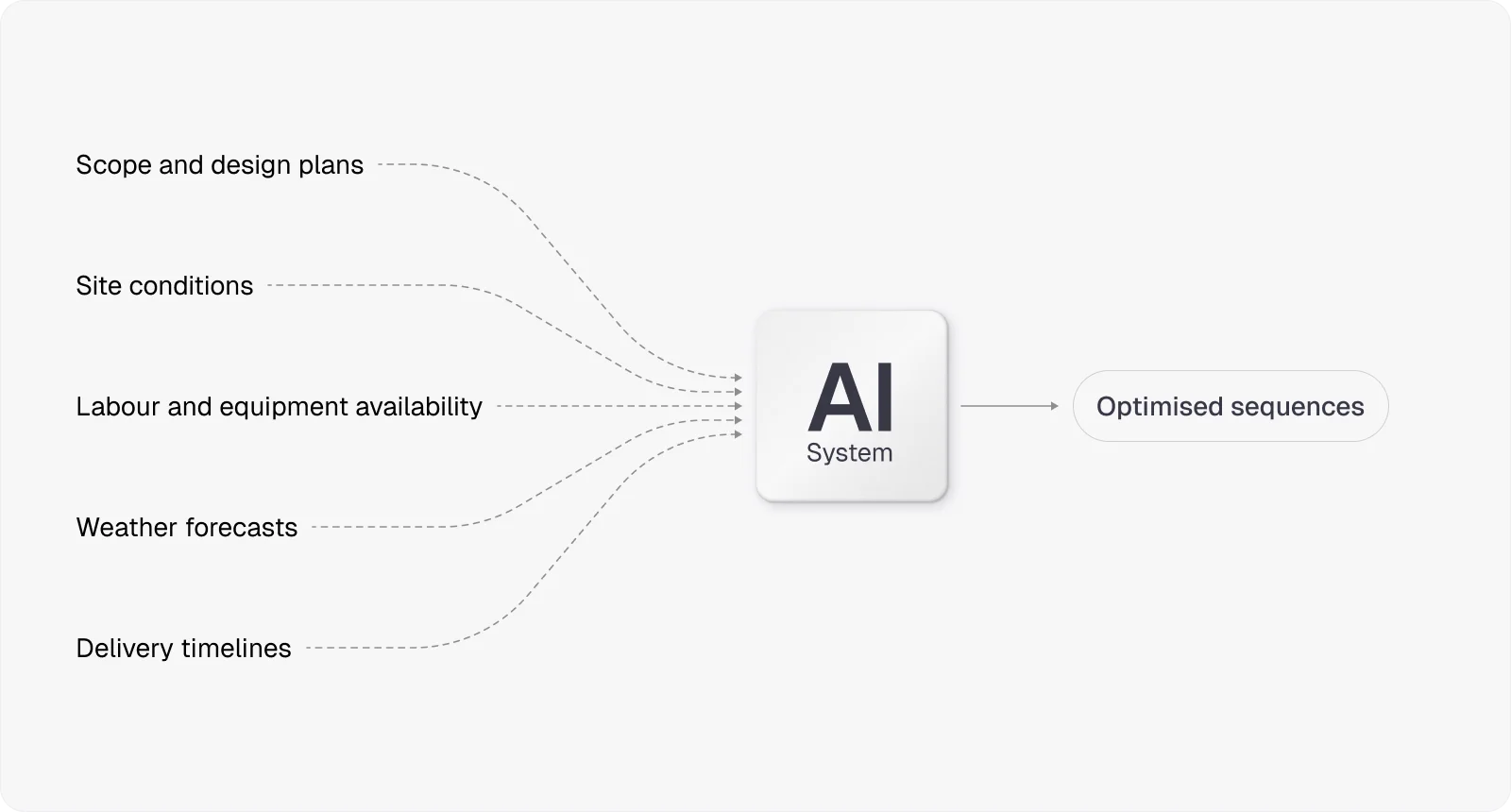
AI-driven construction scheduling goes a step further: the system itself can explore the “what ifs” based on the data from the scheduling software and user input.
The user input includes:
Scope and design plans
Site conditions
Labour and equipment availability
Weather forecasts
Delivery timelines
Then, instead of producing one static plan, the system creates and tests thousands or even millions of possible sequences.
AI asks the same questions as your planning team does, only faster and at scale:
What if we brought in a second excavator to shorten the groundwork phase?
What if we switched to prefabricated wall panels instead of on-site assembly?
What if the delivery of steel framing was delayed by a week?
Every change runs through the virtual model until the software finds combinations that balance time, cost, and resource constraints.
That’s the essence of AI construction scheduling: using the technology not just to record a plan, but to discover the best one. And when the conditions change, the model will adapt.
A week of rain, a crane out of service, or a delayed shipment, and the system will automatically reshuffle work, reassign crews, or reschedule deliveries to protect critical paths and productivity.
How AI construction scheduling works step by step
Artificial intelligence can’t schedule a project out of thin air. It needs structure—clear data, connected systems, and defined processes from existing scheduling software.
The table below shows how these elements come together to create an AI construction scheduling workflow.
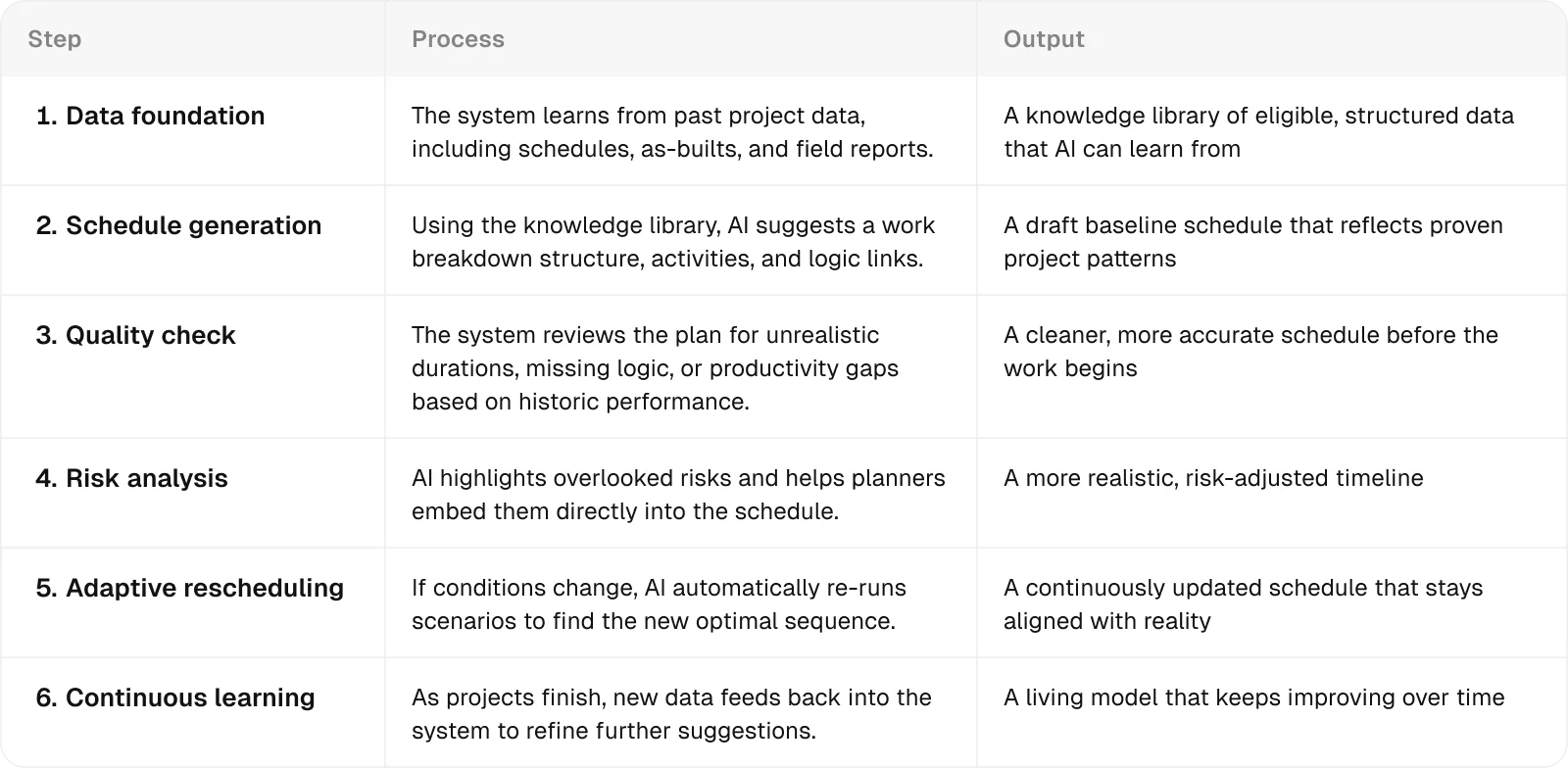
This process works because AI-powered construction scheduling combines two kinds of intelligence:
Language-based intelligence: It reads specifications, reports, and project correspondence.
Mathematical intelligence: It’s built to calculate, simulating dependencies, constraints, and resource limits.
Together, they make a hybrid system that can both interpret and optimise.
In construction, this precision matters because “close enough” isn’t good enough. A schedule has to work in the real world, under real conditions.
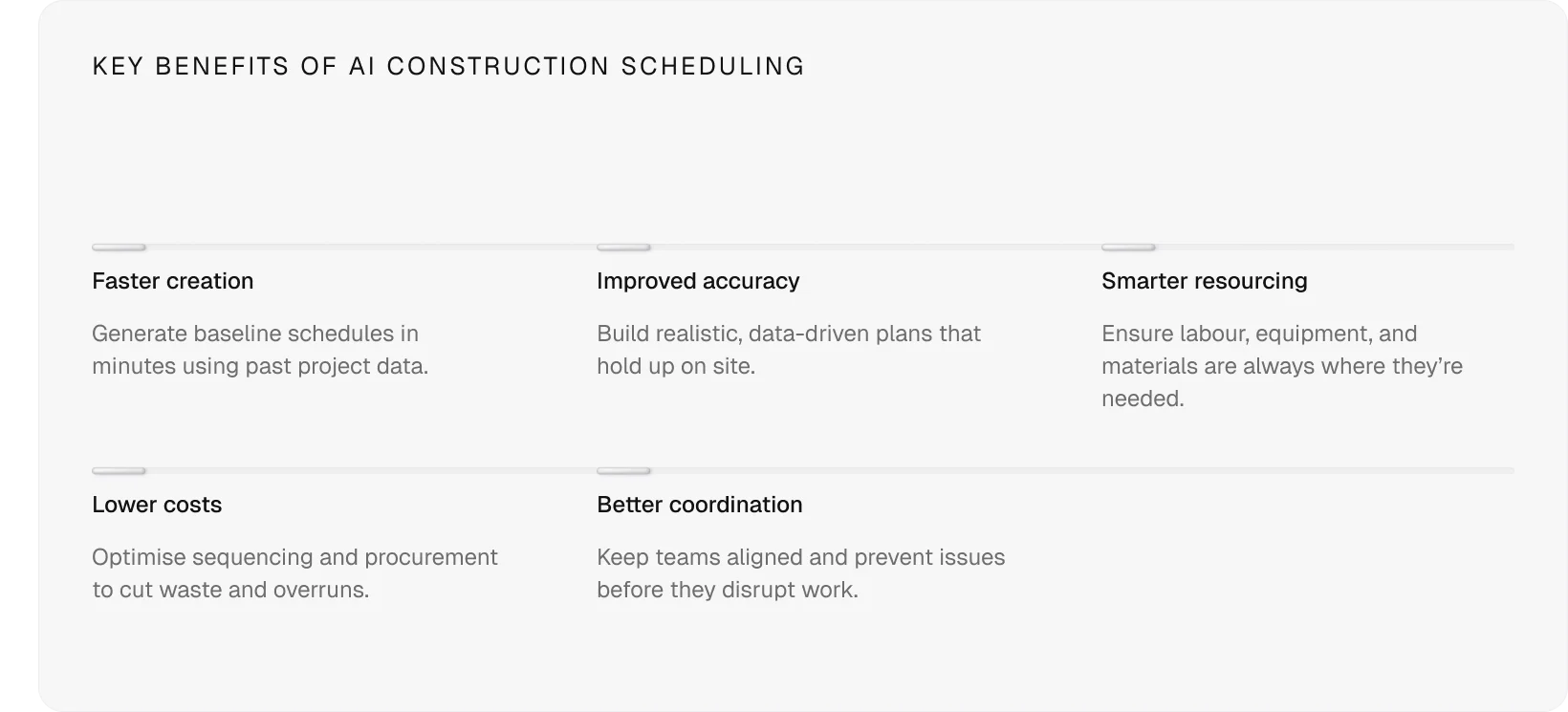
5 key benefits of AI for construction scheduling
AI construction scheduling isn’t just for billion-pound infrastructure projects.
While large firms were early adopters, small and mid-sized contractors now have access to user-friendly AI tools that don’t require technical expertise. A visual no-code AI agent builder bypasses this technical hurdle, letting operational teams create AI assistants for their workflows seamlessly.
Here’s how these AI-powered platforms can help teams of any size.
1. Build schedules in a fraction of the time
Depending on project size, building a schedule can take weeks or even months. With so many dependencies, from MEP coordination and permits to procurement and access, there are a lot of moving parts to line up before the first shovel hits the ground.
AI speeds up this process by learning from your own project history: schedules, timesheets, BIM models, reports, and signed documents. It recognises patterns and suggests structure, sequencing, and durations automatically.
What once took weeks of setup can now be done in days, helping teams move faster, increase capacity, and pursue more opportunities.
2. Plan with accuracy that matches the real world
Speed only matters if the plan delivers in reality. That’s why it’s important to note that AI creates more accurate schedules, not just faster ones.
When it learns from well-organised project data, it benchmarks activity durations against what your team actually achieved. This limits optimism bias and produces timelines that hold up on site.
For teams with data scattered across legacy systems, tools like Glean's AI for deep search can help surface and index that historical project data before it's fed into the scheduling model.
With more realistic schedules and data-driven insights, project managers can make confident, fact-based decisions that keep work running smoothly and reduce costly surprises later on.
3. Keep people and equipment working, not waiting
According to industry experts, as much as 20% to 30% of total working time in construction is lost to downtime. Crews wait for materials, equipment, and other trades to finish, wasting time that cuts into productivity and profit.
AI helps close those gaps.
By analysing live data from schedules, deliveries, and site updates, it can spot clashes early and suggest smarter sequencing. This way, the right people and equipment show up when they’re actually needed, not hours too soon or a day too late.
The result?
Fewer bottlenecks, smoother hand-offs, and a site that stays productive from start to finish.
4. Cut costs without cutting corners
AI doesn’t just save time; it also saves money. It makes your construction projects more profitable by:
Reducing material waste through smarter procurement and accurate quantity forecasts
Predicting price changes so teams can lock in better rates before costs rise
Spotting financial risks early with real-time cost tracking and alerts
Keeping crews and equipment productive by preventing downtime and overruns
5. Keep teams aligned and problems off the schedule
One of the biggest benefits of construction software is that it keeps everyone on the same page, improving communication and collaboration.
AI-powered construction scheduling does the same, but it also looks ahead. It predicts conflicts before they happen.
By analysing schedules, resource loads, and field progress, AI can flag clashes between crews, trades, or deliveries in advance. This means fewer last-minute phone calls, rework, or lost days and smoother communication between everyone on site and in the office.
5 major challenges to adopting AI in construction scheduling
In 2025, AI became the top construction technology for increased investment, with 56% of the surveyed firms planning to boost spending. Yet, nearly half still report no implementation at all, showing that interest is high, but adoption remains cautious.
Here’s what’s holding many construction teams back.
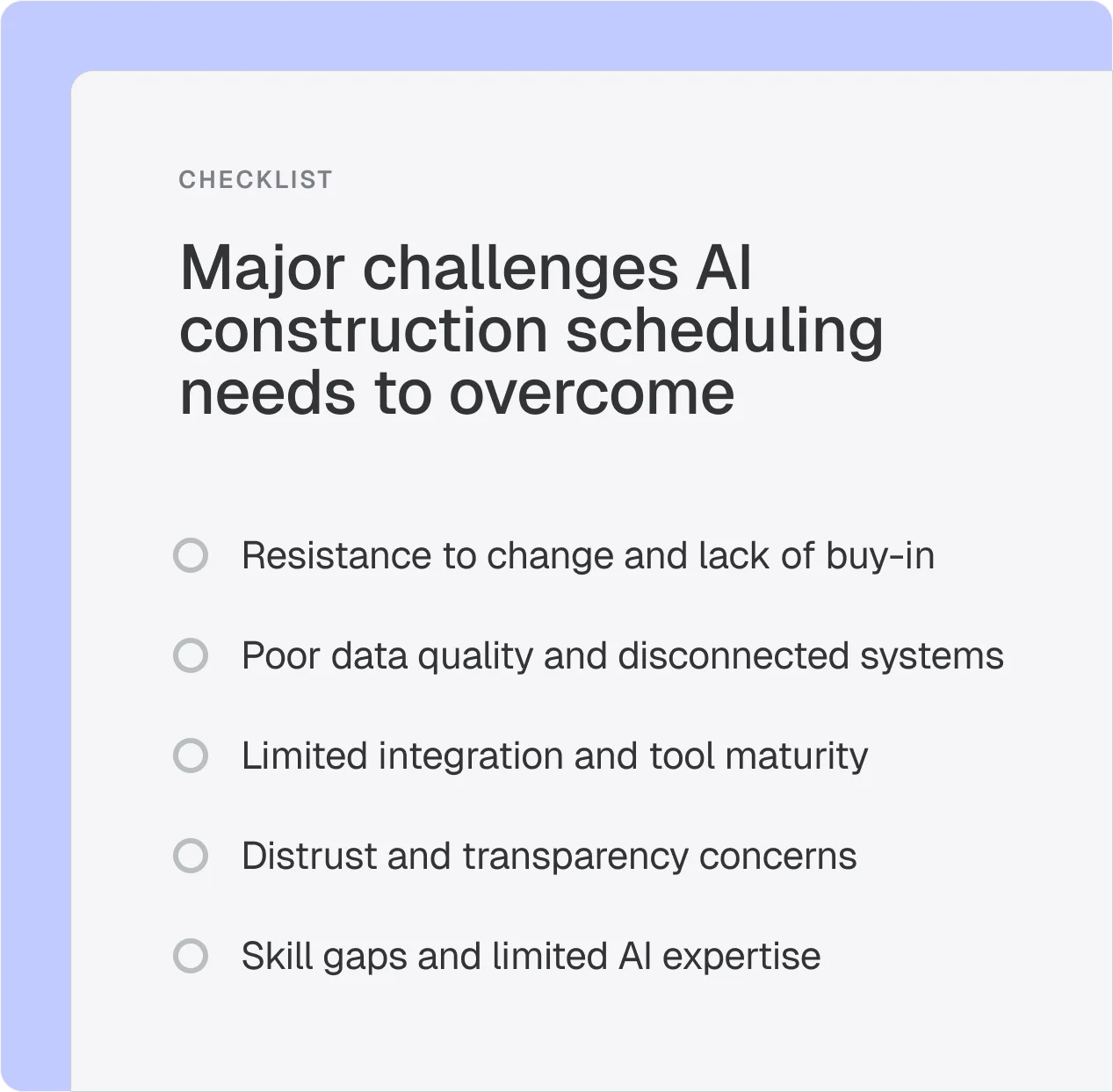
1. Resistance to change and lack of buy-in
The biggest challenge to using AI in construction scheduling isn’t the technology itself. It’s the people who are supposed to use it.
Most construction teams are used to tried-and-tested methods, and construction is generally slow to adapt to new technologies.
Adopting AI means changing how projects are planned and managed, which requires training, time, and trust.
2. Poor data quality and disconnected systems
AI is only as good as the information it learns from.
Inconsistent or incomplete data will likely result in unreliable predictions. That’s why construction organisations first need centralised data systems that capture progress, costs, and field reports all in one place. To maintain data integrity and meet GDPR requirements, organisations should also incorporate cloud governance tools to stay compliant and secure.
Pro tip:
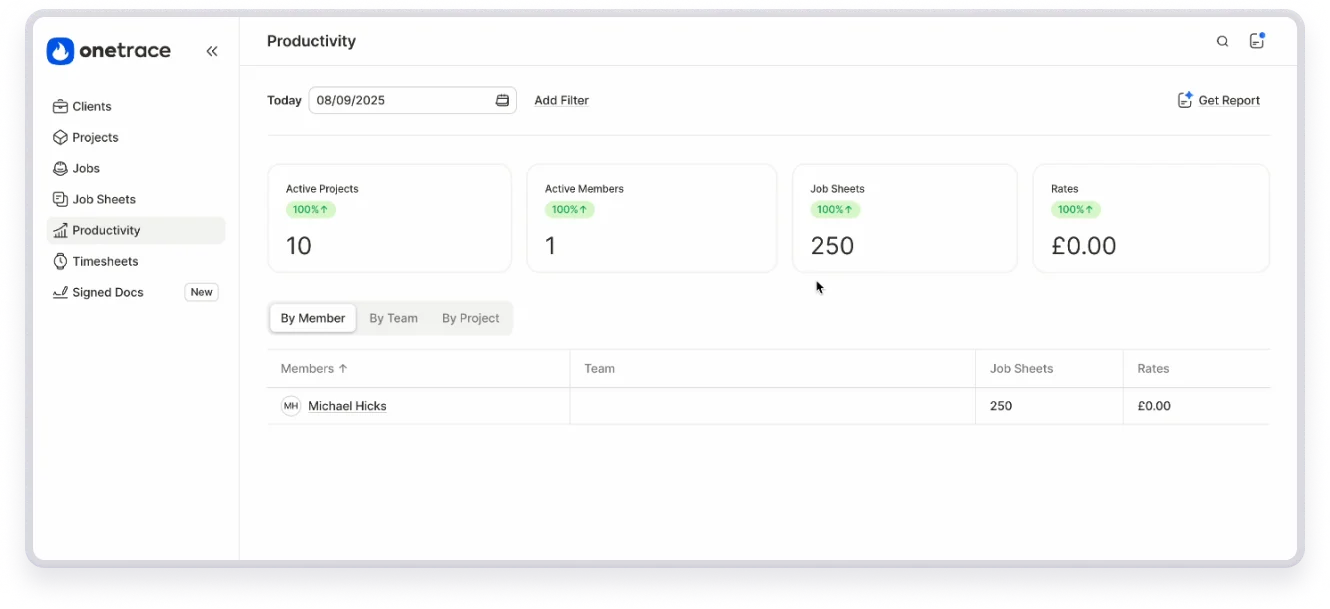
Use a centralised platform like Onetrace to keep all data on projects, team members, and cost in one place, so your AI tools can work with complete, reliable information.
3. Limited integration and tool maturity
AI-driven scheduling is relatively new in the construction industry. This means that the market isn’t yet flooded with solutions that can connect with every system contractors rely on.
And even when integration exists, some users find the results underwhelming, with software still requiring heavy manual input to be useful. For the most part, truly autonomous generative scheduling remains more promise than practice.
4. Distrust and transparency concerns
Schedulers often rely on intuition and experience. That’s why some of them may hesitate to trust algorithms with decisions that affect millions in cost or weeks of work.
This challenge could be overcome with full transparency. AI-powered scheduling tools must show why they’re suggesting something in order to avoid the so-called “black box” effect.
5. Skill gaps and limited AI expertise
AI adoption requires new technical skills that many construction teams don’t have—at least, yet.
Smaller firms in particular struggle to train staff or afford custom models for each project type. Ensuring that the AI-powered scheduling tools are intuitive and scalable is key to industry-wide adoption.
Beyond AI construction scheduling: Other applications of AI in construction management
Even with all the challenges to its adoption, one thing’s for sure: AI isn’t going anywhere.
Although 36% of professionals rank scheduling as the area that stands to gain the most from AI, the technology is already reshaping many other parts of construction.
Some examples include:
Design and planning optimisation: Generative design tools test thousands of layouts to find the safest, most efficient, and most sustainable options.
Smarter cost estimating: AI analyses past projects and market data to create faster, more accurate bids and budgets.
Supply chain management: AI can predict material demand, optimise delivery timing, and reduce both shortages and surplus stock.
Real-time site safety monitoring: Using on-site cameras and sensors, AI can detect unsafe conditions or behaviours and alert the supervisors instantly.
The experts behind today’s leading AI construction scheduling platforms also agree on one thing: this is only the beginning.
In the near future, AI will take on even more of the heavy data work, leaving engineers and project teams free to focus on decisions that require human judgment.
Some of the developments already on the horizon include:
Automated specification matching: Design specs like lighting or materials will get instantly linked to compatible products from the manufacturers.
Conversational project databases: Teams will be able to query project data in plain English, with questions like, “How many doors on Level 5 are installed but not certified?”
Contract management: AI will streamline submittal reviews, risk analysis, and dispute resolution.
A partner, not a replacement
Artificial intelligence isn’t replacing construction schedulers. It’s only reimagining their roles.
Instead of spending days revising charts or chasing updates, planners will focus on evaluating the options AI generates, balancing time, cost, and risk across scenarios that were once impossible to test manually.
But as the adoption of AI construction scheduling grows, success will depend on one thing above all: data.
The more connected, accurate, and accessible your project data is, the more value AI can deliver. That’s why platforms like Onetrace will stay at the centre of the shift, providing the structure and visibility the next-generation scheduling relies on.
If you haven’t already, get started with Onetrace to get your data in order for what experts are calling the fourth generation in construction scheduling.
FAQs
1. Can AI build a construction schedule?
AI can build a construction schedule, but it needs quality project data and human oversight to ensure the final plan is accurate.
2. Will construction be taken over by AI?
No, AI won’t take over construction. It’s designed to support planners, engineers, and site teams, not replace their expertise or decision-making.
Marketing Team
@Onetrace
The Onetrace marketing team is passionate about sharing insights, ideas, and innovations that help construction businesses stay connected, compliant, and efficient. Combining industry expertise with a love for clear communication, we aim to deliver content that empowers professionals to work smarter and safer.