Subcontractor types: A labour classification guide 2026

By
Marketing Team
@Onetrace
A subcontractor is any individual or business hired by a main contractor to carry out a defined scope of work on a construction project, whether that’s a single trade, a specialist package, or a phase of a larger build.
Subcontracting is a well-established part of the UK construction industry. While no official figures show what proportion of the 2.057 million people working in construction today are subcontractors, one fact is well-known: demand for subcontracted labour has never been stronger.
Whether you’re already working as a subcontractor or just starting out, making the most of that demand starts with understanding where you fit within the subcontracting model.
This guide explains the main subcontractor types and their practical implications to help you learn more about your tax obligations, insurance cover, contracts, and responsibilities.
Key takeaways
Subcontractor types are about more than trade specialisms
The classifications that matter most are how you supply work, how you’re paid and taxed, and how your business is structured.
Your subcontractor type affects your responsibilities
Different classifications come with different obligations around tax, insurance, compliance, supervision, pricing, and liability. It’s important to understand where your business fits.
Most UK subcontractors work under the Construction Industry Scheme (CIS)
CIS offers independence and remains the dominant model in construction, but it also means taking responsibility for your own tax affairs, income fluctuations, and compliance requirements.
Growth creates new management challenges
As you move from working alone to managing crews or specialist teams, you’ll need stronger processes for training records, health and safety, documentation, workforce tracking, and supply chain oversight.
The right systems help subcontractors scale without losing control
Platforms like Onetrace help growing subcontractor businesses manage compliance, project documentation, workforce visibility, quality assurance, and reporting from a single place, making it easier to take on larger projects while maintaining high standards.
What are the types of subcontractors in construction?
When people talk about types of subcontractors in construction, they usually mean trades, such as roofing, plumbing, and carpentry.
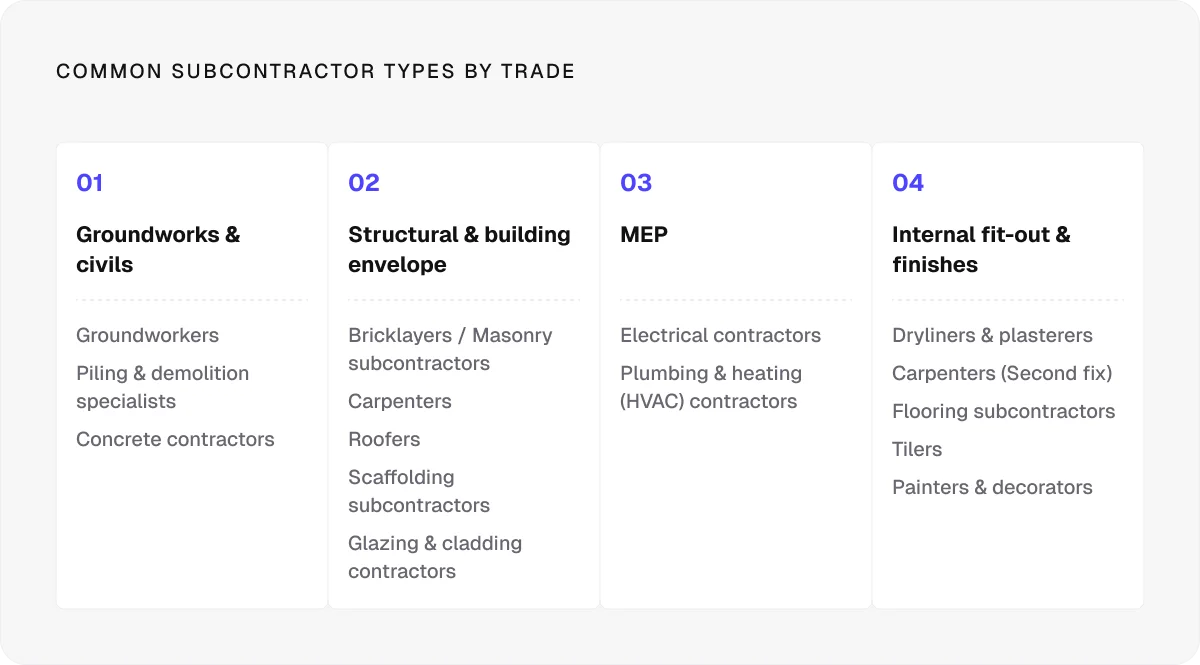
However, your trade is just your specialism. It doesn’t define how you’re engaged, how you’re paid, or what you’re liable for on a project, and those are the factors that shape how you work.
The subcontractor types that matter for running your business are defined by three factors:
Commercial arrangement (what you supply)
Employment and engagement status (how you’re paid and taxed)
Organisational form (how your labour is structured)
1. Commercial arrangement
Based on what they supply, UK subcontractors fall into two categories:
Labour-only subcontractors
Bona fide subcontractors
Labour-only subcontractors (LOSC)
A labour-only subcontractor supplies their time and skills—nothing else.
The main contractor provides the materials, plant, and equipment, while LOSC works under their direct supervision, follows their risk assessments and method statements, and has no responsibility for managing others or the wider project.
From an insurance standpoint, LOSCs are treated as employees.
This means they are covered by the main contractor’s employers’ liability policy and aren’t responsible for any quality issues or accidents that arise from their work.
LOSCs are typically paid by the hour, day, or week.
Bona fide subcontractors (BFSC)
A bona fide subcontractor operates independently. They quote the main subcontractor for the job, supply their own materials, tools, and equipment, produce their own risk assessments, and take responsibility for the quality and safety of their work.
BFSC can also bring in their own staff or delegate work to others.
This level of independence comes with more responsibility but also more control.
As a BFSC, you invoice for your work—usually at a fixed price or in agreed stages—and carry your own public liability insurance. Bear in mind that average construction materials prices in the UK are now almost 40% higher than pre-pandemic levels, so accurate pricing is critical when quoting for bona fide work.
2. Employment and engagement status
How you’re paid and taxed as a subcontractor depends on your legal status. In the UK, this comes down to two main frameworks: PAYE and CIS.
PAYE
Pay As You Earn (PAYE) is the system His Majesty’s Revenue and Customs (HMRC) uses to collect income tax and National Insurance directly from wages.
If you’re on PAYE, your employer handles your tax before you’re paid. You don’t need to file a Self Assessment return for that income, and you’re entitled to employment rights, including sick pay, holiday pay, and redundancy protection.
In 2024, there were 370,770 VAT and PAYE-registered construction firms in Great Britain, and if you’re working on larger sites or for established contractors, PAYE is likely part of the picture.
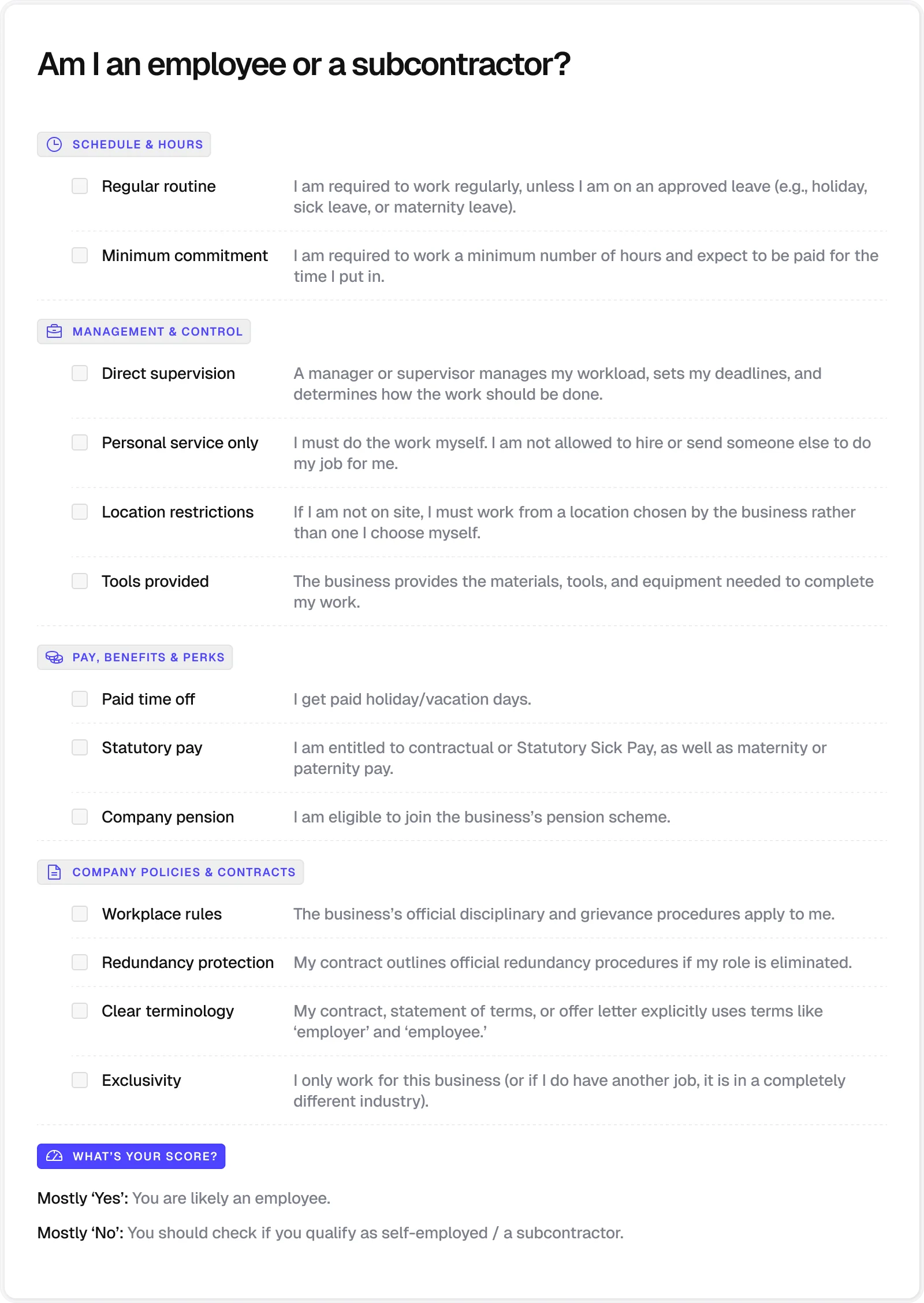
The challenge with PAYE in construction is that the line between employee and subcontractor isn’t always clear.
A worker might call themselves a subcontractor, but if the reality of how they work looks more like employment—set hours, supervised work, tools provided by the contractor—HMRC may treat them as an employee for tax purposes. Getting this classification wrong can result in unpaid tax and penalties for both parties.
CIS
The Construction Industry Scheme (CIS) is the relevant framework for most subcontractors in the UK.
The scheme sets out how contractors must handle payments to subcontractors—deducting tax at source and passing it to HMRC as an advance payment against the subcontractor’s tax and National Insurance liability.
Under CIS, a subcontractor is any person or business that has agreed to carry out construction work for a contractor. This can include:
Self-employed individuals and sole traders
Partnerships and limited companies
Labour providers, officially known as gang leaders
Labour agencies supplying workers under a construction contract
Foreign businesses carrying out construction work in the UK
Self-employment under CIS remains the dominant model in UK construction.
In the first quarter of 2026, self-employed workers accounted for 39% of the entire construction workforce—slightly above the long-run average of 37% since 1997. With employed workers down 6% year-on-year, the sector’s reliance on flexible, self-employed labour shows no sign of easing.
However, that flexibility comes with exposure.
Self-employed tradespeople earned an average of £1,000 per week in January 2026—down 7.7%—as bad weather disrupted work across England and Wales. External trades were hit hardest, with bricklaying earnings down 15.9%, scaffolding 15.4%, and demolition 12.9%.
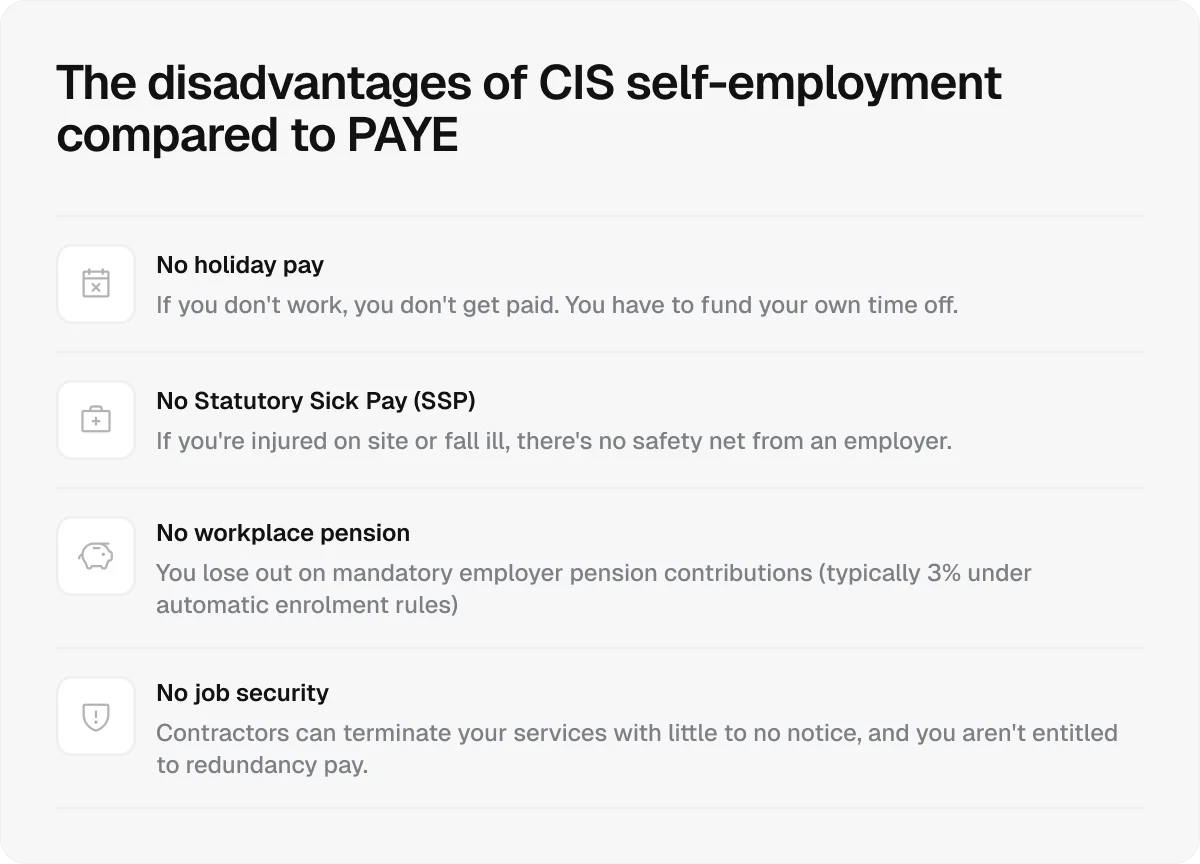
These figures are a reminder that, under CIS, income variability is part of the deal. There’s no sick pay, no guaranteed hours, and no buffer when conditions turn against you.
The UK construction sector’s reliance on self-employed labour has also brought greater scrutiny of employment status.
The problem is that not everyone registered as self-employed is genuinely operating as an independent business. Some workers are only registered as self-employed to reduce tax and social security costs.
This is likely set to change.
The Employment Rights Act, introduced in December 2025 and being phased in through 2026 and 2027, proposes moving towards a single ‘worker’ status, replacing the current three-tier system of employee, worker, and self-employed.
For a sector built on flexible labour, the implications are significant. If the reforms go ahead, some workers currently treated as self-employed could be reclassified, affecting everything from employment rights and tax arrangements to labour costs and workforce planning.
While consultations on the proposals are still to come, it’s worth keeping a close eye on how these changes develop if you work under CIS.
3. Organisational form
In the UK, subcontractors typically operate as individual tradespeople, gangs or crews, or specialist subcontract firms.
Individual tradesperson
The simplest and most common form of subcontracting is the individual tradesperson. This is a self-employed worker who contracts directly with a main contractor to carry out a specific trade or package of work.
Examples include electricians, bricklayers, plasterers, roofers, and groundworkers working on their own account. These tradespeople are typically responsible for their own tools, insurance, tax affairs, and day-to-day delivery of the work they have agreed to complete.
This form is the starting point for many people entering the industry as subcontractors. It offers flexibility and independence, but also means taking full responsibility for managing workloads, finances, and compliance requirements.
Gang or crew under a labour provider
Some construction work is carried out by gangs or crews rather than individual workers.
In this arrangement, a contractor agrees on the scope of work with a labour provider, i.e., gang leader, who then organises and manages the workers carrying out the job.
Under CIS, the contractor’s direct responsibility is generally limited to the labour provider. The provider receives payment from the contractor and is responsible for paying the other crew members and handling any relevant tax obligations.
This structure is common in labour-intensive activities where several workers are needed to complete work efficiently, such as:
Groundworks
Demolition
Scaffolding
However, the arrangement changes if the contractor enters into separate agreements with individual crew members. In that case, those workers may be treated as separate subcontractors or employees, with the relevant CIS or PAYE obligations applying to each person individually.
Specialist subcontract firm
Specialist subcontract firms are established businesses that deliver defined packages of work using their own workforce, management team, equipment, and supply chain.
Common examples include:
Mechanical and electrical contractors
Cladding specialists
Steelwork contractors
Fire protection firms
Ground engineering companies
Rather than supplying labour alone, these firms often take responsibility for planning, supervision, materials procurement, quality control, and project execution within their specialist area.
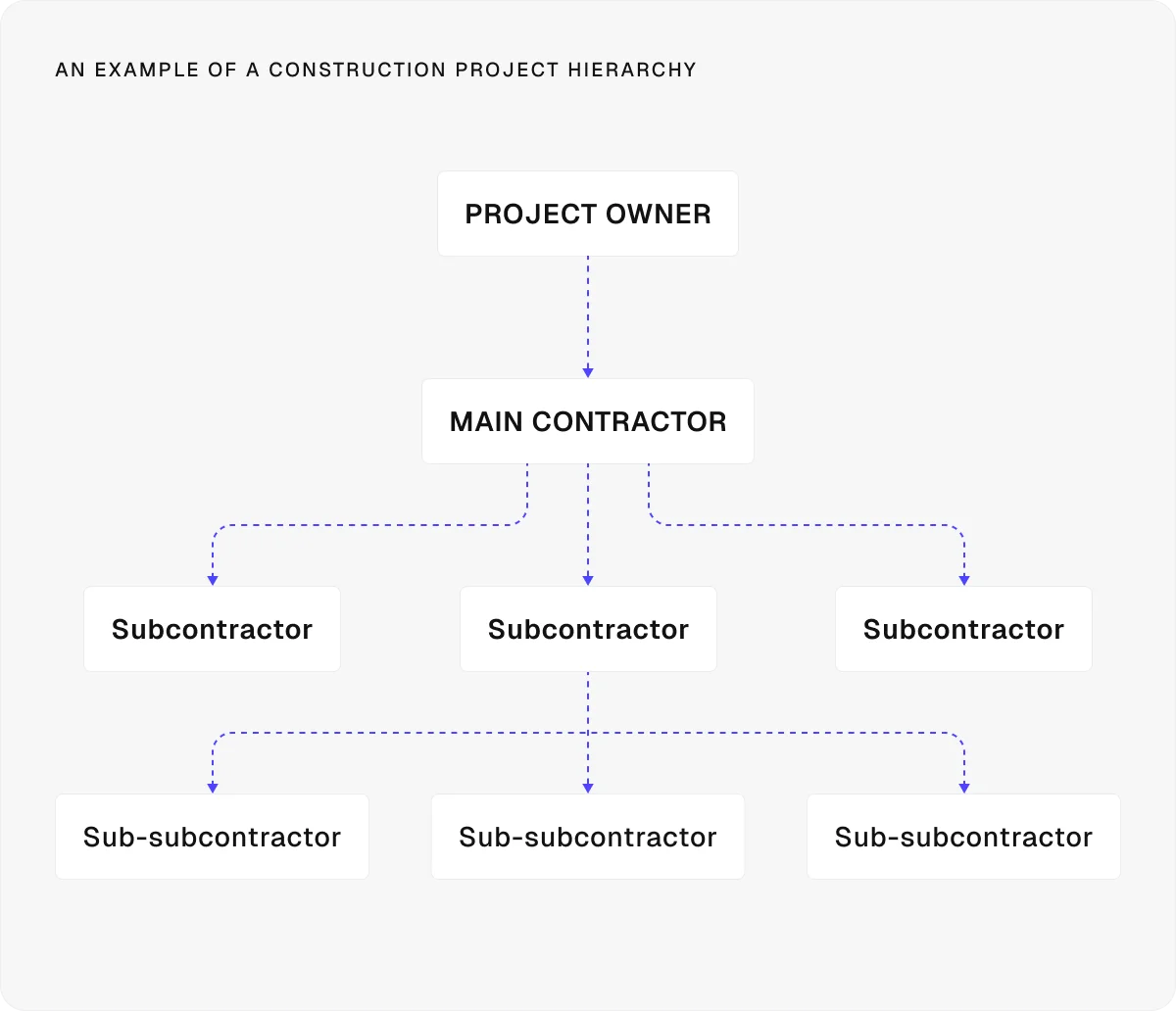
Many large construction projects rely heavily on specialist subcontract firms because they provide expertise that main contractors don’t hold in-house. In some cases, a specialist subcontractor may manage its own subcontractors.
How to manage different subcontractor types
Not all subcontracting businesses face the same management challenges.
If you’re a labour-only subcontractor working on your own, administration is relatively straightforward. You’ll still need to stay on top of tax, insurance, certifications, and contracts, but you’re only managing your own compliance and workload rather than coordinating a wider workforce.
Complexity tends to increase as subcontracting businesses grow.
Taking on additional workers, leading crews, or delivering larger specialist packages can open the door to bigger projects, higher turnover, and longer-term client relationships, but it also brings greater responsibilities.
As your operation becomes more complex, you’ll need to pay closer attention to:
Competency and training records: Qualifications, CSCS cards, trade certifications, licences, and training records all need to be tracked and kept up to date.
Health and safety compliance: Site inductions, risk assessments, method statements, permits, and Toolbox Talks form part of your ongoing safety responsibilities.
Insurance and liability: Appropriate cover must be maintained for your workforce, activities, and contractual obligations.
Document management: Contracts, policies, certificates, and compliance records need to be organised, accessible, and regularly reviewed.
Workforce tracking: Knowing who is working on each site, what work they’re carrying out, and whether they meet project requirements is essential for coordinating work effectively across multiple projects and locations.
Supply chain management: Any sub-subcontractors, labour providers, or specialists working beneath you need to be coordinated and rigorously monitored throughout the project lifecycle.
For many subcontractors, the move from sole trader to a labour provider or a firm is a natural step in growing the business. The ultimate challenge is making sure management processes keep pace as the operation expands.
Managing growth with subcontractor software
As your subcontracting business grows, so does the amount of information you need to manage.
A handful of certificates, timesheets, job records, and project documents can quickly grow into hundreds of forms, workers, locations, and compliance requirements spread across multiple sites. At that point, spreadsheets, paper records, and email chains just won’t cut it anymore.
That’s why many growing subcontractor businesses turn to subcontractor management software like Onetrace.
Built specifically for subcontractor businesses, Onetrace provides a single platform to manage the day-to-day requirements that come with larger projects and growing teams.
Its key capabilities include:
Compliance and document management: Store all project documents in one place while tracking signatures and acknowledgements to ensure workers have read and accepted critical information.
Standardised forms and inspections: Create custom forms for surveys, inspections, installations, and quality checks, with mandatory fields and templates that help ensure consistent data collection across every project.
Evidence capture and reporting: Record photographic evidence before, during, and after work, then generate professional reports that support client sign-off, audits, and compliance requirements.
Workforce and project visibility: Track who is working on each project, monitor attendance through digital timesheets, and maintain a clear view of progress across sites, teams, and operatives.
Quality assurance and approvals: Build structured approval workflows that allow supervisors, managers, and clients to review work, provide feedback, and maintain quality standards throughout the project lifecycle.
Material and cost tracking: Keep accurate records of materials, rates, and project costs to improve cost control, reporting accuracy, and invoicing.
Project planning and coordination: Schedule operatives, allocate resources, and keep site teams aligned through a shared view of projects and workloads.
Whether you’re evolving from a one-person operation into a larger subcontracting business or taking on larger projects, Onetrace can make it easy to manage growth.
Arrange a personalised walkthrough to see how the platform can help you create reliable processes that allow your business to scale without losing control of quality, compliance, or profitability.
FAQ
What are Tier 1, 2, and 3 contractors?
Tier 1 contractors are the main contractors appointed by the client to deliver a project. Tier 2 contractors are subcontractors hired by Tier 1 contractors to deliver major work packages, while Tier 3 contractors are specialist trades, suppliers, or local firms working further down the supply chain.
Are subcontractors different from contractors?
Yes. A contractor is hired directly by the client and takes overall responsibility for delivering the project, while a subcontractor is hired by the contractor to carry out a specific trade, service, or package of work.
Marketing Team
@Onetrace
The Onetrace marketing team is passionate about sharing insights, ideas, and innovations that help construction businesses stay connected, compliant, and efficient. Combining industry expertise with a love for clear communication, we aim to deliver content that empowers professionals to work smarter and safer.