Construction project scheduling: 10 best practices

By
Marketing Team
@Onetrace
Construction scheduling is the process of planning, sequencing, and managing all tasks needed to complete a build on time, making it one of the main drivers of project success.
Poor planning or unrealistic schedules are the leading cause of delays, cited by almost 40% of construction professionals.
And those delays are rarely small.
While some projects slip by just 2%, others run over 600% beyond the original schedule, which reinforces how critical it is to get scheduling right from the start.
Unforeseen site conditions, weather, supply chain disruptions, labour shortages, and coordination issues can all throw a schedule off course. That’s why it’s not enough to simply create a construction schedule; you need to build one that holds up in real conditions.
To help you do just that, this article outlines 10 construction project scheduling best practices.
Key takeaways
Break work into clear, actionable tasks
Well-defined tasks improve on-site visibility, make ownership obvious, and help you spot delays before they escalate.Build your schedule around real sequencing and constraints
Link tasks based on how work actually happens, so you can see knock-on effects early and adjust before delays spread.Use real input and data to set realistic durations
Combine site team input with historical data to avoid overly optimistic timelines that can quickly fall behind.Keep the schedule live and grounded in reality
Regular updates based on actual progress allow you to re-plan work, manage delays, and stay in control as conditions change.Use the right system to apply these practices consistently
Tools like Onetrace help you keep schedules accurate, track resources in real time, and connect planned work with what’s happening on site.
1. Break the project into actionable tasks
Construction projects involve a high number of moving parts.
So, when the scope is too broad or loosely defined, it becomes challenging to see what’s actually happening on site. That’s when gaps appear, responsibility gets blurred, and delays go unnoticed until it’s too late.
Breaking the project down into actionable tasks helps bring order to that complexity.
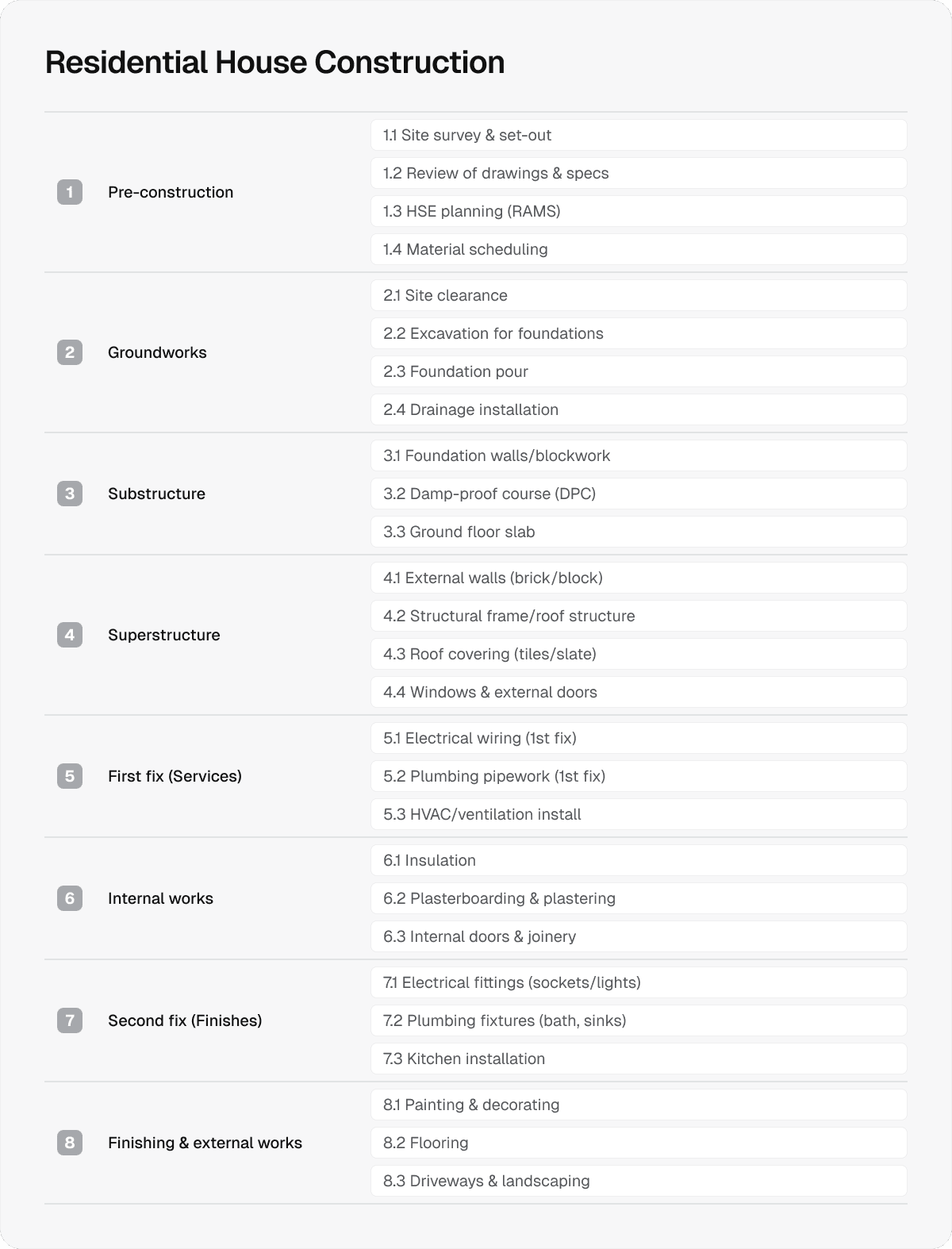
Instead of general phases like ‘construction’, the schedule is built around clearly defined activities, such as excavation, drainage pipe installation, and concrete pouring.
Each task should be detailed enough to measure progress and assign ownership, but not so small that it creates unnecessary admin. This level of detail makes the schedule easier to manage, improves coordination across teams, and helps surface delays before they escalate.
2. Sequence tasks based on real dependencies
Construction work follows a physical order.
For example, concrete needs to cure before walls go up, structural steel must be in place before decking starts, and electrical first fix needs to be complete before finishes can begin.
When a schedule ignores these relationships and focuses only on start and end dates, it quickly breaks down under real conditions.
To avoid this scenario, you must build your schedule on task dependencies. This means linking each activity to what comes before and after it through one of these dependency types:
Dependency type | Definition | Site example | The importance |
Finish-to-start | One task must finish before the next task can begin. | Brickwork must be completed before external rendering starts. | Activities that can’t overlap rely on this dependency. |
Start-to-start | One task must start before another can start. | Cable installation starts once containment installation begins. | Parallel workstreams are easier to manage with this approach. |
Finish-to-finish | One task must finish before another can finish. | Final inspections must finish before the project handover is completed. | Coordinated completion across tasks depends on this link. |
Lead / lag | A delay or overlap is applied between two linked tasks. | A drying period is allowed before painting begins. | Time gaps or overlaps between tasks can be modelled this way. |
If one activity slips, you can immediately see the impact on the rest of the project.
That visibility is what allows teams to re-sequence work or reallocate resources in order to protect key milestones before the delay affects the wider programme.
3. Get early input from those delivering the work
Schedules often look good during the planning stage, but break down once work starts.
For instance, access routes may not be available when needed, trades may be scheduled to work in the same area at the same time, and planned crew sizes may not match on-site capacity.
These challenges usually happen due to missing input from those responsible for delivering the work on site.
As a result, sequencing doesn’t reflect how work is carried out in practice, and practical constraints—like space, access, or handover between trades—aren’t built into the plan.
This is where subcontractors make a difference.
Their early input helps flag clashes, confirm realistic sequencing, and highlight constraints before they become problems.
4. Use real data to define task durations
Task durations are often based on assumptions or best-case scenarios, which causes schedules to drift. In real site conditions, work takes longer than planned, crews fall behind, and delays begin to stack across the programme.
Using real data helps prevent this.
This includes:
Historical data from similar projects
Proven productivity rates for key activities
Lessons learned from past work
This data is especially valuable for repeat activities, where past performance is a strong indicator of future output.
Where data is limited, the best course of action is to adopt a conservative approach and refine it as the project progresses.
Pro tip:
Base your durations on output, then adjust for real working conditions.
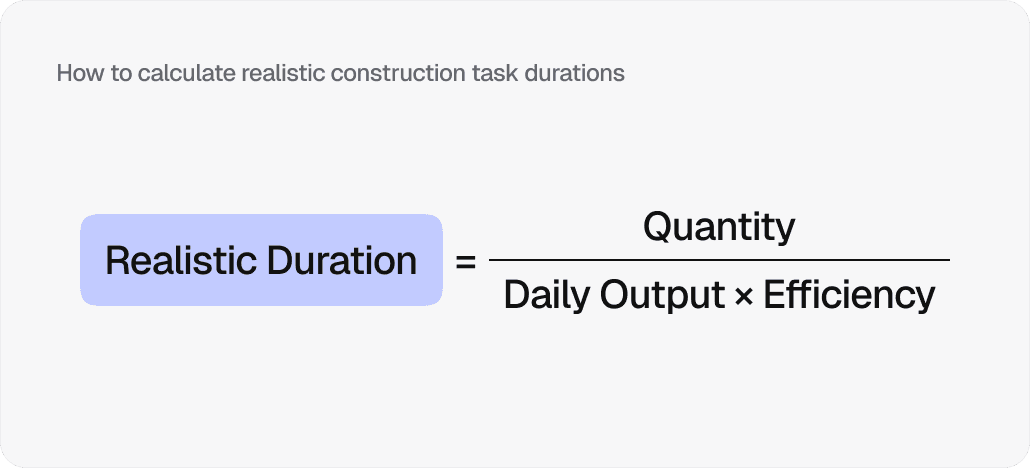
Start with a simple calculation: duration equals quantity divided by daily output.
For example, if a crew installs 100 square metres of tiling per day and the total scope is 500 square metres, the base duration is five days.
However, this duration must be adjusted to reflect real-world conditions, since crews are rarely productive for a full shift due to meetings, coordination, access issues, and other interruptions.
A common approach is to plan at 70% to 80% efficiency, rather than assuming full productivity. This means that the same five-day task may realistically take six to seven days on site.
This small adjustment makes a big difference, as it gives you a schedule you can realistically manage, not one you keep trying to catch up with.
5. Align the schedule with actual resource capacity
A schedule that doesn’t account for resources may look complete, but it won’t hold up on site.
That’s because it overlooks real constraints like crew availability, shared equipment, and access to materials, leading to clashes between trades, bottlenecks, and lost time.
To prevent these situations, every task in the schedule should be tied to real resources, primarily including labour, equipment, and key materials.
This approach forces you to check whether the plan is deliverable with the resources available on site, quickly exposing common issues, such as:
The same crew being assigned to multiple tasks at the same time
Critical equipment being double-booked across activities
Too many trades planned to work in the same area at once
Materials not being available when work is scheduled to start
Crews waiting on access, handovers, or preceding work to finish
Adjusting the schedule around these constraints helps prevent bottlenecks, reduce idle time, and keep work flowing across trades.
6. Update the schedule frequently (and honestly)
Construction schedules don’t stay accurate for long.
In a single day, access can get delayed, deliveries can arrive late, weather can disrupt planned work, and preceding trades—like plumbing or HVAC—can fail to finish on time.
That’s why in construction, treating the schedule as a fixed document quickly makes it irrelevant. Instead, you should update it regularly according to the actual site progress.
This means:
Recording progress based on what has actually been completed on site
Updating ongoing tasks to reflect current status, not planned status
Adjusting remaining durations based on real performance
Identifying delays early and understanding their impact on upcoming work
Re-planning sequences or resources where needed to keep work moving
7. Plan for risk and build buffers into the schedule
When it comes to executing construction projects, delays are not the exception; they are the norm.
Older research suggests that 77% of megaprojects are at least 40% late, while ‘regular’ projects are still at least 10%–30% late.
These figures show that uncertainty is built into construction projects and shouldn’t be ignored.
While you can’t eliminate these risks, you can manage their impact by:
Identifying high-risk activities early, especially those on the critical path
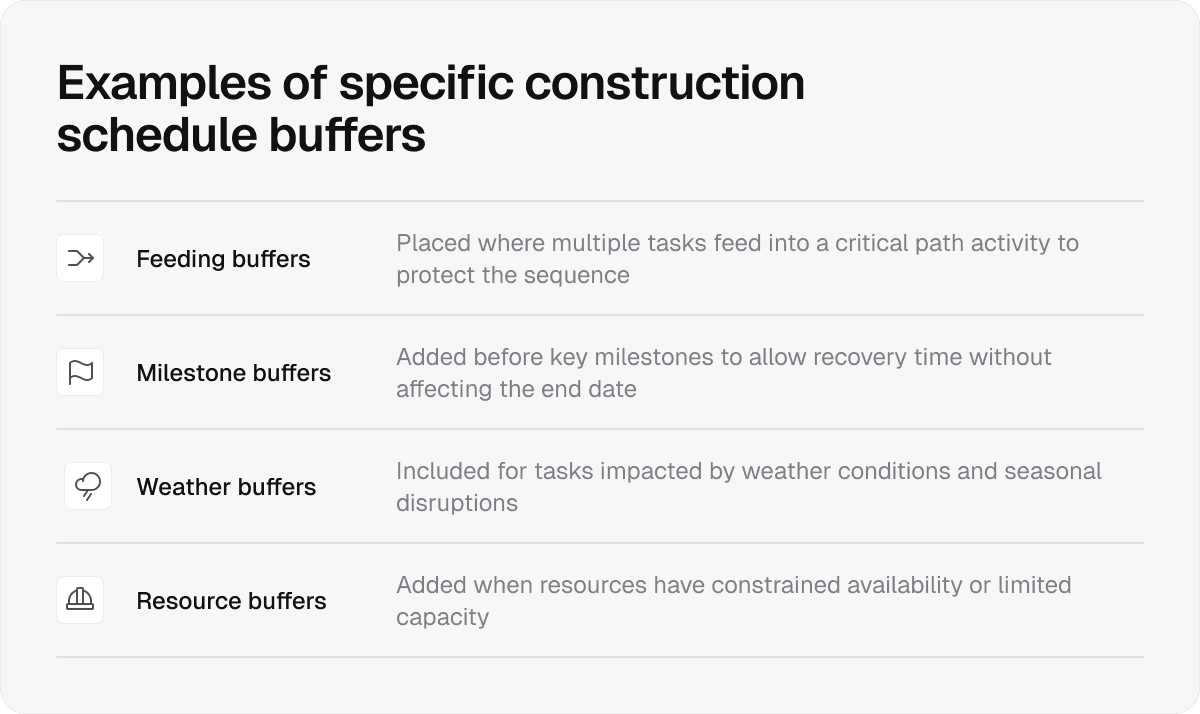
Adding buffer time where it protects the overall programme, not individual tasks
Planning mitigation actions in advance, so teams know how to respond when delays occur
Pro tip:
Buffers shouldn’t be hidden inside task durations. When every trade adds extra time ‘just in case’, the schedule becomes bloated and harder to manage.
A better approach is to keep task durations realistic and manage buffer time separately.
This makes risk visible, allowing you to track how much buffer is being used and act before it runs out.
8. Make the schedule easy to understand
A construction schedule is only useful if people can understand and act on it.
Long Gantt charts and complex plans often stay at the office level, while site teams work from incomplete or outdated information.
To make the schedule usable:
Share simplified, task-focused views for site teams.
Highlight key milestones, constraints, and handover points.
Use visual formats that are quick to read and update.
Keep communication regular through site meetings and daily coordination.
Clear communication, in particular, reduces confusion between trades and helps teams stay aligned.
When everyone understands the plan, coordination improves, and work flows more smoothly across the site.
9. Use short-term lookahead planning
High-level schedules are too broad to manage daily work on site.
They show the overall plan but don’t help teams deal with what needs to happen this week or next.
Short-term lookahead schedules—typically covering two to six weeks—bridge that gap.
They focus on upcoming work in enough detail to coordinate trades and prepare for what’s ahead. This turns the schedule into a practical tool for day-to-day delivery, not just long-term planning.
10. Get the most out of scheduling software
Scheduling tools are now standard across the construction industry, and their use continues to grow.
In the UK alone, the construction software market is expected to reach around £628 million by 2035, with scheduling and project management tools accounting for most of that growth.
In other words, just using scheduling software is no longer the differentiator. The difference comes from how well it’s used.
In practice, this means:
Keeping an accurate, real-time view of who is working where
Spotting and resolving conflicts before they lead to double-bookings or missed work
Making sure both office teams and operatives are working from the same, up-to-date information
Reducing manual coordination, like calls, messages, and last-minute reshuffling
Linking planned work with actual progress to spot gaps and missed work
Software should support good scheduling practice, not replace it.
Turning construction project scheduling best practices into day-to-day work
Before you can get the most out of scheduling software, you need the right system in place.
Onetrace is designed around the day-to-day realities of construction work, helping you keep schedules accurate as conditions shift on site.
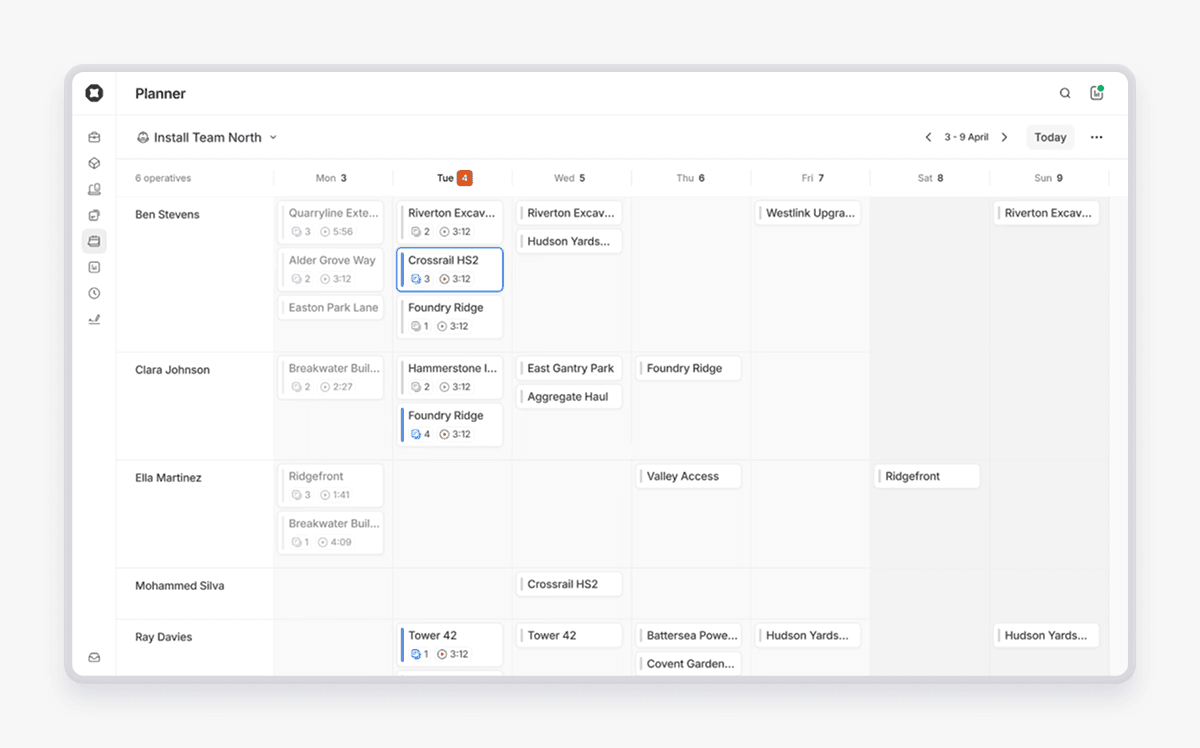
With this comprehensive construction site management software, you can do the following:
Keep schedules live and up to date: A visual planner lets you assign operatives and adjust schedules quickly as work changes, without rebuilding the plan.
Stay on top of resources and availability: Timesheets and live attendance tracking show who is on site and when, making it easier to spot gaps or over-allocation early.
Connect planned work with actual progress: Operatives can capture work, photos, and updates directly from the site, giving you real-time visibility instead of relying on reports after the fact.
Reduce delays and rework through better coordination: Drawings, pins, and structured site data help teams understand exactly what needs to be done and where, improving sequencing and handovers.
Keep a traceable record of changes and completed work: Variation tracking, reports, and photo evidence create a strong audit trail, reducing disputes and speeding up sign-off.
Keep teams aligned without constant calls and messages: Mobile access ensures operatives always have the latest schedule, job details, and documents, even when working offline.
When the system supports how work actually happens on site, the construction project scheduling best practices become part of day-to-day operations rather than extra effort.
Share how you’re managing schedules today in a personalised demo and see how Onetrace can help you reduce manual coordination, avoid clashes, and keep work moving across sites.
FAQ
How detailed should a construction schedule be?
A construction schedule should be detailed enough to track progress and assign responsibility, but not so granular that it becomes hard to manage. Each task should be measurable, clearly owned, and typically span a few days to a couple of weeks.
How often should a construction schedule be updated?
A construction schedule should be updated at least weekly, and more often on fast-moving projects. Updates should reflect actual site progress so you can spot delays early and adjust before they spread.
Marketing Team
@Onetrace
The Onetrace marketing team is passionate about sharing insights, ideas, and innovations that help construction businesses stay connected, compliant, and efficient. Combining industry expertise with a love for clear communication, we aim to deliver content that empowers professionals to work smarter and safer.