How to grow your plumbing business: 13 proven strategies

By
Marketing Team
@Onetrace
Plumbers provide work that is an essential part of modern society, and demand for those skills continues to grow worldwide.
In the UK alone, industry forecasts show that more than 70,000 new plumbers will be needed by 2032 just to keep pace with demand.
For anyone starting a plumbing business—or looking to grow an existing one—this presents a clear opportunity. The key challenge is building a business that can meet that demand sustainably.
To help you do exactly that, this guide on how to grow your plumbing business sets out 13 practical strategies that work in real trade businesses.
Key takeaways
Growth starts with clarity, not guesswork
Before scaling, you need a clear view of your local market, your competitors, and the customers you want to serve. Understanding where demand actually sits helps you focus time and money on work that pays off, instead of spreading effort too thin.Visibility and trust drive enquiries
Strong branding, a simple high-performing website, local visibility, and genuine reviews all work together to turn searches into phone calls. Customers choose plumbers they recognise and trust, especially when they have never worked with them before.Repeat work is more reliable than constant lead chasing
Referral programmes and maintenance plans help turn one-off jobs into long-term relationships. They cost less than ads, bring in warmer leads, and create steadier demand over time.Systems matter as much as marketing
Even with strong demand, growth stalls if jobs, people, and information are poorly organised. Standardised pricing, fast responses, and clear internal processes reduce friction and protect margins as workload increases.Onetrace helps turn growth into something manageable
Most growth strategies only work if your day-to-day operations can keep up. Onetrace gives you clear traceability and workforce control, helping you organise work, prove what’s been done, and scale without adding back-office strain.
1. Study your market before you scale
Strong demand for plumbers doesn’t mean work is evenly shared.
A significant share of the UK’s 46,336 plumbing, heating, and air-conditioning businesses are likely competing for the same local customers as you are.
That’s why proper market research should come first.
The goal is to understand:
Your local market and where demand is strongest
Your competitors and how they position themselves
Your ideal clients and the problems they care about
You can do this by searching local plumbers online, reviewing their services and pricing, and speaking directly to customers about what they struggle to find.
Your findings will help you focus your effort where it pays off.
2. Make your business recognisable
It’s easy to think that your technical skills are all that matter. While quality workmanship is undoubtedly the foundation of any plumbing business, customers usually notice the difference only after the work is done.
Before that point, strong branding helps them recognise you, remember you, and feel confident choosing you in the first place.
To build a recognisable brand, you should focus on:
A clear logo, so customers spot you instantly
Consistent colours and fonts to look established
A simple tagline to explain what you’re about at a glance
Branded vehicles and uniforms to reinforce your name wherever you’re working

3. Build a website that brings in work
In today’s market, digital marketing matters just as much as its traditional counterpart, if not more. And the starting point for all digital marketing efforts should be a solid website.
Yet, a 2022 survey of UK tradespeople found that 63% of plumbers didn’t have their own website. If you’re one of them, you’re invisible to a large share of customers who search online first.
Your website doesn’t need to be complex; it should load fast and display the following elements:
Clear services and service areas
Tap-to-call phone number
Simple contact or booking form created with Amelia
Customer reviews or testimonials
Trust signals like reviews, licences, and guarantees
When done right, your site becomes a steady source of enquiries, not just an online placeholder.
4. Make your business easy to find
With your foundations in place, you can focus on online visibility.
This means making sure your business is visible and easy to act on wherever potential customers look for a plumber.
The table below outlines the most valuable visibility channels for plumbing businesses, and what actually matters on each one:
Channel | Why you need it | What you should pay attention to |
Google Business Profile | Helps you appear in local searches and maps when customers need a plumber | Accurate service areas, categories, opening hours, photos, and contact details |
Local search results | Captures high-intent customers actively looking for services | Clear location signals, relevant service pages, consistent business details |
Facebook business page | Keeps you visible in local communities where recommendations happen | Complete profile, regular updates, enabled messaging, correct contact info |
Trade directories and databases | Builds trust with customers who are checking your credentials | Up-to-date listings, accreditations, and matching contact details |
5. Build trust with genuine customer reviews
There’s one word that comes up repeatedly when talking about how to grow a plumbing business: trust.
But how do you earn the trust of customers who have never met you? By showing proof that others already rely on your work.
More than half of UK adults use online reviews when choosing local services, making them one of the strongest trust signals available. That’s why building reviews early matters.
Keep in mind that your reviews should be genuine, relevant, and lawful, in line with consumer protection rules.
To gather such reviews, you should try:
Making review requests a standard part of the job close-out
Sending a simple review link by text or email to previous customers
Responding professionally to every review
6. Build repeat and referral work
While investing time in your online presence is important, don’t forget that around nine in ten people trust recommendations from friends and family more than they trust any form of marketing.
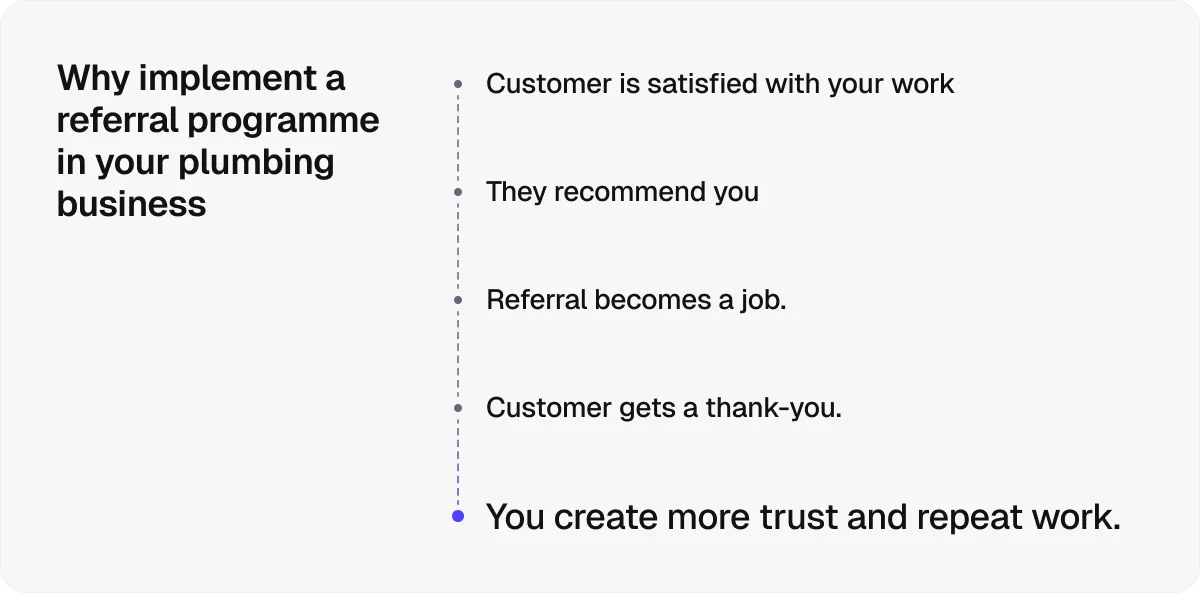
That’s why you should also put a simple referral programme in place.
For example, when a customer recommends you and that referral turns into a job, they receive a practical thank-you gift. This could include:
A fixed discount on their next job
A cash or gift card reward once the referral books
A free minor service (inspection, call-out fee waived, small fix)
Credit added to their account for future work
Neighbour or family discounts they can pass on directly
Keep it simple and transparent, and your referral programme will encourage repeat work and bring in customers who are already inclined to trust you.
7. Offer maintenance plans to encourage repeat work
Another effective way to encourage repeat work is through maintenance plans or service agreements.
These give customers a reason to stay in touch, rather than only calling when something breaks.
A simple plan might include:
Annual or seasonal checks
Priority call-outs
Discounts on repairs or parts
These should be set up as monthly or annual payments, with an easily understandable offer.
8. Be reachable and quick to respond
By now, customers should have several ways to contact you—through your website, social media, business cards, and local listings.
To ensure every enquiry receives a prompt and professional response, many growing plumbing businesses also rely on services like CallingAgency to manage incoming customer calls, especially during busy periods or after business hours.
However, having multiple ways of contacting you doesn’t mean much if they can’t reach you when needed.
Since any delays can cost you jobs in plumbing, you should focus on:
Answering calls promptly, especially during working hours
Returning missed calls quickly, ideally within minutes
Using call handling or messaging when you’re unavailable
Keeping first contact clear and helpful
9. Use ads to fill gaps in demand
Getting new enquiries organically is the ultimate goal. Over time, strong word of mouth and visibility can certainly keep your diary full.
But until you reach that point—or when demand dips—paid ads can help fill the gaps. Using an AI ad maker or AI Ad generator can help your plumbing business create professional video ads quickly and reach more customers. When used properly, these ads can put your business in front of customers who are already looking to book.
The table below outlines the most useful ad types for plumbing businesses, and when they make sense to use:
Type of ads | What they are | Why run them |
Google Local Services Ads | Pay-per-lead ads shown above search results for local trades | To capture urgent, high-intent enquiries |
Google Search Ads | Keyword-based ads shown in search results | To reach customers who are actively searching for plumbing services |
Call-only ads | Mobile ads designed to generate phone calls | To drive fast bookings with minimal friction |
Social media ads | Paid posts shown to local audiences on platforms like Facebook | To build awareness and generate enquiries during quieter periods |
10. Price consistently and with confidence
Pricing plays a direct role in how your plumbing business grows: Set prices too low and margins disappear; set them too high, and you might lose work.
While the price itself is important, applying it consistently matters just as much.
Standardised pricing helps customers understand what they’re paying for and gives them confidence in your recommendations. That’s why you should:
Provide professional, easy-to-read estimates every time
Present consistent prices for the same services across jobs
Use clear scopes of work, so there’s no confusion about what’s included
11. Use software to support growth
If you’re putting real effort into marketing, and enquiries are still slipping through the cracks, it’s time to look inward.
Growth often stalls not because of demand, but because the systems behind the business can’t keep up. Re-evaluating your day-to-day setup can help you take on more work without adding stress.
If you’re not already using plumbing or field service software to manage jobs, it may be worth considering your options.
These tools can offer numerous benefits that can help grow your plumbing business, including:
Keeping customer history in one place, so nothing is lost between jobs
Streamlining scheduling and job tracking, helping you stay organised as the workload increases
Maintaining oversight of work quality, especially when more people are involved
Producing professional reports that you can share with customers
Providing clear proof of work, which helps explain value and avoid disputes
Pro tip:
Don’t make the mistake of choosing software just because it looks good to clients. Client-facing tools only work if your internal processes are already solid.
What actually drives growth is a system that helps you organise, control, and prove your work from the inside out.
When that’s done well, the benefits are visible to clients automatically, through clearer reporting, better communication, and fewer issues.
A tool like Onetrace helps you achieve these outcomes by offering:
Clear oversight of projects and operatives
Consistent proof of work
Better control of costs and time
Simpler compliance and reporting
Straightforward workflows designed for subcontractors
When the back end runs smoothly, customers feel it, even if they never see the system itself.

12. Build partnerships with local businesses
While other plumbers in your area are competitors, other local professionals can be valuable allies. Many work in and around properties every day, and they likely need a reliable plumber they can call on.
That’s why your business can benefit from relationships with:
Estate and letting agents
Property managers
Home inspectors
Restoration and maintenance companies
These partnerships create a steady stream of relevant work and help you grow through trusted recommendations rather than constant marketing spend.
13. Invest in your team to unlock growth
To take on more work without burning out, you need the right people and the right training, processes, and tools to support them.
Growing your team well means:
Hiring for attitude and reliability, not just skill
Offering continuous training
Documenting simple processes so that work is done consistently
Providing clear expectations and feedback
Fostering open communication to avoid issues
Creating room for progress, especially for apprentices
A well-trained team protects quality, increases capacity, and allows the business to grow without creating unnecessary strain.
How to grow my plumbing business with Onetrace
When thinking about how to grow your plumbing business, it’s easy to focus on marketing tactics and quick wins. And while each of those strategies plays a role, they’re ultimately add-ons.
The real foundation for growth is how well your work is organised, controlled, and evidenced day to day.
That’s why you need Onetrace.
This subcontractor software helps you run jobs properly from the inside out, creating clarity for your team and confidence for your clients.
Onetrace supports growth in two key areas:
Traceability | Workforce |
|
|
Together, these two products allow you to scale operations without adding back-office strain, while maintaining control and visibility as workload increases.
Book a personalised demo with the Onetrace team to see how this might play out for your plumbing business.
Marketing Team
@Onetrace
The Onetrace marketing team is passionate about sharing insights, ideas, and innovations that help construction businesses stay connected, compliant, and efficient. Combining industry expertise with a love for clear communication, we aim to deliver content that empowers professionals to work smarter and safer.