6 phases of construction project management [Full guide]

By
Marketing Team
@Onetrace
Construction project management is the process of planning, coordinating, and overseeing construction work from the initial idea to completion. It brings together the people, resources, and activities needed to deliver the project successfully.
Whichever stage you work in, the pressures on the wider process reach you.
Only 31% of UK construction projects finish on budget, while 9 in 10 run into some form of cost overrun. At the same time, the industry faces a growing skills gap, with the Construction Industry Training Board (CITB) estimating that the sector will need an average of 41,200 additional workers each year to 2030.
With less room for error and fewer hands on deck, every team member needs a clear picture of how the project comes together.
This guide breaks down the six key phases of construction project management, explaining what happens in each and what teams need to consider to keep the project on track.
Key takeaways
Construction projects follow six core phases
Conception, planning, procurement, construction, monitoring, and closeout each have distinct goals and activities.Early planning sets the project up for success
Feasibility, scope, cost, programme, design, and approvals should be addressed before construction begins.Coordination becomes critical during construction
Project managers need to align trades, track progress, manage changes, and resolve issues before they cause delays or rework.Monitoring needs to run alongside construction
Tracking cost, schedule, quality, risks, and changes helps teams spot problems early and take corrective action.Project management software can connect every phase
Onetrace centralises drawings, forms, approvals, variations, field evidence, reports, and project records, helping teams stay coordinated from planning through handover.
6 core phases of construction project management
While the exact activities, decisions, and deliverables vary by project type, size, and complexity, the construction project management lifecycle can be broadly broken down into six core phases.
1. Project conception and initiation
Every construction project starts with a need, opportunity, or idea. The conception phase turns that starting point into a defined project worth pursuing.
The goal of this phase is to establish:
What the project should achieve
Whether it’s viable
What would need to be true for it to move forward
Project managers typically have a lighter role here than in later stages.
They bring structure to the process, test assumptions, and make sure the right questions are answered before the project gains momentum. Their job is to either create a sound basis for the work that follows, or identify early that the project needs to change or shouldn’t proceed.
Who is involved?
The client or project owner usually leads this phase, working closely with the project manager, architect, and relevant consultants. Depending on the project, this phase may also involve technical experts like:
Financial advisers
Planning specialists
Engineers
Surveyors
What are the key activities?
Project objectives: Define what the project needs to achieve, who it will serve, and what success should look like.
Business case: Assess the project’s expected value, costs, and strategic fit to determine whether the investment makes sense.
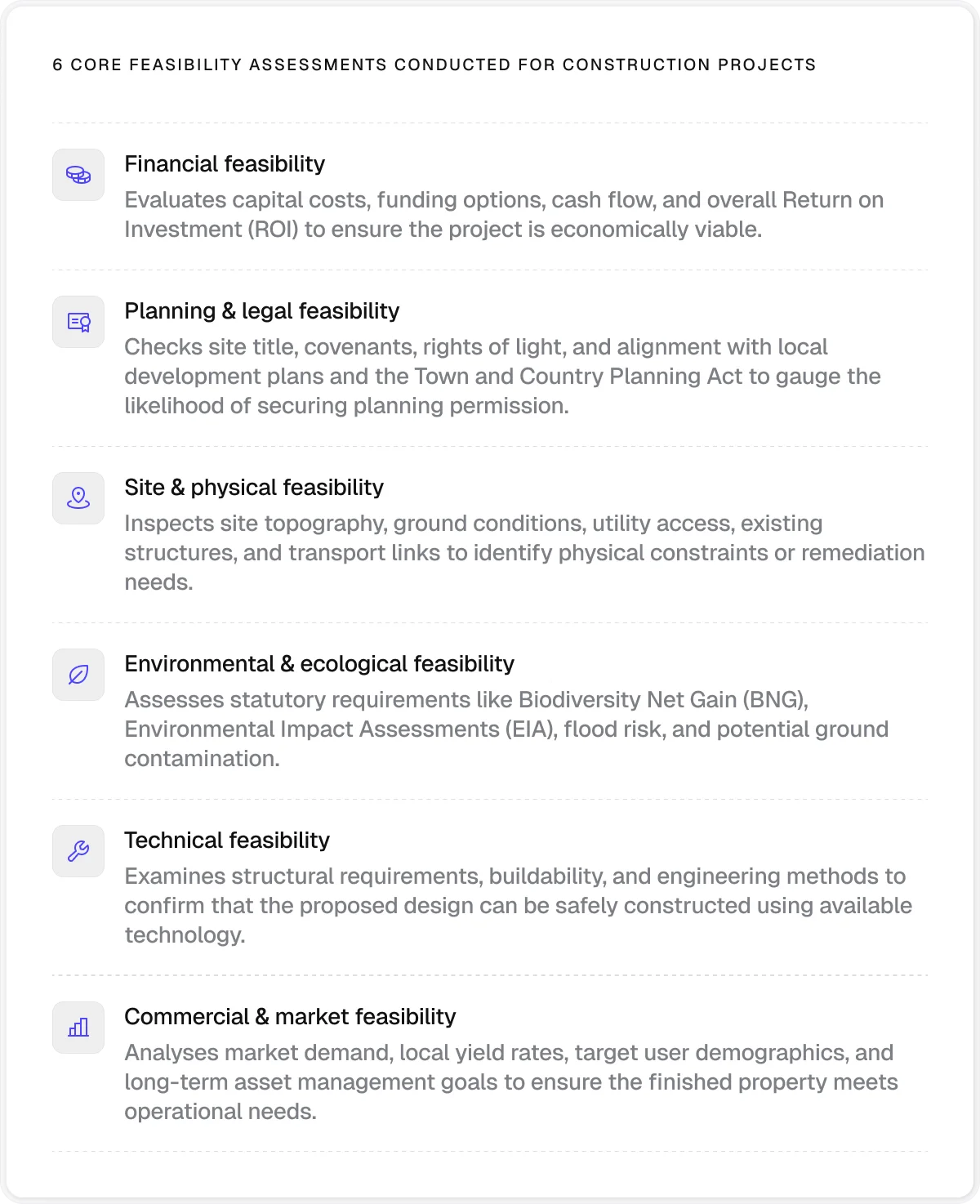
Feasibility assessment: Test whether the project is technically, financially, legally, and operationally viable before significant resources are committed.
Site assessment: Examine factors like location, land constraints, access, and environmental or regulatory issues that could affect viability.
Initial project parameters: Establish high-level expectations for scope, budget, timeline, and quality without moving into detailed planning.
Go/no-go decision: Use the findings to decide whether to proceed, revise the concept, or abandon the project.
What are the common challenges?
Limited information: Early decisions often rely on estimates and assumptions because many project details aren’t yet known.
Conflicting expectations: Stakeholders may have different views on the project’s purpose, scope, budget, or desired outcome.
Pressure to move ahead: Commercial or political pressure can push teams towards commitment before they’ve tested key assumptions.
2. Project planning and pre-construction
Once the project has been approved, the early project brief is turned into the construction project management plan.
This phase is where project management becomes much more hands-on.
The project manager brings the different workstreams together, sets out how they will interact, and builds a shared roadmap for delivery.
Getting this stage right matters because decisions made here shape how smoothly the project runs once construction begins. Gaps in the plan can lead to clashes, delays, cost growth, or unclear responsibilities later.
Who is involved?
The project manager typically takes the lead in coordinating this phase, working closely with the client, architects, engineers, quantity surveyors, the main contractor, and specialist consultants.
Other contributors may include:
Planners
Health and safety professionals
Suppliers
What are the key activities?
Work breakdown: Divide the project into manageable activities and work packages that can be sequenced and assigned.
Cost planning: Develop detailed cost estimates based on the design, labour, materials, equipment, and other project requirements.
Programme development: Set out task sequences, dependencies, milestones, and target dates for delivery.
Design coordination: Bring architectural, structural, and specialist designs together to identify clashes and gaps before site work begins.
Approvals management: Secure the planning, Building Control, environmental, utility, and other approvals required before construction.
Procurement planning: Decide how contractors, subcontractors, materials, and services will be sourced and when they will be needed.
Project controls: Establish processes for managing risks, quality, safety, communications, and project information.
What are the common challenges?
Design coordination: Different disciplines may produce conflicting information that takes time to resolve.
Approval delays: Slow decisions or regulatory reviews can push back the start of construction.
Resource conflicts: Labour, equipment, and specialist contractors may not be available when the programme requires them.
Information handoffs: Inconsistent or outdated project information can cause teams to work from different assumptions.
3. Procurement and contracting
With the project plan in place, the next step is to secure the people, materials, equipment, and services needed to deliver it.
This phase needs to be approached carefully because the quality of contractors, suppliers, and agreements in place can directly affect how smoothly construction progresses.
For example, choosing a contractor or supplier on price alone can create problems if they lack the capacity or experience to meet the project’s requirements. That’s why each appointment needs to be weighed against factors like capability, reliability, cost, and fit with the project’s needs.
Who is involved?
The project manager works closely with the procurement and commercial teams during this phase, with legal advisers helping shape and review contractual terms.
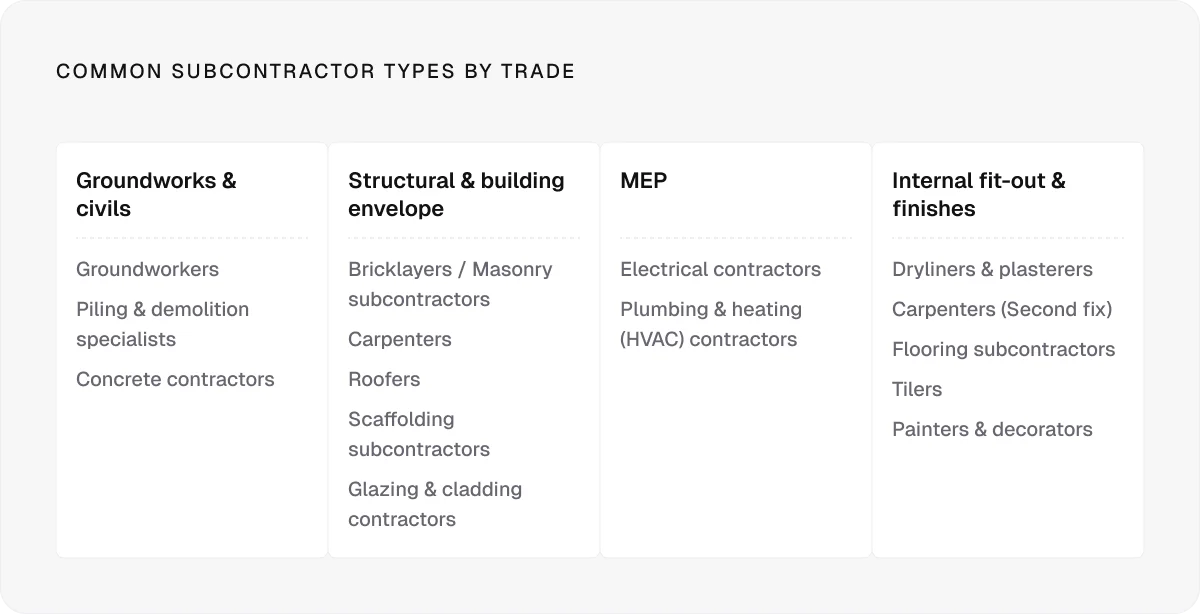
The main contractor takes a leading role in selecting and managing trade partners, while specialist subcontractors and suppliers join the project as their work packages are awarded.
What are the key activities?
Tender preparation: Assemble the drawings, specifications, scopes, and commercial information bidders need to price the work accurately.
Bid evaluation: Compare submissions against price, experience, capacity, programme, and technical requirements to identify suitable partners.
Contract negotiation: Agree commercial terms, responsibilities, payment arrangements, and procedures for handling changes or disputes.
Contract award: Formally appoint contractors, subcontractors, and suppliers so responsibilities are established before work begins.
Resource procurement: Order materials, equipment, and specialist services while allowing for lead times and planned delivery dates.
Contract controls: Set up processes for payments, variations, claims, reporting, and other contractual matters.
What are the common challenges?
Commercial disputes: Unclear terms around scope, payment, or changes can create disagreements once contracts are underway.
Long-lead items: Specialist materials or equipment may require early commitment because extended manufacturing or shipping times can affect delivery.
Contractor capacity: A preferred bidder may lack the workforce, equipment, or financial strength needed to support the project.
Price volatility: Changes in material and labour costs can affect tender values and complicate negotiations.
4. Construction execution and delivery
Once the required teams, resources, and agreements are in place, the project moves into active construction.
At this point, the project manager needs to coordinate multiple trades and keep information moving between the site and wider project team.
Strong management practices are essential during this phase because even small issues can affect other activities, resulting in delays or costly rework.
Who is involved?
The construction manager and site manager take a central role in directing day-to-day site activity, working closely with the project manager.
Site supervisors, foremen, quality inspectors, health and safety professionals, and trade crews also become prominent as physical work gets underway.
What are the key activities?
Site mobilisation: Set up the site, welfare facilities, access arrangements, and resources needed to begin work safely.
Construction work: Carry out the planned building activities in line with approved drawings, specifications, and programme requirements.
Site coordination: Sequence trades, manage dependencies, and resolve clashes so different crews can work without disruption.
Quality and safety checks: Inspect work and site conditions to verify compliance with project standards and safety requirements.
What are the common challenges?
Trade clashes: Overlapping activities or poor sequencing can leave crews waiting or interfere with other work.
Productivity losses: Unplanned downtime, restricted access, or inefficient workflows can reduce output.
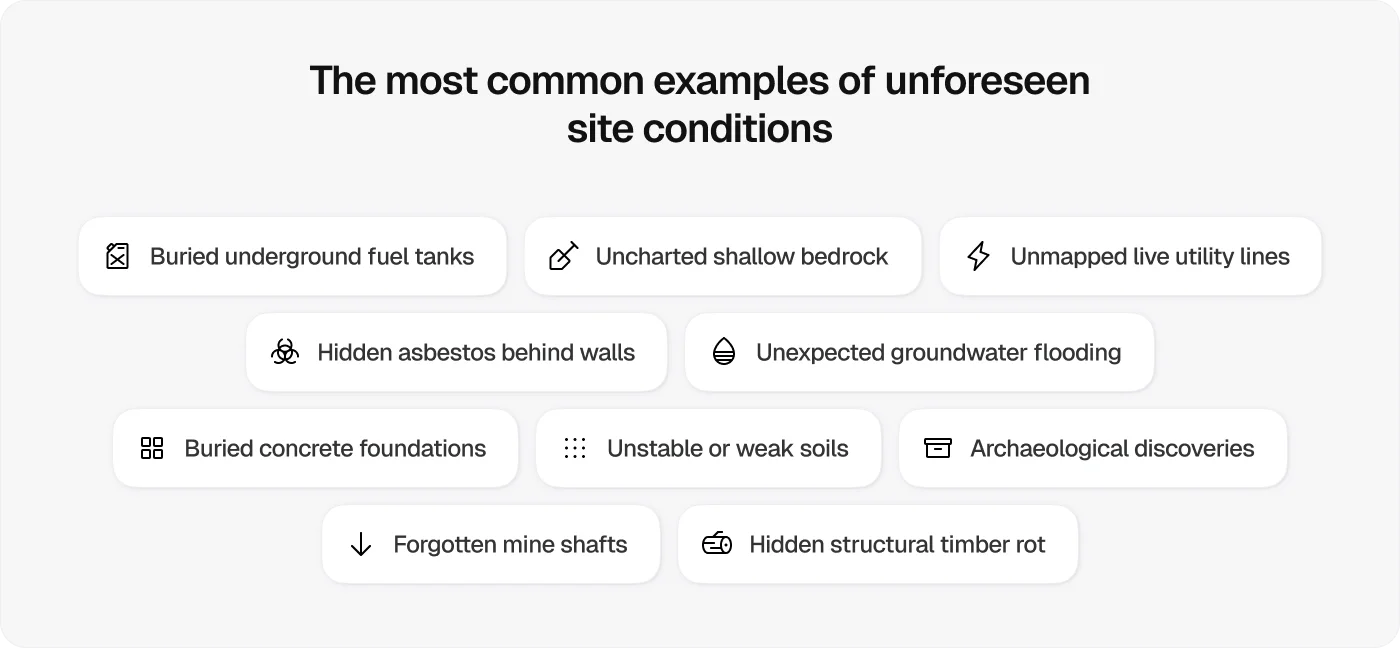
Unforeseen site conditions: Unexpected ground or existing-building conditions can force changes to the planned approach.
Rework: Defective workmanship or installation errors can require completed work to be corrected.
Decision bottlenecks: Slow responses to site questions or approvals can leave crews unable to proceed.
5. Performance monitoring and change management
Unlike the previous phases, monitoring and control doesn't occupy a fixed slot in the sequence. It runs alongside construction, giving the project manager an ongoing view of whether delivery is matching the agreed scope, programme, budget, and quality standards.
By comparing actual performance with expectations, the team can spot problems while there’s still time to act.
Who is involved?
The project manager leads the monitoring process, working closely with the commercial manager, project controls or planning team, and site management.
The data and specialist input needed to assess performance and changes can come from:
Cost engineers
Quality managers
Contract administrators
What are the key activities?
Progress measurement: Compare completed work with planned milestones to identify emerging delays or performance gaps.
Cost forecasting: Review actual spending and projected costs to determine whether the project remains within its financial limits.
Schedule control: Update the programme as conditions change and develop recovery measures when activities fall behind.
Change assessment: Evaluate proposed variations for their effects on cost, time, scope, and quality before approval.
Risk review: Reassess known risks and emerging threats as the project develops and adjust mitigation measures accordingly.
Performance reporting: Record progress, costs, risks, issues, and key decisions so stakeholders have an up-to-date view of delivery.
What are the common challenges?
Scope creep: Small additions or adjustments can gradually expand the project without proper approval or corresponding changes to time and cost.
Data lag: Delayed or incomplete site information can leave managers making decisions based on an outdated picture.
Change volume: A steady stream of variations can overwhelm approval processes and make it difficult to assess their combined effect.
Control fatigue: Repeated reporting and reviews can become routine, making teams less likely to act on warning signs.
6. Project completion and handover
As construction work reaches completion, the focus shifts to proving that the building is ready for use and formally bringing the project to an end.
This phase checks that the finished work meets the agreed requirements, outstanding issues are resolved, and the owner receives everything needed to operate the asset.
Who is involved?
The project manager coordinates the closeout process with:
The client or owner’s representative
Commissioning specialists
Facilities management team
Contractors and specialist subcontractors return to address outstanding defects, while document controllers and commercial teams support the final records and accounts.
What are the key activities?
Final inspections: Review the completed work against the agreed requirements and identify anything that still needs attention.
Defect resolution: Coordinate the correction and verification of outstanding workmanship or installation issues before handover.
Systems commissioning: Test building systems and equipment to confirm they operate as intended under the required conditions.
Handover documentation: Compile as-built information, manuals, warranties, certificates, and other records the owner will need.
Final account settlement: Resolve outstanding payments, claims, and contractual obligations before formally closing the project.
Lessons learned: Review project performance and capture useful findings that can improve future work.
What are the common challenges?
Incomplete records: Missing or inconsistent documents can hold up handover and leave the owner without information needed for operation.
Late defects: Issues found near completion can be difficult to resolve when specialist trades have already demobilised.
Testing failures: Building systems may require further adjustment or repair when commissioning reveals performance problems.
Handover disputes: The client and delivery team may disagree over whether outstanding items meet the standard required for acceptance.
How Onetrace supports every phase of construction project management
Information and coordination problems are two of the most common challenges running through the construction lifecycle. Teams need to keep all project documents aligned while coordinating people who may be working across different locations and organisations.
This is where construction project management software like Onetrace can help, providing a central place for project information and day-to-day workflows.
Here’s how Onetrace’s features support each phase of construction project management:
Phase | Feature(s) | Explanation |
Project initiation | Project templates | Pre-populate projects with standard forms, materials, locations, approvals, and folders so recurring project setups follow a consistent structure. |
Planning & pre-construction | Upload drawings, organise them by blocks and levels, and attach site information to specific locations. | |
Build standardised survey and inspection forms with mandatory fields, photos, checklists, and text fields. | ||
Procurement & contracts | Materials & Rates | Record material usage, quantities, costs, and rates to support cost tracking and accurate reporting. |
Docs & Files | Store contracts, quotations, specifications, and other project documents in a central location with access controls. | |
Construction | Assign operatives, manage schedules, and update field teams when plans change. | |
Capture attendance and hours with GPS-stamped clock-ins and clock-outs. | ||
Mobile app | Let operatives access drawings, capture evidence, complete job sheets, and work offline. | |
Monitoring & change management | Approvals | Create multi-stage review workflows, record rejections and feedback, and maintain an approval history. |
Variation tracking | Identify and report work that falls outside the original scope. | |
Completion & handover | Reports | Generate branded PDF or Excel reports containing job data, photos, materials, drawings, and approval records. |
QR codes | Link physical work to its digital history so future teams can retrieve information about completed installations and maintenance. |
Book a tailored walkthrough with the Onetrace team to see how these features could fit into your projects.
FAQ
What are the 7 phases of a construction project?
The 7 phases of a construction project are project conception, design, bidding, pre-construction, procurement, construction, and closeout.
What are the 7 stages of project management?
The 7 stages of project management are initiation, planning, execution, monitoring and control, risk management, closure, and post-project review.
What are L1, L2, L3, and L4 schedules in planning?
L1, L2, L3, and L4 schedules form a hierarchical framework for project planning and control. Each level adds more detail, moving from high-level milestones and management summaries at L1 to detailed, near-term execution planning at L4.
Marketing Team
@Onetrace
The Onetrace marketing team is passionate about sharing insights, ideas, and innovations that help construction businesses stay connected, compliant, and efficient. Combining industry expertise with a love for clear communication, we aim to deliver content that empowers professionals to work smarter and safer.