Subcontractor safety management: Everything you need to know

By
Marketing Team
@Onetrace
Subcontractor safety management is the process of making sure subcontractors can carry out their work safely, legally, and to the required standard.
This aspect of subcontractor management is crucial because construction consistently ranks as one of the UK’s most dangerous industries.
In 2025/26, 25 construction workers were killed in work-related accidents—the highest number of fatal injuries among the main industry sectors. Construction also has a higher-than-average rate of workplace non-fatal injuries.
Subcontractors, in particular, sit in a difficult position.
Site workers are generally there to carry out the work, while contractors set the rules and oversee the wider job, often from off site. Subcontractors have to do both: follow the site rules set by others while also managing their own people, plant, and processes safely on the ground.
To give you a practical starting point, this guide breaks down proper subcontractor safety management from both perspectives, with steps for safer work on site.
Key takeaways
Subcontractors have their own safety duties
Following the principal contractor’s rules doesn’t remove your legal responsibilities.Coordinate with the principal contractor
Review the CPP, complete inductions, submit site-specific RAMS, and report changing site conditions.Control the work under your direction
Check equipment, supervise workers, manage sub-subcontractors, and address health risks.Keep safety records up to date
Maintain RAMS, training, inspections, incident records, and other evidence needed for compliance and pre-qualification.Use software to simplify safety tracking
Onetrace brings documents, inspections, reports, photo evidence, approvals, and signed records into one platform.
What is subcontractor safety management?
Subcontractor safety management is an ongoing process of planning, controlling, and reviewing the health and safety risks linked to the work you carry out.
Its main goal is to prevent people being killed, injured, or made ill by the work. The people in question include your own workforce as well as anyone else who could be affected by your activities, such as:
Other workers on site, including those working for other subcontractors
Members of the public, particularly around sites near roads, homes, or businesses
Visitors, including clients, inspectors, delivery drivers, or other authorised personnel
Beyond keeping people safe, effective subcontractor safety management is also a legal duty in the UK. The table below outlines the main regulations that apply here and what they mean for subcontractors in practice:
Regulation | What it does | What it looks like in practice |
Requires employers to protect their workers and anyone else who could be affected by their work | • Providing safe systems of work • Maintaining suitable equipment • Providing suitable training and supervision | |
Sets out how health and safety should be managed | • Carrying out and reviewing risk assessments • Appointing competent people • Providing information and training • Agreeing emergency arrangements • Cooperating with other dutyholders | |
Construction (Design and Management) Regulations 2015 (CDM 2015) | Sets specific safety duties for construction contractors, including subcontractors | • Planning work before it starts • Checking worker competence • Providing suitable supervision • Coordinating work with other contractors • Sharing relevant health and safety information |
Activity-specific regulations | Apply to particular hazards, activities, substances, or equipment | • Following COSHH requirements when working with hazardous substances • Planning work at height in line with the Work at Height Regulations • Inspecting and maintaining equipment under PUWER • Planning and carrying out lifting operations in line with LOLER |
While these regulations apply broadly, the paperwork and level of detail needed will vary with the size of the subcontractor’s business, the work being carried out, and the risks involved.
Subcontractor safety management: How to work with the principal contractor
Working with the principal contractor on health and safety allows subcontractors to understand their safety obligations, meet site-specific requirements, and avoid contractual penalties for unsafe working practices.
Here’s what you should do to stay compliant and avoid problems on site.
1. Provide evidence of competence early
Send your subcontractor documentation before mobilisation so the principal contractor can verify your competence before you arrive on site. This might include:
Health and Safety Policy (if you employ more than five people)
Construction Skills Certification Scheme (CSCS) cards
Construction Plant Competence Scheme (CPCS) or National Plant Operators Registration Scheme (NPORS) plant qualifications
Prefabricated Access Suppliers’ and Manufacturers’ Association (PASMA) or International Powered Access Federation (IPAF) certificates
Current employer’s liability and public liability insurance certificates
Safety Schemes in Procurement (SSIP) accreditation
You should keep these records current throughout the project and make sure they reflect the people and equipment on site.
2. Align with the Construction Phase Plan (CPP)
The principal contractor’s Construction Phase Plan (CPP) sets out how health and safety will be managed across the site, so your work needs to fit into those arrangements.
Before starting, review the parts that affect your team, including:
Welfare arrangements
Restricted areas
Temporary works
Nearby trades
The CPP should be treated as a live plan, not a document to read once and file away.
Pro tip:
Before each shift, compare the planned controls with what your team will actually face. If there are any mismatches, stop and raise them with the principal contractor before work continues.
This step is crucial because a 2021 study published in the Journal of Safety Research shows that written safety programmes only weakly predict safety behaviour on site.
3. Submit site-specific RAMS for approval
As a subcontractor, you need to prepare risk assessments and method statements (RAMS) to set out the hazards your work creates and the controls you will use to manage them.
The risk assessment identifies the risks and required controls, while the method statement turns those controls into a clear sequence of work.
Using RAMS, the principal contractor can review your approach before the work starts and check that it fits the wider site plan.
The RAMS should reflect the actual site and task, including relevant safety hazards like:
Work at height
Structural instability
Electrical hazards
Fire
Plant and vehicles
Lifting operations
Excavations
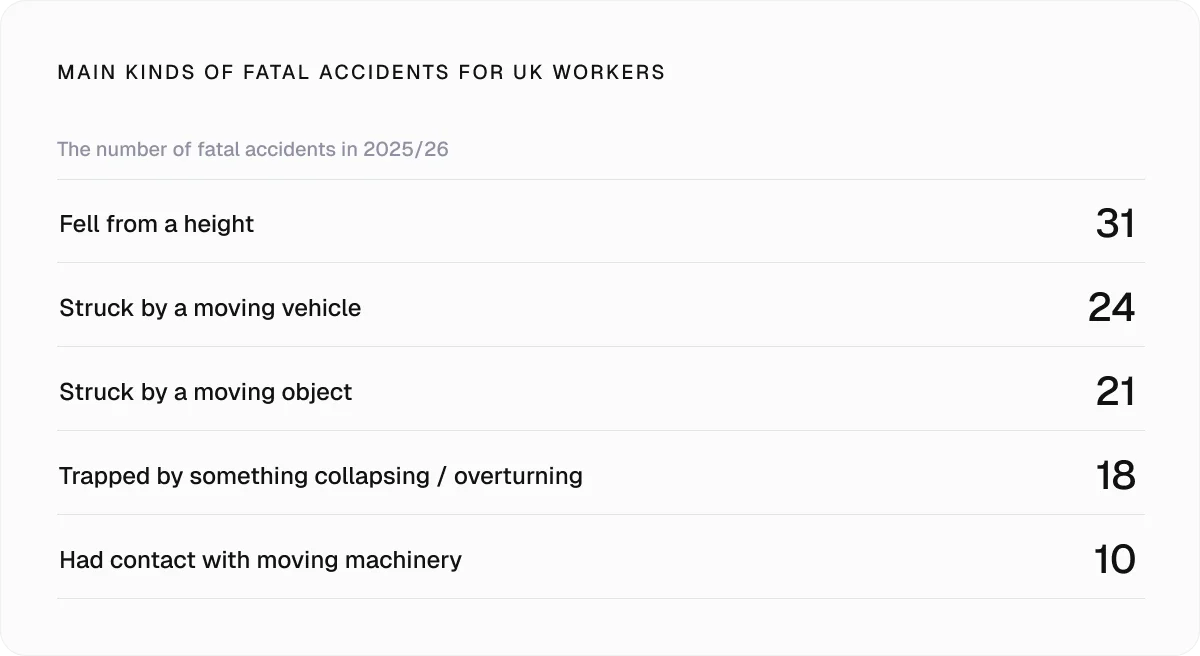
The first item deserves particular attention, as the Health and Safety Executive’s data shows that falls from height continue to be the most common kind of fatal accident, accounting for 31 deaths in 2025/26.
4. Attend and enforce site inductions
Every worker you send to site, including replacements and sub-subcontractors, should complete the principal contractor’s site-specific induction before starting work. This induction should cover:
Site rules
Known hazards
Access and traffic routes
Restricted areas
However, induction is only the starting point.
You should also attend relevant Toolbox Talks, pre-start briefings, and coordination meetings so your team can point out risks created by your work or by other activities happening around you.
Pro tip:
The 2021 research found that workers at smaller firms reported safety mindsets and behaviours similar to those at larger subcontractors, despite differences in formal safety systems.
Even if you run a small subcontracting business, don’t treat the lack of a dedicated safety team as a reason to scale back safety management.
5. Get the remaining site information you need
The CPP and induction will give you the wider site picture, but you may still need specific information to plan your own work safely.
Before mobilisation, you should confirm:
Which vehicles, plant, and equipment you will be expected to use or work around
Who else will be working in your area
Whether any hazardous materials or site-specific restrictions could affect your task
Always ask the principal contractor for information you can’t reasonably identify yourself, particularly where it affects your RAMS or the controls you’ve planned.
6. Report all incidents, hazards, and near-misses immediately
Report incidents, dangerous occurrences, hazards, and near-misses to the principal contractor’s site management as soon as possible, and cooperate with any follow-up investigation.
The same applies when site conditions no longer match your RAMS.
If another trade creates a new hazard, your work area changes, equipment becomes unsuitable, or planned controls can no longer be followed, stop the affected work and raise the issue.
You should never let the pressure to keep the programme moving lead your team to work outside the agreed controls.
Where needed, revise the RAMS and agree the new approach before restarting.
Subcontractor safety management: How to manage the work under your control
Some subcontractors operate as sole traders, but many have employees, apprentices, specialist tradespeople, or other subcontractors working under their direction.
The following practices cover the key areas you need to address when planning, directing, and supervising all the people working under your control.
1. Inspect and maintain your own plant and equipment
You’re responsible for ensuring that plant, tools, and equipment you bring to site are suitable, safe, and properly maintained. To achieve these outcomes, you should:
Carry out pre-use checks
Arrange required inspections and examinations
Keep maintenance records
Make sure only competent people use the equipment
Use the equipment only in the way specified by the manufacturer
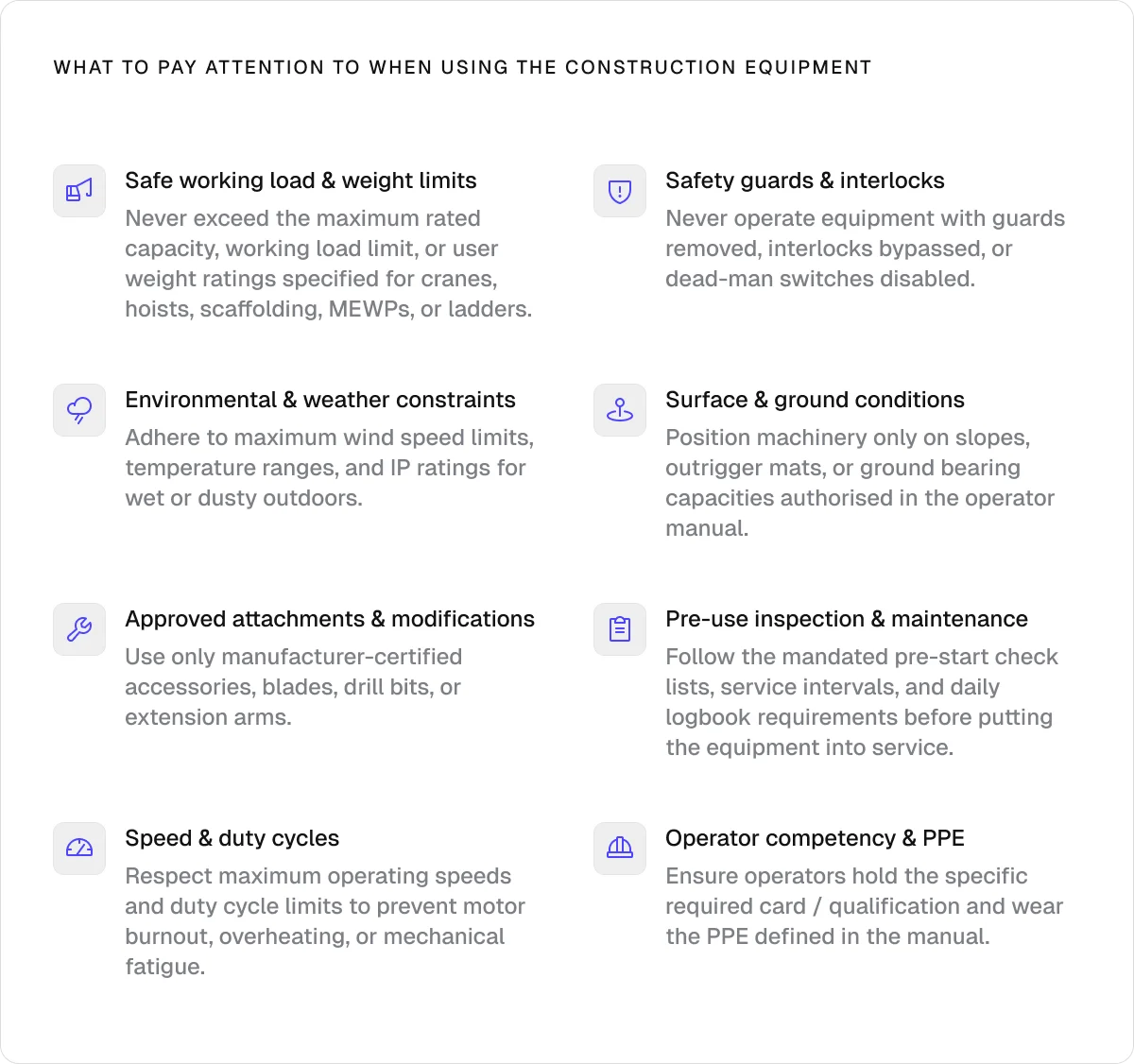
Any defects should be reported and dealt with before the equipment is used again.
When the equipment isn’t in use, you should:
Park or store it so it can’t fall, roll, collapse, obstruct walkways, or create another hazard
Remove keys, isolate controls, lock equipment where needed, or otherwise stop people who aren’t authorised from using it
2. Manage your own sub-subcontractors and labour-only hires
If you bring other trades, self-employed specialists, or labour-only workers onto a job, their safety becomes part of the work you control.
Before they start, you should:
Check their competence, qualifications, and experience
Explain the risks and controls that apply to their work
Make sure they understand the relevant site arrangements
For labour-only workers, be particularly clear about who provides their personal protective equipment (PPE), equipment, supervision, and training.
You should also keep records of all the checks and briefings, and monitor your workers’ activities rather than assuming they will follow the agreed method without supervision.
3. Control the health risks created by your work
Safety management covers long-term health risks, not just immediate injuries.
You should identify the occupational health hazards linked to your trade and put controls in place before work starts. Depending on the job, these hazards could include:
Silica and other dusts
Hazardous substances
Noise
Vibration
Manual handling and repetitive work
You should pay special attention to the last hazard on the list, as construction has a higher-than-average rate of work-related musculoskeletal disorders, according to HSE data for 2022/23–2024/25.
As far as controls go, start with the hierarchy of measures: eliminate the hazard where possible, then change the process or use engineering measures to reduce exposure.
PPE should be the last line of defence rather than the main measure.
When exposure can’t be adequately reduced through other means, provide suitable respiratory protective equipment (RPE) or other appropriate PPE.
4. Fulfil your RIDDOR reporting duties
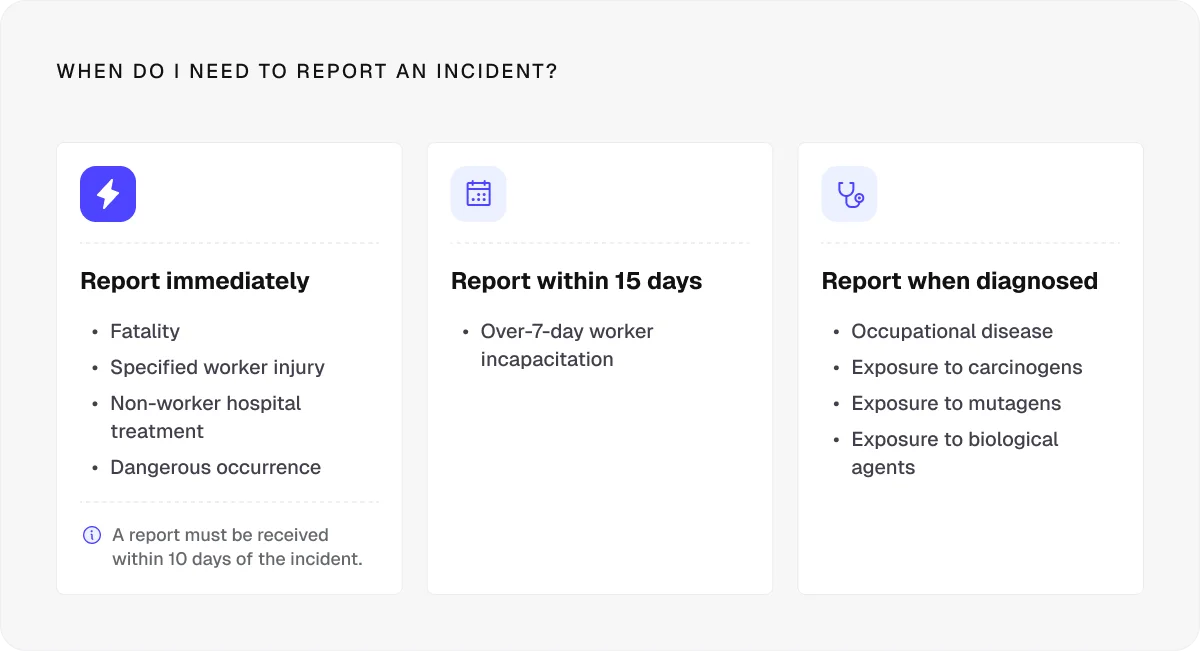
Reporting an incident to the principal contractor doesn’t automatically satisfy your duties according to the Reporting of Injuries, Diseases and Dangerous Occurrences Regulations (RIDDOR) 2013.
If an incident involving your workers meets the reporting criteria, you may need to notify the HSE directly.
Your workers should also know:
Who they report incidents to
What needs reporting
How to report it
When work must stop
Pro tip:
Keep an internal record of incidents and near-misses, so you can spot recurring problems, check whether existing measures are working, and identify where your safety practices need to change.
5. Keep your safety records organised
Properly maintained records give you evidence that safety arrangements are being followed and make it easier to spot gaps before they become problems. Depending on your work and legal duties, these records may include:
Training and competence
Individual risk assessments or RAMS
Equipment inspections and maintenance
Toolbox Talks and worker briefings
Keeping these records in one organised system also makes pre-qualification and tendering easier when a principal contractor asks for evidence of your health and safety performance.
Pro tip:
Construction management software can make collecting, updating, and finding safety records easier by keeping all relevant documents in one place.
Some platforms, such as Onetrace, go a step further by turning compliance documents into trackable records, rather than simply storing them.
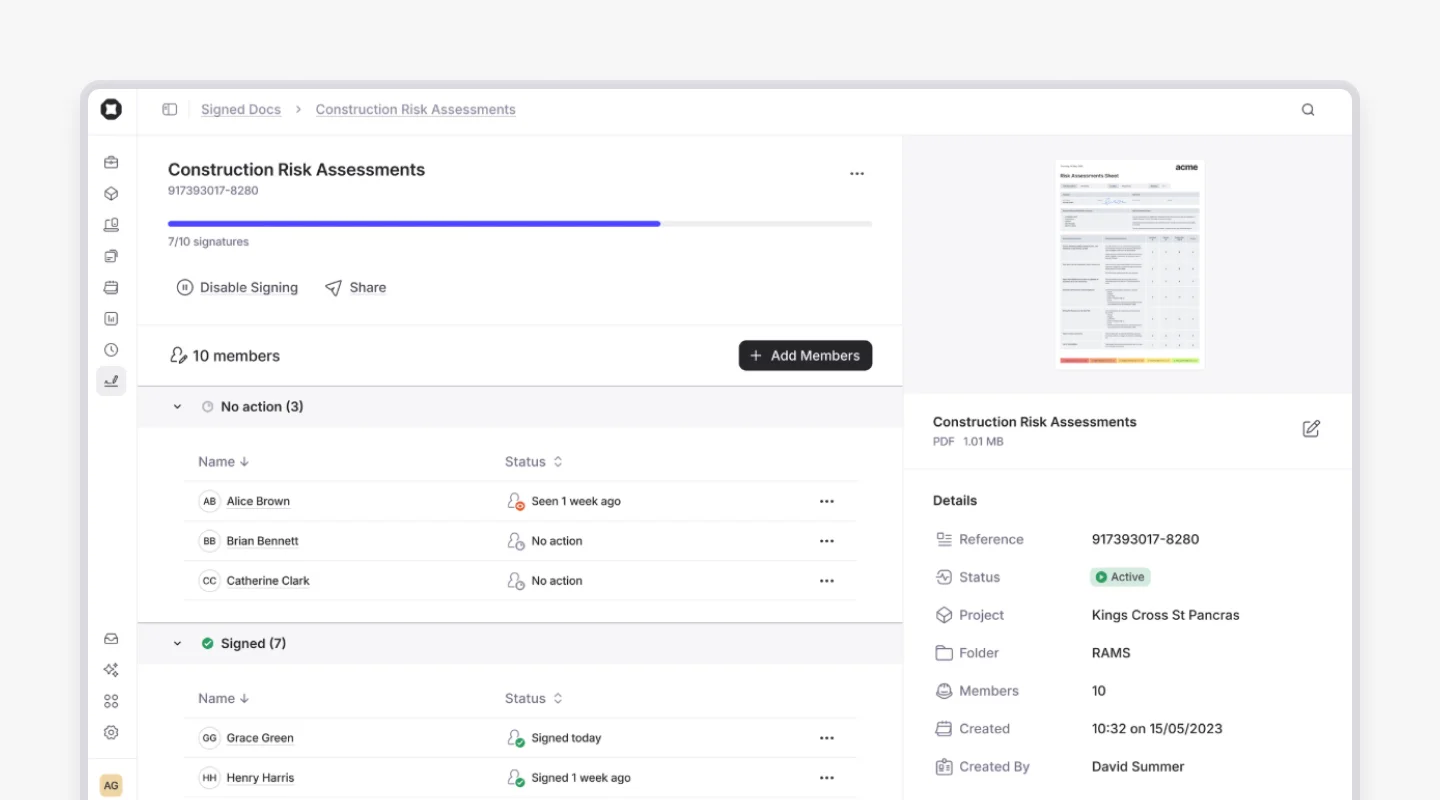
Its Signed Docs feature lets you:
Send RAMS, health and safety documents, and Toolbox Talks to workers for digital sign-off
Track who has viewed or signed each document
See outstanding signatures in real time
Required signatures can also be linked to job workflows, so work can’t start until the necessary acknowledgements are completed.
How Onetrace supports subcontractor safety management
Onetrace was built specifically for subcontracting businesses, with workflows designed around the way subcontractors actually operate. More than 1,000 subcontractors already use the platform to manage work across sites, coordinate mobile teams, meet compliance requirements, and keep a reliable record of what happens on site.
Besides keeping safety documents organised and signed, Onetrace supports day-to-day safety management through features like:
Custom forms: Create site-specific forms for inspections, equipment checks, and other safety checks, so operatives consistently record the information needed to identify and address risks.
Photographic evidence: Capture photos during inspections and site checks to document hazards, defects, and completed corrective actions, giving you visual evidence of site conditions and the steps taken to address them.
Approval workflows: Route completed safety checks and job records to the appropriate supervisor for review, so issues can be identified, feedback recorded, and work formally approved before the record is closed.
Site reports: Turn recorded site information into PDF or Excel reports that can be used to demonstrate completed checks, inspections, and other safety activities to principal contractors, clients, or auditors.
Site attendance records: Record operative attendance with location data, creating a reliable record of who was on site during specific periods if an incident or safety investigation requires it.
Operative declarations: Build formal declarations into workflows so operatives can confirm that required work or checks have been completed, creating an additional record that can support safety accountability.
Book a personalised Onetrace walkthrough to see how these features could fit into your safety workflows.
FAQ
What are the responsibilities of a subcontractor?
The responsibilities of a subcontractor include protecting their workforce and anyone affected by their work, assessing risks, providing competent workers, following safety requirements, and maintaining appropriate records.
What are common issues with subcontractors?
Common issues with subcontractors include poor coordination, incomplete documentation, inadequate supervision, inconsistent safety practices, and failures to communicate changing site conditions.
What are the rules and regulations for subcontractors?
The rules and regulations for subcontractors include the Health and Safety at Work etc. Act 1974, CDM 2015, Management of Health and Safety at Work Regulations 1999, and activity-specific regulations like COSHH, PUWER, and LOLER, as well as site-specific rules and safety requirements set out in their contracts.
How do I get contractors to prioritise safety compliance?
To get contractors to prioritise safety compliance, set requirements before work starts, make them part of the contract, monitor compliance on site, and act on breaches consistently.
Are there platforms for subcontractor safety tracking?
Yes. Platforms like Onetrace support subcontractor safety tracking through digital documentation, inspections, photo evidence, approvals, reports, and signed documents.
Are there construction safety software options that don’t require long-term contracts?
Yes. Onetrace offers a flexible, per-user monthly subscription, so subcontractors can adjust their user count as project and workforce needs change rather than committing to a fixed long-term setup.
Marketing Team
@Onetrace
The Onetrace marketing team is passionate about sharing insights, ideas, and innovations that help construction businesses stay connected, compliant, and efficient. Combining industry expertise with a love for clear communication, we aim to deliver content that empowers professionals to work smarter and safer.