Subcontractor management: A detailed guide for 2026

By
Marketing Team
@Onetrace
Subcontractor management is the process of planning, coordinating, and overseeing operatives and field workers from job assignment to completion.
While the number of contractor businesses in the UK is falling—from 99,088 in 2024 to 97,115 in 2025—demand for skilled subcontractors is heading in the other direction, with 69% of builders planning to take on more workers and subbies in 2026.
The increasing demand only strengthens the case for effective subcontractor management that can turn a busy pipeline into a well-run, profitable operation.
To help you do just that, this guide breaks down what good subcontractor management looks like in practice.
Key takeaways
Subcontractor management is done in two directions
As a subcontractor, you manage up to your contractor and down to your operatives. Both matter, but managing your own field team is where the real operational challenge lies.
Manual processes are behind most common problems
Scheduling conflicts, compliance gaps, and communication breakdowns are usually the result of managing a field team without the right systems in place.
Health and safety are your responsibility
The duty of care for your operatives sits with you. Compliance documents need to be signed consistently across every job, and your records need to prove every sign-off took place.
The right software makes all of this manageable
Most of the challenges of subcontractor management have a simple solution. Onetrace was built specifically for subcontractors, giving you the tools to manage your team, stay compliant, and keep more of what you earn.
What is subcontractor management?
Subcontractor management is the system a subcontracting business uses to organise, deploy, and supervise its operatives, making sure they’re set up to do the job properly.
Most resources online approach subcontractor management from the contractor’s perspective, discussing how a main contractor selects, contracts, and monitors the subbies they bring onto a project.
While managing up and managing down share some common ground, such as the importance of comprehensive onboarding, communication, and quality control, the day-to-day reality for subcontractors has its own distinct challenges.
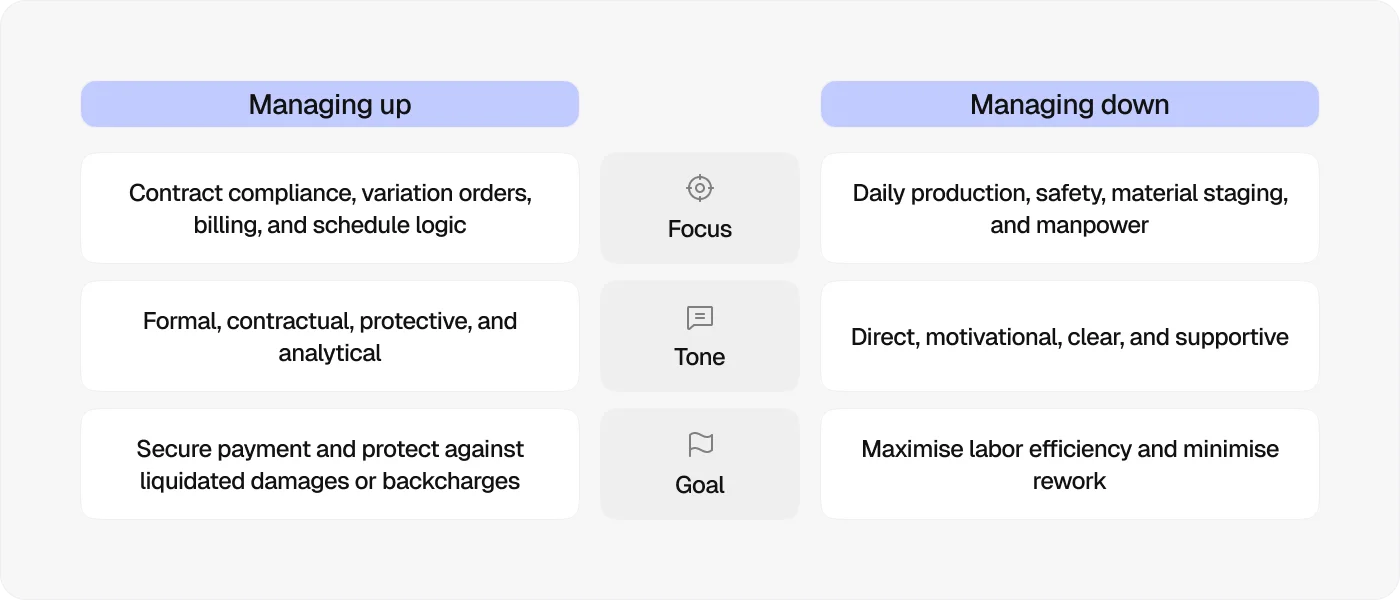
Managing up vs managing down
Managing up—maintaining your relationship with the main contractor—primarily requires you to meet agreed deadlines, stay compliant with contract terms, report progress accurately, and protect your right to be paid on time.
Managing down means taking responsibility for your operations by:
Scheduling and dispatching your field team across multiple jobs
Tracking attendance and time on site
Making sure operatives have the right certifications and equipment
Maintaining quality and safety standards on every job
Monitoring output and productivity to make sure work is progressing at the right pace
In other words, managing up is about meeting expectations, while managing down is about setting them.
Pro tip:
Never let the friction of managing up carry over into how you manage down.
If the main contractor is putting pressure on you about a delay, you shouldn’t let your field crew feel the full weight of it. Unfiltered urgency usually results in rushed work, mistakes, and safety incidents.
A great subcontractor acts as a shock absorber, filtering the contractual noise from above so the field can focus on building.
Common pain points subcontractors face
Here are the most common pain points subcontractors face when managing their operations:
No single source of truth: When job information lives across WhatsApp messages, spreadsheets, and paper sheets, it’s easy for details to get lost, duplicated, or missed entirely.
Compliance that’s easy to overlook: Certifications lapse, right-to-work checks get missed, and safety documentation falls behind because there’s no system flagging what needs attention and when.
Cash flow pressure from above: Late payment affects 77% of subcontract projects in the UK, and with retention on top of that, subcontractors are often waiting on money they’ve already earned while still covering wages and materials below.
Reactive scheduling: Without clear visibility of your team’s availability and workload, scheduling becomes guesswork. This leads to last-minute changes, coverage gaps, and operatives showing up for jobs before the necessary groundwork has been completed.
Admin that never ends: The paperwork involved in running a field team requires regular attention. When job sheets, timesheets, and reports are created manually, it takes time away from the work that actually grows the business.
Disputes that are hard to defend: Without accurate records of hours worked, jobs completed, and sign-offs given, any disagreement with a contractor or operative becomes difficult to resolve.
10 steps to effective subcontractor management
Most of the challenges subcontractors face when running a field team have a common solution: the right subcontractor management software.
That’s why the foundation of effective subcontractor management is investing in a platform built specifically for subcontractors, like Onetrace.
From there, follow these 10 steps to take control of your operations from the ground up.
1. Build and onboard your field team the right way
A strong field team is built before anyone sets foot on site.
When bringing on a new operative, you should:
Check their Construction Skills Certification Scheme (CSCS) card and any trade-specific certifications
Make sure they’ve completed the relevant health and safety induction
You should also set clear expectations from day one, as your operatives should know how they report progress and who they report to. A consistent onboarding process protects your business, reduces errors, and allows new starters to hit the ground running.
2. Assign the right operative to the right job
To choose the right person for each job, you need to know your team’s qualifications, expertise, and experience.
The best way to do that is to keep a central record of every operative’s details, certifications, and competencies that you can check at a glance.
Without it, assignment decisions rely on memory and guesswork, which increases the risk of sending someone unqualified to a job and exposing your business to compliance failures and rework.
3. Schedule and dispatch your workers efficiently
Good construction scheduling starts with visibility.
You need a clear picture of your team’s availability, current workload, and any upcoming commitments. Without this information, you’re making decisions in the dark, and the knock-on effects of one poor scheduling call can affect multiple jobs.
A visual scheduling tool can help you avoid many of the common scheduling issues.
Being able to see your whole team’s week at a glance, filter by project or operative, and move people around quickly means you can respond to changes without turning each inconvenience into a crisis.
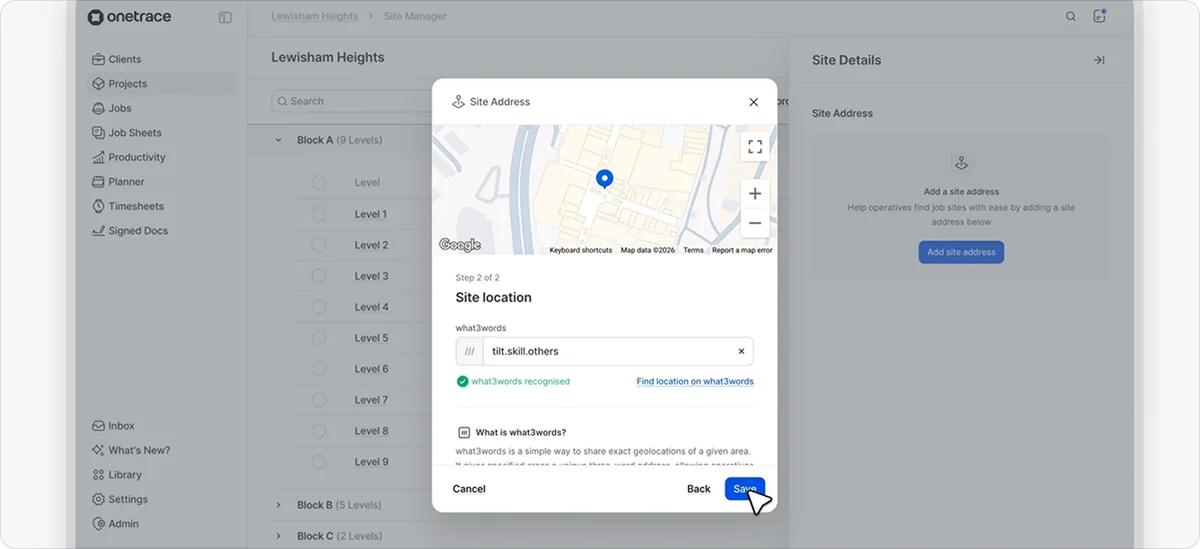
Once the schedule is set, your operatives need to be able to act on it without friction. This includes having accurate job information on their device and reliable directions to their destination.
For this reason, Onetrace includes built-in maps, easy-to-understand directions, and what3words integration so operatives always arrive at the right location, reducing late starts, missed sites, and back-and-forth calls.
4. Track time and attendance on site
Knowing who is on site and when is fundamental to running a field team well.
Considering how complex modern construction operations have become, this type of tracking is no longer sustainable to do manually, as paper timesheets and self-reported hours create room for error, disputes, and payroll headaches.
A reliable time and attendance system gives you accurate, verifiable data on hours worked, which is necessary for payroll but also useful for:
Spotting patterns in productivity
Managing overtime
Defending your position if a payment dispute arises
GPS-based clock-in and clock-out, in particular, removes any ambiguity when it comes to disputes or payroll queries.
5. Monitor job progress in real time
Waiting until the end of the week—or even the end of the day—to find out how a job is progressing is usually too late. By the time a problem surfaces, it has most likely already caused a delay. That’s why you need real-time progress monitoring, which allows you to flag issues and address them as they happen.
This works best when both office staff and field operatives do their part.
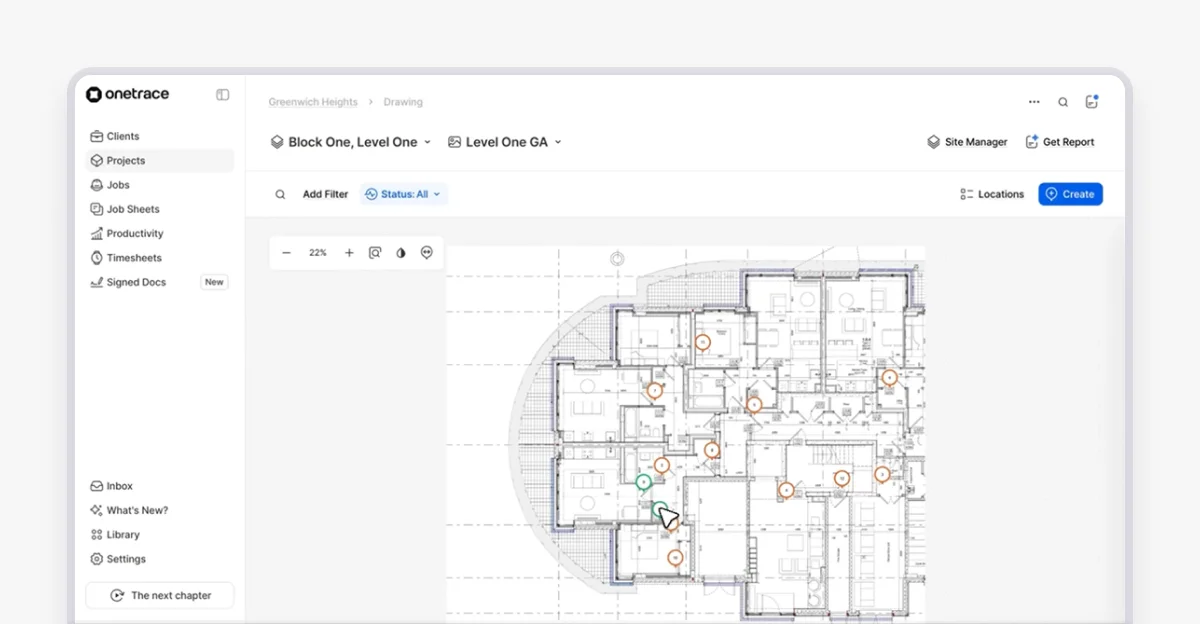
From the office, you need a clear view of what’s happening across all your jobs at any given time. From the field, operatives need a simple, reliable way to update progress as work moves forward.
Onetrace’s custom statuses are a practical way to make this work.
Rather than defaulting to generic labels, you can build statuses that reflect your actual workflow, using colours, icons, and labels that mean something to your team. As operatives move through a job, they update the status accordingly, giving the office an accurate, up-to-date picture of where everything stands without needing to pick up the phone.
6. Stay on top of compliance
Construction compliance is an ongoing responsibility that runs alongside every job. To ensure all field crews stay compliant throughout the project, you must:
Keep operative certifications and qualifications up to date and easy to verify
Make sure all compliance documents are signed before work begins
Capture photographic evidence on site and tie it directly to the relevant job
Store all compliance records in one central place so they’re easy to find when needed
When your records are complete and easy to access, proving compliance becomes a routine part of the job, not a last-minute scramble.
7. Enforce health and safety standards across every job
Construction remains one of the most hazardous industries to work in.
In 2024/25 alone, 35 construction workers lost their lives, and over the past three years, an average of 50,000 workers a year have been injured on site.
As a subcontracting business, the duty of care for your operatives sits with you.
RAMS—Risk Assessments and Method Statements—are your first line of defence here.
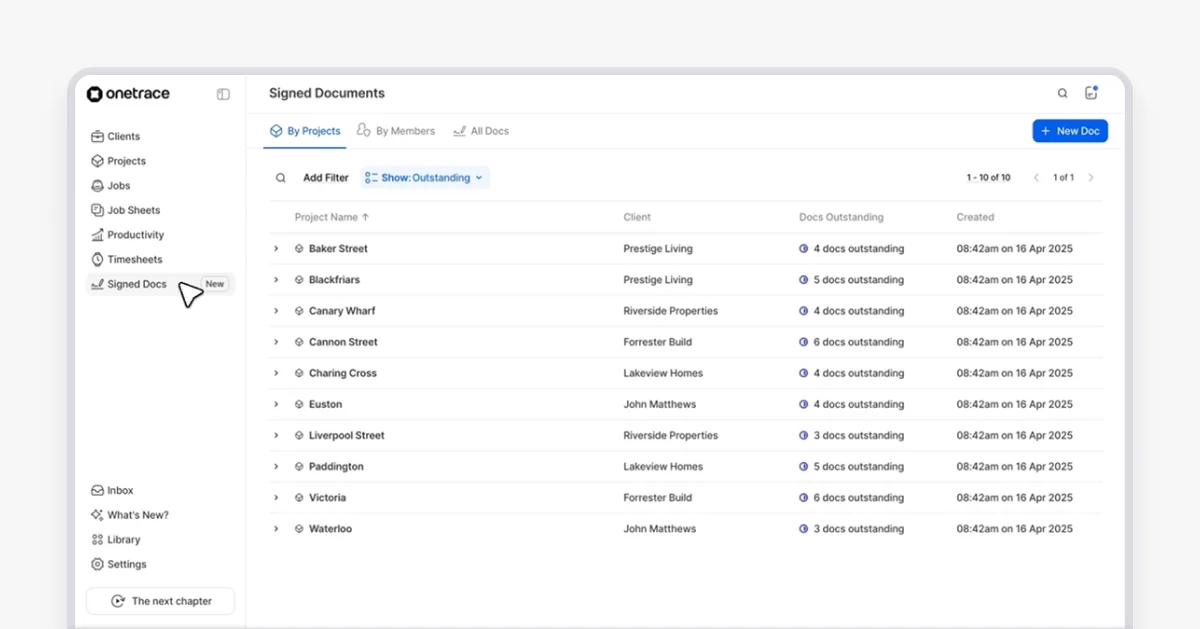
Before any operative starts work on site, they need to have read, understood, and signed off on the relevant RAMS for that job. Since these documents set out exactly how the work should be carried out safely, this practice protects both your operatives and your business if something goes wrong.
The challenge is making sure RAMS are signed consistently—not just on the first day of a project, but whenever conditions, scope, or personnel change.
Onetrace’s Signed Docs feature makes this straightforward. Documents can be distributed digitally, signed directly from a mobile device, and tracked in real time, so you always know who has and hasn’t signed.
8. Keep communication flowing between the office and the field
Good communication between the office and the field has less to do with how often you’re in touch and more to do with how well your systems share information.
Chasing updates over WhatsApp, fielding calls about job locations, and resending documents that were lost in an email thread all take time away from more valuable work.
When your tools are set up properly, much of this disappears:
Operatives get their schedule, job details, and documents in one place.
The office gets live progress updates, signed documents, and flagged variations without having to ask.
Communication happens through the work itself, not around it.
9. Handle no-shows, last-minute changes, and emergencies
No matter how well you plan, construction projects don’t always unfold exactly as expected.
An operative might call in sick, a contractor might move a deadline forward, or a site issue might bring work to a halt. How quickly you respond to these circumstances is what separates a minor disruption from a costly delay.
The key here is being prepared for change before it happens.
Having backup options in place makes it easier to deal with unexpected changes. When someone becomes unavailable, you can quickly find a replacement, reassign work, and update the field.
10. Review operative performance and job quality
Understanding which operatives are consistently delivering, which jobs are running efficiently, and where quality is slipping gives you the information you need to make better decisions, have honest conversations, and set meaningful goals.
Onetrace’s Productivity tab gives you a granular financial and operational overview—by member, by team, or by project—so you can see exactly where time and resources are being spent and what they’re generating.
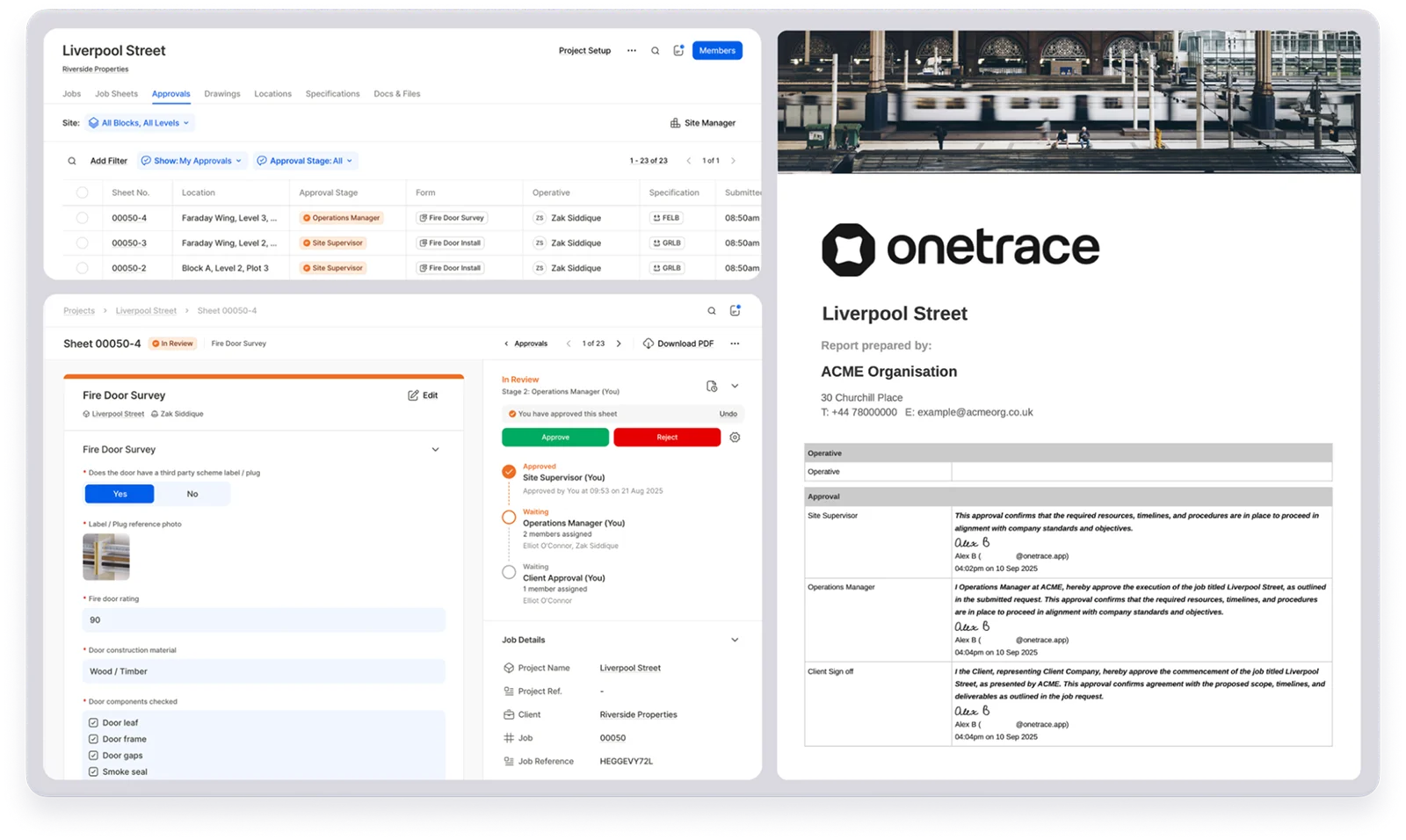
Regarding quality, Onetrace’s Approvals feature creates a structured review process for every job submitted. Work moves through defined approval stages, from site supervisor to operations manager or client sign-off, with feedback provided at each stage if something needs to be corrected.
The result is a full audit trail of every decision made, early identification of recurring issues, and a consistent quality standard maintained across every project.
Take control of your subcontractor management with Onetrace
Running a subcontracting business well takes more than skilled operatives and a full order book.
Without the right systems in place, even the busiest pipeline can unravel—through missed compliance, scheduling gaps, disputed hours, or work that doesn’t meet the required standard.
Keeping on top of compliance, scheduling, time tracking, and job quality consistently across multiple jobs and sites takes subcontractor software that’s built around your workflows.
This is often a challenge, as most construction management software tools are built with contractors in mind.
That’s why Onetrace stands out.
This platform was purpose-built for subcontractors by a team that understands the realities of their work. Today, over 1,000 of the UK’s leading subcontractors trust Onetrace to deliver higher quality work, stay compliant, and protect their margins.
If you want to see what it can do for your business, book a personalised demo and we’ll walk you through the platform in the context of your own workflows.
FAQ
How do you manage subcontractors effectively?
Managing subcontractors effectively comes down to having reliable systems for scheduling, time tracking, compliance, communication, and performance review.
Why is subcontractor management important?
Subcontractor management is important because the quality of your operations directly affects your reputation, your compliance, and your bottom line.
What are common issues with subcontractors?
The most common issues with subcontractors include scheduling conflicts, compliance gaps, late payment, poor visibility of job progress, and communication breakdowns between the office and the field.
Marketing Team
@Onetrace
The Onetrace marketing team is passionate about sharing insights, ideas, and innovations that help construction businesses stay connected, compliant, and efficient. Combining industry expertise with a love for clear communication, we aim to deliver content that empowers professionals to work smarter and safer.