Impact of technology on the construction industry: 10 benefits

By
Marketing Team
@Onetrace
For years, construction has been operating with one foot in the past.
As McKinsey’s Sam O’Gorman put it, much of the work was still done in ways that would look familiar to someone from a century ago. McKinsey’s research backed this claim up, ranking construction as the least digitised sector in Europe.
However, UK contractors, in particular, are proving that the industry is ready to leave this reputation behind.
According to NBS’s 2025 Digital Construction Report, 51.4% of construction professionals now believe the sector is no longer lagging behind others in digital adoption—up from just 27% in 2023. This important shift reflects the growing adoption of construction technology and the real-world benefits contractors and subcontractors are seeing from it.
With that in mind, we’ll explore the positive impact of technology on the construction industry, looking at the 10 key benefits helping UK contractors move from digital scepticism to practical adoption.
Key takeaways
Technology improves productivity and cost control
Digital tools reduce admin, errors, and wasted time.AI is making planning more proactive
AI can analyse project data to flag potential delays earlier.Digital tools improve safety and quality
Drones, inspections, and digital records help reduce risk and improve compliance.Connected software improves project visibility
Cloud-based platforms bring field and office teams onto the same page.Onetrace ties it all together
Onetrace adds another layer of visibility and control across project, workforce, field, and compliance workflows.
Understanding the impact of technology on the construction industry through 10 practical benefits
The biggest impact of technology on the construction industry can be seen in how it helps tackle the day-to-day pain points contractors have faced for years.
These 10 practical benefits show where technology is making a real difference across all phases of construction project management.
1. Higher productivity and lower project costs
Construction has long struggled to improve productivity, with manual processes, fragmented information, and repetitive site work all taking time away from higher-value tasks.
In 2023, the Construction Leadership Council estimated that better productivity could unlock around £45 billion in additional value for the UK construction industry each year.
Technology helps the industry work towards this goal by cutting unnecessary admin, automating routine work, and giving teams faster access to the information they need.
A 2026 study found that this approach also has a significant financial impact: businesses with advanced digital capabilities generate 3.1 times more revenue and 4.7 times more profit per employee than businesses with developing digital capabilities.
Technology landscape
Artificial intelligence (AI)
Automation
Digital workflows
Robotics
Connected equipment
Building information modelling (BIM)
The technology to watch
Robotic automation stands out because it can take repetitive physical tasks away from skilled workers altogether. For example, autonomous robots designed for tasks like tile grouting can deliver up to five-fold productivity gains, allowing teams to complete routine work faster and focus their skills where they add more value.
2. Better project planning and programme certainty
Construction programmes can quickly become difficult to manage if sequencing, site access, and logistics are only clarified once crews are already on site.
Traditional plans can show what needs to happen, but they don’t always make it easy to see how each activity will play out in the real world. Digital tools give contractors a chance to test the build before committing time, labour, and materials.
Teams can model different sequences, check access and temporary works, and identify potential conflicts while there’s still time to change the plan.
Technology landscape
AI
4D planning software
BIM
Digital twins
Geographic Information System (GIS)
Machine control
The technology to watch
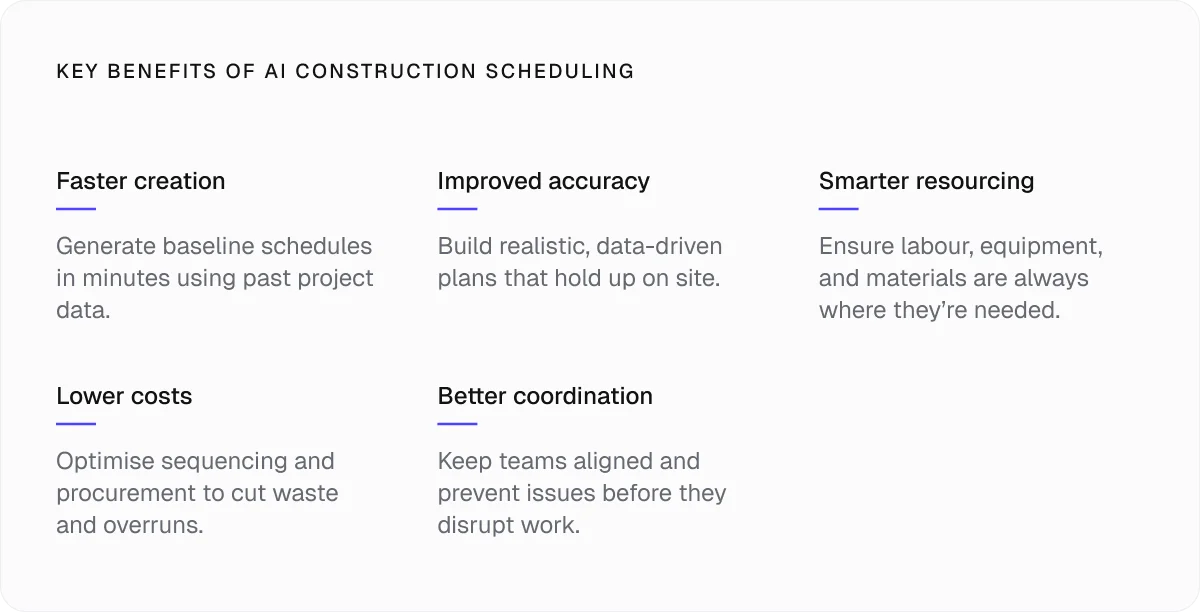
AI can turn the large volume of project data into useful signals for planning and scheduling teams. By analysing information from current and past projects, it can help identify patterns, highlight potential delays, and give teams earlier insight into where a construction schedule may come under pressure.
3. Fewer errors, defects, and expensive rework
Even small errors can become expensive once they reach the site. A clash between services, a design discrepancy, or a mistake that forces one trade to redo another’s work can all add labour, materials, and delay to a project.
According to the Get It Right Initiative, avoidable errors cost around 5% of project value directly, with the wider impact potentially reaching 10–25%.
Construction technology helps teams catch issues before they become expensive problems. Teams can coordinate designs digitally, capture existing conditions accurately, and check completed work against the plan.
Technology landscape
BIM
Clash detection
Reality capture
Quality control software
Augmented reality (AR)
Drones
The technology to watch
BIM has become a mainstream part of UK construction, with 72.3% of construction professionals reporting adoption in 2025. Its strength here is bringing information from different disciplines into a coordinated model, making potential conflicts easier to identify before work begins. This approach reduces the need for costly changes and rework once trades are on site.
4. Improved health and safety
Construction sites will always involve risk, but technology is changing how much of that risk workers need to face directly.
Manual inspections in confined spaces, work at height, and exposure to moving plant can all put people in harm’s way.
Technology helps identify hazards earlier, monitor changing site conditions and, most importantly, remove workers from dangerous situations altogether. Digital software can also strengthen safety compliance by making permits, inspections, reports, and safety records easier to manage and keep up to date.
Technology landscape
Drones
Wearable technology
Internet of Things (IoT) sensors
AR and virtual reality (VR)
Digital permits
BIM
The technology to watch
Drones can capture detailed images and survey data from a safe distance, reducing the need for workers to enter or approach potentially unstable areas.
5. Better collaboration and information management
A construction project can involve thousands of drawings, reports, inspections, and other documents moving between clients, designers, contractors, subcontractors, and suppliers.
When this information sits across separate systems, email threads, and paper files, teams can waste time searching for the right document or risk working from outdated information.
Cloud-based platforms bring project information into one shared environment, making it easier for teams to access, update, and exchange documents wherever they are. This approach supports faster communication, better coordination, and fewer version-control headaches.
Digital tools can also keep a record of changes and site activity, strengthening accountability and reducing the administrative work involved in managing project information.
Technology landscape
Common Data Environments (CDEs)
Cloud platforms
BIM
Mobile apps
Document management software
The technology to watch
Cloud-based software brings the office and the site onto the same system. With a mobile app for field teams, workers can access the latest information, complete inspections, capture photos, and report issues from the point of work. The wider project team then gets updates without relying on paperwork or passing information back through the office.
6. Greater cost and commercial control
Keeping a close eye on costs becomes harder as projects grow in size and design changes accumulate. Quantity take-offs, estimates, variations, and progress information can sit across different systems, making it difficult to see the commercial impact of a decision quickly enough.
Digital tools bring these data points closer together.
Contractors can work with more accurate quantities, track changes more clearly, and compare project progress with financial forecasts.
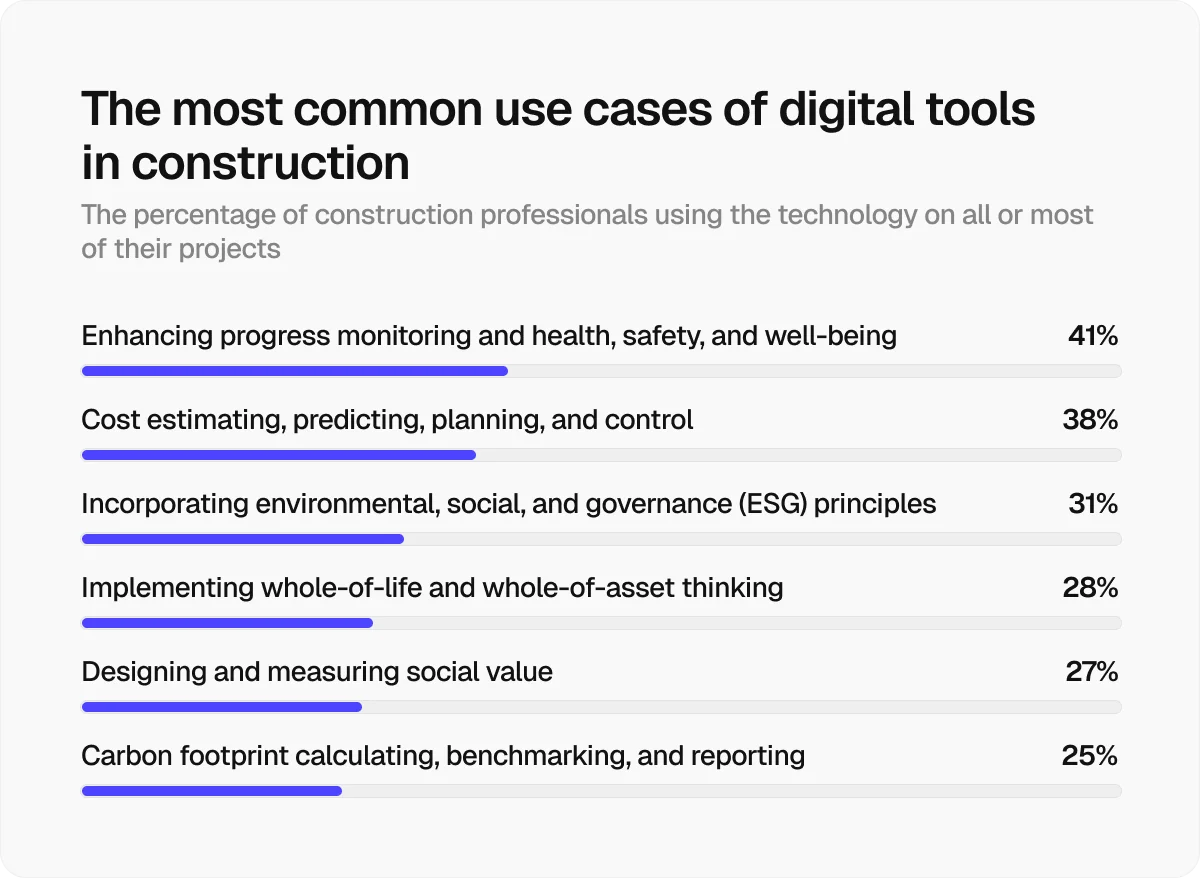
RICS research found that 38% of construction professionals use digital tools for cost estimation and planning on most or all of their projects, showing that digital commercial management is becoming a more established part of project delivery.
Technology landscape
5D BIM
Estimating software
Cost management platforms
Data analytics
AI
The technology to watch
Cost management software gives commercial teams a clearer view of where the project money is going. By bringing budgets, commitments, variations, forecasts, and project progress into one place, it can make financial changes easier to spot and act on.
7. Reduced waste and carbon emissions
Waste and carbon are increasingly challenging for contractors to treat as separate concerns. Clients and procurement frameworks expect greater visibility of environmental performance, while wasted materials, unnecessary deliveries, and inefficient site activity also add directly to project costs.
Technology gives contractors better control over both.
Digital tools can track materials from delivery to disposal, monitor energy use, measure carbon, and compare the environmental impact of different choices.
Technology landscape
Digital material tracking
Carbon accounting software
AI
Sensors
Design for Manufacture and Assembly (DfMA)
The technology to watch
Digital material tracking turns waste from an estimate into a measurable part of project performance. A great example of the tech impact in this department is Qflow, a software solution that has helped construction teams cut site administration time by 80% and save an average of £200,000 per project annually.
8. Faster construction through offsite manufacturing
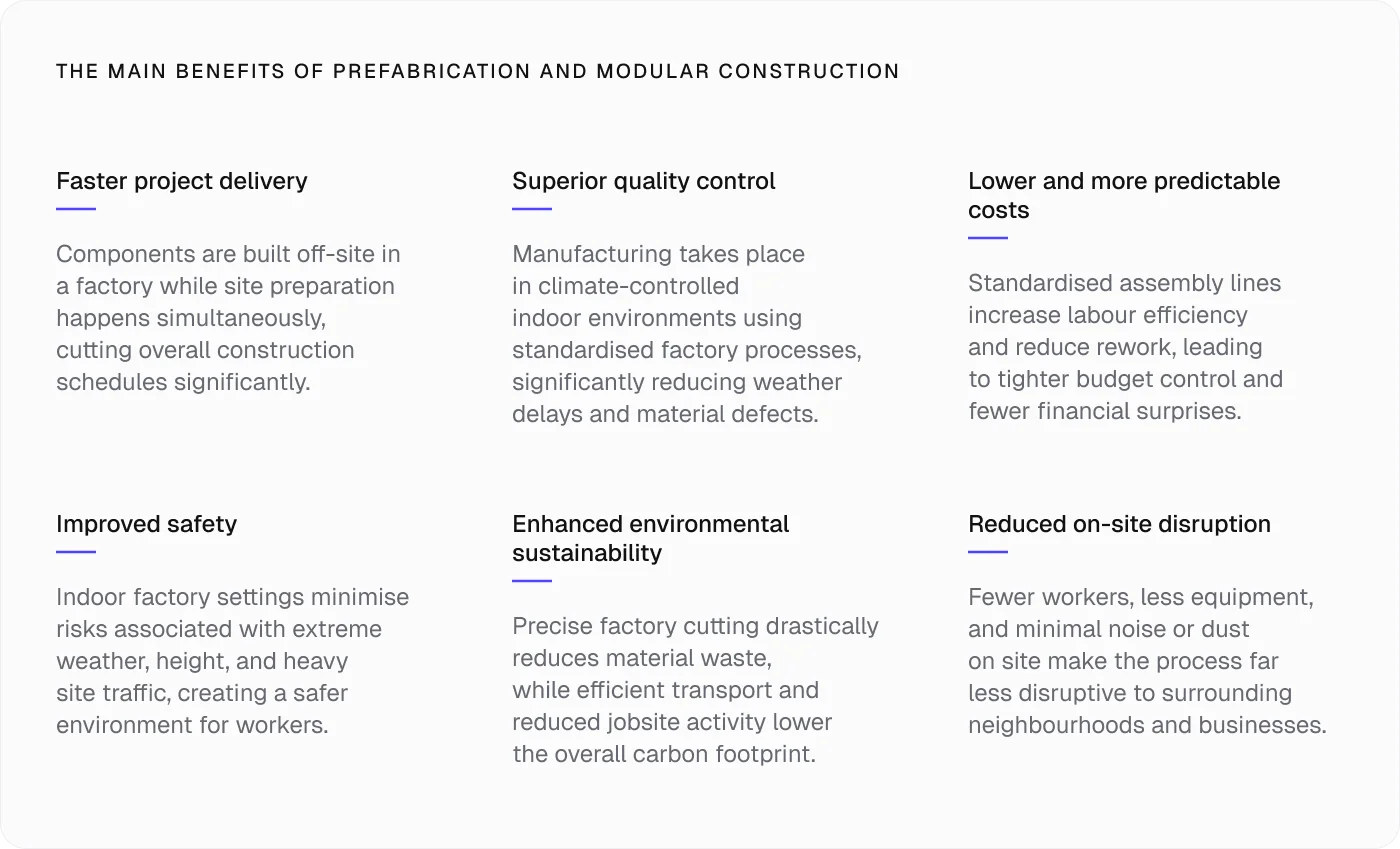
A large amount of construction work still has to happen in environments where space, weather, labour, and logistics can all slow progress. Moving more of that work into controlled manufacturing settings can reduce the pressure on site while making production more consistent.
Digital design and manufacturing technology make this shift more practical.
Components can be designed, produced, and quality-checked away from site before being delivered for assembly, reducing the amount of work that needs to happen in a busy construction environment.
Technology landscape
DfMA
Modular construction
Robotics
Manufacturing automation
Digital design
BIM
The technology to watch
DfMA changes the way a building is delivered by designing components with manufacture and assembly in mind from the outset.
Laing O’Rourke’s Two Fifty One project in Southwark shows what this can achieve: more than 70% of the residential tower was constructed off site, while an integrated just-in-time approach reduced on-site hours by 50%. The result is less work competing for space, labour, and time on a constrained construction site.
9. Better quality assurance and compliance
Quality checks have traditionally relied heavily on paper forms, manual records, and information being passed between people and systems. This approach made it harder to keep inspections consistent, prove what was checked, and follow up on issues before work moved on.
Digital workflows bring quality control closer to the point of work.
Teams can record inspections, attach photographs, assign corrective actions, and keep a searchable audit trail without having to recreate information later. Connected systems can also capture data automatically, reducing the amount of manual checking and recording required.
Technology landscape
Digital inspection software
Sensors
Automated records
Reality capture
Mobile apps
Robotics
The technology to watch
Digital inspection software allows each inspection to be linked to evidence, a location, a responsible person, and a follow-up action. For contractors, this means stronger control over quality management and clearer evidence for compliance.
10. Better asset handover and long-term building performance
The handover stage can leave clients with a lot of information but not always a usable record of what was actually built. Plus, drawings, manuals, inspection records, and asset data may be stored in different systems, making it harder for building operators to find what they need once the construction team has moved on.
Digital technology can keep useful project information connected from design to operation and maintenance.
Asset data can be captured during construction, updated as the project develops, and passed to facilities teams for ongoing use. This capability gives clients a complete picture of the finished asset, supporting better maintenance and decision-making over time.
Technology landscape
Digital twins
Asset management platforms
Data analytics
The technology to watch
A digital twin keeps the digital record of an asset useful long after construction is complete. By connecting information about the physical building with data from its operation, it can give facilities teams a more comprehensive view of asset condition, performance, and maintenance needs.
One platform, multiple construction technology benefits
When discussing the impact of technology on the construction industry, one form of technology keeps coming up: software.
Whether it’s used for planning, cost control, inspections, compliance, or managing information, software increasingly connects the different parts of a construction project.
However, this doesn’t mean you need a separate tool for every task.
A better approach is to invest in a comprehensive construction management platform like Onetrace. This software combines project, workforce, field, and compliance management, giving teams greater visibility without adding more disconnected systems.
The table below shows how Onetrace can contribute to each of the benefits covered in this article:
Benefit | How Onetrace contributes |
1. Higher productivity and lower project costs | • Productivity tracking shows performance across operatives, teams, and projects • Timesheets reduce manual time tracking with GPS clock-in/out • Project templates reduce repetitive setup work across projects |
2. Better project planning and programme certainty | • Planner gives managers a visual view of projects, teams, and workloads • Real-time schedule updates keep field teams aligned with changes • Mobile app gives operatives current schedules and job instructions |
3. Fewer errors, defects, and expensive rework | • Custom forms and mandatory fields standardise data capture and reduce missed information • Drawings and pins link work to precise locations • Photos and evidence provide a record of work completed |
4. Improved health and safety | • Signed Docs manages RAMS, health and safety forms, and Toolbox Talks • Mandatory signatures can be required before job sheets are created • Digital forms and evidence create a traceable record of site activity |
5. Better collaboration and information management | • Docs & Files provides a central place for project documents • Cloud-based access connects office and field teams • Client visibility and construction reporting make project information easier to share |
6. Greater cost and commercial control | • Materials and rates capture material costs directly against jobs • Variation tracking records changes to scope and price |
7. Reduced waste and carbon emissions | • Material tracking records material type, quantity, cost, and dimensions • Material reporting provides visibility of usage across projects |
8. Faster construction through offsite manufacturing | • Drawings, specifications, and materials keep installation information structured for field teams • Mobile job sheets help teams access the information needed to complete work on site, even offline |
9. Better quality assurance and compliance | • Approval workflows create structured quality checkpoints and feedback • Approval history and audit records provide traceable evidence of decisions |
10. Better asset handover and long-term building performance | • QR codes link completed work to its digital job history • Structured reports, records, and evidence make information easier to retrieve for future work |
Onetrace isn’t designed to replace the wider range of technologies used in construction. Instead, it ties the different strands together, adding another layer of visibility and control across the project and helping (sub)contractors get more from the technology already in place.
To see how this platform can fit into your existing workflows, book a personalised demo with the Onetrace team.
FAQ
How has technology impacted the construction industry?
Technology has helped construction teams improve productivity, reduce errors and rework, strengthen safety, and manage projects with better visibility and control. Digital tools are also making collaboration, project planning, and quality management more efficient.
What are the latest technologies used in the construction industry?
The latest technologies used in the construction industry include AI, BIM, robotics, drones, digital twins, and IoT sensors.
Will AI replace the construction industry?
No. AI is more likely to change how construction work is done than replace the industry. It can automate routine tasks, analyse project data, and support better planning decisions, while skilled workers remain essential for physical work, judgement, and problem-solving.
How does technology benefit roofers?
Technology can help roofers work more safely, estimate jobs faster, track materials and labour, document work, and keep projects organised. Drones and aerial tools can also speed up roof inspections and measurements, while roofing software helps connect field work with project management.
Marketing Team
@Onetrace
The Onetrace marketing team is passionate about sharing insights, ideas, and innovations that help construction businesses stay connected, compliant, and efficient. Combining industry expertise with a love for clear communication, we aim to deliver content that empowers professionals to work smarter and safer.