11 subcontractor management best practices [A 2026 guide]

By
Marketing Team
@Onetrace
Subcontractors sit in the middle of a demanding supply chain.
They have to deliver work to the main contractor while managing their own field workers, suppliers and, in many cases, lower-tier subcontractors.
At the same time, they often have less certainty over when they get paid. According to a 2022 study published in the Journal of Legal Affairs and Dispute Resolution in Engineering and Construction, as many as 77% of subcontract projects experienced late payment.
While you can’t manage your way out of someone else’s poor payment practices, strong subcontractor management can give you a firmer grip on costs and payment processes, making it easier to protect your cash flow.
But cash flow is only one part of running a well-managed subcontracting business.
You also need to coordinate your people, meet your contractual obligations, manage risk, and maintain the records that support your work.
This guide covers 11 subcontractor management best practices designed to give you better control over your projects, from the first day on site through to final payment.
Key takeaways
Clarify scope before work starts
Confirm responsibilities, exclusions, access, materials, and changes up front.Keep evidence as work happens
Record progress, delays, variations, and site conditions while the details are fresh.Check readiness before committing labour
Make sure drawings, materials, access, RAMS, and preceding work are in place first.Stay ahead of cash flow
Track applications, retention, payment dates, and project-level cash exposure.Use software to streamline management
Onetrace can centralise records, automate site data capture, and give subcontractors better visibility across projects.
Subcontractor management: 11 best practices for more controlled project delivery
These 11 subcontractor management best practices cover the key processes behind well-controlled project delivery, helping you plan work, streamline subcontractor workflows, and meet your commitments with fewer surprises.
1. Run a contract-to-site handover before anyone starts work
A signed subcontract often contains contractual details that sit with the estimator or commercial team rather than the person running the work on site.
Without a formal handover, important requirements can get lost between the office and the site team, leaving supervisors unclear about scope limits, notice requirements, design responsibilities, and the main contractor’s obligations.
To avoid this scenario, you should hold a contract-to-site handover before mobilisation, effectively turning the agreement into a practical site checklist. This checklist should cover:
The agreed scope and exclusions
Programme dates
Access arrangements
Labour and plant assumptions
Material supply and storage responsibilities
Inspection requirements
Payment milestones
Retention percentage and release terms
Defect obligations and rectification requirements
Change procedures
In addition, use this time to record any information you still need from the main contractor before work can start.
Pro tip:
Walk through the checklist with the site supervisor and give them access to the relevant drawings, specifications, and contract records. This creates a shared starting point and reduces the risk of commercial requirements being missed once work begins.
2. Apply the same pre-qualification standard downstream that you face upstream
If a main contractor checks your competence, insurance, training, and track record before appointing you, your lower-tier subcontractors should face the same level of scrutiny.
However, don’t treat accreditation alone as proof that someone is suitable for the job. According to the Health and Safety Executive (HSE), you should always assess project-specific skills, experience, and capability.
So, for each sub-subcontractor, check:
Relevant experience
Trade qualifications
Competence cards
Plant authorisations
Insurance
Then compare what you've verified against the work they'll perform to spot a competence gap before allocating someone to a specialist activity.
3. Maintain a live scope gap and exclusion register
Scope disputes often arise when responsibility for work between trades hasn’t been clearly agreed.
So, before work starts, compare your subcontract against the drawings, specification, and tender assumptions, and record anything that is included, excluded, or still unclear.
Pay particular attention to areas where responsibilities overlap, such as:
Work area | What to agree up front | Where to record it |
Penetrations | Who forms, seals and fire-stops each opening | Coordinated drawing |
Temporary protection | Who supplies and removes protection | Scope / subcontract |
Testing | Who carries out testing and provides certificates | Inspection plan |
Making good / repairs | Who restores surfaces after installation | Scope / marked-up drawing |
Waste removal | Who removes trade waste and when | Site rules / scope |
If any of these responsibilities are unclear, record the task, the party responsible and the document that confirms the agreement.
For example, if it’s unclear who must fire-stop a service penetration as part of the passive fire protection works, record the responsible trade and reference the relevant drawing or written instruction.
Avoid relying on phrases like ‘that’s normally included’. If you haven’t priced the work, mark it as excluded, provisional, or subject to written instruction until responsibility is agreed.
4. Record changes and variations as they happen
In construction, changes are often agreed verbally on site, then left until the monthly valuation or final account, when it becomes much harder to prove what was instructed, when it happened, and what it cost.
A live variation log helps tackle this challenge by giving your commercial and site teams the same record.
For each change, you should capture the following details:
Instruction reference
Date
Person who instructed it
Reason
Scope
Estimated value
Labour or material impact
You should also keep supporting drawings, photos, emails, and site records with the entry.
On higher-risk building projects in England, changes may also need to be assessed and recorded under the project’s formal change-control process.
5. Treat daily site records as commercial evidence, not admin
A delay, disruption, or defect may be challenged weeks later, and the people reviewing it probably weren’t on site when it happened. So, a vague note like ‘work delayed by other trades’ won’t tell them much.
That’s why you should use a standard daily record to capture:
Headcount, trades, and hours worked
Available and restricted work areas
Quantities installed and work completed
Materials received, rejected, or missing
Plant and equipment used or unavailable
Completed and outstanding inspections and tests
Dated photographs of progress and site conditions
You should keep all written entries factual and specific. For instance, instead of writing ‘good progress’, record something like ‘three mechanical installers fitted 18 metres of pipework in the first-floor plant room’.
The same process should apply to your sub-subcontractors. You should check their labour returns, delivery records, and photographs before including their work in your own payment application.
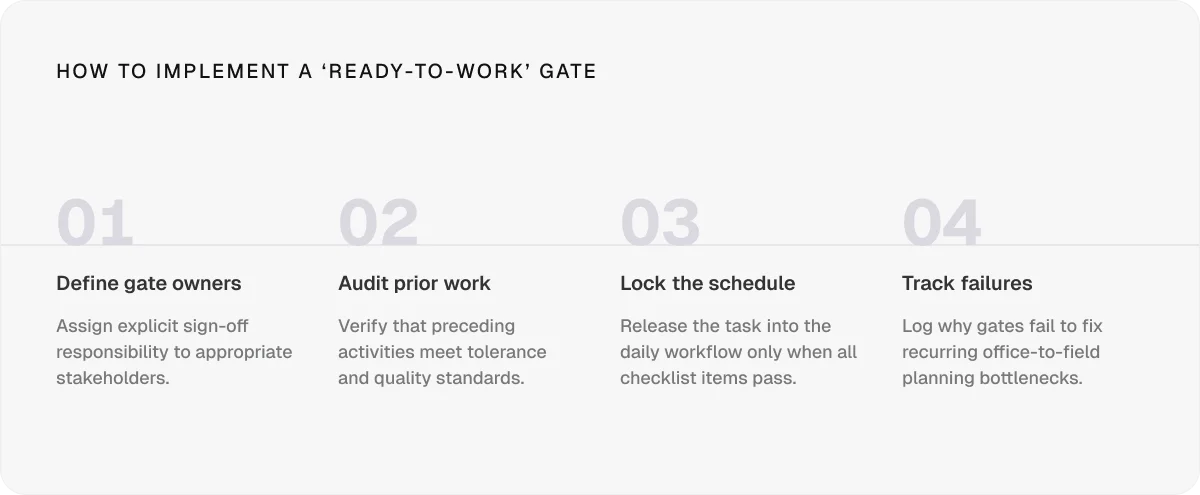
6. Build a ‘ready-to-work’ gate for every activity
Sending a crew to an area that isn’t ready wastes labour and can create knock-on delays that are difficult to recover. A simple ready-to-work gate gives the supervisor a defined checklist before assigning an activity to the team. This checklist should confirm:
Latest approved drawings and specifications
Completed preceding work
Safe and accessible work area
Required materials and plant
Approved RAMS and permits
Competent, inducted workers
Required inspections or hold points
Agreed access and trade interfaces
If any item is missing, record the constraint and hold the task rather than committing labour unnecessarily. Assign a person to resolve the issue and only release the activity once the requirements are met.
7. Keep your own information dependency register
A subcontractor can lose days waiting for a drawing, approval, or survey while still being held to the original programme. If those requests sit only in emails, it can be difficult later to show when the information was needed, who was responsible for providing it, or how the delay affected your work.
That’s why you should keep a simple register for every external input your work depends on, covering:
Which information you needed
Who was supposed to deliver it
When it should’ve been delivered
When it was actually delivered
How the delay impacted your work
This register should be reviewed during project meetings in order to flag approaching deadlines before they affect labour, procurement, or programme dates.
8. Make payment applications evidence-led
A payment application is easier to challenge when the amount claimed can’t be traced back to completed work, agreed changes, or contract records. For this reason, you should build each application from evidence already collected during the project rather than assembling the figures at month-end.
For each application, reconcile the following:
Measured work
Approved variations
Materials on site (where allowed)
Previous payments
Retention and deductions against the subcontract value
Link each of the figures to relevant drawings, progress records, variation instructions, and other supporting documents.
Then check the assessment against your previous payment certificate. If the certified amount is lower than your application, identify exactly which item was reduced and why.
Pro tip:
Building payment evidence is much easier when you don’t have to waste time manually compiling it every day.
Subcontractor software like Onetrace can assist you during each part of this process, including:
Measured work: Job sheets, photos, and marked-up drawings provide a record of completed work by location.
Variations: Variation fields flag work outside the original scope and let you track it through project reports.
Materials: Material tracking records types, quantities, costs, and dimensions, while associated rates feed into job costs.
Payment support: PDF and Excel reports pull project data into a format you can share with clients or use for your own payment records.
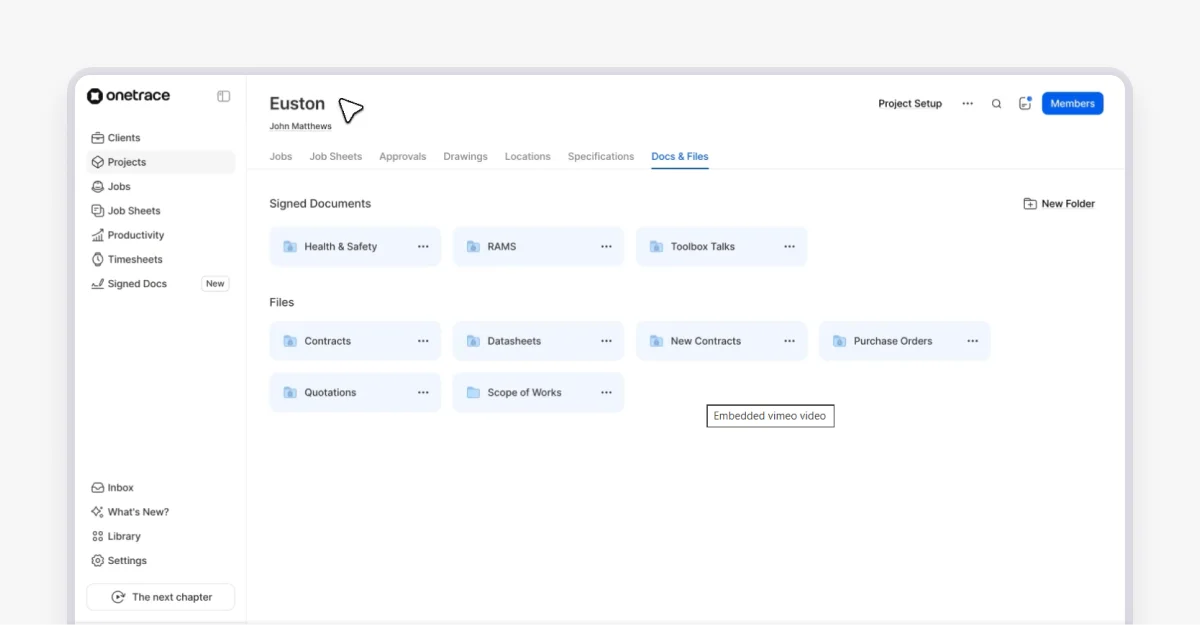
Supporting records: Custom forms capture structured site data, photos, and checklists, while the Docs & Files folder keeps contracts, quotations, and other project documents together.
9. Track retention as a separate receivable
Retention can sit unpaid long after the work that earned it is complete, making it easy to lose sight of when the money should be released. That’s why you should treat retention as a separate receivable instead of leaving it buried in project accounts.
For each project, maintain a retention register covering:
The amount withheld
Deductions
Release date or trigger
Outstanding defects
The person responsible for release and next action
Review this register alongside your payment schedule and follow up before the contractual release date arrives. Additionally, keep the relevant certificates, correspondence, and defect records with it so you can challenge a missed release with evidence.
Pro tip:
Keep the register open until the retention has actually been released, as retention periods can last for years.
10. Review cash exposure before accepting the next project
A large contract value doesn’t tell you whether a project is financially manageable. You may need to fund labour, materials, and plant weeks before the first payment arrives, while retention and disputed variations can push that point further out.
So, before accepting a new package, model its cash exposure alongside the expected margin. Include:
Mobilisation costs
Payroll
Material and plant commitments
Supplier payment dates
Payment application and certification periods
Retention
Tax liabilities
Feed those figures into a rolling 13-week cash forecast covering each project’s expected applications and realistic receipt dates. Include best-case, expected, and delayed-payment scenarios so you can see how another slow payment would affect your ability to meet payroll and pay suppliers.
This practice also gives you a firmer basis for deciding whether you have the cash capacity to take on another project at the same time.
11. Maintain one version-controlled project record
When subcontractor documents and other relevant project records are spread across email, messaging apps, and personal devices, it becomes difficult to establish which information the team was working from at a given point in the project.
To prevent outdated or conflicting information from being used on site, you should keep project records in one central, version-controlled location, with pre-defined access for the people who need it. The records in question should cover:
Drawings and specifications
RAMS
Instructions
Variations
Inspection records
Photographs
Certificates
Handover information
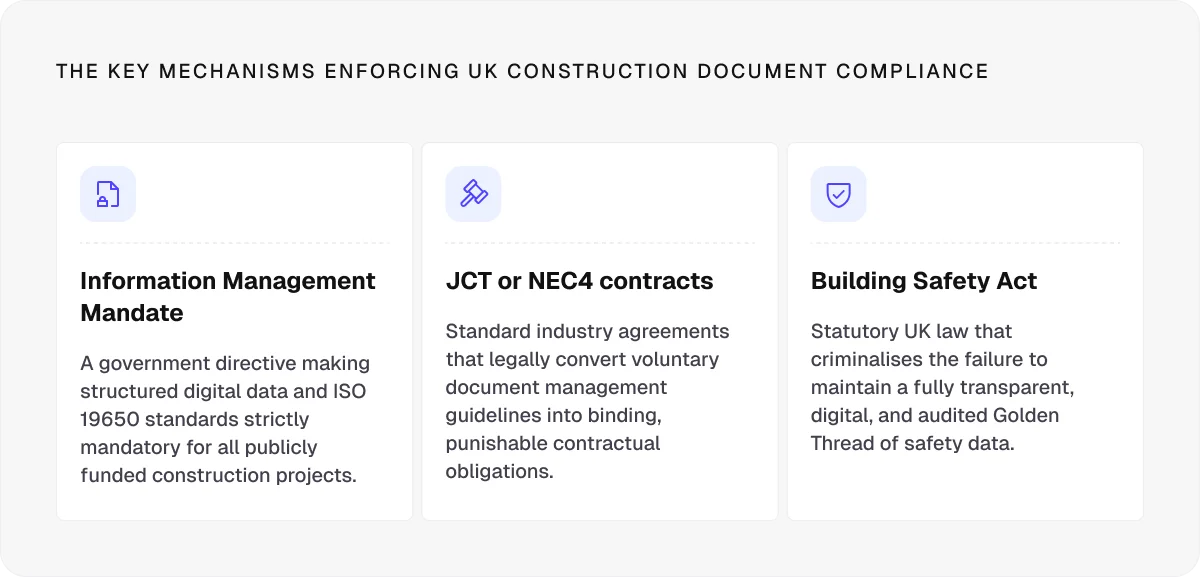
On higher-risk building projects, this approach also supports the golden thread of information: a digital record that keeps building information secure, accessible, and up to date, with version control showing changes.
Put better subcontractor management into practice with Onetrace
Many of the best subcontractor management practices come back to the same core principles: having a single source of truth, maintaining consistency, and ensuring accountability.
Subcontractor management software like Onetrace is built to deliver all three.
With Onetrace, subcontractors can:
Plan and reallocate their workforce from a visual project calendar, moving operatives between sites as workloads change
Automate time and attendance tracking with GPS-stamped clock-ins and clock-outs, reducing manual timesheet administration
See productivity at member, team, and project level to understand how efficiently resources are being used and where performance can improve
Give operatives location-specific instructions through built-in maps, directions, and what3words, helping teams get to the right place without unnecessary coordination
Link physical work to its digital history using QR codes, so future operatives can scan a location and access previous surveys and completed work
Manage client relationships and contacts from one place, with current contact details and project visibility readily available to the team
Scale repeatable processes with project templates, preloading the forms, materials, locations, approvals, and folders needed for different types of work
The result is a more consistent approach to subcontractor management, making it easier to apply best practices and handle every project with the same level of visibility.
Ready to streamline your subcontractor management?
Book a personalised Onetrace demo to explore the features that match your needs, see how they can tackle your daily challenges, and get started quickly if it’s the right fit.
FAQ
What is the best way to manage subcontractors effectively?
The best way to manage subcontractors effectively is to use subcontractor management software like Onetrace for centralising project information, tracking workforce activity, managing workflows, and maintaining visibility across your jobs.
What are the best practices for using subcontractors?
The best practices for using subcontractors include defining responsibilities, checking competence, documenting changes, tracking performance, and maintaining accurate records.
What are the key qualities of a good subcontractor?
The key qualities of a good subcontractor include relevant experience, proven competence, reliable communication, strong safety practices, and the capacity to deliver.
What are common issues with subcontractors?
Common issues with subcontractors include scope disputes, delayed information, poor documentation, payment issues, quality problems, and coordination failures.
Marketing Team
@Onetrace
The Onetrace marketing team is passionate about sharing insights, ideas, and innovations that help construction businesses stay connected, compliant, and efficient. Combining industry expertise with a love for clear communication, we aim to deliver content that empowers professionals to work smarter and safer.