8 benefits of construction document management done right

By
Marketing Team
@Onetrace
Construction document management is the process of organising, storing, controlling, and sharing project documents throughout the construction lifecycle.
Such a structured approach to construction document handling is essential to keep information accurate, accessible, and up to date. That’s because a single construction project can potentially produce thousands of documents, many of which are revised multiple times and dispersed across different teams and systems.
To understand the value of this approach, this guide explores 10 benefits of construction document management and the impact it can have on contractors and their projects.
Key takeaways
Rework and cost overruns are largely preventable
Most budget and schedule problems trace back to information failures: outdated drawings, missed updates, and poor version control. Structured document management removes the conditions that let these problems take hold.Every role on a project suffers when documents are disorganised
From site workers building from yesterday’s drawings to project managers chasing approvals, poor document control affects everyone. A single source of truth fixes this at the root.Compliance and risk management both depend on your paper trail
In the UK, the consequences of inadequate records are serious. Having documents is not enough. They need to be complete, traceable, and retrievable when scrutiny comes.Client relationships are built on transparency, not just delivery
Clients judge contractors on how easy they were to work with, not just the finished build. Organised documentation makes it easier to keep clients informed, resolve disputes, and win repeat work.Software is the most reliable way to make this stick
Manual processes depend on individuals following the right steps every time, which rarely holds up on a busy site. A platform like Onetrace builds document control into your team’s workflow, so the right processes happen consistently without extra effort.
8 benefits of construction document management (and why they matter)
Proper construction document management gives every team member—from the site to the office—a single source of truth. When everyone works from the same documents, in the same place, the fragmentation that has historically plagued the construction industry starts to ease.
That’s where the 10 benefits below begin.
1. Spend less time fixing, more time building
Rework is one of the biggest drains on construction projects, with avoidable errors costing the UK construction industry up to £25 billion a year.
A significant share of that rework traces back to poor document control: teams working from outdated drawings, missing revision updates, or conflicting versions of the same spec.
Efficient document management closes those gaps by:
Ensuring only current, approved documents are in circulation
Giving every team member access to the same version of the truth
Making sure changes are communicated clearly and promptly across all teams
Creating a traceable record of revisions so nothing gets missed or overlooked
2. Keep your costs where you planned them
Cost overruns are the norm in construction. Research spanning over 70 years and 20 countries found that 86% of transport projects exceed their original budget, with an average overrun of 28%.
Improper document management practices are a significant contributor to these spiralling costs. The table below highlights some of the areas where better document control can help reduce costs:
Area | How document management helps | Example |
Change orders | It logs and tracks every variation through a structured approval process. | A groundworks contractor installs extras without a signed change order. No record means no payment. |
Disputes | It maintains a full audit trail of decisions and communications. | A client disputes a cost increase, but time-stamped approval emails and revision logs back up your position. |
Scope creep | It documents the original scope so additions are identified and priced promptly. | Additional steelwork gets absorbed into the programme. Without a scope record, it never gets billed. |
Material ordering | It ensures specs are accurate and current before orders are placed. | Cladding is ordered to a superseded spec, and the mismatch isn’t caught until it arrives on site. |
Forecasting | It keeps project data centralised and up to date. | A cost discrepancy surfaces in week 3 rather than at the month-end review, leaving time to act. |
3. Give your programme a fighting chance
Delays are as common in construction as cost overruns. Research shows rework alone is responsible for schedule overruns of up to 22%, and that’s before factoring in the time lost to slow approvals, missing information, and teams waiting on documents that should already be in their hands.
Searching for project data, in particular, is a well-documented time drain, robbing teams of valuable hours every week.
Well-managed documentation claws that time back by:
Keeping all project information in one place so nothing gets lost between teams or revisions
Reducing the back-and-forth caused by incomplete or missing information at the point of decision
Ensuring approvals and sign-offs follow a defined process rather than sitting in someone’s inbox
Giving everyone on the project visibility of the latest documents as soon as they’re available
4. Get everyone on the same page
Poor communication is one of the most persistent problems in construction, and one of the most costly. A significant share of avoidable waste on construction projects traces back to information not reaching the right people at the right time.
Part of the reason is structural. A construction project rarely involves one team in one place. You have project managers in the office, subcontractors on site, designers sending revisions remotely, and clients expecting updates. They all have different information needs, work from different systems, and are rarely in the same room at the same time.
The table below breaks down how proper document control addresses the communication challenges of key roles in a construction project:
Role | Why communication breaks down | How document management helps |
Client / project owner | They’re typically off-site and depend on the contractor to keep them informed, which doesn't happen consistently. | It gives them visibility of approved documents and sign-offs, supporting informed decisions throughout the project. |
Architect / designer | Their revisions can pass through several hands before reaching the site, creating delays and the risk of the wrong version being used. | It creates a defined distribution process so updates reach all relevant parties promptly and without ambiguity. |
Project manager | They sit at the centre of all information flows—between client, designers, and site—making them a bottleneck when documents aren’t centralised. | It provides them with a single, up-to-date record of all approvals, revisions, and decisions so they can coordinate more efficiently. |
Subcontractor | They’re rarely present when key decisions are made, and often rely on verbal handovers or second-hand updates from the main contractor. | It allows them to have documented access to change orders, updated specs, and approvals without relying on someone to pass the message along. |
Site worker | Most site workers have no regular access to office systems or meetings, yet need up-to-the-minute information to do their jobs safely and accurately. | It makes the latest documents accessible on site, so teams are never working from yesterday's information. |
5. Stay on the right side of regulations
Construction is one of the most heavily regulated and scrutinised industries in the UK. In 2024/25, the Health and Safety Executive (HSE) secured over £33 million in fines, carried out 246 criminal prosecutions, and issued more than 4,400 notices across the sector. For businesses caught without adequate records, the HSE’s hourly investigation rate of £188 means the costs mount quickly.
Documentation is critical to proving compliance and reducing the risk of enforcement action.
Whether it’s building regulations, health and safety obligations, or contractual requirements, the evidence that standards were met almost always comes down to paperwork: signed approvals, inspection records, version histories, permits, and communications.
But having documents isn’t the same as managing them well.
A folder of unorganised files, scattered across email threads and shared drives, is of limited use when a regulator asks you to produce a specific permit or prove that a design change went through the proper approval process.
Disciplined document management ensures that records are complete, traceable, and retrievable, so that you’re ready when scrutiny comes.
6. Put your risk management on solid ground
Construction carries risk across every dimension of a project, and many of those risks don’t materialise out of nowhere. They build gradually through poor decisions, missed communications, and gaps in the project record.
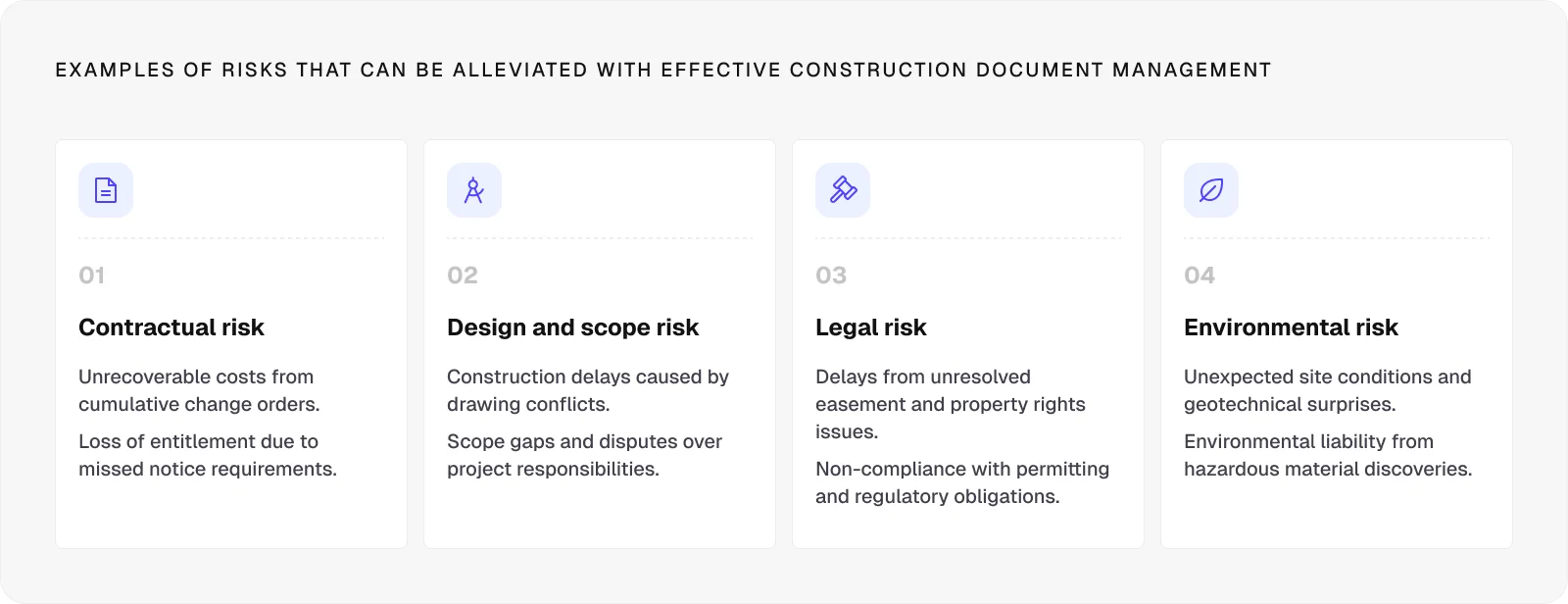
Rigorous document control supports your risk management by organising the information you need to identify, track, and respond to different types of risks throughout the project lifecycle. Here’s how this plays out across some of the most common risk categories:
Contractual risk: Keeping signed contracts, change orders, and correspondence in one traceable place reduces the chance of disputes escalating and strengthens your position if they do.
Design and scope risk: A controlled revision process means errors and omissions in drawings or specifications are caught and resolved before they reach the site.
Legal risk: A complete, time-stamped record of decisions, approvals, and communications gives you solid ground to stand on if a claim or dispute reaches a formal stage.
Environmental risk: Having permits, assessments, and compliance records properly filed means you can demonstrate due diligence quickly if your site practices are ever questioned.
7. Raise the bar on quality without adding overhead
Quality issues are a persistent problem in UK construction, and they’re often tied to information gaps. A Building Research Establishment study found that around 25% of quality-related events on construction sites stemmed from unclear or missing project information, and that finding has held up across decades of industry research.
Much of that comes down to how documents are managed: teams working from incomplete specs, inspections carried out inconsistently, or defects that go untracked until they become bigger problems. Effective document management addresses this by making quality control a natural part of how a project runs. It does so through:
Consistent inspections: Standardised checklists and documented sign-offs mean quality is measured against the same criteria across every trade and every site visit.
Issue tracking: Defects and corrective actions are logged, assigned, and followed up on, so nothing slips through the cracks.
Audit readiness: A complete, traceable record of tests, approvals, and material sign-offs means you can demonstrate build quality to clients or regulators without scrambling for paperwork.
8. Leave clients with no reason to look elsewhere
Clients don’t just judge you on the finished build. They look at how easy you were to work with, how well you kept them informed, how quickly you responded to questions.
When documents aren’t managed well, client communication suffers across the board.
Records go missing, updates get delayed, and disputes arise with no paper trail to fall back on, eroding trust. And in a relationship-driven industry, that kind of friction is hard to recover from.
Structured document management helps you avoid these scenarios by:
Keeping clients informed without constant phone calls or formal meetings, because project information is always ready to share
Presenting a professional front without extra effort, because tidy records and prompt responses speak for themselves
Resolving disputes quickly without things turning adversarial, because a full paper trail means both sides are relying on the same facts
Winning repeat business without having to pitch for it, because clients who trust you are far more likely to come back
Why use construction document management software
Managing documents manually on a live construction project is difficult to sustain, as paper trails can get lost and shared drives quickly become disorganised. Plus, version control relying entirely on individuals remembering to follow the right process rarely survives contact with a busy site.
Due to these common construction document management challenges, contractors now increasingly turn to dedicated software to enforce the right processes rather than depending on each team member’s discipline.
A comprehensive construction management platform like Onetrace can turn document management from an administrative burden into a natural part of how your team works on site. This is made possible through features like:
Drawings and pins: Upload floor plans and mark up work locations with pinpoint accuracy, so every operative knows exactly where they’re working and what’s been done.
Version control: Replace and reorder drawings as your project evolves, ensuring teams always work from the most current set of documents.
Custom forms: Build unlimited job-specific forms with mandatory fields and conditional logic, so data captured on site is consistent and complete every time.
Approvals: Run multi-stage quality assurance workflows in which job sheets move through structured sign-off chains before work is marked complete.
Signed Docs: Distribute RAMS, Toolbox Talks, and compliance documents digitally, with full visibility of who has viewed and signed each one.
Photographic evidence: Capture before, during, and after photos directly against job records, building an audit trail that proves quality and supports client sign-off.
Reports: Generate branded PDF or Excel reports instantly from live project data, giving clients and auditors exactly what they need without manual formatting.
Variation tracking: Log and report on any changes to the original scope of work in real time, keeping clients informed and protecting your business from unbilled extras.
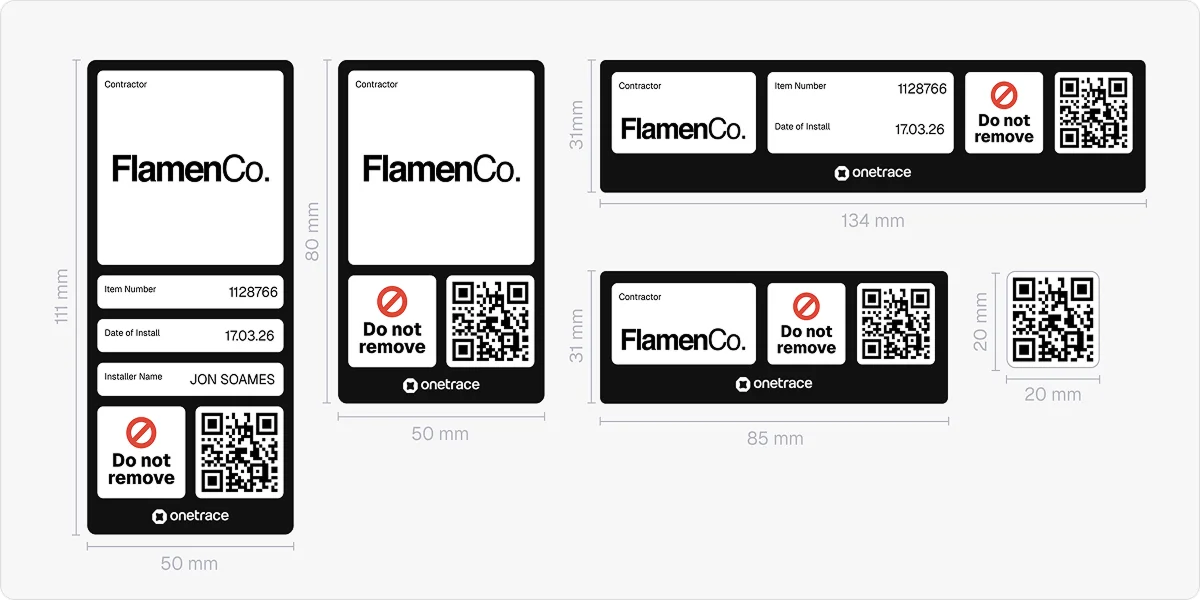
QR codes: Tag completed work on site so any future operative or auditor can scan and access the full history of that installation instantly.
Onetrace organises documentation across multiple levels of a project, from drawings that define where work is being carried out, to materials, specifications, and solutions that set out exactly what needs to be installed and how.
All of this sits within a central docs and files hub, where folders can be structured, access permissions controlled, and clients given visibility of exactly what you choose to share with them.
If you’d like to see how all of this works in practice, book a personalised demo with the Onetrace team.
FAQ
What types of documents need to be managed on a construction project?
The types of documents that need to be managed on a construction project include:
Drawings and floor plans
Specifications
Contracts and change orders
RAMS
Inspection and test records
Material submittals and data sheets
RFIs
Permits
Correspondence between project parties
How long should construction documents be kept after a project is complete?
In the UK, there’s no single universal retention period, but construction project records must be kept for at least six years after practical completion.
Marketing Team
@Onetrace
The Onetrace marketing team is passionate about sharing insights, ideas, and innovations that help construction businesses stay connected, compliant, and efficient. Combining industry expertise with a love for clear communication, we aim to deliver content that empowers professionals to work smarter and safer.