Subcontractor documents checklist: 7 must-have documents

By
Marketing Team
@Onetrace
Subcontractor documents are the records that help prove a subcontractor can carry out construction work safely, legally, and to the required standard.
Having the right documents is often the difference between securing work and failing the onboarding checks.
Proper documentation can also minimise the risk of payment delays, compliance issues, and problems with His Majesty’s Revenue and Customs (HMRC) under the Construction Industry Scheme (CIS).
The stakes are also high because demand for subcontractors shows no sign of slowing down. In fact, 69% of builders plan to grow their workforce in 2026, creating new opportunities for skilled subcontractors.
To keep you as prepared on paper as you are on site, this guide breaks down seven essential subcontractor documents most contractors expect to see.
Key takeaways
Keep your core onboarding documents ready
Contractors commonly ask for identification documents, a Unique Taxpayer Reference confirmation letter, National Insurance or company registration details, insurance certificates, qualifications, and right-to-work records before awarding work.
CIS verification can delay work if your records aren’t accurate
Contractors must verify new subcontractors with HMRC before making payments. Keeping your UTR and business details up to date can prevent onboarding delays.
Health and safety documents are often a deciding factor
Risk assessments and method statements (RAMS) are among the most frequently requested documents, especially for higher-risk activities.
Qualifications help prove competence and secure site access
CSCS cards, NVQs, and trade-specific certifications prove that you have the skills and training required for the work. Many sites require evidence of competency before allowing access.
Organised paperwork keeps you contract-ready
Onetrace enables subcontractors to manage RAMS, certificates, qualifications, contracts, and other project documents in one place, making it easier to demonstrate compliance, respond to contractor requests, and stay ready for new opportunities.
Subcontractor documents: 7 essential records contractors expect to see
Subcontractors need to provide documents that prove they are properly registered, insured, qualified, and compliant. Contractors use these records to assess risk, verify competence, and decide who gets the job.
Here are seven of the most important documents to have prepared.
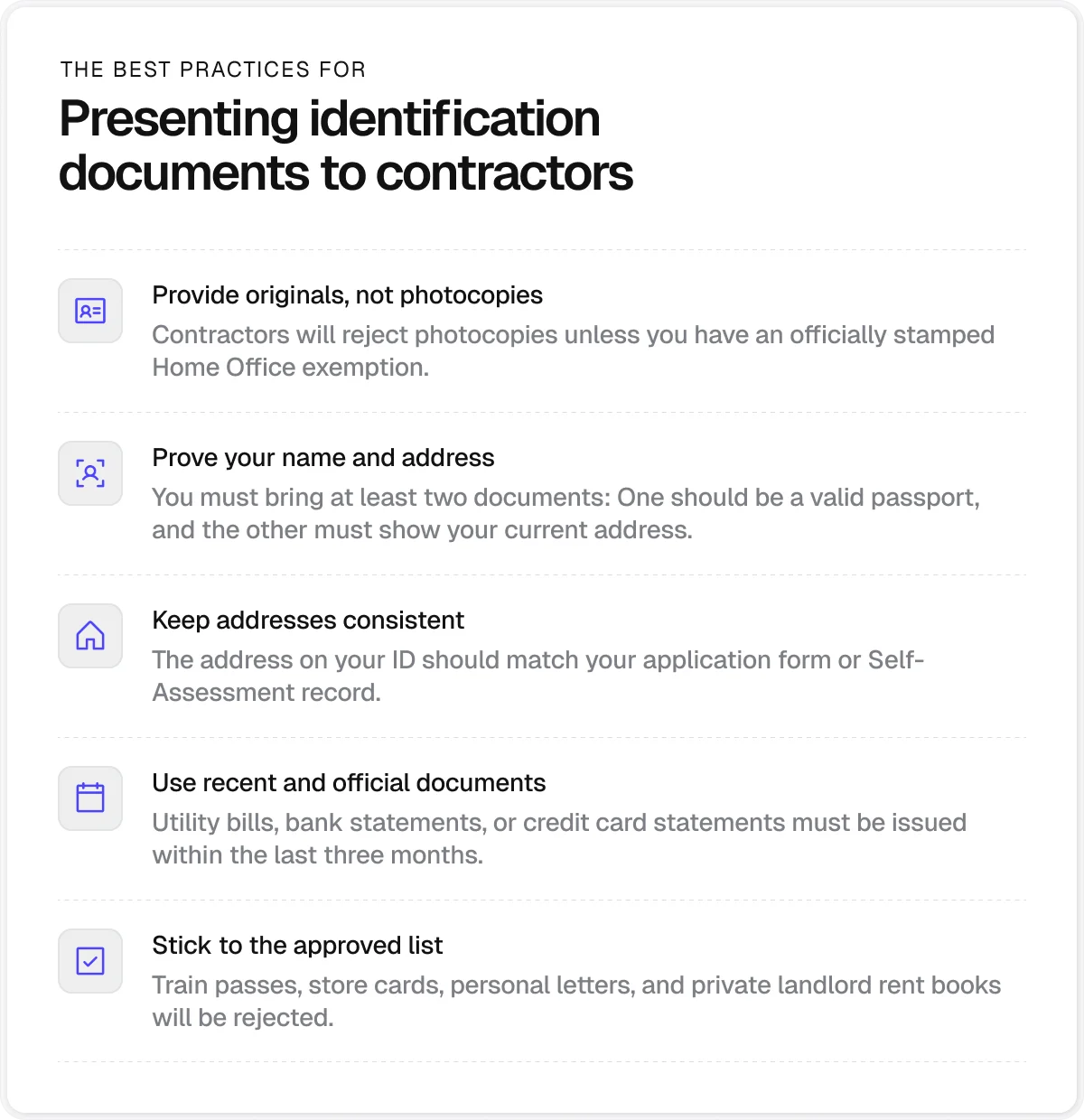
1. Identification documents
The first group of documents has nothing to do with your construction skills, qualifications, or experience. Identification documents serve a much simpler purpose: proving that you are who you say you are.
Commonly accepted identification documents include:
A valid passport
A driving licence
A recent utility bill
A recent bank statement
A council tax bill
A UK residence permit
In some cases, you’ll have to present your passport, alongside another document showing your current address. Where possible, provide original documents and make sure the details are up to date and consistent across all records.
2. Right-to-work identification
Right-to-work documents provide evidence that you’re legally allowed to work in the UK.
While these checks are most commonly associated with employees, many contractors also carry them out for subcontractors, agency workers, and labour providers.
Contractors may request right-to-work documentation as part of their onboarding process to meet compliance requirements, reduce the risk of illegal working, and verify the identity of everyone working on site.
The documents required will vary depending on your circumstances, but commonly accepted forms of evidence include:
A valid British or Irish passport
A UK residence permit
A digital right-to-work check through the Home Office
3. Unique Taxpayer Reference (UTR) confirmation letter
Before paying a new subcontractor, contractors must verify them with HMRC.
As part of this process, they will usually ask for your Unique Taxpayer Reference (UTR) to confirm your CIS registration status and the correct tax deduction rate. The UTR is a 10-digit number issued by HMRC when you register for Self Assessment or set up a limited company.
You can find it on HMRC letters, tax returns, and within your Personal Tax Account.
Keeping a copy of your UTR confirmation letter on hand can help speed up onboarding and prevent delays when starting a new contract.
4. National Insurance number or company registration details
Contractors also need basic business information to verify subcontractors with HMRC. If you’re a sole trader, you’ll usually need to provide your National Insurance number.
If you operate through a limited company, contractors may ask for:
Your company name
Company registration number
Company UTR
As for partnerships, they may need to provide the partnership UTR and nominated partner details.
Make sure the information you provide matches HMRC’s records exactly, as even small discrepancies can delay the verification process.
5. Insurance documents
Insurance documents show that you have the financial protection needed to cover accidents, injuries, property damage, and other risks that can arise on construction projects.
Many contractors require proof of insurance before allowing subcontractors on site, while some policies may be required by contract or law.
Among those required by law, arguably the most important one is employers’ liability insurance. This insurance is a legal requirement for most subcontractors who employ staff, labourers, or apprentices. It covers legal and compensation costs if an employee is injured or becomes ill as a result of their work.
As for insurance certificates that aren’t legally required, public liability insurance is one of the most commonly requested documents during subcontractor onboarding. This insurance covers claims made by third parties for injury or property damage caused by your work.
The table below gives an overview of other insurance documents subcontractors may need:
Insurance type | What it covers | When you need it |
Tools insurance | Loss, theft, or damage to tools and equipment | If you use your own tools on site |
Contractors’ all risk insurance | Damage to ongoing work, materials, or projects | For projects where you’re responsible for work in progress |
Hired-in plant insurance | Loss, theft, or damage to rented plant and machinery | If you hire equipment for a project |
Professional indemnity insurance | Claims arising from professional advice, designs, or specifications | If your role involves design or consultancy work |
Personal accident insurance | Loss of income following an injury that prevents you from working | If you rely on your own earnings and want additional protection |
Legal expenses insurance | Legal costs arising from disputes or claims | If you want cover for potential legal proceedings |
6. Health and safety documentation
Subcontractors are responsible for their own health and safety, as well as the safety of anyone who could be affected by their work.
In construction, these duties are reinforced by the Construction (Design and Management) Regulations 2015 (CDM), which require subcontractors to work safely, manage risks, and cooperate with principal contractors.
To demonstrate compliance, contractors will often ask for health and safety documentation. This can include risk assessments, method statements, training records, inspection records, and other documents that show how risks will be controlled on site.
Among these, RAMS are among the most commonly requested documents.
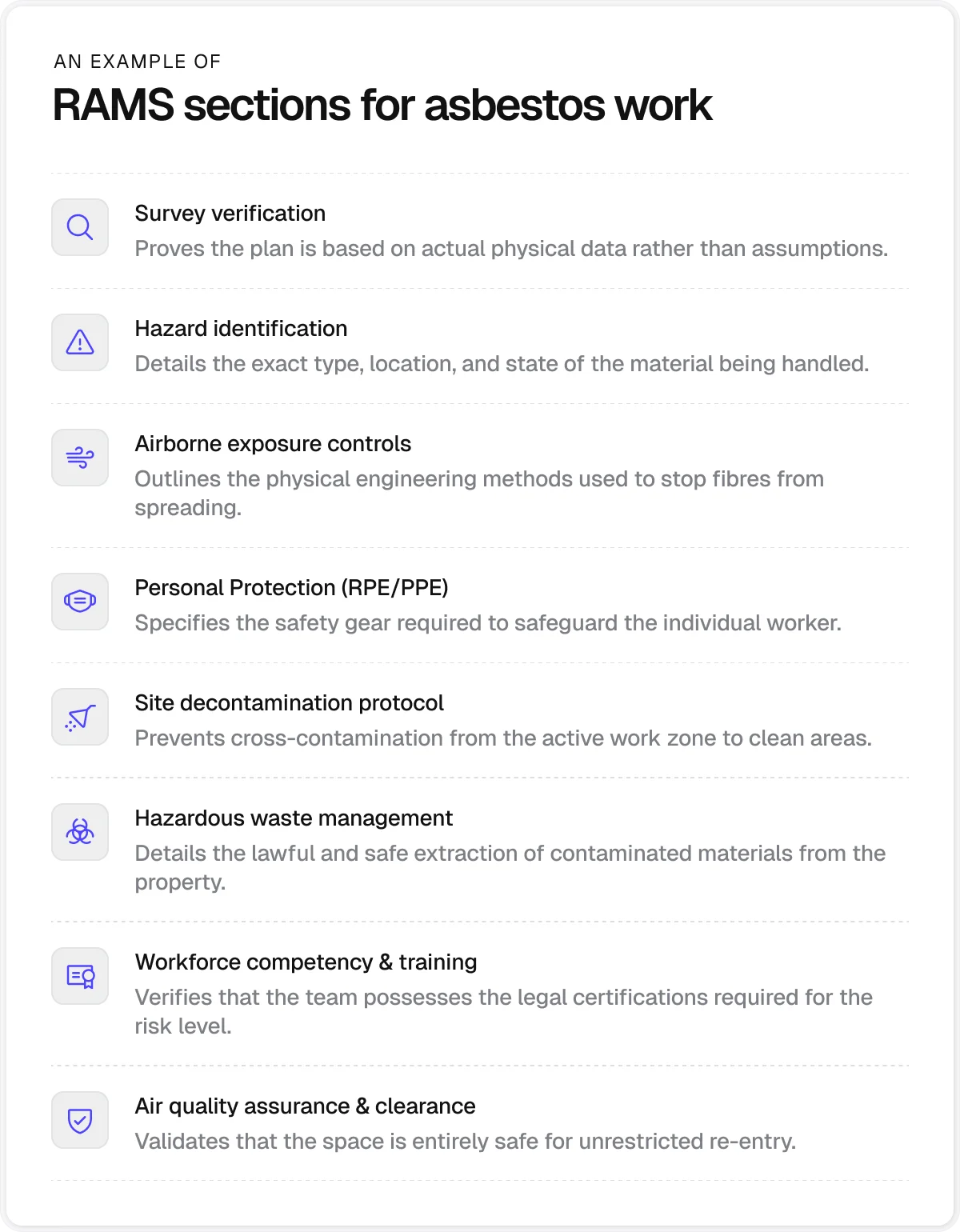
A risk assessment identifies the hazards associated with a task and the measures needed to control them. A method statement details the controls, equipment, and procedures needed to carry out work safely.
RAMS are usually required for higher-risk activities like:
Work at height
Confined space work
Demolition work
Excavation and groundworks
Work near overhead power lines
Activities involving asbestos or hazardous substances
Structural steel erection
Lifting operations involving plant and machinery
Many contractors require RAMS to be submitted and approved before work starts, so keeping them up to date can help avoid delays and demonstrate a professional approach to health and safety.
Pro tip:
Health and safety documents need regular reviews, updates, and approvals.
Using subcontractor management software allows you to keep these documents organised, up to date, and easy to access when contractors request them.
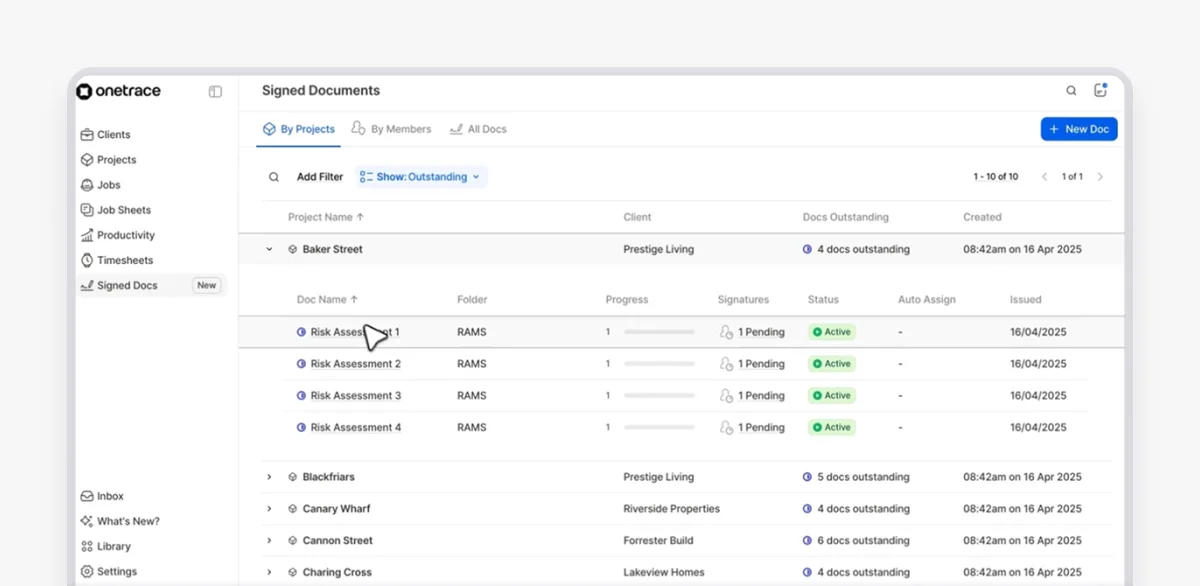
Onetrace provides a central place to manage RAMS, health and safety forms, Toolbox Talks, certificates, and other key project documents across all your projects.
In addition, the platform’s Signed Docs feature allows you to assign RAMS and other compliance documents directly to operatives, collect and track signatures, and see a complete record of who has viewed or signed each document.
This approach helps ensure nothing falls through the cracks while providing clear evidence of compliance when contractors or clients request it.
7. Competency and trade qualifications
Contractors often ask for qualifications and competency records as part of the onboarding process. These documents demonstrate that you have the training and experience required for your role.
The exact documents you’ll need depend on your trade, role, and the type of projects you work on. However, there are a few qualifications that contractors commonly want to see during onboarding.
CSCS cards
The Construction Skills Certification Scheme (CSCS) card is the most widely recognised way of demonstrating competence in the UK construction industry.
While a CSCS card isn’t a legal requirement, many principal contractors and house builders require workers to hold a valid card before they can access the site.
Different card colours reflect different roles, qualifications, and levels of responsibility.
NVQs and trade qualifications
National Vocational Qualifications (NVQs) are among the most common trade qualifications in construction.
They provide evidence that a worker can perform the tasks required for their role to an industry-recognised standard.
The level required will depend on your position.
For example:
Level 2 NVQs are commonly held by skilled tradespeople like bricklayers, carpenters, and plasterers.
Level 3 and 4 NVQs are often required for advanced tradespeople and supervisors.
Level 6 and 7 NVQs are typically aimed at site managers and senior construction professionals.
Other qualifications and accreditations
Depending on your trade, contractors may also request evidence of:
Manufacturer training and accreditations
Plant and machinery certifications
Temporary works qualifications
Specialist health and safety training
Trade-specific competency cards
Subcontractor documents: What contractors must provide
Providing documents isn’t a one-way process.
Contractors also have a responsibility to share key information that enables subcontractors to work safely, understand project requirements, and get paid correctly.
The last item is particularly important because strong demand for skilled subcontractors hasn’t translated into equally strong earnings growth. In fact, subcontractor pay rose by just 3.6% in 2025.
The table below outlines some of the most common documents contractors are responsible for providing:
Document | What it is | Why it matters |
Subcontractor agreement | The contract that sets out the scope of work, responsibilities, payment terms, and project requirements | Prevents disputes and ensures both parties understand their obligations |
Site induction records and safety information | Site-specific health and safety procedures, rules, and risk information | Helps subcontractors work safely and comply with site requirements |
Project drawings and specifications | Technical information, plans, and instructions for the work being carried out | Ensures work is completed to the correct standards and requirements |
Payment notices and pay less notices | Documents explaining the calculation of payments and any deductions applied | Provides transparency and shows subcontractors what they’re being paid and why |
CIS payment and deduction statement | A record showing payments made and any CIS tax deductions taken | Needed for tax records, Self Assessment returns, and verifying deductions |
Keep your subcontractor documents organised and accessible with Onetrace
Creating a subcontractor onboarding pack is one of the simplest ways to make the onboarding process faster and more consistent.
By keeping key subcontractor documents together and ready to share, you can respond to contractor requests more quickly and reduce the risk of delays.
Just as importantly, these documents need to be kept organised, accessible, and up to date. Expired insurance certificates, missing qualification records, and outdated health and safety documents can create compliance issues and slow down the approval of your next project.
Onetrace addresses these challenges through:
Centralised document management: Store RAMS, certificates, contracts, drawings, quotations, and other project documents in one place.
Structured folders and access controls: Organise documents by project, and control who can view or edit sensitive information.
Training and certification tracking: Keep qualification records up to date and readily available when contractors request proof of competence.
Project-specific documentation: Link drawings, specifications, materials, and supporting documents directly to the relevant project.
Combined with Signed Docs for compliance sign-offs and document tracking, Onetrace keeps your paperwork as job-ready as your team.
Ready to spend less time chasing paperwork and more time delivering work?
Book a personalised Onetrace demo to explore the platform’s compliance, document management, and project delivery features.
FAQ
What are subcontractor documents?
Subcontractor documents are the records used to prove that a subcontractor is qualified, compliant, and eligible to carry out construction work.
What is a subcontract agreement?
A subcontract agreement is a contract that sets out the scope of work, responsibilities, payment terms, and conditions between a contractor and subcontractor.
Can I pay a subcontractor without verifying them?
No. Contractors must verify new subcontractors with HMRC before making payments under the Construction Industry Scheme.
What do I need to verify a subcontractor?
To verify a subcontractor, you’ll typically need their UTR and either their National Insurance number, company registration details, or partnership information, depending on how the business operates.
Marketing Team
@Onetrace
The Onetrace marketing team is passionate about sharing insights, ideas, and innovations that help construction businesses stay connected, compliant, and efficient. Combining industry expertise with a love for clear communication, we aim to deliver content that empowers professionals to work smarter and safer.