20 construction project management tips that actually work

By
Marketing Team
@Onetrace
Construction project management is the process of planning, coordinating, and overseeing a building project from first brief to final handover.
The challenges to effective project management are well-documented and include cost overruns, schedule slippage, and quality failures. Worse still, each challenge feeds the next, with rework accounting for an average of 52% of total cost growth and up to 22% of programme overruns industry-wide.
While project management alone can’t prevent every delay or defect, the right approach makes a real difference. So, here are 20 construction project management tips worth your time—practical, specific, and rooted in the realities of on-site work.
Key takeaways
Plan thoroughly before construction starts
Strong pre-construction planning helps prevent delays, rework, and costly surprises later.
Create realistic schedules together
Involve trades, subcontractors, and suppliers to build timelines that reflect real site conditions.
Monitor progress consistently
Track budget, milestones, resources, and quality to spot issues before they escalate.
Prioritise accountability and communication
Clear responsibilities and standardised communication keep teams aligned and projects moving.
Use project management software to stay organised
Tools like Onetrace centralise schedules, documents, approvals, and site updates, helping teams deliver projects more efficiently and with fewer mistakes.
20 construction project management tips for running better projects
Successful project management touches every part of a project: the people, the resources, the processes, and the details that sit between them. These 20 tips reflect that, covering the full range of what it takes to deliver a project well.
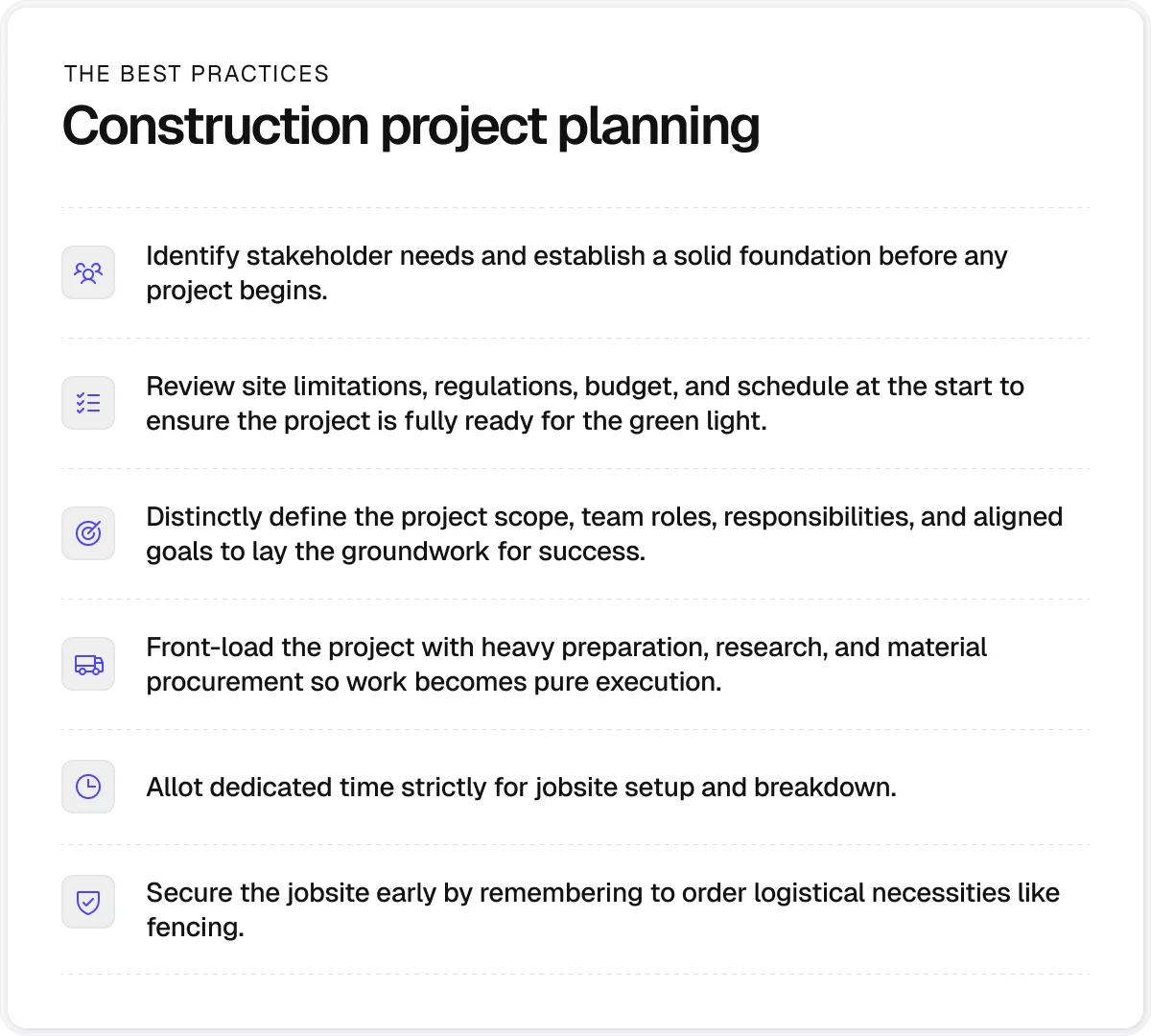
1. Front-load your planning so execution runs itself
Many construction project issues are planning problems in disguise.
That’s why you shouldn’t treat the pre-construction phase as a warm-up, but as the job itself. This means getting materials ordered early, walking through site logistics with your field team, and closing out every open question before work begins.
When planning is rushed or understaffed, delays and rework follow almost every time.
2. Estimate small to avoid big surprises
When you estimate a project as a whole—or even phase by phase—it’s easy to miss what sits between the lines.
Think about a first fix electrical package: The cable runs, back boxes, consumer unit, containment, and testing are all separate costs that vanish inside a single line item. To avoid underestimation eating into margins, break every element down to its smallest components and estimate each one individually.
The more granular your estimate, the less room there is for costly surprises.
3. Never hand down a schedule—build one together
A schedule built in isolation is a schedule doomed to fail.
If trades, subcontractors, vendors, architects, engineers, and the owner haven’t had input, you’re handing people a timeline that likely doesn’t match reality.
To avoid creating a schedule that looks right on paper but falls apart on site, build it collaboratively. Give every relevant stakeholder the chance to confirm that their portion of the programme is achievable.
4. Base your timeline on what’s real, not what’s ideal
Not every stakeholder can be involved early enough to feed into the original programme. Subcontractors, in particular, are often appointed after the initial schedule is issued.
If that’s the case, build in contingency for those packages and flag their timelines as provisional, adjusting as each party comes on board and can give a realistic view of what their work requires.
If you’re uncertain, it’s always better to overestimate than to commit to a timeline that was never achievable.
5. Order what you need—nothing more, nothing less
With total construction costs projected to rise by 6.6% in 2026, wasting resources directly eats into already-thinning margins.
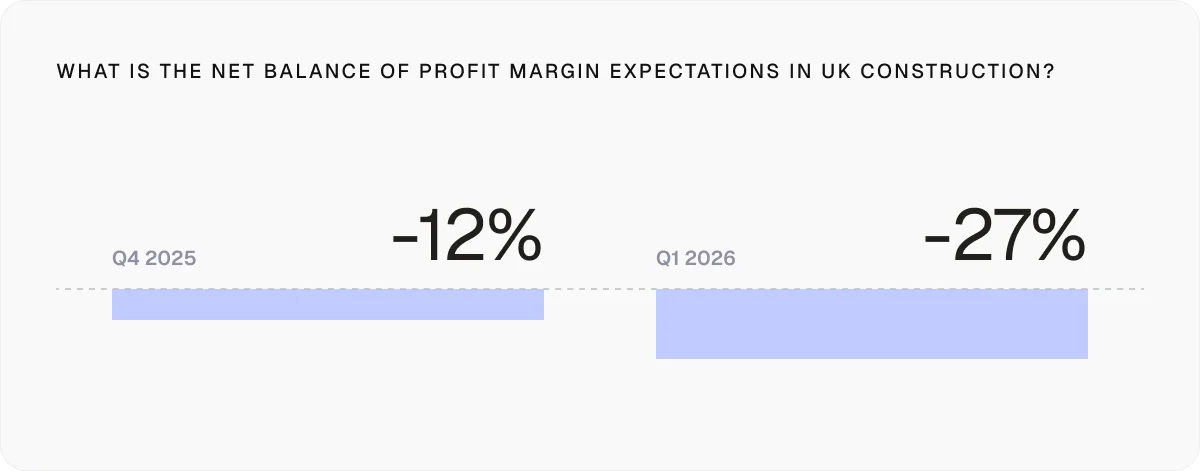
Over-ordering materials, renting equipment you already have on site, or hiring more labour than the current phase needs can all push projects into the red before anyone notices.
So, before placing any orders, check what you already have in stock. Then, order the correct sizes and quantities from the start: If you need a 2.7-metre plasterboard, don’t order 3 metres. The same logic applies to plant and labour: Only hire and rent what the job actually requires at that stage.
If there are leftover materials, make sure those that can be repurposed are sorted and stored rather than sent to the skip.
6. Go directly to each trade to lock down their schedule
You should never assume everyone knows when they’re needed on site. Instead, go directly to each trade, confirm their schedule, and ensure it lines up with the programme. A quick check-in takes minutes, while a no-show on the day costs considerably more.
7. Never assume a solid start means a smooth finish
A strong project start is worth nothing if you stop paying attention once work is underway. All it takes is for one trade to finish late and push the next package back, a material order to come in short, or a defect to get missed and end up in finished work, and the programme can start to unravel.
To spot problems early and act before they escalate, track the following:
What to track | Why it matters |
Daily progress against milestones | Spots slippage early, before it affects the wider programme |
Resource usage | Flags overspend on labour, plant, or materials before it compounds |
Quality against acceptance criteria | Catches defects early, reducing the risk of costly rework |
Trade and supplier schedules | Confirms everyone is still aligned with the programme |
Budget vs actual spend | Keeps cost overruns visible and manageable |
Open issues and actions | Ensures nothing gets lost or left unresolved |
8. Adapt to changes without losing sight of the original programme
Being ready to adapt to changes is rule number one in construction. Most guides focus on contingency plans and change order processes, but what they rarely say is that every adaptation should come with a plan to recover the original programme, not just accommodate the new one.
Think of it like a pilot managing turbulence: The flight plan doesn’t change just because conditions do. The job is always to get back on course as quickly as possible.
Here’s how to do that in practice:
Understand what the change means for the budget and programme
Price changes before approving them
Re-sequence work to buy back time
Bring in additional resources where it makes sense
Keep a buffer list of tasks that can be brought forward
9. Set up a document register so nothing gets lost mid-project
A document register is a centralised log that tracks every key project document along with its current revision, status, and submission date. Instead of hunting through email threads or shared folders mid-project, you can access exactly what you need in minutes, whether that’s a drawing revision before a meeting, a signed change order during a dispute, or a fire risk assessment during an audit.
10. Make accountability a standard, not a reaction
Accountability only works if it’s established before anything goes wrong.
For example, if a carpentry package runs over and delays the plumbing fit-out, the plumber isn’t responsible for recovering that time. Each trade should own its scope, and that boundary needs to be clear from day one.
This can be achieved by:
Documenting roles and responsibilities in writing
Requesting submittal schedules upfront and flagging missed dates immediately
Running short, regular check-ins to keep commitments visible
Addressing slippage as soon as it happens
Applying the same standard to all parties
11. Delegate clearly and give people what they need to deliver
Delegation is unavoidable in construction, as one person can’t run a project alone. But handing a site manager, trade supervisor, or a field operative a task without the right context or authority to complete it is nothing more than offloading.
When delegating, be specific by giving team members:
A well-defined brief (what the task involves, what a good outcome looks like, and when it’s due)
Access to the information they need (e.g., latest drawings, specs, and change orders)
Adequate resources (the right tools, materials, and support)
A single point of contact for questions
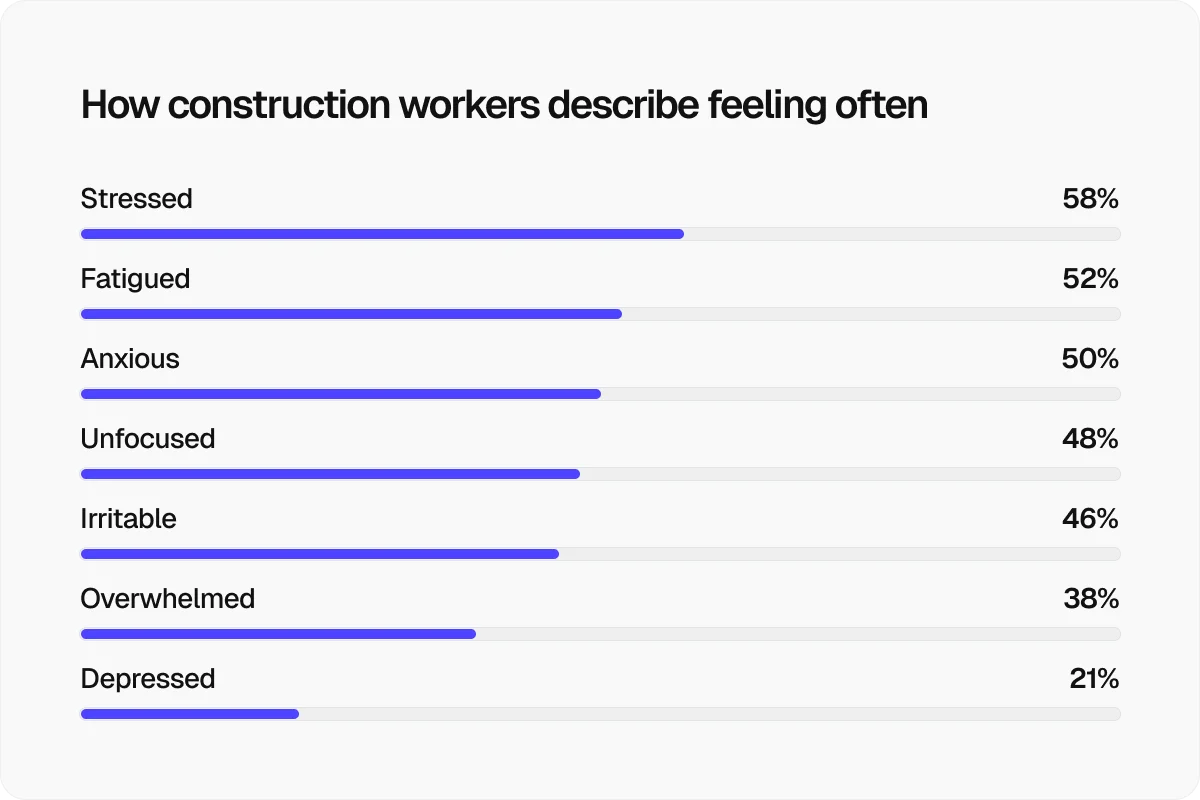
In addition, you should make sure workloads are realistic and check in with each person regularly. This is especially important given that 38% of construction workers report feeling overwhelmed often, and burnt-out workers can easily make mistakes.
12. Settle on one way of communicating and make it non-negotiable
Most construction projects suffer from too much information in too many places. When updates are split across WhatsApp groups, email threads, phone calls, and site meetings, critical information gets buried, and people work from whatever they happened to see last.
Pick a single platform for each type of communication—site updates, document sharing, formal decisions—and make sure everyone uses it. When there’s one place to look, fewer details can slip through the cracks.
13. Pay more for reliable people and spend less fixing their mistakes
With 34% of UK construction companies reporting a severe labour shortage, finding workers—especially high-quality ones—is undoubtedly challenging. However, building a reliable team is worth every bit of that effort.
Even if your budget is tight, be selective about where you cut.
Paying higher rates and scheduling around the best operatives you can find can end up costing you less than poor workmanship, avoidable delays, and hard-fought disputes.
14. Reward progress as well as completion
A structured incentive system that rewards progress milestones—not just the final handover—keeps momentum up and gives teams a tangible reason to stay on pace.
The system in question can cover options like:
Milestone bonuses tied to specific programme dates
Additional work guaranteed on future projects for hitting targets
A day-rate uplift for finishing a package ahead of schedule
Preferential scheduling for consistently reliable teams
15. Lead from the front, but know when to step back
A happy site is a productive one. To achieve it, you should trust people to work within their scope, learn where each person is strongest, and praise quality work when you see it.
But while seasoned leaders set the tone and keep things moving, they also know when to step back, giving employees explicit authority to make day-to-day calls without needing sign-off on everything.
16. Assume good intentions and be honest when things go wrong
The best working relationships on site are built on straight talking. Be honest in meetings about expectations, flag problems early, and offer solutions instead of pointing fingers. When problems arise—and they will—the teams that trust you will work harder to fix them.
17. Take site safety seriously and back it up with action
Construction is one of the most dangerous industries to work in. In 2024/25, 35 workers lost their lives on sites, while 50,000 of them reported non-fatal injuries—a rate significantly higher than the all-industry average.
But besides a welfare concern, safety compliance is also a programme issue. That’s because workplace injuries and work-related illnesses account for 2.2 million lost working days every year in the sector.
To protect both your people and your programme, you should:
Conduct regular site inspections and safety audits
Make sure every operative has up-to-date training on hazard recognition, personal protective equipment (PPE) use, and emergency procedures
Establish firm protocols for high-risk activities like working at height
Keep a record of all safety checks, incidents, and near-misses
Address hazards as soon as they’re identified
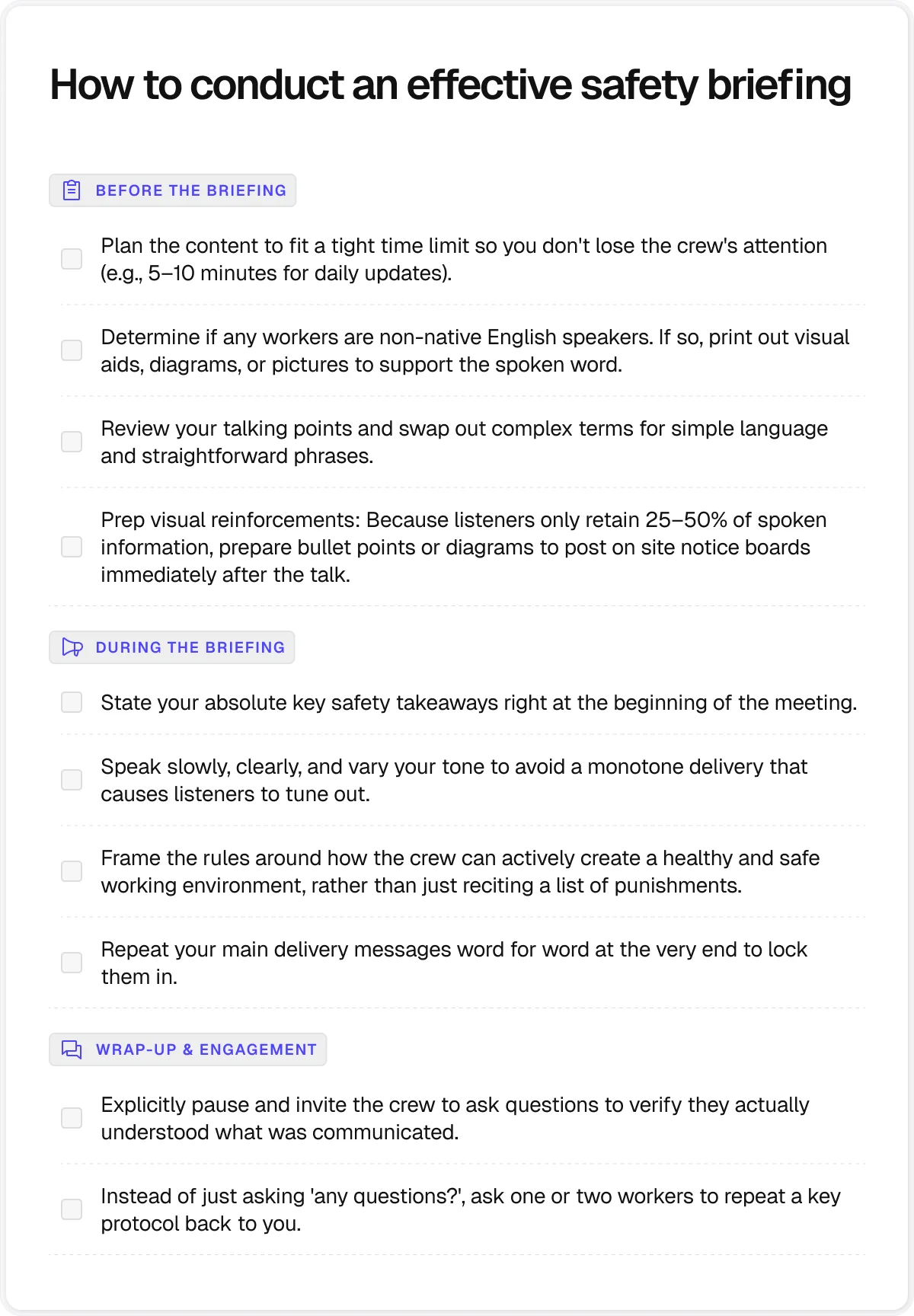
Make safety briefings a regular part of the site routine
18. Go to the site regularly and see the project with your own eyes
There’s often a gap between what’s being reported and what’s actually happening on the ground. The only reliable way to close it is to show up. Regular site visits let you spot quality issues, assess progress accurately, and identify problems while they’re still straightforward to fix.
19. Never rely on a verbal agreement alone
Verbal agreements might feel efficient in the moment, but they’re unreliable as soon as something goes wrong. That’s why all your agreements should always be in writing, whether it’s a change order, a revised deadline, or a client approval.
When expectations are documented, there’s less room for ‘that’s not what we agreed’ conversations mid-job.
20. Make clients feel involved without letting them slow the project down
To avoid difficult conversations and last-minute pushback, keep clients informed at key stages, involve them in decisions that require their input, and make it easy for them to respond quickly when sign-off is needed.
At the same time, be clear about which decisions are theirs to make and which aren’t. Scope creep often starts with a client who feels uninvolved and starts making suggestions that weren’t part of the brief.
The ultimate construction project management tip: Use the right software
Running a construction project well chiefly depends on having the right information, in the right hands, at the right time. A well-built project management platform like Onetrace makes that possible by replacing scattered spreadsheets, email threads, and paper records with a single system that keeps everyone aligned.
Thanks to its comprehensive set of features, Onetrace delivers the following project management benefits:
Centralised document management: Keep all project records organised and accessible with Onetrace’s logical file management and access control.
A real-time picture of site progress: Get a real-time picture of progress with custom job sheets, drawing pins, and approval workflows.
Full visibility of material spend: Log material types, quantities, and costs as work progresses, making sure nothing is over-ordered or unaccounted for.
Accountability at every stage: Move job sheets through defined QA checkpoints and multi-stage approval workflows to prevent late-stage snagging.
One place for every project update: Use a single platform for document sharing, approvals, and project updates, keeping everyone aligned without the back-and-forth.
A schedule your whole team can see: Rely on Onetrace’s Planner for a visual overview of your team’s schedule, with any timeline changes reflected on the mobile app in real time.
Compliance tracking without the admin burden: Ensure RAMS, Toolbox Talks, and safety sign-offs are tracked, completed, and audit-ready throughout the project with Signed Docs, operative declarations, and photographic evidence.
The best way to see whether Onetrace fits the way you work is to try it on your own projects. Book a tailored walkthrough with the team, explore the features most relevant to you, and get up and running straight away if it’s the right fit.
FAQ
What is the best way to manage a construction project?
The best way to manage a construction project is to plan thoroughly before work starts, keep communication clear and consistent throughout, and track progress closely enough to catch problems early.
How to be a good project manager in construction?
To be a good project manager in construction, you need to combine solid planning and communication skills with the ability to make quick decisions when conditions shift.
Marketing Team
@Onetrace
The Onetrace marketing team is passionate about sharing insights, ideas, and innovations that help construction businesses stay connected, compliant, and efficient. Combining industry expertise with a love for clear communication, we aim to deliver content that empowers professionals to work smarter and safer.