Construction compliance audit: A contractor’s guide

By
Marketing Team
@Onetrace
A construction compliance audit is a systematic review of a project, site, or contractor to assess whether the required processes, controls, and records are in place.
These audits matter because they support safe working practices and effective risk management, while demonstrating compliance to clients, principal contractors, insurers, and regulators.
Regulators, in particular, take a firm line approach to construction compliance.
In 2024/25, the Health and Safety Executive (HSE) carried out more than 13,200 inspections, issued over 4,400 enforcement notices, secured 246 criminal prosecutions with a 96% conviction rate, and saw more than £33 million awarded in fines.
To help you reduce the risk of enforcement actions, this guide explains what a construction compliance audit involves, what auditors look for, and what practical steps you can take to stay prepared.
Key takeaways
Compliance audits verify that work meets required standards
They assess whether legal, safety, environmental, and operational requirements are being met.Documentation is critical
Auditors rely on records, inspections, permits, training logs, and sign-offs to verify compliance.Audits review a wide range of compliance areas
Common areas include site management, RAMS, worker competence, health and safety controls, environmental management, and welfare facilities.Audit readiness is an ongoing process
Regular reviews, up-to-date records, and prompt action on issues make audits easier to manage.Onetrace helps keep projects audit-ready
Onetrace’s centralised records, digital forms, photographic evidence, and audit trails make it easier to demonstrate compliance.
What is a construction compliance audit?
A construction compliance audit is a structured assessment of whether a project is meeting the legal, safety, environmental, and operational requirements that apply to the work being carried out.
In UK construction, the term can refer to two different but closely related types of audits:
CDM audits: These audits focus on compliance with the Construction (Design and Management) Regulations (CDM) 2015.
Site compliance audits: These audits take a broader view of on-site compliance. Alongside health and safety requirements, they assess whether the systems, controls, and processes needed to manage risk and maintain compliance are working effectively in practice.
Who carries out a construction compliance audit?
Construction compliance audits can be carried out by either internal teams or independent external specialists.
Internal audits are typically used to monitor ongoing compliance, identify gaps, and prepare for client reviews, accreditation assessments, or regulator inspections. External audits provide an independent assessment and are often used when organisations need to demonstrate due diligence to clients, insurers, lenders, or regulators.
Who carries out the audit depends on what is being assessed. The table below outlines the most common auditors and the types of compliance audits they typically perform:
Auditor | Typical requirements | Best suited for |
Internal H&S or compliance team | Strong knowledge of company procedures, relevant regulations, and audit processes | Routine site compliance audits, internal reviews, pre-audit checks |
H&S auditor or consultant | Demonstrable construction H&S expertise, relevant qualifications such as NEBOSH, and knowledge of CDM 2015 | CDM audits, health and safety audits, site compliance audits |
Independent construction consultant | Construction compliance experience and knowledge of applicable regulations and standards | Broad compliance audits covering documentation, processes, and site controls |
Chartered engineer or technical consultant | Relevant engineering qualifications, chartered status, and technical expertise | Technical compliance, quality assurance, structural and building regulation audits |
Environmental consultant | Expertise in environmental regulations, controls, and site management practices | Environmental compliance audits and environmental management reviews |
External audit firm | Proven audit competence, construction sector experience, and independence from the project being audited | Independent compliance assessments for clients, insurers, lenders, or certification schemes |
What is the construction compliance audit process?
A typical construction compliance audit process involves the following steps:
Defining the scope: The auditor agrees on what will be reviewed.
Reviewing documentation: Relevant records, policies, plans, permits, training records, and other compliance documents are assessed before or during the site visit.
Inspecting the site: The auditor examines site conditions, working practices, equipment, and controls to verify that procedures are being followed in practice. Photographs are often used to record observations and support the audit report.
Speaking with key personnel: Site managers, supervisors, and workers may be interviewed to understand how responsibilities are managed and how procedures are applied on site.
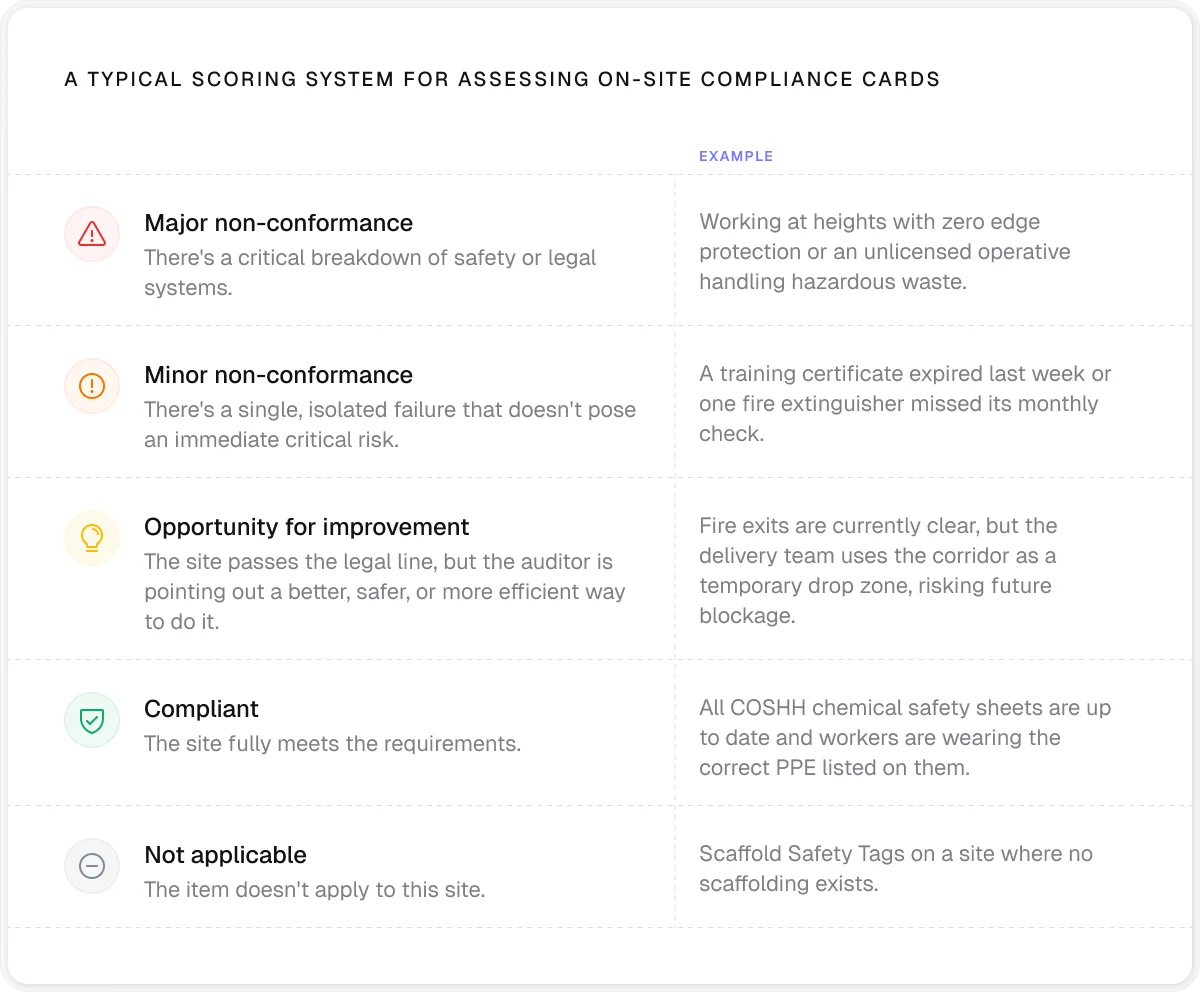
Identifying findings: Any areas of non-compliance, gaps in documentation, or opportunities for improvement are recorded and assessed.
Issuing the audit report: The auditor produces a report summarising the findings, highlighting any corrective actions required, and recommending steps to improve compliance.
How long does a construction compliance audit take?
The duration of a construction compliance audit depends on the size, scope, and complexity of the project. As a general guide, most on-site audits take between two and four hours, while larger or higher-risk sites may require more time.
The physical audit itself is also only part of the process. Time is also needed to review documentation, assess findings, and prepare the final report.
How often should construction compliance audits be carried out?
Although health and safety legislation requires organisations to monitor and review their arrangements at regular intervals, there’s no fixed legal requirement for how often construction compliance audits must be carried out.
As a matter of good practice, many contractors:
Carry out an initial audit when a site is set up and before work begins
Complete regular audits throughout the project, often on a monthly basis
Increase the frequency of audits on larger, higher-risk, or more complex projects
Conduct additional audits following significant changes, incidents, or identified compliance issues
The ultimate goal is to identify and address issues early instead of waiting for a formal inspection or external audit.
What is included in a construction compliance audit? 13 key areas reviewed
The exact scope of a construction compliance audit depends on the type of audit being carried out and the requirements of the project. However, most audits follow a structured checklist and assess many of the same core areas.
1. Site management and supervision
Auditors assess whether the project is being actively planned, managed, monitored, and coordinated. The focus is less on individual documents and more on whether duty holders understand their responsibilities and have effective systems in place to oversee compliance.
Typical checklist items
CDM duty-holder roles and responsibilities are clearly defined.
Principal Contractor responsibilities are understood and being fulfilled.
Suitable arrangements exist to monitor compliance and site performance.
Near-miss, incident, and safety observations are reported and reviewed.
Site supervisors understand key project risks and control measures.
Communication and coordination arrangements are in place between duty holders.
Corrective actions from previous inspections or audits are tracked and closed out.
Evidence shows ongoing review and monitoring throughout the project.
2. Construction Phase Plan (CPP)
The Construction Phase Plan (CPP) sets out how health and safety will be managed throughout the project. During an audit, it serves as a key piece of evidence that risks have been considered and appropriate controls are in place.
Typical checklist items
A CPP has been prepared before construction work begins.
The plan is regularly reviewed and updated as the project changes.
Project details, key dates, and duty holders are clearly identified.
Health and safety objectives, site rules, and management arrangements are documented.
Arrangements for worker consultation and coordination are included.
Site induction, welfare, fire, and emergency procedures are covered.
Relevant Schedule 3 high-risk activities and control measures are addressed.
F10 notification details are accurate and up to date where required.
The CPP is accessible to site management and the workforce.
3. Worker competence and site inductions
Workers must have the skills, knowledge, training, and experience needed to carry out their roles safely.
Typical checklist items
Site-specific inductions have been completed and recorded.
Workers hold relevant qualifications, certifications, or competency cards.
Training records are up to date and available for review.
Supervisors hold appropriate supervisory training.
Competency assessments have been completed for high-risk activities.
Toolbox Talks are delivered and documented.
Workers receive ongoing instruction, information, and supervision.
Site personnel understand key hazards, control measures, and emergency procedures.
4. Risk assessments and method statements (RAMS)
RAMS show whether risks have been identified and controlled before work begins.
Typical checklist items
RAMS are available, current, and approved where required.
Workers have reviewed and signed the relevant RAMS.
Task-specific risk assessments are in place.
COSHH (Control of Substances Hazardous to Health) assessments are available for hazardous substances.
PUWER (Provision and Use of Work Equipment Regulations) assessments have been completed where applicable.
Lifting plans are available for lifting operations.
5. Permit-to-work systems
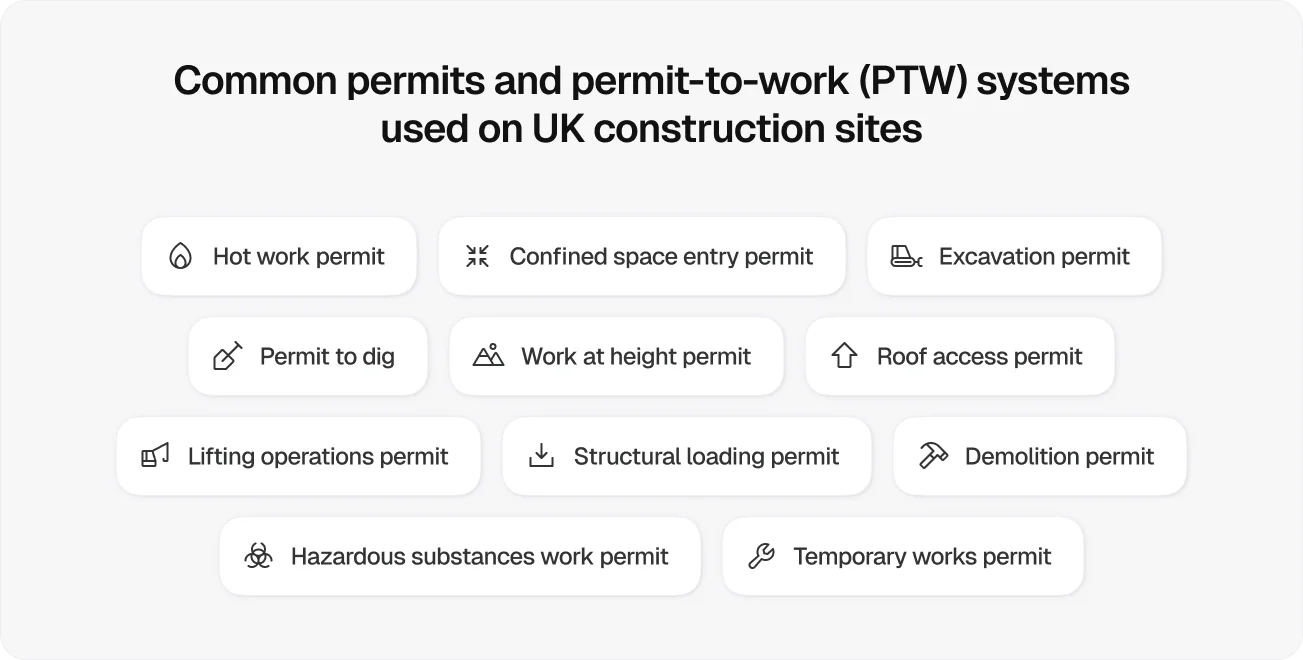
Permits to work are used to authorise and control specific site activities.
Typical checklist items
Permits to dig are in place where required.
Hot work permits have been issued and authorised.
Required permits are available for plant and equipment operations.
Permit conditions are understood and followed.
Completed permits are retained as part of the project record.
6. Site surveys and project information
Site surveys provide essential information about the site, its existing conditions, and any constraints that could affect the work. Audits review whether the necessary surveys have been completed and whether the findings have been made available to those who need them.
Typical checklist items
Required site surveys have been completed.
Asbestos surveys and registers are available where applicable.
Utility searches have been carried out and documented.
Structural, ground condition, or other specialist surveys are available where required.
Survey findings have been communicated to relevant personnel.
Survey records are retained and accessible.
7. Site records and compliance documentation
Auditors examine whether key project documents are complete, up to date, and readily available to demonstrate compliance and support an effective audit trail.
Typical checklist items
Daily site inspections are completed and documented.
Training and competency records are up to date.
Accident and near-miss reports are recorded.
Plant inspection and maintenance records are available.
Equipment testing and certification records are current.
Exposure monitoring records are maintained where required.
8. Temporary works
Auditors review whether temporary works have been properly designed, recorded, inspected, and managed throughout the project lifecycle.
Typical checklist items
Temporary works designs are available where required.
Temporary works are recorded in a register.
Inspection records are completed and retained.
Temporary works are regularly monitored throughout the project.
Relevant personnel have access to the information needed to manage and use temporary works safely.
9. Health and safety controls
Health and safety controls are among the most important areas reviewed during a construction compliance audit because they directly contribute to preventing injuries, ill health, and fatalities on site.
Take working at height as an example. In 2024/25, the HSE reported 35 worker fatalities, with falls from height being the leading cause of death in the industry. It’s the auditor’s job to verify that the controls designed to prevent these incidents are in place, understood by workers, and being followed in practice.
The table below highlights the main safety management areas covered during a typical construction compliance audit:
Area | The goal of the audit | Checklist item examples |
First aid | Ensure prompt treatment of injuries and incidents | First aid kits available and stocked, eyewash stations provided, trained first aiders identified |
Fire safety | Protect workers in the event of a fire or emergency | Fire action notices displayed, escape routes kept clear, extinguishers inspected, assembly points identified |
Electrical safety | Reduce the risk of electric shock, fire, and equipment damage | Safe power supplies, RCD protection, cables managed safely, controls for overhead power lines |
COSHH | Control exposure to hazardous substances and harmful dusts | Hazardous substances labelled and stored correctly, dust suppression measures in use, respiratory protection available where required |
Manual handling | Reduce the risk of strains and musculoskeletal injuries | Manual handling aids available, clear access routes, relevant training provided |
Personal protection equipment (PPE) | Ensure workers have appropriate personal protection | PPE available, worn where required, and maintained in good condition |
Working at height | Prevent falls and falling objects | Safe access provided, edge protection installed, scaffolds and towers inspected |
Excavations and confined spaces | Protect workers during below-ground operations | Services identified, excavations supported, gas monitoring in use, emergency equipment available |
Piling operations | Ensure piling activities are carried out safely | Services located, work areas controlled, exclusion zones established |
Lifting operations | Prevent lifting-related incidents | Lift plans available, equipment certified, work areas segregated, lifting accessories suitable for the task |
10. Environmental management
Construction compliance audits often assess how environmental impacts are managed on site. This refers to all controls designed to minimise disruption to workers, the public, and the surrounding environment.
Typical checklist items
Waste is segregated and stored appropriately.
Waste transfer and consignment notes are completed and retained.
Spill kits and pollution control measures are available where required.
Concrete washout facilities are provided and maintained.
Roads and access routes are kept free from waste and debris.
Dust control measures are in place.
Noise is managed in line with project requirements and permitted working hours.
11. Work equipment and machinery
From hand tools to heavy machinery, equipment must be suitable for the task, properly maintained, and safe to use. This part of the audit focuses on whether the right controls are in place to prevent equipment-related incidents and ensure compliance with work equipment requirements.
Typical checklist items
The equipment is suitable for the task being carried out.
The plant and machinery are maintained and in good working condition.
Appropriate guards and safety devices are fitted.
Safety interlocks and emergency stops are operational.
Warning alarms and beacons are functioning correctly.
Equipment-related hazards have been identified and controlled.
12. Site security and access management
Construction sites must be organised in a way that protects both the workforce and anyone who may be affected by the work. This includes controlling access, maintaining safe site conditions, and preventing unauthorised entry.
Typical checklist items
Site access is controlled and monitored.
Warning signs are clearly displayed.
Fencing, hoardings, and perimeter controls are maintained.
Safe access routes are provided around the site.
Noise protection zones are clearly identified where required.
Edge protection is installed and maintained.
Adequate lighting is provided across the site.
Housekeeping standards are maintained.
13. Site welfare and amenities
Suitable welfare facilities must be available from the start of a project and maintained throughout the construction phase. Auditors check that workers have access to the facilities needed to support their health, well-being, and day-to-day needs.
Typical checklist items
Toilets are available, clean, and regularly serviced.
Suitable washing facilities are provided.
Drinking water is readily available.
Welfare facilities are maintained in good condition.
Rest areas are available and separate from work areas where required.
Facilities are available for preparing food and hot drinks.
How do I prepare for a construction compliance audit?
Here are a few steps you can take to prepare for a construction compliance audit:
Organise your records: Keep compliance documents, inspection records, permits, and training information in a central location so they can be accessed quickly during an audit.
Document work thoroughly: Record inspections, checks, and completed work consistently, using photographs where appropriate to strengthen the record.
Maintain an audit trail: Make sure activities are properly recorded, signed off, and traceable from planning to completion.
Review your compliance internally: Carry out regular internal audits and site inspections to identify gaps and address them before an external review.
Keep records up to date: Check that training certificates, equipment inspections, permits, and other compliance documents remain current throughout the project.
Address issues promptly: Track corrective actions and close out findings as they arise rather than leaving them until audit time.
Stay audit-ready with Onetrace
Many compliance issues during construction compliance audits arise because crucial records are missing, sign-offs can’t be verified, or documentation is spread across emails, spreadsheets, and paper files.
That’s why contractors are increasingly moving towards dedicated construction site management software like Onetrace.
Here’s how Onetrace supports construction compliance audits in practice:
Custom digital forms: Create inspection forms, checklists, surveys, and compliance records tailored to your processes, with mandatory fields to ensure essential information isn’t missed.
Photographic evidence capture: Record before, during, and after photos directly against completed work, creating a visual record that supports compliance, quality control, and client sign-off.
Centralised document management: Store RAMS, certificates, permits, contracts, drawings, and other project documents in one place, making information easier to find during audits and inspections.
Digital sign-offs and compliance records: Request, track, and manage signatures for RAMS, Toolbox Talks, and other compliance documents, with full visibility of who has viewed and signed each document.
Approval workflows: Build structured approval processes for inspections, installations, and quality checks, creating a documented record of reviews, feedback, corrective actions, and approvals.
Complete audit trails: Maintain a detailed record of site activity, including who completed work, what was recorded, when it was submitted, and how it was approved.
Audit-ready reporting: Generate professional reports containing photographs, inspection records, approval histories, and other supporting evidence, making it easier to respond to client reviews, accreditation assessments, and compliance audits.
Rather than preparing for audits retrospectively, Onetrace helps contractors build compliance into their day-to-day site management processes. The result is better visibility, stronger evidence, and greater confidence when an audit takes place.
Curious to see Onetrace in action? Book a personalised demo and discover how the platform can help you stay audit-ready.
Marketing Team
@Onetrace
The Onetrace marketing team is passionate about sharing insights, ideas, and innovations that help construction businesses stay connected, compliant, and efficient. Combining industry expertise with a love for clear communication, we aim to deliver content that empowers professionals to work smarter and safer.