Fire safety certificate: What contractors need to know

By
Marketing Team
@Onetrace
In England alone, fire and rescue services attended 39,859 building fires in the year ending March 2026. That’s more than 100 every day.
Each one means damaged property, lost work, and, too often, people put at risk.
So, it’s no surprise that clients, insurers, and building owners want proof that fire safety has been done properly, and a fire safety certificate is a huge part of that proof.
But what does the term actually cover, and what does it mean for your work on site?
This guide explains everything you need to know as a contractor.
Key takeaways
A fire safety certificate can mean different things
The right document depends on the building, the work being carried out, and the evidence requested.Know what documentation you actually need
Confirm the required document, scope, location, dates, standards, and supporting evidence before gathering records.Keep clear evidence of the work
Certificates, inspection results, photographs, drawings, and remedial records should be linked to the right project and location.Check and organise records before handover
Make sure documentation is complete, current, and clearly named, then retain a copy to maintain a reliable audit trail.Use technology to simplify fire safety documentation
Onetrace helps subcontractors capture evidence on site, link it to specific locations, manage supporting documents, and create handover reports in one system.
What is a fire safety certificate?
A fire safety certificate is a document that provides evidence that specific fire safety measures, systems, or arrangements at a particular premises have been assessed, installed, tested, or maintained.
Under the old UK fire safety system, the term ‘fire safety certificate’ referred to a formal document, required by the Fire Precautions Act 1971.
This certificate was issued by the local fire authority after an inspection of the premises. It covered matters like escape routes, fire-fighting equipment, fire warnings, and the measures needed to make escape routes safe to use.
The certificate could also set out ongoing requirements, such as:
Keeping escape routes clear
Maintaining fire safety equipment
Providing staff with suitable fire safety training
This system changed when the Regulatory Reform (Fire Safety) Order 2005 came into force in 2006.
The general requirement for fire certificates was removed, and responsibility shifted towards the person in control of the premises, known as the Responsible Person.
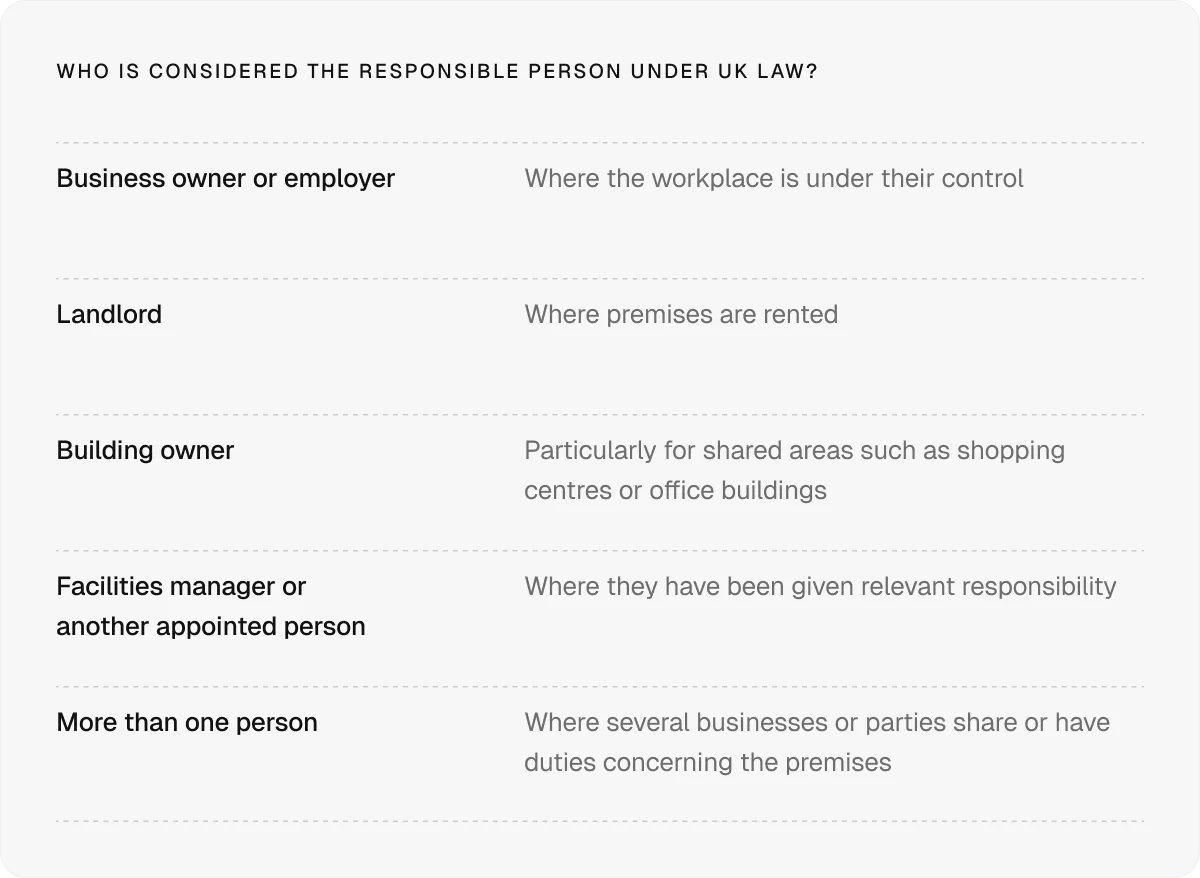
Instead of relying on the fire service to certify a building, the Responsible Person now must carry out a suitable and sufficient fire risk assessment (FRA) and take appropriate action to control the risks.
However, this doesn’t mean an FRA is the same as a fire safety certificate. The term can refer to several different documents, depending on what type of building is involved, what work is being carried out, and who’s asking for the evidence.
The table below gives an overview of the main types of fire safety documentation contractors may come across:
Document or record | What it can show |
System commissioning certificate | That a specified fire safety system was commissioned against its stated design or standard |
Inspection or service record | What was inspected, which conditions were found, and what work was carried out |
Installation or product certification | That a particular product or installation meets the requirements of the relevant certification scheme |
Building Control completion information | That the relevant building work went through the Building Control approval process |
Licence or permission | That an activity or premises has the required approval, subject to the conditions attached to it |
These documents cover different parts of fire safety and aren’t interchangeable. In addition, a single certificate shouldn’t automatically be treated as proof that an entire occupied building complies with fire safety law.
Regardless of the type of document, the goal is to provide evidence and assurance that the necessary fire safety measures have been addressed to protect occupants and reduce the impact of a fire.
Who needs a fire safety certificate?
No premises in the UK require the old-style fire safety certificate.
However, certain types of buildings and activities may still require specific fire safety-related certificates, licences, or other approvals. This includes:
Houses in Multiple Occupation (HMOs) and residential properties: These premises may be subject to fire safety requirements linked to HMO licensing, including measures like fire doors, alarms, and escape routes.
Licensed premises: Pubs, clubs, and restaurants may have fire safety conditions attached to their premises licence.
Hotels and guest accommodation: Hotels, B&Bs, and hostels can have additional fire safety requirements, particularly in higher-risk or multi-occupancy buildings.
Care homes and healthcare facilities: These premises have specific fire safety considerations, including arrangements for evacuating vulnerable occupants.
Factories, warehouses, and industrial sites: Premises involving flammable materials, high-risk processes, or specialist equipment may require additional fire protection measures and supporting documentation.
Contractors may, therefore, encounter different types of fire safety documentation depending on the project.
How to get a fire safety certificate: A step-by-step guide for contractors
Given the different meanings of the term, the fire safety certification process doesn’t follow a pre-defined route. Instead, contractors need to establish what documentation is required, ensure the relevant work has been properly recorded, and provide the right evidence when requested.
Here’s what that process looks like in practice.
1. Identify the required documentation
Start by confirming exactly what evidence is needed before gathering documents.
To do so, ask for the request in writing where possible and check:
What document is required (e.g., a fire door survey report)
What part of the work it must cover (e.g., compartmentation)
What date or review period applies (e.g., the date of the fire stopping inspection)
What standard or scheme the document needs to meet (e.g., a specified British Standard or certification scheme)
Whether supporting evidence is also needed (e.g., test results, photographs, drawings, and maintenance records)
2. Confirm which part of the building it relates to
Once you know what documentation is required, confirm exactly where in the building the evidence needs to apply. This is particularly important on larger projects where contractors and subcontractors may be working across different locations.
You’ll need the following information:
Which building or site is covered, including the exact address or project reference
Which floor, area, or compartment is covered (e.g., a plant room, escape route, or specific fire compartment)
Whether the request covers the whole installation or a defined section
Whether the building layout or use has changed since the work was completed
3. Gather the relevant evidence
With the scope confirmed, gather the records that demonstrate the work was completed and meets the requirements set out in the request.
Depending on the work involved, this might include:
Certificates and reports
Test and inspection results
Photographs
Drawings and plans
Product information
Records of remedial work
Make sure each record can be clearly linked to the right project, location, and piece of work. This makes the evidence easier to check and reduces the risk of having to track down missing information when the client or another party requests it later.
Pro tip:
Use fire protection software while work is being carried out to make it easier to capture, organise, and link evidence to the right location.
Recording photographs, inspection details, and other project data as you go means you have a reliable evidence trail ready when documentation is requested, rather than having to piece it together afterwards.
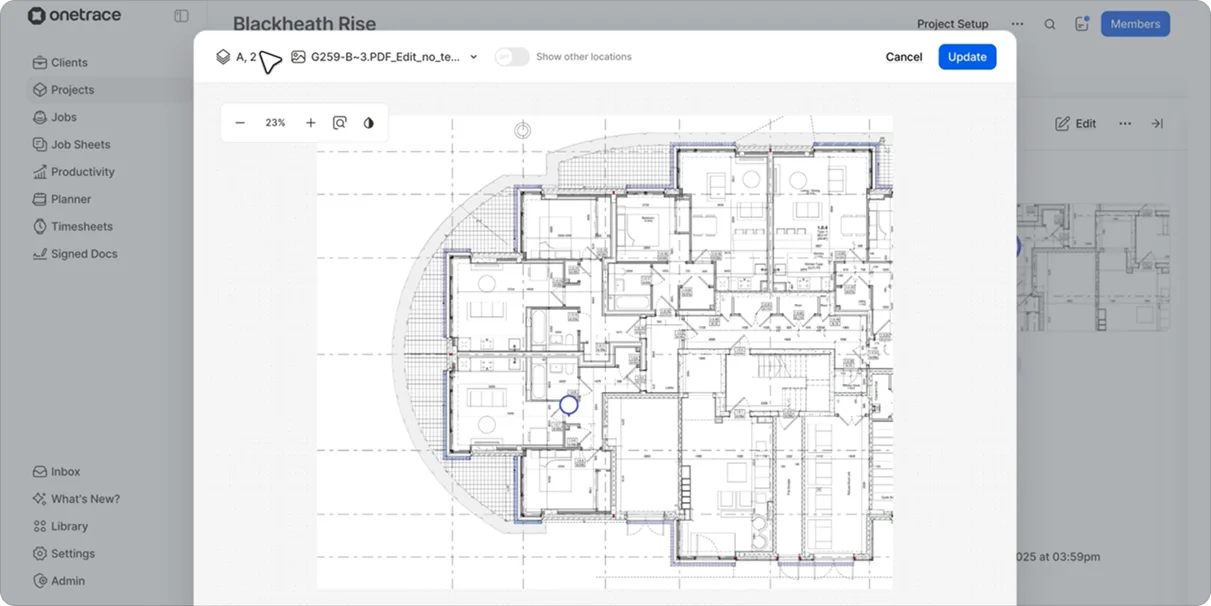
Onetrace, for example, lets subcontractors mark up drawings and link project data to specific locations, helping create an accurate record of where work was completed.
4. Check that the records are complete and current
Before sending the documentation, check that each record is complete, legible, and still relevant to the work it’s being used to evidence.
In particular, review:
Dates: Confirm that inspections, tests, and other records fall within the required period.
Scope: Make sure the document covers the correct work, system, and location.
Details: Check that key information, such as project references, locations, results, and equipment details, has been recorded.
Sign-offs: Confirm that any required approvals, signatures, or declarations have been completed.
Outstanding actions: Verify whether any defects or remedial actions remain open and make sure completed actions are supported by evidence.
It’s also worth checking whether anything has changed since the record was created.
Fire safety evidence reflects what was assessed, installed, inspected, or tested at a particular point in time, so it shouldn’t be treated as proof that conditions have remained unchanged.
5. Record and hand over the evidence
Once the records are complete, keep them organised and hand over the relevant evidence in an accessible format.
Before sending the documentation, make sure:
The right records are grouped together: Allow the recipient to instantly see which documents relate to the same project and work.
Files are clearly named: Include useful details like the project, location, system, and inspection or completion date.
The handover is recorded: Keep a record of what was provided, when it was sent, and who received it.
A copy is retained: Preserve the final records with the project documentation in case the evidence is needed again.
This approach creates a traceable audit trail and keeps evidence available if a client, principal contractor, or other stakeholder asks for it later.
Use technology to make fire safety certificates easier to manage
Traceability is central to fire safety.
It’s not enough to have a fire safety certificate or inspection record sitting in a folder. You need to be able to show what work was carried out, where it was carried out, when it was completed, and what evidence supports it.
That’s why having the right digital system can make the fire safety certification process much easier to manage.
Onetrace is software built for fire protection subcontractors, giving teams one central system to capture project data, manage compliance, and provide proof of work.
Specifically, Onetrace allows you to:
Record the right information with custom forms: Create custom forms for different types of work, including surveys, inspections, and installations. Use photographs, checklists, text fields, dates, and yes / no confirmations to structure the information your operatives need to capture.
Link evidence to specific locations: Upload drawings and add pins to show exactly where work was carried out, with projects organised by blocks, levels, and zones.
Capture photographic evidence as work happens: Take before, during, and after photos during surveys and inspections to document completed work and support client sign-off.
Gather evidence without a signal: The mobile app works offline, so operatives can access drawings and data and continue recording evidence on site. Everything syncs automatically once a connection is available.
Keep a record of work at each location: Use QR codes to link physical locations to their digital records, allowing operatives to access the history of work and add new records during future visits.
Store supporting documents in one place: Store and organise certificates, RAMS, data sheets, contracts, and other project documents in the central Docs & Files area, with access controls to manage who can view them.
Build checks and approvals into the process: Set up approval stages so submitted work can be reviewed, rejected, or approved, with a record of decisions and feedback for an accurate audit trail.
Create reports for handover: Generate branded PDF and Excel reports from job sheets, locations, and drawings, making it easier to compile and share the evidence required by clients or auditors.
This feature set keeps the whole fire safety certification process connected, so you can easily provide the right evidence when it’s needed.
To learn more about Onetrace and get started, schedule a personalised demo with our team.
FAQ
How do I get a fire safety certificate?
Under UK fire safety law, physical fire safety certificates are no longer issued. Instead, you get compliance documentation by completing a legal FRA for your premises and obtaining service or inspection certificates for individual systems, such as fire alarms, emergency lighting, fire doors, and extinguishers.
Where can I get a fire certificate?
You can get a fire certificate through accredited third-party fire safety consultancies, qualified fire risk assessors, or specialist fire protection contractors registered with recognised bodies like BAFE (British Approvals for Fire Equipment) or the IFE (Institution of Fire Engineers).
Who issues a fire safety certificate?
General fire safety compliance is self-directed and documented by a competent fire risk assessor or the designated Responsible Person rather than an official government body. However, enforceability falls under local fire and rescue authorities, who inspect premises and issue formal statutory notices if standards are missed.
Which safety certificate is best?
The best certificate depends on your role and responsibility. The NEBOSH National General Certificate in Occupational Health and Safety is the industry benchmark for general workplace health and safety. Designated fire safety roles will benefit from a NEBOSH Certificate in Fire Safety or IFE Level 3 Certificate, while general employees need an accredited Fire Marshal or Warden Certificate approved by RoSPA, CPD, or IOSH.
How much is a fire safety course?
Course costs depend on the required level of qualification. They generally start at £30 for Basic Staff Fire Awareness training and can exceed £1,300 for professional qualifications like the NEBOSH Certificate in Fire Safety.
Marketing Team
@Onetrace
The Onetrace marketing team is passionate about sharing insights, ideas, and innovations that help construction businesses stay connected, compliant, and efficient. Combining industry expertise with a love for clear communication, we aim to deliver content that empowers professionals to work smarter and safer.