Benefits of construction RAMS software: Why contractors use it

By
Marketing Team
@Onetrace
Risk Assessment Method Statements (RAMS) are a core part of safe construction work. When they fail, the consequences can be serious—both for workers and the businesses responsible for the work.
In 2024, a roofing company was fined £20,000 and nearly £6,000 in costs after a worker fell 12 metres through a skylight. In another older case, a contractor and principal contractor were fined £10,000 and £18,000 respectively after unsuitable RAMS failed to cover part of the work, resulting in grave injuries.
However, just having RAMS in place is no longer enough, as paper documents, scattered PDFs, and email attachments can lead to version confusion, missed sign-offs, outdated information, and poor audit trails.
That’s why RAMS are another part of the construction sector that’s going digital.
This guide breaks down 12 key construction RAMS software benefits and explains why more construction professionals are moving away from traditional ways of managing RAMS.
Key takeaways
Digital RAMS software speeds up the whole RAMS process
Templates, digital approvals, and mobile sign-offs reduce admin and help teams get work started sooner.It keeps RAMS consistent, accessible, and up to date
Teams can work from standardised documents and access the latest RAMS directly from the site.It makes compliance and sign-offs easier to manage
Managers can track outstanding signatures, maintain audit trails, and spot potential compliance gaps before they become problems.Onetrace brings RAMS management into one platform
With centralised storage, automatic document assignment, mobile signing, and compliance controls, Onetrace helps contractors manage RAMS more efficiently from creation through to sign-off.
What is construction RAMS software?
Construction RAMS software is a digital system that helps contractors and subcontractors manage RAMS across construction projects more efficiently.
Instead of treating RAMS as documents that are created once and then passed around as PDFs, the software turns them into managed digital records.
Teams can build these documents from templates, tailor them to a specific task or site, send them for review and approval, and make them available to the people who need to follow them.
Once a RAMS is approved, workers can access it from a phone or tablet, confirm that they have read and understood it, and provide a digital signature where required.
The system can then keep a record of who approved or signed the document, when they did so, and which version they saw.
This approach gives managers a clearer view of the status of RAMS across different projects without having to search through emails, folders, or paper files.
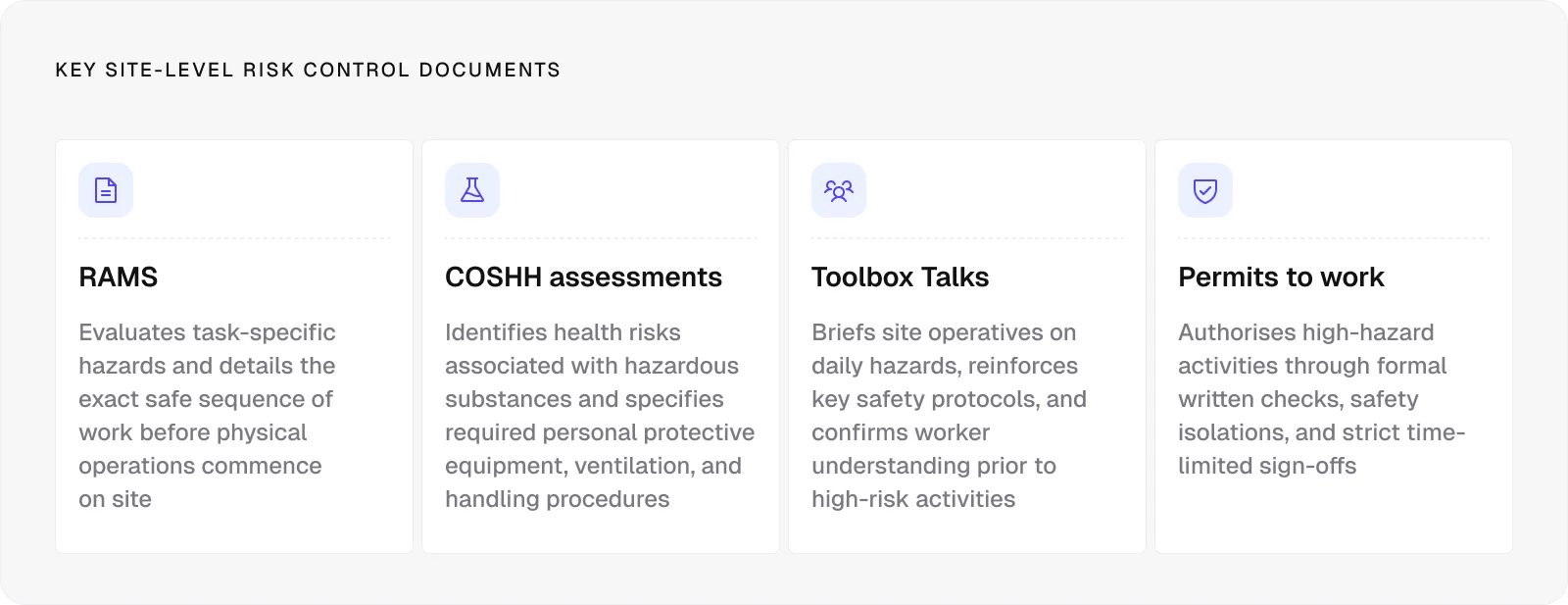
Many systems also extend beyond RAMS to cover related safety documents, such as Toolbox Talks. This functionality allows contractors to keep key health and safety records in one place rather than managing each document through a separate process.
12 practical construction RAMS software benefits
Digital RAMS software transforms construction risk management. These 12 benefits explain where it can make the biggest difference.
1. It speeds up the whole RAMS process
Creating and managing RAMS manually can be a slow and time-consuming process.
Teams may have to find an old template, adapt it for the new task, format the document, send it by email for review, make changes, then resend it for approval.
With multiple subcontractors or sites involved, these small delays can push back mobilisation and leave site teams waiting for the paperwork they need to start work.
Software accelerates each step of the RAMS workflow.
Reusable templates and hazard libraries give teams a starting point, so they can build site-specific RAMS without creating every document from scratch. Documents can then be edited, reviewed, and approved within the same system instead of being passed back and forth through email.
2. It cuts manual admin and paperwork
RAMS management can create a steady stream of admin around the actual safety work.
Site managers and safety teams may need to print documents, file completed forms, update trackers, chase signatures, move attachments between folders, and keep records of what has been submitted. When several projects are involved, this can become a sizeable workload.
Construction software removes much of this manual work by keeping RAMS records and related actions in one digital workflow.
For contractors and subcontractors, the benefit here isn’t just fewer sheets of paper. It’s that they now have more time to focus on risk control and site coordination.
3. It keeps RAMS consistent across projects
When contractors manage RAMS manually, the quality and structure of documents can vary between projects.
Different stakeholders may use different templates, wording, or approaches, making it harder to maintain a consistent standard across the business.
With RAMS software, construction teams have a common way to create and manage their documentation. Templates and structured content provide a consistent starting point, while standardised processes help teams apply the same approach to risk assessments and method statements on different sites.
4. It keeps everyone working from the latest version
RAMS can change when the task, site conditions, equipment, or working methods change. With paper copies and downloaded PDFs, there’s a risk that an older version remains in circulation after an update.
Digital RAMS software helps prevent this by keeping the current document available to the people who need it.
When a RAMS is updated, the latest version replaces older versions on connected devices, reducing the chance of a crew following superseded instructions. This, in turn, reduces the risk of hazards being missed or managed incorrectly.
5. It gives site teams easy access to RAMS
On a construction site, RAMS are only useful if the people carrying out the work can access them when needed. Paper copies may be kept in a site office or cabin, while digital files can be buried in email threads or stored on a device that a worker doesn’t have with them.
With RAMS software, on-site operatives have instant access to the relevant documents from their phones or tablets.
This is particularly useful when crews move between work areas or when a RAMS needs to be checked during the job.
6. It makes sign-offs clear and trackable
In the past, site teams had to spend time chasing workers to complete RAMS sign-offs.
Managers often knew a briefing had gone out but still had to work out who had read and signed it. With several people involved, that quickly became laborious.
And when work was due to start, a few missing signatures could hold everything up, leaving managers to send reminders and follow up with individuals one by one.
Digital RAMS software makes this process much easier to manage.
Workers can review the relevant RAMS and complete their sign-off from their phone or tablet, while the system records who signed, when they signed, and which RAMS they signed.
Managers can then see outstanding sign-offs in one place, making it easier to track down the right people and confirm that everyone required to carry out the work has completed the briefing.
Pro tip:
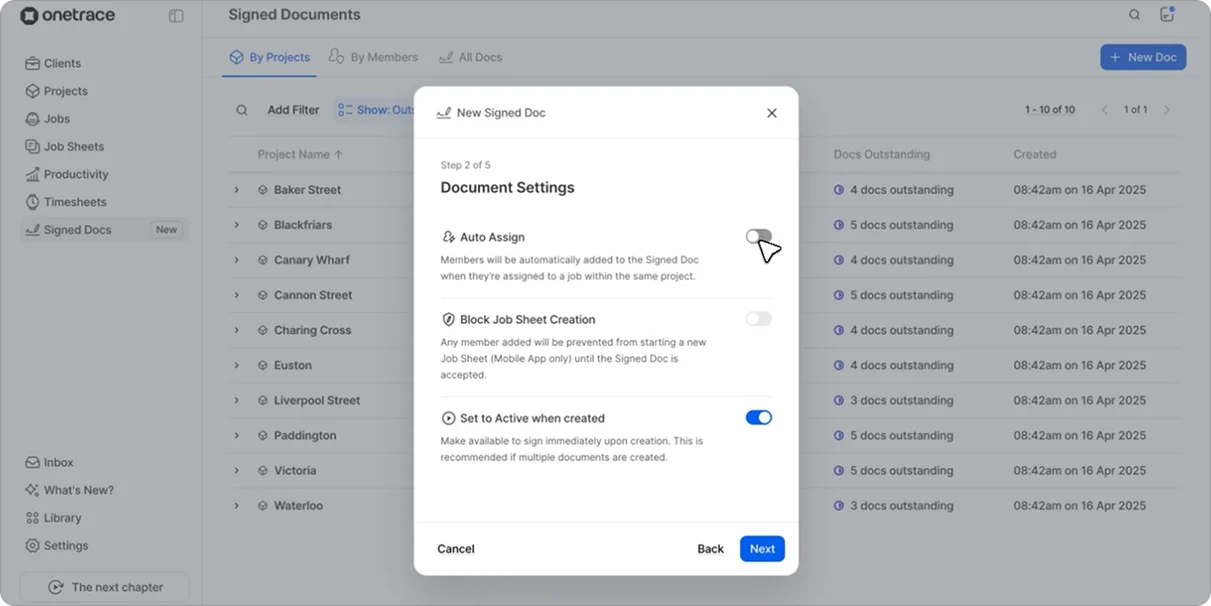
If you want to make RAMS sign-offs even easier to manage, look for construction safety compliance software that can automatically assign required documents to workers when they’re added to a job and flag or prevent work from starting until the necessary signatures are complete.
For example, Onetrace’s Signed Docs feature automatically distributes RAMS to team members and can block job sheet creation until all required signatures have been collected.
7. It makes audits and inspections easier
Site inspections and audits can put pressure on compliance teams to produce the right records quickly.
When someone asks to see a RAMS, its approval history, or evidence that workers have signed it, managers need to be able to find the relevant information without searching through multiple sources or relying on someone remembering where a document was saved.
Digital RAMS software keeps key records organised and searchable, making it easier to retrieve the information needed for an audit or inspection.
In addition, document histories, approvals, signatures, and time-stamped records provide evidence of how a RAMS was created, reviewed, and communicated to the people carrying out the work.
These features make audits less disruptive and give contractors a stronger record of safety management. It also means managers can spend less time gathering evidence and more time dealing with the findings and actions that come out of the inspection.
8. It improves communication across project teams
Construction projects involve multiple people and companies, and they all need to stay aligned on the work being carried out and the controls that apply to it.
When information doesn’t reach the right people at the right time, important details can be missed and teams can end up working from different information.
RAMS software can improve communication and collaboration on and off site by:
Giving site and office teams a shared space to communicate about project requirements and safety information
Helping contractors and subcontractors coordinate their work around the same task requirements
Making it easier to share information between project teams when responsibilities move from one team to another
Allowing teams to collaborate on RAMS and safety documentation without relying on lengthy email exchanges
Helping managers communicate task requirement changes to the workers and teams affected by them
Giving teams a consistent way to brief workers on task-specific controls through RAMS and Toolbox Talks
9. It gives managers complete visibility across sites
When a contractor is running several projects at once, it’s easy for the detail of day-to-day RAMS management to stay with individual site teams. This, however, makes it more challenging for managers to see patterns between projects, spot where processes are falling behind, or understand whether the same standards are being followed throughout the business.
Digital RAMS software brings this information together in a central view, giving managers visibility of RAMS activity across different sites and projects and allowing them to:
See assessment and approval progress
Monitor consistency
Identify areas that need attention without having to rely on separate updates from each site
This approach gives managers a better basis for making decisions, allocating support, and addressing issues before they become recurring problems.
10. It helps prevent gaps in compliance
Compliance gaps don’t always come from a major failure in the way RAMS are managed. They can happen when:
A document expires
A required assessment hasn’t been completed
A worker hasn’t received the right briefing
A change to the work hasn’t been reflected in the relevant documentation
RAMS software can automate parts of the overall compliance process and flag issues that need attention.
This level of oversight matters in the UK construction industry, where businesses have legal duties to assess and control risks under regulations such as the Health and Safety at Work etc. Act 1974 and the Management of Health and Safety at Work Regulations 1999. Additionally, the Construction (Design and Management) Regulations 2015 set duties for those involved in planning, managing, and monitoring construction work.

11. It supports safer, better-informed site work
In 2025/26, 25 construction workers were killed in work-related incidents in Great Britain—the highest number of worker fatalities of any main industry sector. Falls from height were also the leading cause of fatal injury across all industries, accounting for 31 worker deaths.
These grim stats show why giving site teams the right information before and during high-risk work should be a priority.
Thanks to RAMS software, construction workers can have task-specific risk information within reach at all times, which helps them check the relevant controls, understand what is expected of them, and make safer decisions while carrying out the work.
The software also makes it easier to update that information when the job changes, so workers aren’t relying on assumptions or outdated instructions.
12. It helps teams learn from past safety data
Every project generates useful safety information, but that information can lose its value if it’s not captured and reviewed over time.
Looking back at previous RAMS, incidents, and safety records can help teams identify recurring hazards and patterns that may otherwise go unnoticed.
RAMS software can make this process easier by keeping historical safety data in one place and making it available for analysis.
Over time, these insights can help contractors make better-informed decisions about future work and strengthen their approach to risk management based on what has happened in previous projects.
Why use Onetrace for RAMS management
Onetrace is a construction site management software platform with strong RAMS and compliance capabilities built into wider project workflows.
Here’s how some of its key features support construction RAMS software benefits:
Onetrace feature | How it supports RAMS management |
Centralised RAMS storage | Keeps RAMS alongside health and safety forms and other project documentation in one structured location |
Access controls | Allows teams to manage who can view or edit project documentation, protecting sensitive records while maintaining appropriate access |
Automatic document assignment | Adds team members to required documents when they are assigned to a job, helping reduce missed briefings and manual follow-up |
Mobile RAMS review and signing | Lets operatives review and sign RAMS from the Onetrace iOS or Android app, making it easier to complete required briefings on site |
Compliance controls | Can block job sheet creation until all required signatures have been collected, helping ensure sign-offs are completed before work begins |
Signing summaries | Exports signed documents with their signing history, providing a useful record for clients, audits, and internal record-keeping |
Document interaction timeline | Records when users have viewed or signed documents, giving managers a more detailed record of how RAMS have been acknowledged |
Global Signed Docs view | Lets managers monitor sign-offs across projects, allowing them to identify inconsistencies and recurring issues |
RAMS linked to project workflows | Turns RAMS and other compliance documents into trackable records connected to project activity rather than treating them as standalone files |
Onetrace can also connect with other systems through APIs, giving contractors and subcontractors scope to integrate RAMS and compliance workflows with their existing technology stack instead of creating another isolated source of information.
To learn more about Onetrace features for RAMS management and beyond it, schedule a personalised demo with our team.
FAQ
What are RAMS used for in construction?
RAMS are used to identify the risks involved in construction activities and set out the controls and working methods needed to carry out those activities safely.
What should be included in RAMS?
RAMS should include the hazards associated with the task, the level of risk, the control measures required, the people responsible, and the step-by-step method for carrying out the work safely.
Are RAMS mandatory?
RAMS aren’t a legal requirement in themselves, but risk assessments are required under the Management of Health and Safety at Work Regulations 1999, while method statements are widely used to set out safe systems of work for higher-risk construction activities.
How do I get a RAMS document?
You can create RAMS in-house using a suitable template or use construction RAMS software to create and tailor them to specific tasks, sites, and working conditions.
Marketing Team
@Onetrace
The Onetrace marketing team is passionate about sharing insights, ideas, and innovations that help construction businesses stay connected, compliant, and efficient. Combining industry expertise with a love for clear communication, we aim to deliver content that empowers professionals to work smarter and safer.