Fire door survey explained: Everything you need to know

By
Marketing Team
@Onetrace
In 2021, three-quarters of all fire doors in the U.K. didn’t meet the required safety standards. That was the finding from the Fire Door Inspection Scheme, which assessed over 100,000 doors and discovered that most would fail to do their job in a fire.
And given what their job actually is, this is a worrying figure.
Fire doors are critical safety barriers that slow the spread of fire and smoke, protect escape routes, and give people the vital extra minutes they need to get out safely. When they’re damaged, poorly fitted, or simply neglected, lives are put at risk.
So, how can this alarming statistic be turned around?
By carrying out regular fire door surveys—thorough inspections designed to make sure every fire door works as it should.
That’s why this guide breaks down the essentials:
What a fire door survey is
What it includes
Why it matters
How often it should be done
Key takeaways
Most fire doors fail safety standards
Over 75% of fire doors inspected in the U.K. don’t meet legal safety requirements. This is alarming given their role in slowing the spread of fire and smoke, protecting escape routes, and saving lives. Regular, professional surveys are the most effective way to reverse this trend.Fire door surveys are essential for compliance and safety
A fire door survey is a detailed inspection carried out by certified professionals to ensure every fire door performs correctly in an emergency. It checks construction, installation, and maintenance, forming a critical part of any building’s passive fire protection strategy.Legal obligations make regular surveys non-negotiable
Regulations like the Fire Safety (England) Regulations 2022 and the Building Safety Act 2022 require ongoing inspections and recordkeeping. Failing to comply can result in fines, invalid insurance, and serious legal consequences. Keeping documented survey records is both a legal and moral responsibility.Proactive maintenance prevents costly repairs
Regular surveys help detect issues like damaged seals or faulty closers early, before they turn into expensive replacements or insurance liabilities. Preventative maintenance not only saves money but also ensures consistent building safety and peace of mind.Digital fire door management simplifies compliance
Using modern fire protection software like Onetrace streamlines the entire process. It enables digital recordkeeping, photographic evidence, and QR code tracking for each door. This means easier compliance, faster audits, and greater transparency for building managers and owners.
Fire door survey: The basics
Before diving into the details, it helps to start with the fundamentals. Understanding these basics makes it easier to see why surveying matters and what to expect when it’s time to have yours done.
What is a fire door survey?
A fire door survey is a systematic inspection of all fire doors in a building to check whether they meet legal and safety standards. It looks at how doors are built, installed, and maintained, and whether they can perform properly in the event of a fire.
Fire door surveys sit at the heart of a building’s passive fire protection strategy. Alongside alarms, extinguishers, and emergency lighting, they form part of the wider fire risk assessment, helping ensure escape routes stay protected, and people have enough time to get out safely.
Who can conduct a fire door survey?
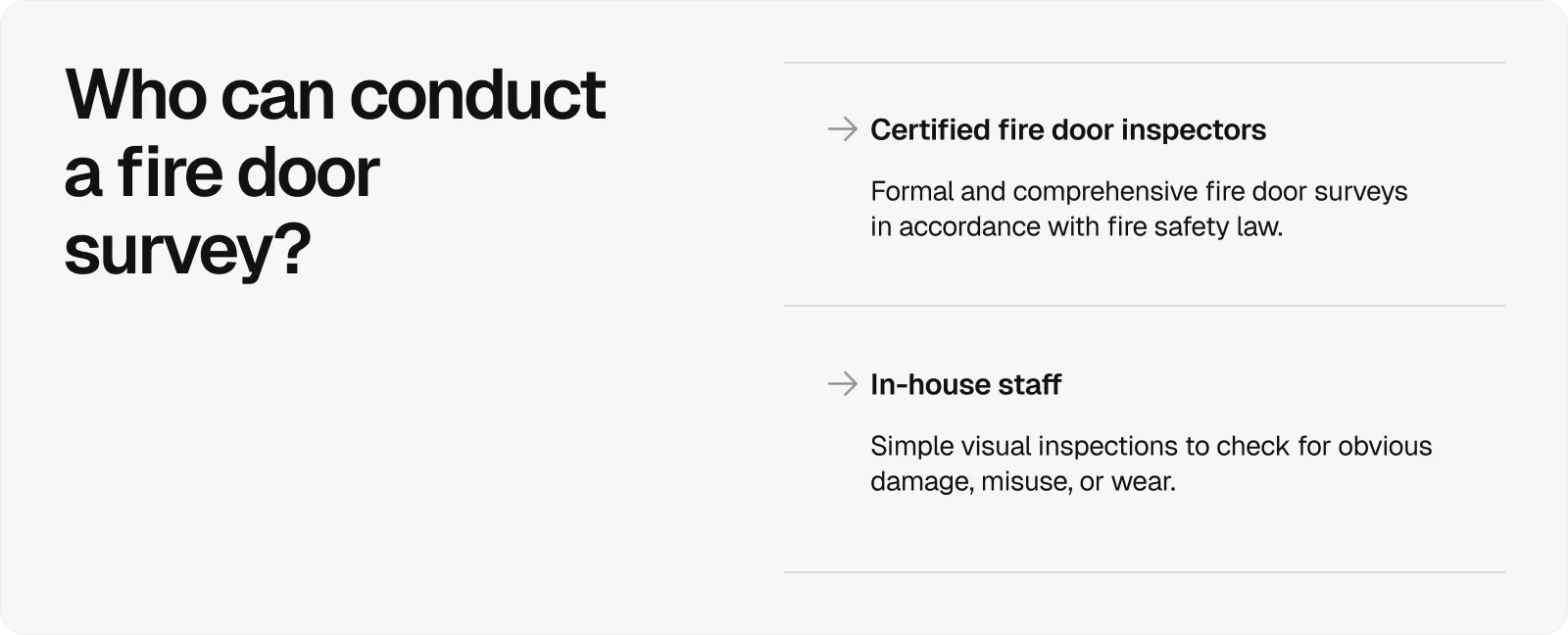
A fire door survey should only be carried out by a competent, qualified professional with specialist knowledge of fire door regulations, installation methods, and the laws on fire protection.
In most cases, this means a certified fire door inspector, often accredited through recognised schemes, such as the Fire Door Inspection Scheme or equivalent third-party certification bodies, such as:
FIRAS – a recognised fire protection certification scheme
BM TRADA – an established certification and testing body
ASFP – the Association for Specialist Fire Protection
These professionals have the training and experience to spot issues that might not be visible to the untrained eye and to recommend the right remedial action.
So, does this mean you can’t carry out a fire door survey yourself?
Not quite—but there’s a clear distinction.
Routine visual checks can and should be done in-house by building or maintenance staff, looking for obvious signs of damage or misuse. These inspections help ensure every fire door stays in working order between formal surveys.
How long does a fire door survey take?
The time it takes to complete a fire door survey mainly depends on the size of the building and the number of fire doors being inspected.
On average, a qualified surveyor can assess 20 to 30 fire doors per day. This figure can drop to 15 if the inspection is more comprehensive than usual, since these can take between 30 and 60 minutes per door.
After all, in fire door surveys, the goal is always quality over speed, ensuring every hinge, seal, frame, and closer is checked properly for full compliance.
How is a fire door survey performed?
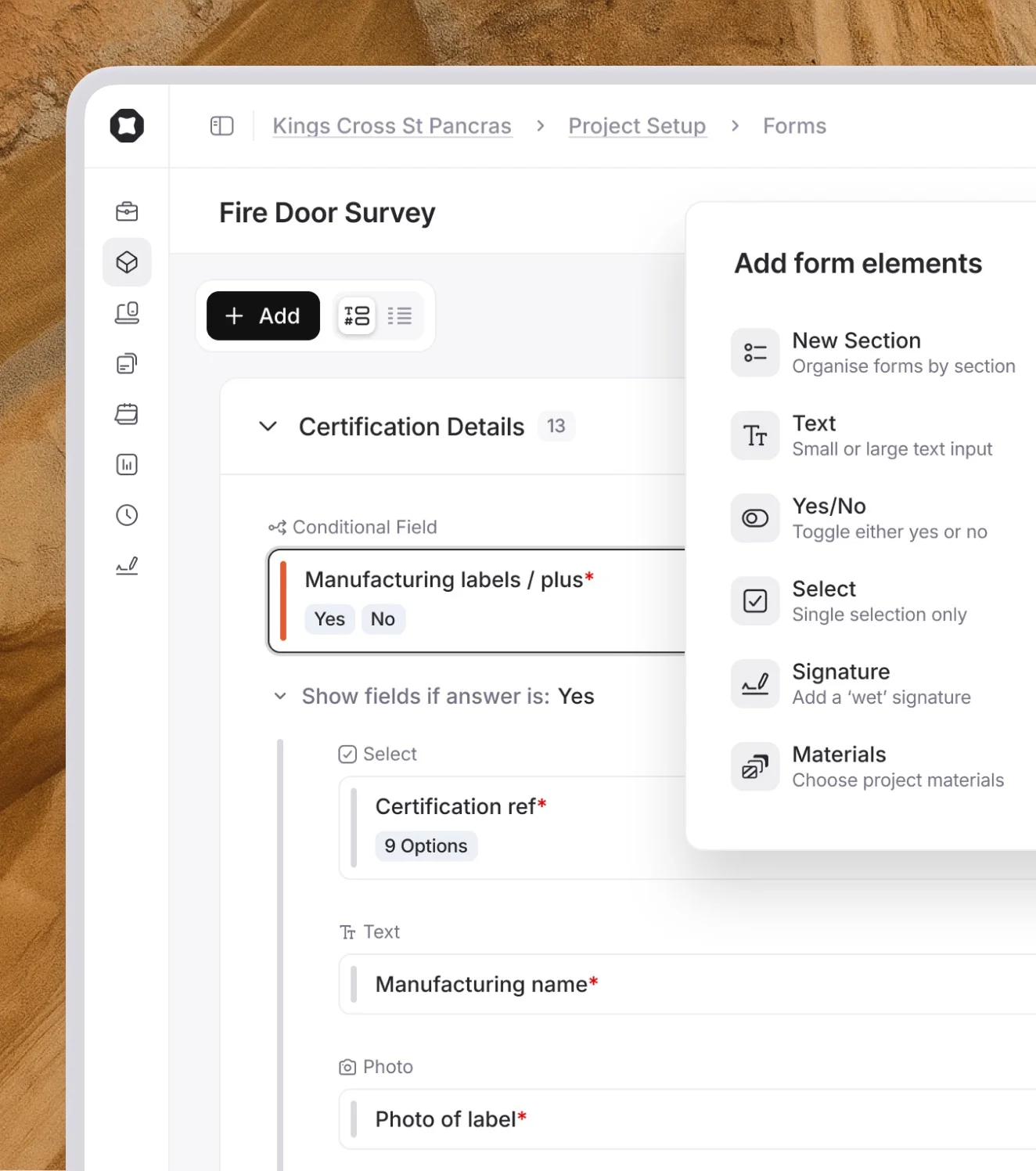
Nowadays, most fire door surveys are carried out using digital tools that make the process quicker, more accurate, and easier to manage.
Inspectors use tablets or mobile devices to record findings directly on digital floor plans, making sure each door is thoroughly checked and its condition clearly documented.
When fire door surveys are carried out with fire protection software like Onetrace, it means you get:
Tailored surveys for your building, ensuring every door is inspected and recorded in detail
Clear photographic evidence showing any issues found or demonstrating that the door remains compliant
Structured, professional reports that make compliance easy to understand
Reliable digital records that give you confidence that your fire doors meet safety standards
Inside a fire door survey: 7 essential steps
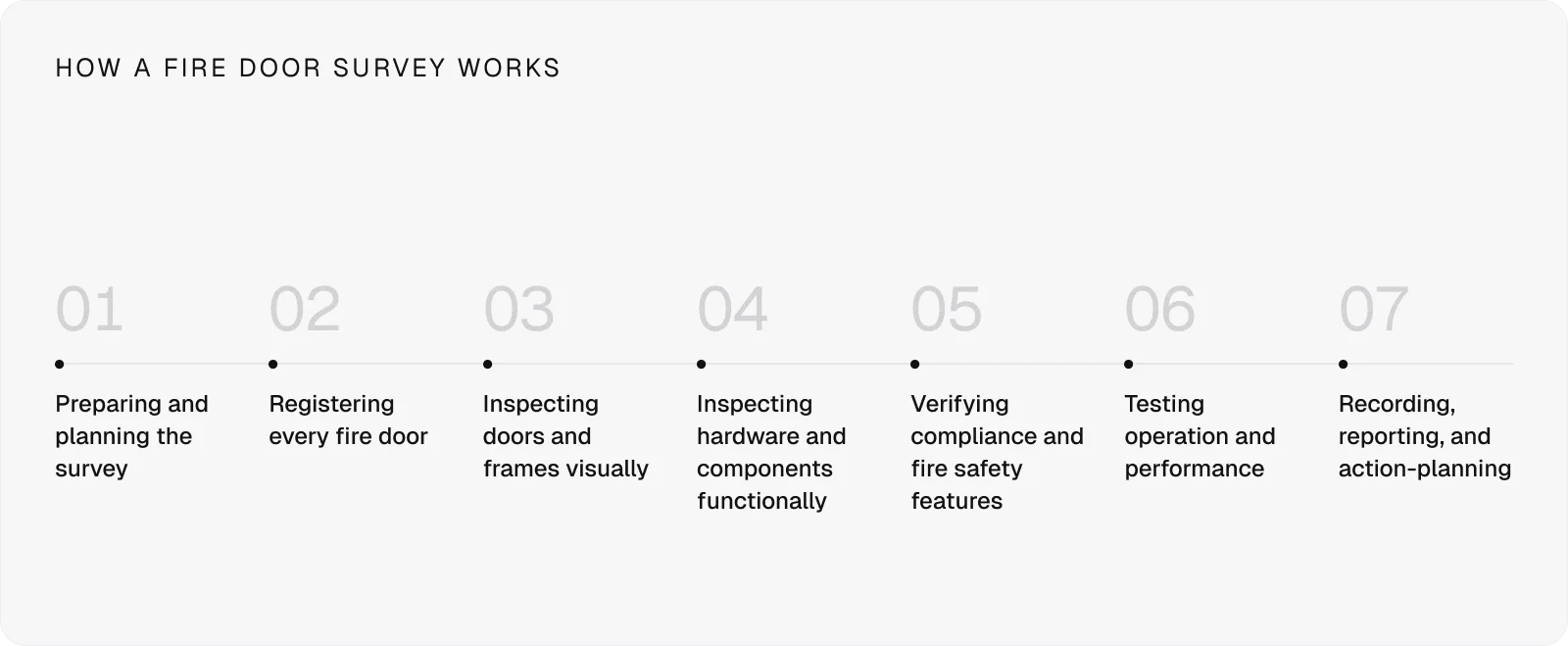
A professional fire door survey follows a structured, step-by-step process. While methods vary slightly between providers, the core stages are generally the same. Here’s what they are.
Step 1: Preparing and planning the survey
Before the first fire door is checked, the surveyor reviews building plans, fire strategies, and risk assessments to understand the layout, occupancy, and high-risk areas.
This preparation ensures that every fire door is located, logged, and assessed in context, so no critical route or compartment is overlooked. Plus, good planning saves time on site and guarantees full coverage, especially in larger or complex buildings.
Step 2: Registering every fire door
The survey begins with creating or updating an asset register—a complete list of all the fire doors in the building. This includes recording the location, certification label, and fire rating of each door.
Such a clear register forms the foundation for ongoing maintenance and compliance tracking, not just during the survey itself but throughout the building’s life cycle.
Step 3: Inspecting doors and frames visually
Visual defects are often the first signs of performance failure. That’s why inspectors usually examine each door and frame for visible signs of damage, wear, or alteration first.
These usually show up as cracks, warping, or holes in the door leaf and frame, as well as through missing or damaged seals.
A visual inspection also includes checking the signage, ensuring labels like “Fire door keep shut” or “Fire door keep locked” are present, legible, and correctly positioned.
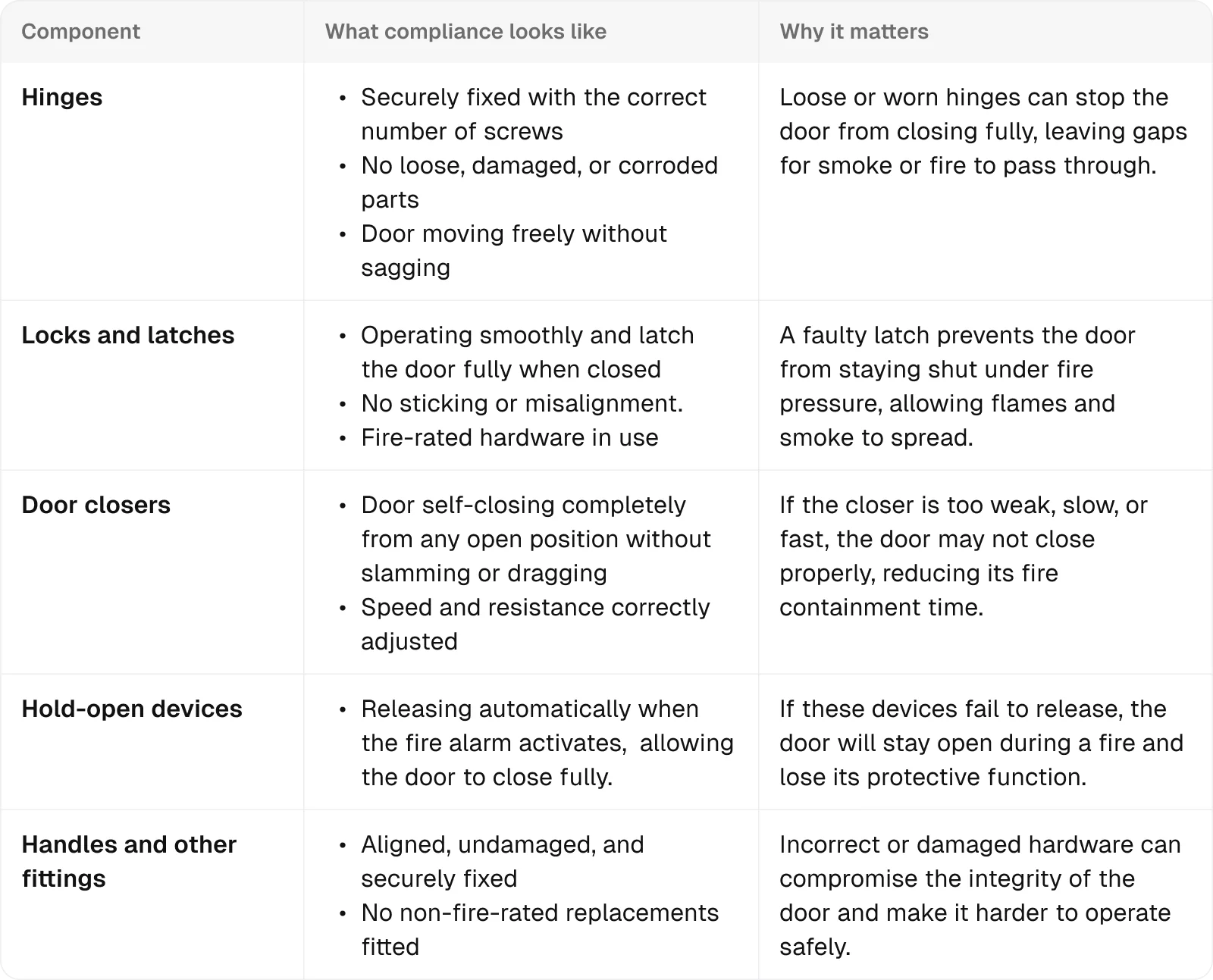
Step 4: Inspecting hardware and components functionally
Now, it’s time to dig deeper. The surveyor switches focus on all mechanical and moving parts—anything that affects how the door operates.
Each component must be secure, correctly fitted, and in good working order. Here’s what that looks like in practice:
Step 5: Verifying compliance and fire safety features
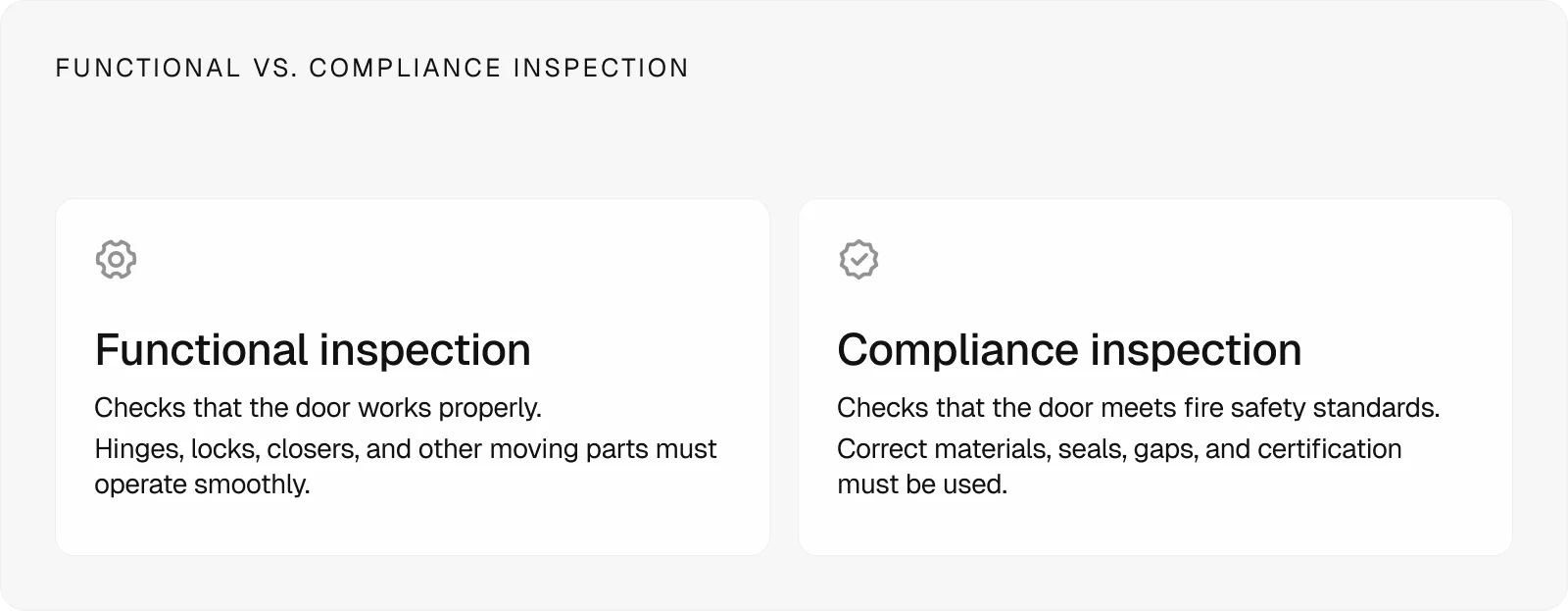
Just because a fire door closes properly, it doesn’t mean it’s fully compliant. It also has to be built, installed, and fitted to the correct fire rating, down to the smallest details.
Compliance checks usually cover:
Gaps and clearances: There shouldn’t be more than 3 to 4 millimetres around the door’s sides and top, and up to 10 millimetres at the threshold.
Intumescent and smoke seals: The correct seals should be fitted continuously and remain in good condition.
Glazing and vision panels: Any glass panels should be fire-rated and securely fitted, with intact beading and no cracks or movement.
Certification labels or markings: Each door should display a clear, legible label confirming its fire rating (for example, FD30), proving its tested performance.
Door thickness and materials: The door leaf and frame must match the certified fire rating and be made from approved materials.
Step 6: Testing operation and performance
Your fire doors shouldn’t just meet standards on paper. They must also prove they can perform under pressure.
During this step, the surveyor aims to confirm that the door and the escape route would work exactly as intended in a real-life scenario.
To achieve this goal, these professionals will carry out a series of practical tests, including:
Opening and closing the door repeatedly to make sure it moves freely, without sticking, dragging, or slamming
Checking that escape routes stay clear with no wedges, mats, or obstacles blocking safe evacuation paths
Verifying that the overall fire compartmentation works as intended, ensuring the door seals the area and supports safe evacuation
Step 7: Recording, reporting, and action-planning
Once the fire door survey is completed, inspectors document all their findings in a detailed report, often supported by photographic evidence and floor plan references. The report typically includes:
A summary of each door’s condition and compliance status
Clear photos of any defects
A prioritised list of recommended actions (e.g., urgent or routine)
Optional cost estimates or remedial guidance
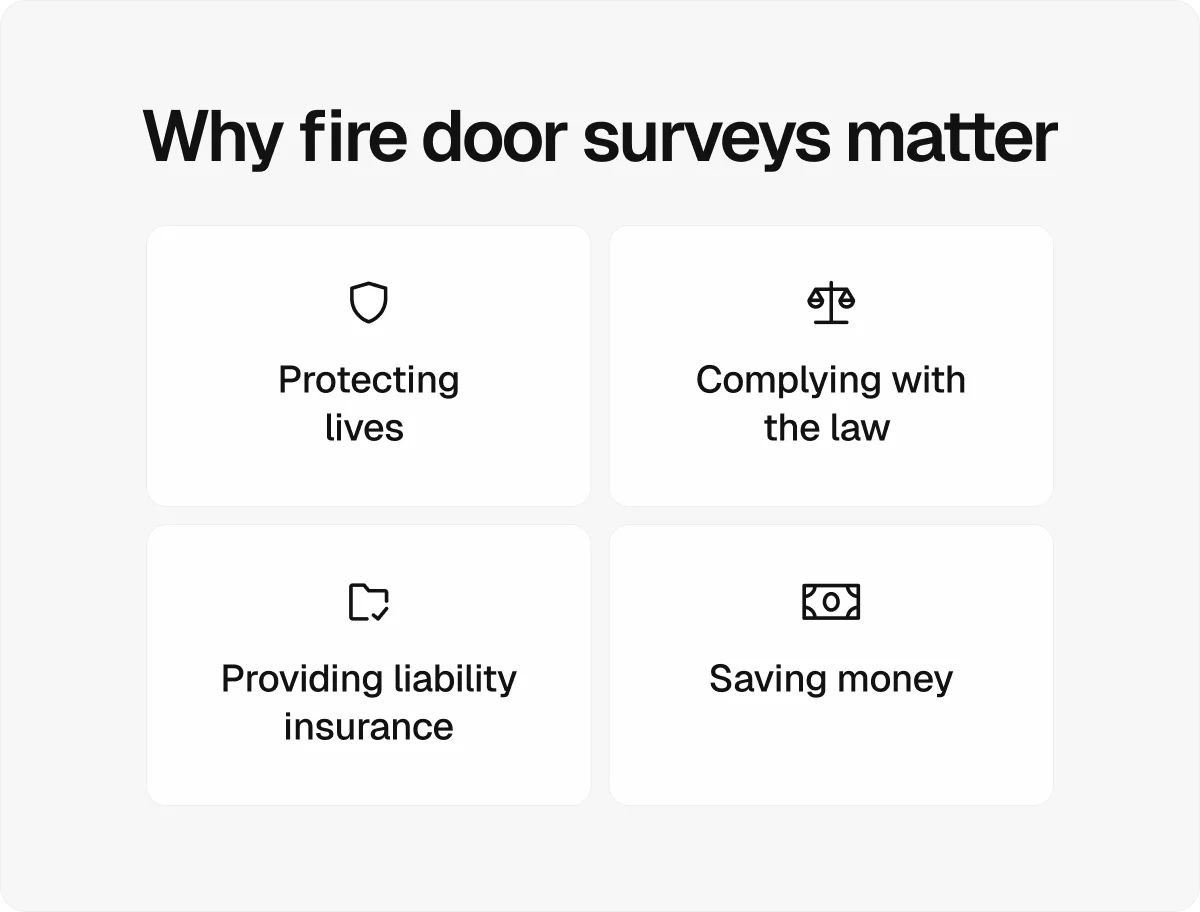
Why fire door surveys matter: 4 key reasons
Whether you manage an office, a residential block, or a public facility, regular fire door surveys should be a non-negotiable part of your building’s safety strategy. Here are four reasons why.
1. They protect lives
A fire door survey is about one thing above all: protecting lives.
A compliant fire door can slow the spread of fire and smoke, keeping escape routes clear and giving occupants the time to reach safety.
Regular surveys help keep fire doors in a working order, so when an emergency happens, they do their job as intended. It’s one of the simplest, most effective ways to protect the people who use your building every day.
2. They’re your legal responsibility
Given how important fire doors are for safeguarding lives, it shouldn't be surprising that they’re also required by law.
In England and Wales, several key laws set out the duties of the so-called Responsible Person to keep fire doors in good repair and working order:
Regulatory Reform (Fire Safety) Order 2005: It requires fire doors in non-domestic buildings and shared residential areas to be maintained in efficient working order.
Fire Safety (England) Regulations 2022: They mandate quarterly checks of communal fire doors and annual checks of flat entrance doors in residential buildings over 11 metres.
Building Safety Act 2022: It introduces ongoing duties for “Accountable Persons” in higher-risk buildings to keep up-to-date fire door condition records.
British Standards (BS 8214, BS 9999, BS 9991): They provide codes of practice for inspection, maintenance, and management of fire doors.
Failing to comply with these obligations can result in fines and prosecution.
3. They protect your insurance and liability
Fire door surveys play a big part in insurance compliance since many insurers require up-to-date evidence of fire safety maintenance before approving claims.
If a fire occurs, and your records are incomplete or outdated, an insurer may deny coverage or reduce payouts.
By keeping survey records current, you demonstrate that you’ve taken all reasonable steps to maintain fire safety, protecting your property and your legal and financial position.
4. They save you money
Besides reducing the chance of emergencies, regular fire door surveys can prevent expensive repairs.
Spotting small issues like worn seals or misaligned hinges early gives you the possibility to repair rather than replace entire doorsets later on.
It’s a practical, preventative step that once again proves that proactive maintenance almost always costs less than emergency remediation.
How often do you need a fire door survey?
Noticing signs of damage, warping, or poor closure is one thing; that’s when you need a fire door survey straight away.
Urgent surveys are also required in the following situations:
A recent fire risk assessment flags issues with fire doors.
There have been changes to the building’s layout or use.
You need to verify compliance after repairs, refurbishments, or new installations.
But beyond urgent cases, fire doors surveys also follow a regular maintenance schedule.
The table below gives a general overview of how this schedule functions based on different building types and conditions:
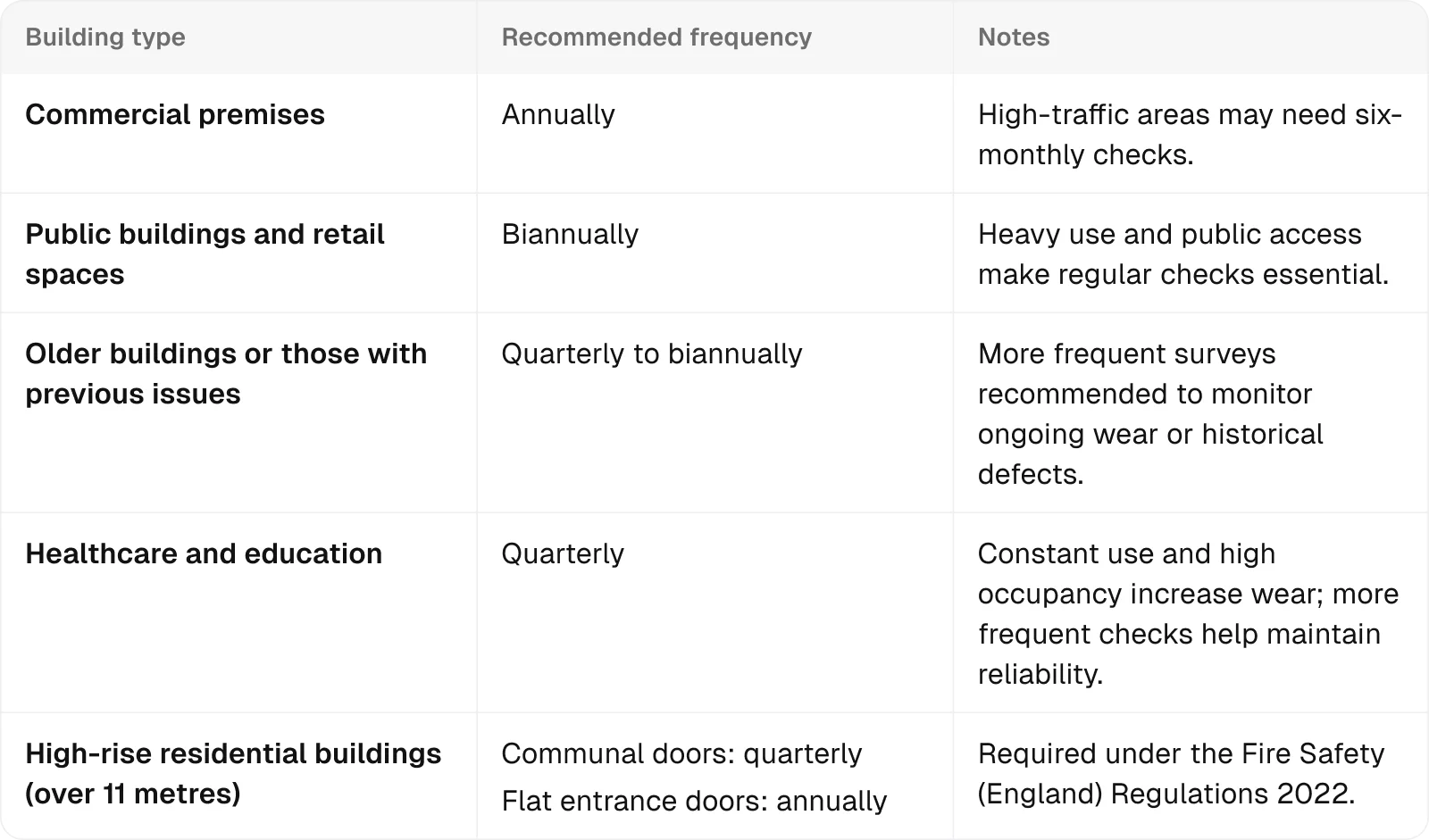
Surveys can often be scheduled outside normal business hours to avoid disruption, as long as inspectors have access to test doors under normal working conditions.
Simplifying fire door compliance with Onetrace
Even if you’re not the one carrying out the fire door survey yourself, choosing contractors who use modern digital tools like Onetrace makes all the difference.
With Onetrace, you get:
Instant access to records: Each fire door or installation can be tagged with a QR code, letting anyone on site scan and instantly see its inspection or maintenance history.
Clear building overview: Complex buildings are kept under control with digital sites divided into floors and zones.
Accurate, consistent data: Pre-built templates make it simple to record the right information every time, ensuring consistency.
Transparency and trust: Every action is logged, so you can easily prove compliance and demonstrate a clear audit trail to insurers, clients, or regulators.
Head to Onetrace’s website to learn more about the software and how it supports safer, more compliant buildings.
Marketing Team
@Onetrace
The Onetrace marketing team is passionate about sharing insights, ideas, and innovations that help construction businesses stay connected, compliant, and efficient. Combining industry expertise with a love for clear communication, we aim to deliver content that empowers professionals to work smarter and safer.