Fire door compliance: What subcontractors need to know

By
Marketing Team
@Onetrace
Fire door compliance remains a persistent challenge across the UK.
The Fire Door Inspection Scheme (FDIS) inspection data from 2025 found that 72% of fire doors inspected failed to meet the required standard, with excessive gaps, smoke-sealing issues, and poor maintenance among the most common problems.

The encouraging part is that 70% of the failed doors needed only minor repairs, meaning most can be brought into compliance by competent subcontractors.
If you’re a subcontractor working with fire doors—or looking to take on this type of work—this guide explains what fire door compliance means in practice.
Key takeaways
Fire door compliance covers the complete doorset
The leaf, frame, seals, hardware, and glazing must work together and match the supporting evidence.Installation quality directly affects fire performance
Subcontractors must follow the specified doorset, certification, and manufacturer’s installation instructions.Inspection, maintenance, and remedial work are ongoing responsibilities
Fire doors need regular checks, appropriate repairs, and maintenance to remain effective throughout their service life.Documentation is essential for long-term compliance
Photographs, test reports, certification, inspection records, and other evidence help demonstrate what was installed and support future work.Passive fire protection software can simplify compliance management
Tools like Onetrace help subcontractors capture, organise, retrieve, and share fire door evidence from one central system.
What is fire door compliance?
Fire door compliance is the conformity of a fire doorset with the standards, specifications, and performance requirements that apply to its intended use.
Using the word ‘doorset’ instead of just ‘door’ is no accident.
A fire door’s performance depends on the whole assembly, including the door leaf, frame, hinges, seals, closer, locks, latches, glazing, and other hardware. These components must be suitable for the specific doorset and its required use.
However, a tested or certified door can fail to provide its intended protection if it’s incorrectly installed, modified, or poorly maintained, and this is where subcontractor workmanship becomes part of the compliance chain.
Why fire door compliance matters for subcontractors
Subcontractors may not be the Responsible Person or the party ultimately accountable for a building’s fire safety, but they still have a responsibility to carry out their work competently and correctly.
The Regulatory Reform (Fire Safety) Order 2005 recognises that people with contractual duties around maintenance, repair, or safety can have responsibilities to the extent of their control, while England’s building regulations framework also places competence requirements on contractors carrying out building work.
So, for subcontractors, getting fire door work right matters because it allows them to:
Protect lives: A correctly installed and maintained fire door helps contain fire and smoke, protect escape routes, and give occupants more time to get to safety.
Safeguard the building: Effective fire doors can reduce the extent of fire damage, helping protect the building, fixtures, equipment, and other assets.
Contribute to wider fire protection compliance: Fire doors are part of a building’s wider passive fire protection strategy, alongside measures like fire-stopping and compartmentation.
Protect their reputation: Main contractors and clients need confidence that specialist subcontractors can deliver compliant work, particularly where fire doors form part of a larger safety-critical project.
Keep work compliant with UK requirements: Fire door work sits within a wider framework of building regulations and fire safety legislation, which continues to evolve.
What are the fire door regulations for UK subcontractors?
Besides the Fire Safety Order, several other regulations and requirements are relevant to UK subcontractors working with fire doors, including:
The Building Regulations 2010 and Approved Document B: Approved Document B sets out guidance for meeting fire safety standards in building design and construction in England. The relevant volume depends on whether the project involves dwellings or other buildings.
Fire Safety (England) Regulations 2022: These regulations require the Responsible Person to arrange quarterly checks of communal fire doors and annual checks of flat entrance doors in relevant multi-occupied residential buildings over 11 metres.
Building Regulations dutyholder and competence requirements: Fire door subcontractors should only take on work they can carry out correctly, properly train and supervise operatives, follow manufacturer instructions, and raise discrepancies rather than improvise.
Building Safety Act 2022: The Act strengthens accountability and record-keeping around building safety, particularly for higher-risk buildings.
Building Safety Regulator: The Building Safety Regulator oversees the building safety regime for higher-risk buildings in England. Subcontractors working on these projects may face greater expectations around competence, information, and change control.
What qualifications and certifications do fire door subcontractors need?
There isn’t a single qualification that every fire door subcontractor must hold. What matters is that the people carrying out the work have the skills, knowledge, and experience needed for the specific work they undertake.
These can include:
Relevant fire-door training: Operatives should have appropriate training in fire door installation, maintenance, or inspection, depending on the work they carry out.
Industry qualifications: Relevant qualifications or recognised training can help demonstrate competence. Fire door inspectors can also pursue specialist qualifications like the FDIS Diploma.
Third-party certification: Certification schemes like FIRAS can provide additional evidence of competence and traceability, particularly for specialist fire door installation and inspection.
Fire door standards and guidance change over time, so keeping knowledge and training up to date is also part of maintaining competence.
How subcontractors achieve fire door compliance
Achieving fire door compliance is a multi-stage process that starts with selecting the right doorset and continues through installation, inspection, maintenance, and documentation.
Fire door installation
Fire door installation is one of the most important stages of compliance because even a tested and certified doorset can fail to perform as intended if it’s fitted incorrectly.
To achieve a compliant installation, subcontractors need to:
Check the door specification before installation: Confirm the required fire rating, smoke-control performance, door configuration, frame type, wall construction, glazing, threshold, and hardware against the project specification and door schedule.
Match the installation to the certification: Check that all the relevant doorset elements match the tested or certified configuration. Never assume a different component is suitable just because that component has its own fire-rating or fire test certificate.
Follow the manufacturer’s installation instructions: Use the specified fixing methods, materials, tolerances, and installation sequence. The manufacturer’s instructions and certification for the particular doorset should take precedence over generic installation practices.
Prepare the opening correctly: Check the opening dimensions, wall construction, frame fixing, packing, tolerances, and surrounding construction before fitting the frame.
Install the frame accurately: Make sure the frame is correctly aligned, securely fixed, and not distorted. Incorrect packing, fixing, or alignment can affect door clearances and prevent the door from closing correctly.
Maintain specified door-to-frame clearances: Measure and record the gaps at the sides and head of the door, as well as the threshold where applicable. Never apply a universal gap measurement; use the tolerances specified for the particular doorset.
Fit intumescent and smoke seals correctly: Use the specified seal type, size, and location, and make sure seals are continuous, undamaged, and properly seated.
Install compatible hardware: Hinges, locks, latches, closers, and other ironmongery must be approved for use with the particular doorset. Position and fix each component according to the manufacturer’s instructions and certification.
Check the self-closing function: The door should close fully and consistently onto the frame and latch correctly without manual assistance. Check that the closer is correctly installed and adjusted for the doorset.
Avoid unauthorised modifications: Don’t cut down, drill, route, or alter the door, frame, glazing, seals, or hardware unless the modification is covered by the relevant evidence or has been appropriately assessed and approved.
Record the completed installation: Keep details like the door identification, location, product reference, certification, installation date, installer, measurements, hardware, and photographs so the completed doorset can be traced and verified later.
Fire door inspection and surveying
A fire door survey is a systematic assessment of a fire doorset to determine whether it remains in suitable condition and can perform as intended.
The fire door inspection requirements can be extensive and will depend on the building, doorset, and inspection requirements.
In general, subcontractors should:
Identify and trace each doorset: Record the door’s location, reference, type, and relevant certification so inspection findings can be linked to the correct door.
Assess the complete doorset: Inspect the door leaf, frame, hardware, seals, glazing, closer, and other relevant components for condition, damage, and compatibility.
Check performance and operation: Confirm that the doorset remains correctly aligned, closes fully, and functions as intended.
Check for alterations or defects: Identify unauthorised modifications, missing components, deterioration, damage, or other issues that could affect the doorset’s certified performance.
Record and classify findings: Document defects clearly, including photographs or measurements where appropriate, and identify whether further investigation, repair, or replacement is needed.
Fire door repair and remedial work
Fire door remedial work is needed when an inspection identifies a defect that could affect the doorset’s ability to perform as intended.
Subcontractors brought in to complete remedial work should:
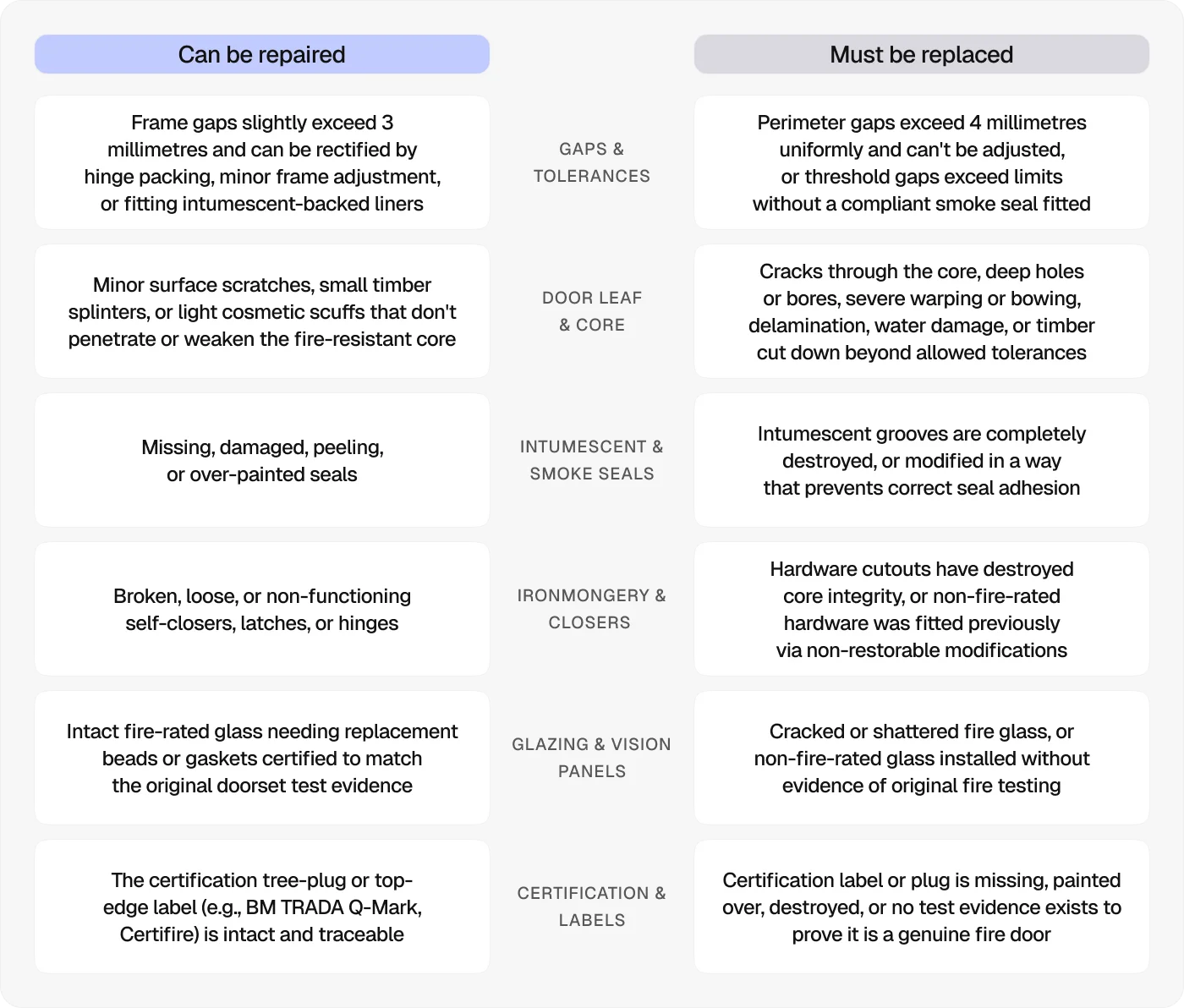
Assess whether the defect can be repaired: Consider the condition, design, and supporting evidence for the doorset before deciding whether repair is appropriate or full replacement is required.
Use an approved repair method: Make sure the proposed repair is supported by the manufacturer’s instructions, certification, or other appropriate technical evidence. Avoid improvised fixes where there’s no evidence that the method is suitable. Otherwise, the repair itself might compromise the doorset’s fire performance or certification.
Replace damaged components appropriately: If a component can’t be repaired, use a replacement that is compatible with the existing doorset and supported by the relevant evidence.
Escalate uncertain or complex defects: If the repair falls outside your competence or the available evidence doesn’t support the proposed work, the issue should be referred to the appropriate specialist rather than resolved through guesswork.
Check the completed remedial work: Once repairs are complete, confirm that the doorset has been restored to the required condition and operates as intended.
Document what was changed: Record the remedial work carried out, including replacement components and any relevant supporting evidence, so there’s a traceable history of what has been done to the doorset.
Fire door replacement
Replacement may be necessary when a fire door:
Is damaged beyond economical or compliant repair
Has deteriorated significantly
Can’t be supported by suitable evidence
No longer provides the level of protection required for its location
Never replace a fire door just because it’s old. The decision should be based on the doorset’s condition, design, certification, and the findings of the inspection or fire risk assessment. However, any door leaf or frame exposed to direct heat or fire must be fully replaced immediately.
When replacement is required, subcontractors should follow the same installation standards covered above.
Fire door maintenance
Fire door maintenance is required to keep doors in effective working order throughout their service life.
To remain compliant, fire door subcontractors should:
Carry out maintenance at appropriate intervals: Follow the inspection and maintenance schedule set for the building, with more frequent attention where doors experience heavy use or higher levels of wear.
Address defects promptly: Repair or replace components where deterioration, damage, or faulty operation could affect the doorset’s ability to perform as intended.
Keep the doorset suitable for continued use: Maintenance should preserve the doorset’s existing performance and shouldn’t introduce changes that fall outside its supporting evidence.
Record maintenance activity: Keep reliable records of inspections, repairs, replacements, and any relevant supporting evidence so the condition and maintenance history of each doorset can be demonstrated.
Fire door handover and documentation
One point runs through every stage of fire door work covered above: evidence and documentation matter just as much as the work itself.
Whether you install, inspect, repair, maintain, or replace a fire doorset, you need to be able to show what was done, which products and components were used, and what evidence supports the completed work.
This matters at handover, but it also matters long after the subcontractor has left the site.
That’s because fire doors need to be inspected, maintained, and potentially repaired or replaced throughout their service life. Accurate records give the main contractor, building owner, or Responsible Person a reliable starting point for future inspections and remedial work, while helping demonstrate that the doorset was installed and maintained in accordance with the relevant requirements.
For higher-risk buildings in England, this also connects with the wider golden thread requirement for building information to remain accurate, accessible, and usable throughout the building's lifecycle.
Proper fire door handover evidence can include:
Photographs: Provide a visual record of the completed installation and any details that may be difficult to verify once the work is finished.
Test reports: Show that the doorset's required fire or smoke performance is supported by relevant test evidence.
Classification reports: Demonstrate how the tested performance has been classified and help confirm that the evidence relates to the required specification.
Third-party certification: Provide additional evidence that the relevant product or doorset has been assessed under a recognised certification scheme.
Technical assessments: Support variations, components, or configurations that aren’t covered directly by the original test evidence.
Manufacturer documentation: Allow future installers and inspectors to identify the correct products, components, and installation methods.
Declarations of performance: Provide the relevant performance information for products where a declaration is required.
Door schedules and identification records: Allow individual doorsets to be located and matched to their specification and supporting evidence.
Inspection or survey reports: Give future inspections a clear record of the doorset's previous condition and any issues already identified.
Collecting this evidence and keeping it organised and accessible is much easier with passive fire protection software like Onetrace.
How Onetrace helps subcontractors manage fire door compliance

Onetrace gives passive fire protection subcontractors one central system for capturing, organising, and sharing the evidence behind their work. Instead of relying on separate photos, spreadsheets, paper forms, and folders, teams can record evidence on site as they complete the work.
In addition, Onetrace can help with:
Capturing evidence on site: Custom forms let teams record inspections, installations, and remedial work using structured fields, checklists, photographs, and mandatory inputs.
Keeping records consistent: Standardised forms and project templates help teams capture the same key information across different operatives, projects, and sites.
Linking records to locations: Drawings, pins, floors, zones, and QR codes make individual doors and their history easier to identify and retrieve.
Managing approvals: Built-in approval workflows create a reliable record of who reviewed, accepted, or rejected work and why.
Producing handover evidence: Professional PDF and Excel reports can bring together the information clients, auditors, and other project stakeholders need.
Providing controlled access: Selected records can be shared with clients or external parties without giving them access to the wider system.
The result is a more robust audit trail from the work carried out on site to the evidence needed to demonstrate it later.
To learn more about the role of Onetrace in fire door compliance, schedule a personalised demo with our team.
FAQ
What is the European standard for fire doors?
The European standard for fire doors is EN 16034, which covers the fire resistance and smoke control characteristics of doorsets, windows, and other opening components.
What are the rules for fire-rated doors?
Fire-rated doors must be suitable for their intended location and installed, maintained, and inspected in accordance with the relevant specification, certification, and the manufacturer's instructions.
Is there a two-hour fire-rated door?
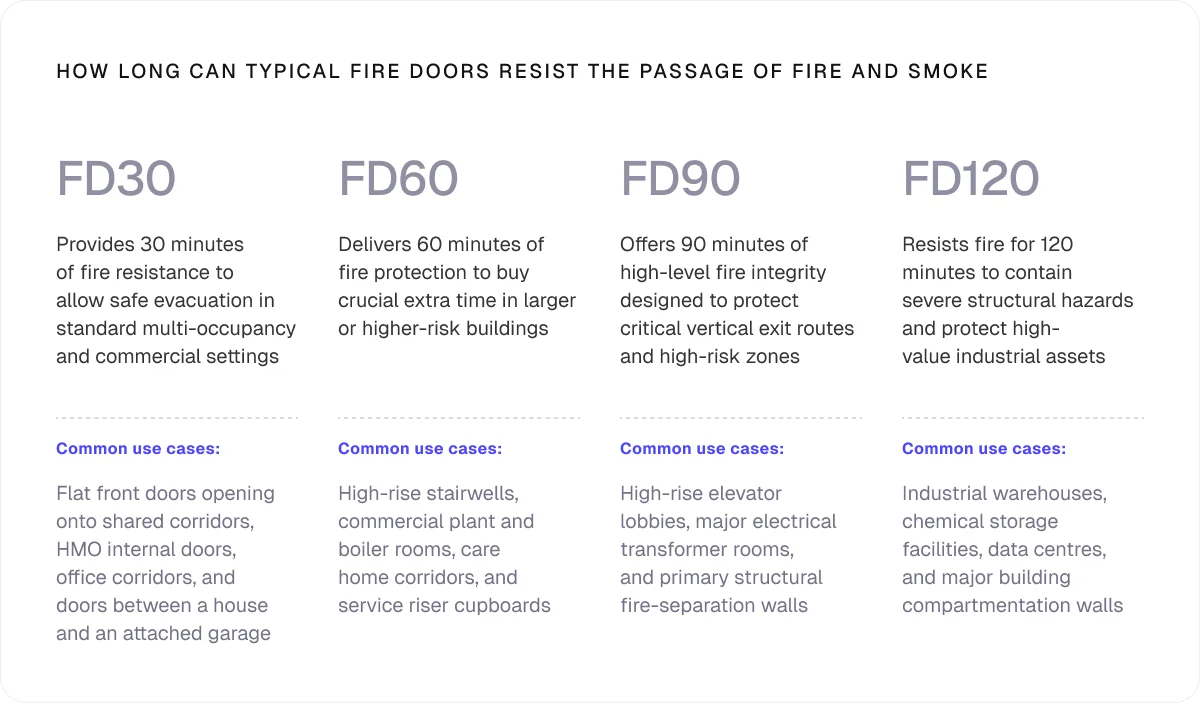
Yes, two-hour (120-minute) fire-rated doors exist, though their availability and code application vary by region.
Do all internal doors need to be fire doors?
No. Fire doors are only required where they are needed to provide fire separation, protect escape routes, or meet the fire safety design of the building.
Marketing Team
@Onetrace
The Onetrace marketing team is passionate about sharing insights, ideas, and innovations that help construction businesses stay connected, compliant, and efficient. Combining industry expertise with a love for clear communication, we aim to deliver content that empowers professionals to work smarter and safer.