Construction project close-out: Steps & checklist guide

By
Marketing Team
@Onetrace
Construction project close-out is a key part of finishing a job properly, yet it often gets less attention than the work itself. Overlook it, and missing paperwork, unresolved snags, and delayed payments can create problems long after the build is finished.
This post-completion period is particularly relevant in the UK, where contractors may remain liable for resolving issues during the defects liability period, which typically lasts six to 12 months, depending on the contract.
To help you close out projects smoothly and avoid costly oversights, this guide breaks down the process into 12 easy-to-follow steps. It also includes a practical checklist to help you keep track of outstanding tasks and make sure nothing gets missed.
Key takeaways
Start close-out planning early
Review contract requirements and track responsibilities, deadlines, and approvals from the outset.Keep records up to date
Gather photos, inspection results, certificates, and handover documents as work progresses.Resolve snags and confirm completion
Check the finished work, complete outstanding items, and arrange required inspections and approvals.Close out the commercial details
Reconcile final accounts and check payment terms, retention, and any obligations that continue after handover.Use Onetrace to simplify handover
Onetrace allows subcontractors to capture site evidence, organise compliance records, and create reports that help demonstrate completed work and reduce delays.
What is a project close-out in construction?
Construction project close-out is the final phase of a construction project, when the contractor confirms that the work is complete, outstanding issues are addressed, contractual obligations are met, and the finished project and required records are handed over to the client.
It brings together the practical, administrative, and financial tasks needed to finish a project properly.
The aim is to ensure that:
The client has the information they need to use and maintain the building.
The project records are complete.
Any remaining obligations are clearly understood.
Close-out also helps contractors and subcontractors avoid unnecessary delays to final payments and disputes over unfinished work or missing records.
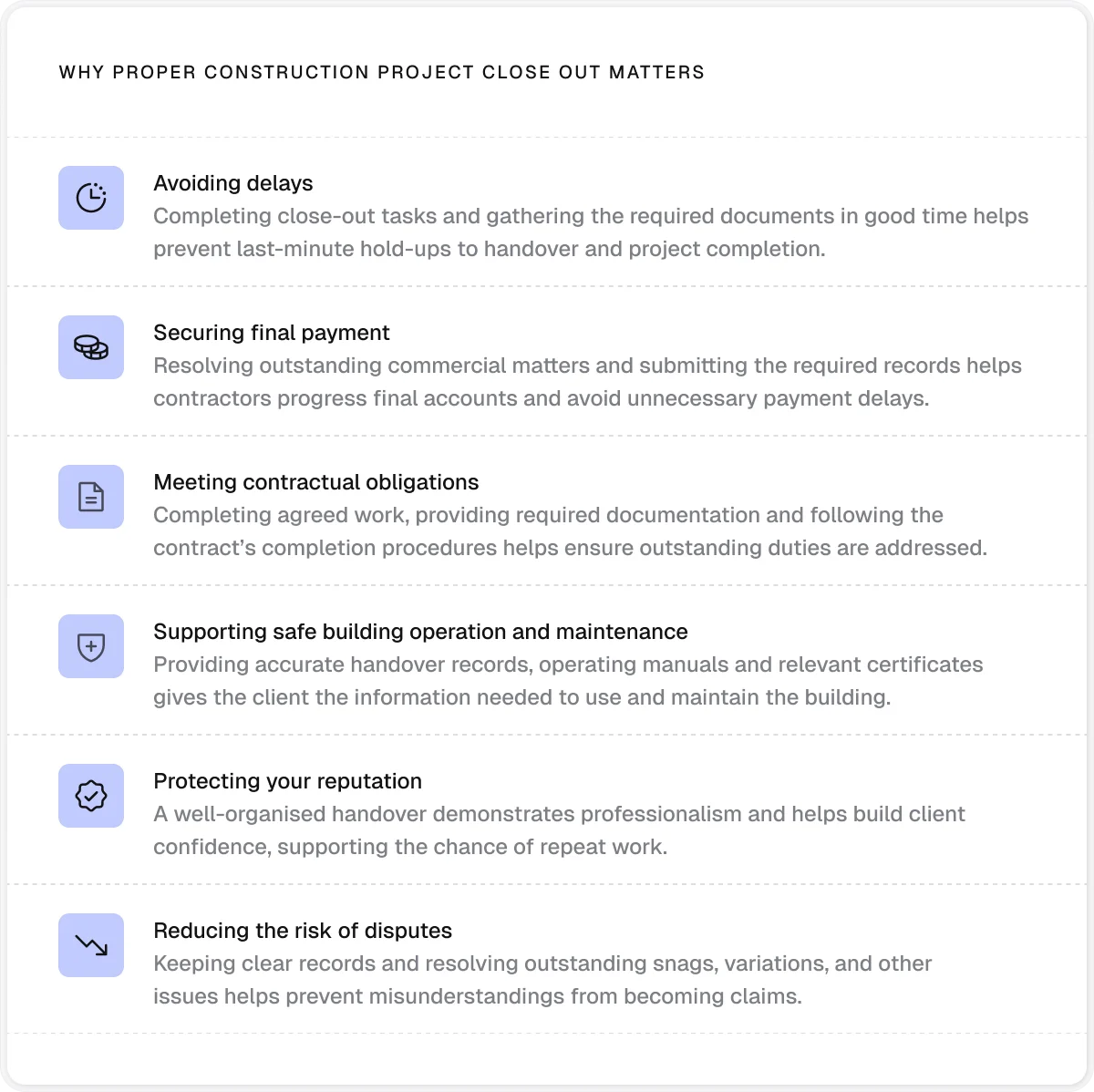
Due to its importance, close-out should never be treated as a last-minute job.
Although it formally takes place towards the end of a project, preparation should begin from the outset.
Keeping records up to date, tracking changes as work progresses, and gathering the required information along the way makes the final handover easier to manage.
Who is involved in the construction project close-out?
Construction project close-out involves everyone responsible for completing, checking, approving, and handing over the work:
Role | Involvement |
Main contractor | Coordinates close-out activities, gathers information from subcontractors, and manages the handover to the client |
Complete outstanding work within their scope and provide relevant records, certificates, warranties, and maintenance information | |
Client or employer | Reviews the completed work, checks that agreed requirements have been met, and accepts the handover |
Oversees progress, coordinates the parties involved, and tracks outstanding tasks through to completion | |
Architect and design team | Review relevant completed work and provide or check design information and record drawings where required |
Contract administrator | Manages contractual notices, completion procedures, and relevant certificates in line with the contract |
Quantity surveyor (QS) | Reviews the final account, assesses variations, and helps reconcile the costs of the work |
Suppliers and manufacturers | Provide product warranties, operating manuals, and other information required for installed products and equipment |
Building services and commissioning teams | Test relevant building systems and provide commissioning records and certificates where required |
How to complete construction project close-out successfully: 12 key steps
The exact construction project close-out process will depend on the contract, the type of work, and the building’s requirements. However, the 12 steps below provide a practical framework to guide you through the key tasks and help you keep close-out on track.
1. Set out the close-out requirements before the final stages
Different projects can have varying completion criteria, approval processes, and document requirements. That’s why you should check what the contract and client require before the work can be handed over. This includes:
Reviewing the contract for the conditions of completion, inspection, and handover
Confirming who’s responsible for arranging inspections, obtaining approvals, preparing documents, and signing off the work
Identifying any certificates, test results, warranties, manuals, drawings, and other records that must be provided
Verifying whether the project will be handed over in stages or by separate sections, and whether each section has its own completion requirements
Creating a close-out tracker showing each task, the person responsible, the deadline, and its current status
Practical tip:
Share the tracker with the project team and review it regularly at progress meetings. If a document or approval is likely to delay handover, you want to know while there’s still time to resolve it.
2. Gather records as the work progresses
Don’t wait until the site is almost finished to chase paperwork. Records are easier to collect and check while the people who carried out the work are still involved and the details are fresh.
Ask subcontractors, suppliers, and specialist installers to provide the information relevant to their work, such as:
Product data, warranties, and manufacturer information
Inspection, testing, and commissioning results
Relevant certificates and approvals
Record drawings showing changes made during construction
Asset details, including equipment models and serial numbers, where required
Health and safety information needed for handover
Practical tip:
Check submissions as they arrive. If a certificate is missing, a drawing is out of date, or a manual doesn’t cover the installed equipment, return it for correction rather than letting the issue roll into the final week.
3. Check the finished work against the agreed scope
Before arranging final sign-off, confirm that the work delivered matches the contract, specifications, and approved design information. This is the point to identify incomplete work, discrepancies, and changes that haven’t been properly recorded.
To achieve this, you should walk the site with the relevant trades and project representatives and record any items that need attention.
A joint site inspection can help uncover problems that are easy to miss when each trade checks only its own work. It also gives the team a shared view of what remains before handover.
Practical tip:
Keep a single, up-to-date snag list. Include the location, a clear description, the responsible trade or person, the target date, and the status of each item. Photos can help make the required work clear.
4. Arrange the required inspections, tests, and commissioning
Some work can’t be signed off simply because it looks complete. Building systems and specialist installations may need inspection, testing, commissioning, or approval before they can be handed over for use.
Depending on the project, this may include:
Electrical installation inspections and test records
Fire alarm and emergency lighting tests
Heating, ventilation, and air conditioning (HVAC) commissioning
Water system checks
Access control and security system testing
Demonstrations that installed equipment operates as intended
Practical tip:
Plan ahead to make sure systems are ready for testing, the right people are available, and any dependencies between trades have been resolved. Also, book tests early enough to allow for failed tests, remedial work, and retesting.
5. Close out snags and agree how any remaining work will be handled
Once snags have been recorded, make sure they are completed and checked rather than just marked as assigned. An item should only be treated as resolved when the work has been done, and the relevant person has verified it.

If some work is to remain outstanding at handover, record exactly what it is, who will complete it, and by when.
Practical tip:
Review the snag list at regular close-out meetings. Focus first on items that affect safety, compliance, the operation of the building, or the client’s ability to use the completed space.
6. Confirm contractual completion and obtain the required approvals
Once the work has been checked and the relevant requirements met, follow the contract’s formal completion process.
In UK construction, this often means arranging an inspection with the contract administrator or other authorised representative and obtaining a practical completion certificate when the contract’s requirements have been met.
However, the terminology and procedure will depend on the contract being used, so confirm the exact steps rather than assuming every project follows the same route.
Practical tip:
Keep copies of formal notices, certificates, approvals, and correspondence, including the dates they were issued or received. These records can matter for determining when contractual periods or other obligations begin.
7. Assemble and check the handover information
Prepare a complete handover package that gives the client the information needed to operate, maintain, and repair the building or completed works. The required contents will vary, so use the contract and the client’s handover requirements as your checklist.
However, regardless of the exact content of the handover package, you should:
Check that the documents relate to the equipment and work installed
Use consistent names and references and follow the agreed document format
Make sure the client knows where the information is stored and how to access it
Practical tip:
Ask someone who wasn’t responsible for compiling the package to review it. They may spot missing documents, unclear labels, or gaps that are easy to overlook when you’ve worked with the information for months.
8. Prepare the client and building for handover
The client needs to understand how to use the completed space, operate its systems, and access the information they’ll need after the project team leaves.
That’s why you should arrange a handover meeting or walk-through with the client and relevant specialists and use it to:
Demonstrate key building systems and equipment
Provide user training where needed, including any safe operating procedures
Hand over keys, access cards, codes, and other access arrangements securely
Confirm the location of manuals, warranties, certificates, and maintenance records
Provide agreed spare parts, specialist tools, and other items included in the contract
Explain any outstanding work, temporary arrangements, or restrictions that affect use of the building
Confirm who to contact about defects, system issues, and aftercare
Practical tip:
Ask the client to confirm in writing that they can access the handover information and know how to operate the systems they’ll be responsible for. This creates a traceable record and helps protect you if questions or disputes arise later about missing information or incomplete handover.
9. Reconcile subcontractor accounts and agree the final account
Close out the commercial side of the project alongside the practical work. Outstanding variations, disputed charges, or incomplete applications can delay payment and leave uncertainty over what each party is owed.
For the main contractor, this means working with the quantity surveyor, subcontractors, and client to:
Reconcile the agreed contract sum against the work completed
Check that variations, instructions, and changes have been properly recorded and valued
Review outstanding applications, invoices, claims, contra-charges, and other adjustments
Resolve disagreements over the value or scope of work where possible
Confirm the status of subcontractor accounts and any amounts still due
Prepare and agree the final account in line with the contract’s procedures and deadlines
Subcontractors should check that their applications reflect the work completed, that agreed variations have been included, and that any outstanding commercial issues have been raised with the main contractor.
Practical tip:
Don’t assume that practical completion automatically means the final account is agreed or payment is due immediately. The contract will set out the relevant process.
10. Check retention, payment notices, and other contractual obligations
Before treating the commercial close-out as complete, review the payment provisions and any other obligations that continue beyond handover. The details depend on the contract and the project arrangements, but you should generally check the following:
Item | What to check |
Retention | What amount is being held, what conditions apply to its release, and when it’s due to be released |
Payment procedures | What applications, payment notices, pay less notices, or final payment steps are required |
Collateral warranties or third-party rights | Whether required documents have been provided and executed |
Bonds and guarantees | What remains in force and whether any release conditions have been met |
Insurance requirements | Whether cover must continue for a defined period or certain obligations remain |
Claims and disputes | Whether outstanding matters have been resolved, formally recorded, or referred through the agreed process |
Practical tip:
Add key payment, retention, and document deadlines to the close-out tracker. This helps prevent a project from being treated as finished while important contractual actions are still outstanding.
11. Demobilise the site and transfer remaining responsibilities
Plan the safe and orderly removal of the project team’s temporary facilities, equipment, and materials. Demobilisation should be coordinated with the client so that it doesn’t disrupt building operations or leave hazards behind.
Practical tip:
Carry out a final walk-round with the relevant site and client representatives. This can help identify forgotten materials, damage, incomplete clear-up, or access issues before the team disperses.
12. Store the final project records and capture lessons learned
After the handover is officially complete, organise the project records so they can be retrieved if questions arise about the work, costs, approvals, or contractual responsibilities.
You should archive versions of all relevant project information, restricting access to sensitive details where necessary. Retain these records for the periods required by law, the contract, insurance conditions, and company policy.
In addition, you should hold a short project review with the people involved to discuss:
What went well
Where delays or rework occurred
Which close-out tasks were missed or repeated
What could be improved on the next job
Where useful, prepare a close-out report summarising the project’s final status, outstanding issues, key costs, and handover documentation.
Practical tip:
Turn lessons into actions. For example, if commissioning records arrived late, set an earlier submission milestone for future projects and make one person responsible for checking progress.
Construction project close-out: A checklist for contractors
A close-out checklist can help you track outstanding work, required documents, formal approvals, and commercial tasks, so fewer items are missed as the project approaches handover.
Work through each section, assign an owner and deadline to every relevant item, and mark tasks complete only once they’ve been checked.
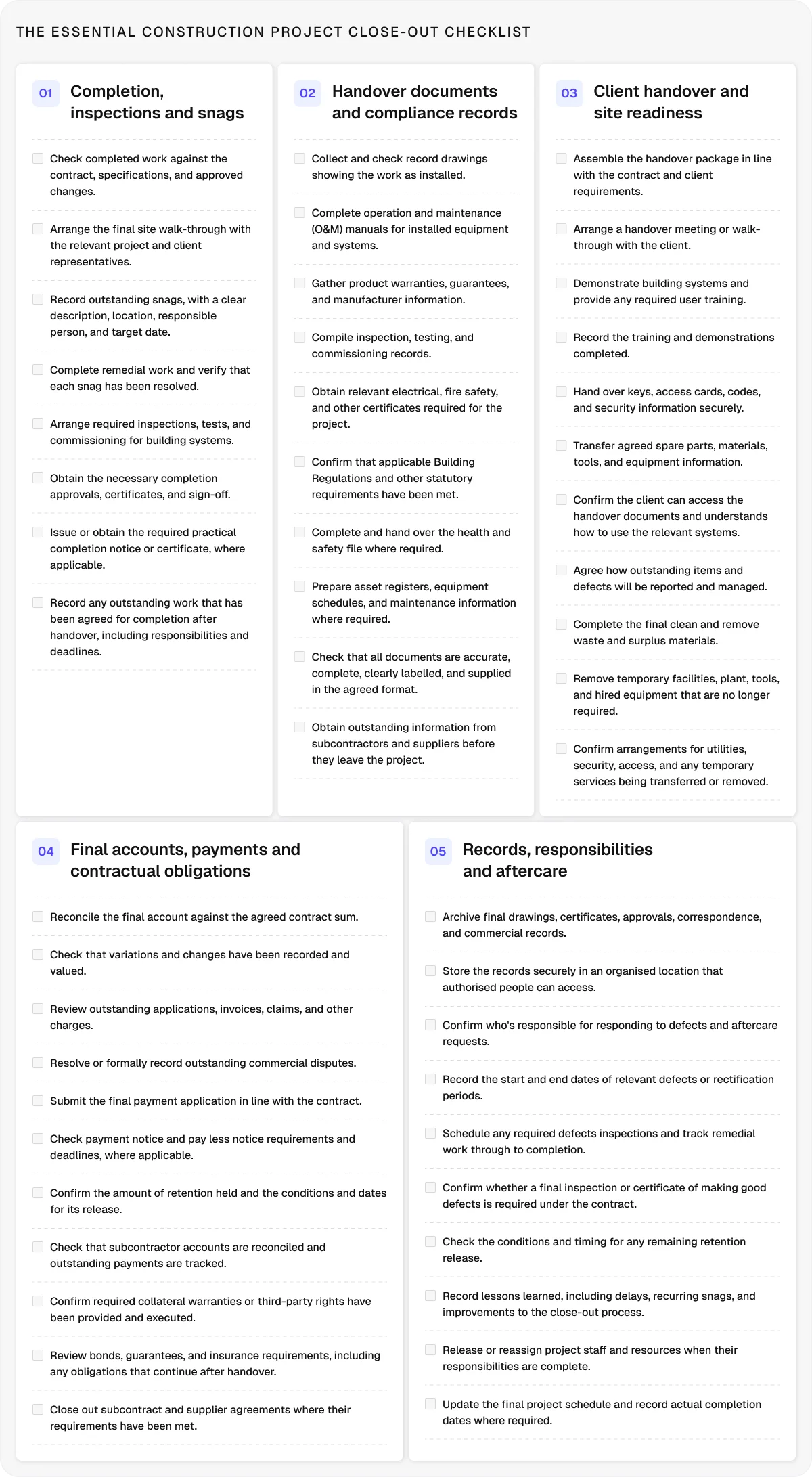
Please note:
This checklist is a practical starting point, not a substitute for project-specific requirements. Use your contract and the relevant statutory requirements to decide which items apply.
How Onetrace helps contractors and subcontractors get handover-ready
Even with a close-out checklist, a smooth handover can be difficult to achieve if the information needed to complete it is scattered across spreadsheets, photos, paper forms, and messages.
Proper record-keeping calls for a more structured approach that allows construction professionals to capture work as it happens, keep information organised, and make evidence easy to retrieve.
Onetrace helps make that approach part of everyday site work.
It gives teams a central place to capture job details, photos, inspection records, and compliance information as work progresses, then turn those records into accurate reports to share with clients. Custom forms, drawing mark-ups, and approval workflows allow teams to record work consistently, identify issues earlier, and keep track of what still needs attention.
Onetrace is designed specifically for subcontractors, helping them:
Provide clear evidence of completed work
Keep compliance records organised
Document changes to the agreed scope
Prepare information for sign-off and handover
Maintain a traceable record of work
However, main contractors and other project teams can also use Onetrace to improve visibility across site activities, review submitted work, and manage approval workflows. This helps them provide feedback where needed and identify outstanding issues before they hold up handover.
To learn more about Onetrace’s role in a successful construction project close-out, book a personalised demo with our team.
FAQ
What does “close out” mean in project management?
Close-out is the final phase of a project, when the team confirms that agreed deliverables are complete, obtains acceptance, finishes the required records and administrative tasks, settles outstanding contractual matters, and documents lessons learned.
What is the first step of the close-out process?
The first step of the close-out process is reviewing the contract and defining the close-out requirements. This helps the team understand what must be completed, which inspections and approvals are needed, what documentation must be handed over, and who is responsible for each task.
What is a project closeout checklist?
A project close-out checklist is a practical list of tasks used to track what must be completed before a project can be closed. It may cover inspections, snags, approvals, handover documents, final payments, record-keeping, and any duties that continue after handover.
What is a construction project close-out report?
A construction project close-out report is a record of the project’s final status. It typically summarises completed work, outstanding issues, final costs, required approvals, and handover documents, along with lessons learned. Its exact contents depend on the project and contract.
Marketing Team
@Onetrace
The Onetrace marketing team is passionate about sharing insights, ideas, and innovations that help construction businesses stay connected, compliant, and efficient. Combining industry expertise with a love for clear communication, we aim to deliver content that empowers professionals to work smarter and safer.